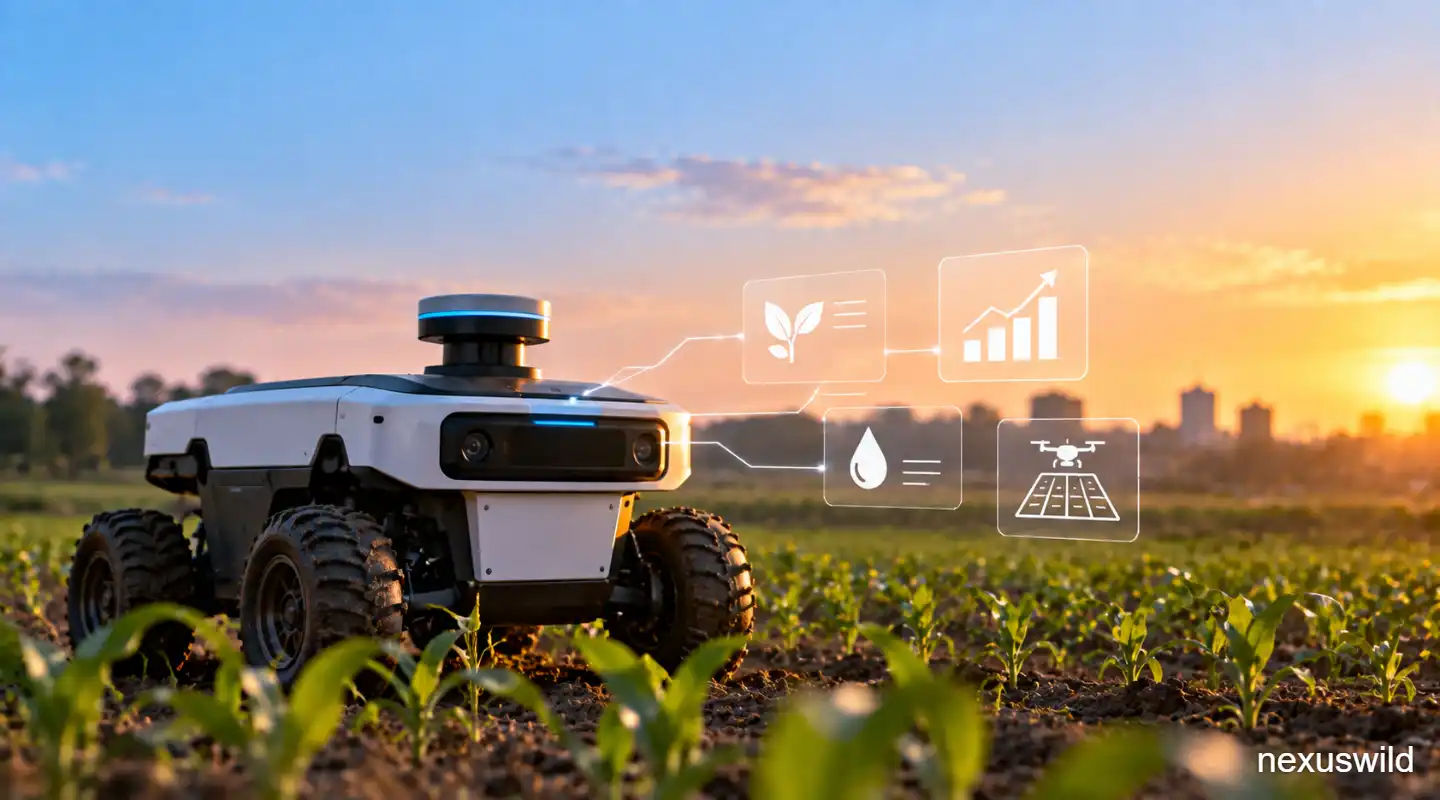

Robotics software startup FieldAI is reportedly preparing to raise $700 million at a $10 billion valuation, a proposed financing that would mark a sharp increase from the company's last publicly reported valuation.
The terms were reported on October 2, 2026, citing a person familiar with the transaction. FieldAI has reportedly signed a term sheet, but the financing had not formally closed at the time of the report. The identity of a lead investor or other participants in the proposed round has not been publicly confirmed.
That distinction is important. The $700 million figure and $10 billion valuation represent reported financing terms rather than a completed funding announcement from FieldAI.
As of October 3, FieldAI's own public news archive did not include an announcement confirming the new round.
Reported Valuation Would Mark a Major Step Up
If completed on the reported terms, the financing would value FieldAI at about five times the level established during its previous major fundraising cycle.
In August 2025, FieldAI officially announced that it had raised $405 million across two consecutive rounds to expand its physical-AI and robotic-autonomy business.
Separate reporting at the time said the more recent of those financings raised approximately $314 million and valued FieldAI at $2 billion, up from about $500 million in an earlier round.
FieldAI's confirmed 2025 investors included Bezos Expeditions, BHP Ventures, Canaan Partners, Emerson Collective, Intel Capital, Khosla Ventures, NVentures, Prysm and Temasek. The company also identified Gates Frontier and Samsung as previous investors.
Those companies and funds are confirmed historical backers. They should not automatically be treated as participants in the reported 2026 round, because investors in the proposed $700 million financing have not been publicly identified.
FieldAI Is Building Software Rather Than Its Own Robot Platform
FieldAI's core business is robotic intelligence rather than manufacturing one specific type of robot.
Founded in 2023 and based in Irvine, California, the company develops what it calls Field Foundation Models, or FFMs, designed to provide a common autonomy layer across different robotic platforms.
Its technology is intended to allow machines to operate in complicated real-world environments without depending on pre-built maps, GPS or fixed routes.
FieldAI says its models combine data-driven AI with physics-based reasoning and explicit treatment of uncertainty. Its current EDGE system uses what the company calls a Belief World Model to predict conditions and help robots choose actions while accounting for risk.
That approach differs from building one robot for one tightly defined task.
FieldAI instead aims to make its autonomy software usable across machines including quadrupeds, wheeled robots and other mobile platforms.
Construction Has Become an Important Application
One of FieldAI's most visible commercial areas is construction.
In March 2026, the company announced a partnership with Boston Dynamics to combine FieldAI's autonomy software with Boston Dynamics' Spot robot for construction and other changing environments.
Construction sites present a difficult robotics problem because layouts, equipment and working conditions can change continuously.
FieldAI says its systems use cameras, LiDAR and onboard sensors to let robots perform tasks such as inspection, mapping and site monitoring without relying on a fixed route prepared in advance.
The company has also documented deployments with construction businesses in which robots collect site imagery, monitor progress and compare real-world construction against digital plans.
These are existing company deployments, not evidence that the technology can yet perform every physical task required on a construction site.
Industrial, Energy and Security Uses Are Expanding
FieldAI is targeting other environments where conventional automation can struggle.
Its industrial and energy applications include autonomous facility inspection, equipment monitoring and collection of thermal, acoustic and visual data in locations such as oil and gas installations.
The company also lists mining, manufacturing, utilities and unmapped federal environments among its use cases.
In February, FieldAI announced a partnership with Singapore-based security services company Certis to explore and deploy robotic systems for patrols, incident detection and remote supervision in real-world security operations.
It has also expanded technical collaboration with Nvidia around simulation and digital-twin workflows, allowing data collected by robots in real industrial environments to feed into virtual environments used for testing and development.
The Company Is Betting on Hardware-Agnostic Robotics AI
The broader business idea behind FieldAI is that the intelligence controlling a robot could become a reusable software layer rather than something developed separately for every machine.
Its software is designed to operate at the edge, meaning robots can perform certain autonomy functions directly on their own computing hardware without requiring continuous cloud connectivity.
FieldAI has said its systems can operate without prior maps or GPS and can adapt to changing environments while deployed.
That could be economically significant if businesses can use the same core autonomy technology across multiple types of machines.
However, general-purpose robotic intelligence remains technically difficult. Real-world environments contain unpredictable people, equipment, terrain and safety hazards, meaning laboratory performance does not necessarily translate directly into dependable industrial deployment.
Why a $700 Million Round Would Matter
A completed $700 million financing would provide FieldAI with substantial capital for a company founded only three years ago.
Robotics businesses can require significant spending not only on AI research but also on field testing, simulation, hardware integration, safety validation and commercial deployment.
FieldAI's strategy also depends on proving that its software can work across many robotic platforms and industries rather than becoming tied to one narrow application.
The reported $10 billion valuation therefore represents an investor assessment of the company's potential scale, not a measure of realised profits or guaranteed future market share.
It would also illustrate the amount of capital moving toward physical AI, where machine-learning systems interact with the physical world through robots rather than operating solely through software interfaces.
Still, the proposed financing should not be treated as evidence that commercial robotics has already reached mass adoption. The sector continues to face high hardware costs, integration challenges, safety requirements and long deployment cycles.
The New Round Has Not Been Officially Closed
The most important qualification surrounding the latest funding report is its status.
Reporting indicates that FieldAI has signed a term sheet for the proposed $700 million round at a $10 billion valuation. A term sheet generally outlines proposed financing terms but can precede final documentation and closing.
FieldAI has not publicly identified participating investors, announced final deal terms or confirmed completion of the transaction.
For that reason, descriptions saying the company has definitively raised $700 million go beyond what has been publicly established as of October 3.
The more accurate description is that FieldAI is reportedly raising or preparing to raise the money under agreed preliminary terms.
Conclusion
FieldAI's reported $700 million financing would be one of the more substantial recent investments in robotics AI and could value the three-year-old company at $10 billion, five times its last reported $2 billion valuation.
But the transaction remains a reported deal rather than a confirmed completed financing.
What is already established is that FieldAI has raised more than $400 million previously, attracted investors including Bezos Expeditions, Temasek, Khosla Ventures and Nvidia's NVentures, and deployed its robotics intelligence across construction, industrial, energy and security environments.
Its central bet is that one risk-aware autonomy system can work across different machines and unpredictable environments rather than requiring separate software for every robot.
If the reported financing closes at its proposed terms, it would give FieldAI considerably more resources to test that strategy at commercial scale. Until then, the $700 million round and $10 billion valuation should be treated as proposed terms, not a final funding event.
Nexuswild welcomes factual corrections. Email contact@nexuswild.com with evidence and the article URL.