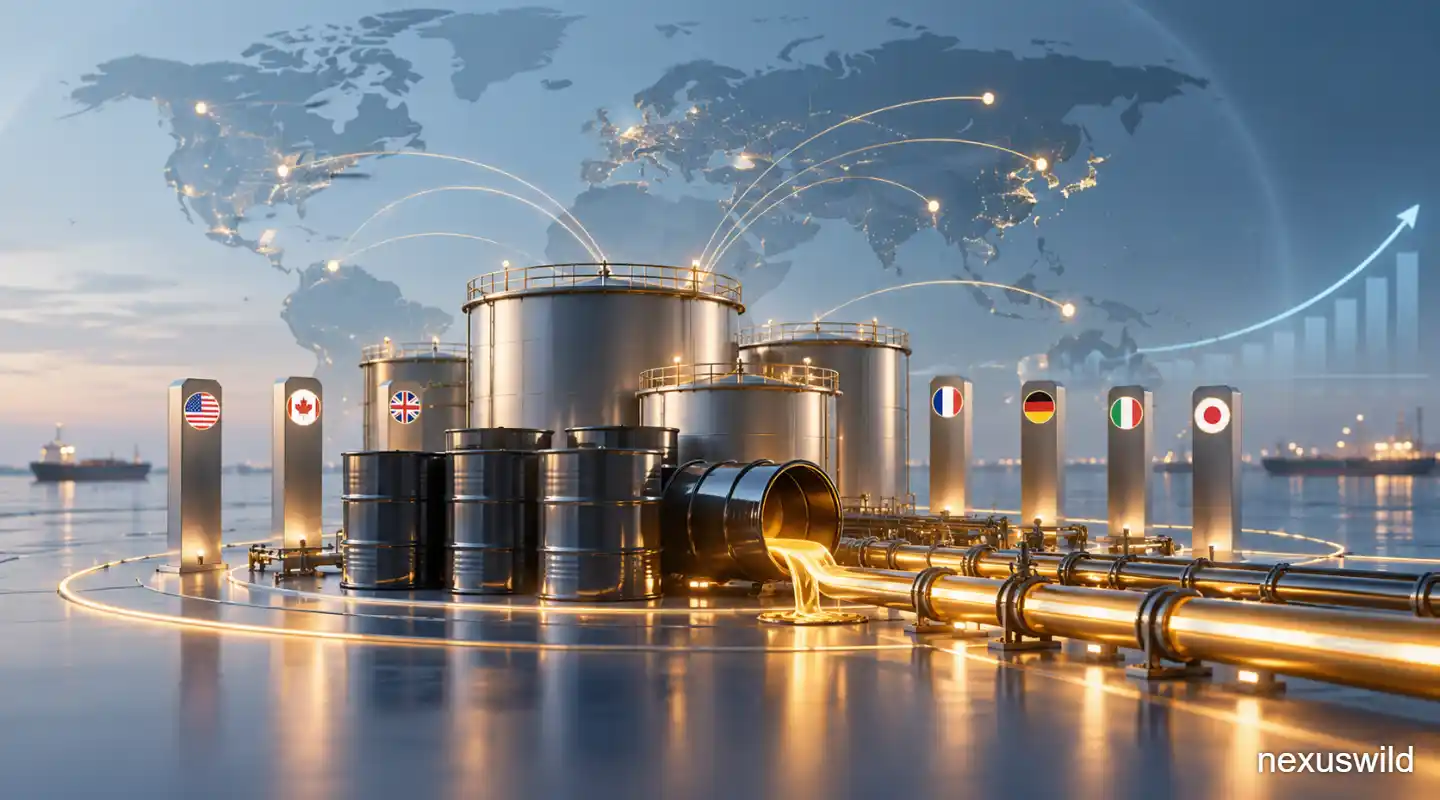

The Group of Seven has agreed to release 100 million barrels of emergency crude oil and refined petroleum products over four months, with a substantial portion of the diesel drawdown scheduled for the first 20 days as governments respond to continued pressure in global fuel markets.
The decision was announced after G7 leaders met by video conference on October 2, 2026, with International Energy Agency Executive Director Fatih Birol participating.
According to the official G7 statement, the release will begin immediately and be coordinated through the IEA. Members and partner countries will front-load a significant amount of diesel during the first 20 days, while the agency will monitor implementation and report back on the measures.
The agreement comes as crude flows from the Middle East have recovered from the severe disruption seen earlier this year, while supplies of refined products, particularly diesel, remain much tighter.
G7 Targets Diesel as Refining Pressures Persist
The October plan is notable because it places particular emphasis on diesel rather than treating the intervention solely as a crude-oil release.
The IEA said on October 2 that Middle Eastern crude exports had recovered significantly but that refined-product flows remained severely constrained. It also pointed to damage and disruption affecting Russian refining capacity as an additional source of pressure on diesel markets.
Diesel is economically important because it is widely used in freight transport, agriculture, construction, industry and backup power generation. Tight supplies can therefore affect costs well beyond retail fuel stations.
The G7 said members would also coordinate refinery maintenance schedules to reduce the risk of simultaneous shutdowns and would temporarily increase refinery utilisation where feasible. Governments also plan to engage countries with significant refining capacity in an effort to increase global production of refined fuels.
The stock release is intended to add near-term supply while those measures take effect.
It does not guarantee a particular movement in fuel prices. Prices will continue to depend on crude production, refining output, shipping conditions, inventories, demand and developments in major producing regions.
Release Will Run for Four Months
The official agreement calls for a coordinated release of 100 million barrels beginning immediately and continuing over four months.
Within that programme, G7 members and partners have committed to make a substantial diesel release during the first 20 days. The IEA has also been asked to examine whether additional diesel releases may be necessary.
The G7 did not provide a public country-by-country breakdown in its joint statement showing exactly how much crude or diesel each participant will release.
That means the confirmed figure at this stage is the aggregate 100 million barrels, rather than specific national allocations.
The IEA will monitor both implementation and the effect on energy security and market stability. The G7 has requested a follow-up report within 20 days that is also expected to address the eventual replenishment of emergency stocks.
October Action Builds on the March Emergency Release
The new announcement needs to be understood alongside the much larger emergency action taken earlier in 2026.
On March 11, the IEA's 32 member countries agreed to make 400 million barrels of emergency oil available after the Middle East conflict severely disrupted flows through the Strait of Hormuz.
At the time, the IEA described it as the largest collective oil-stock release in the agency's history.
By October 2, about 325 million barrels, or more than 80% of that commitment, had already reached the market, according to the IEA.
The G7's October statement explicitly links the latest 100 million-barrel programme to completing and implementing the commitments made in March.
For that reason, the October figure should not automatically be treated as 100 million barrels entirely additional to the original 400 million-barrel pledge.
The official documents do not provide a detailed breakdown showing precisely how much of the October programme represents remaining March commitments and how much may constitute additional releases beyond them.
What is confirmed is that the G7 has asked the IEA to oversee an immediate 100 million-barrel coordinated release over the next four months while taking account of stock releases that have already been completed.
Strait of Hormuz Remains Central to the Energy Risk
The disruption surrounding the Strait of Hormuz remains at the centre of the energy-market response.
Before the conflict intensified, roughly 20 million barrels per day of crude oil and petroleum products passed through the Strait in 2025, representing about a quarter of global seaborne oil trade, according to the IEA.
In March, flows had fallen to less than 10% of their pre-conflict level, forcing producers in the region to curtail output because alternative export routes were limited.
Conditions have since improved.
The French presidency said on October 2 that oil volumes moving through the Strait of Hormuz and through the Yanbu route toward the Red Sea had been increasing in recent days.
Even so, the G7 called for the full restoration of navigational rights and principles through the Strait of Hormuz, saying members would intensify efforts aimed at restoring the free flow of maritime commerce.
The statement reflects the importance of the waterway not only to crude exports but also to refined fuels and global shipping.
G7 Pledges to Avoid Energy Export Restrictions
The agreement also contains a commitment that could be important for international fuel flows.
G7 members pledged not to impose restrictions on exports of energy or energy products to one another and called on other producers to avoid bans that could worsen market pressures.
Export restrictions can protect domestic supply temporarily, but they can also reduce available fuel elsewhere and create additional disruption in interconnected energy markets.
The G7's position is therefore to use coordinated stock releases, refinery measures and international supply cooperation instead of restricting energy trade among members.
The commitment does not prevent governments from maintaining other energy-related policies, including existing sanctions. The G7 separately said it would continue sanctions against Russia while working with international partners to limit further disruption to fuel, gas and other commodity markets.
Emergency Reserves Are Designed for Major Supply Disruptions
IEA emergency stocks exist specifically to provide a buffer during severe oil-supply disruptions.
Before the March action, IEA member countries collectively held more than 1.2 billion barrels in government emergency reserves, with another 600 million barrels of industry stocks held under government requirements.
The March intervention was only the sixth collective stock release in the agency's history.
Previous coordinated actions occurred during major supply shocks in 1991, 2005, 2011 and twice in 2022.
That history illustrates why emergency reserves are not normally used simply to respond to ordinary fluctuations in commodity prices. Their main function is to provide temporary supply while markets adjust to serious disruptions.
The October agreement also acknowledges that stocks eventually need to be replenished, which will become another consideration once market conditions stabilise.
What the Release Can and Cannot Do
The 100 million-barrel programme can increase the availability of crude and refined products during a period of market stress.
The front-loaded diesel component is particularly targeted at the part of the fuel market where supply pressure has remained most acute.
But strategic reserves cannot permanently replace lost production, refinery capacity or unrestricted shipping.
The longer-term market effect will therefore depend on whether crude exports through the Middle East continue to recover, how quickly refinery output normalises and whether additional supply disruptions emerge.
Those factors remain uncertain.
The G7 itself left open the possibility of adjusting its response and asked the IEA to continue monitoring both implementation and market conditions.
Conclusion
The G7's October 2 agreement represents another coordinated effort to cushion global energy markets from the effects of the 2026 supply disruption.
Members will work through the International Energy Agency to release 100 million barrels of crude oil and refined products over four months, with a substantial diesel release concentrated in the first 20 days. The group has also pledged to avoid energy-export restrictions among its members, improve refinery coordination and support the restoration of normal navigation through the Strait of Hormuz.
The action follows the IEA's much larger 400 million-barrel emergency commitment in March, of which roughly 325 million barrels had been released by October 2.
The latest measure is therefore best understood as part of the continuing international response to the same extraordinary supply disruption, rather than as an unrelated new intervention.
It may provide additional near-term liquidity to crude and diesel markets, but the direction of energy prices will continue to depend on physical production, refinery operations, inventories and the restoration of reliable trade routes.
Nexuswild welcomes factual corrections. Email contact@nexuswild.com with evidence and the article URL.