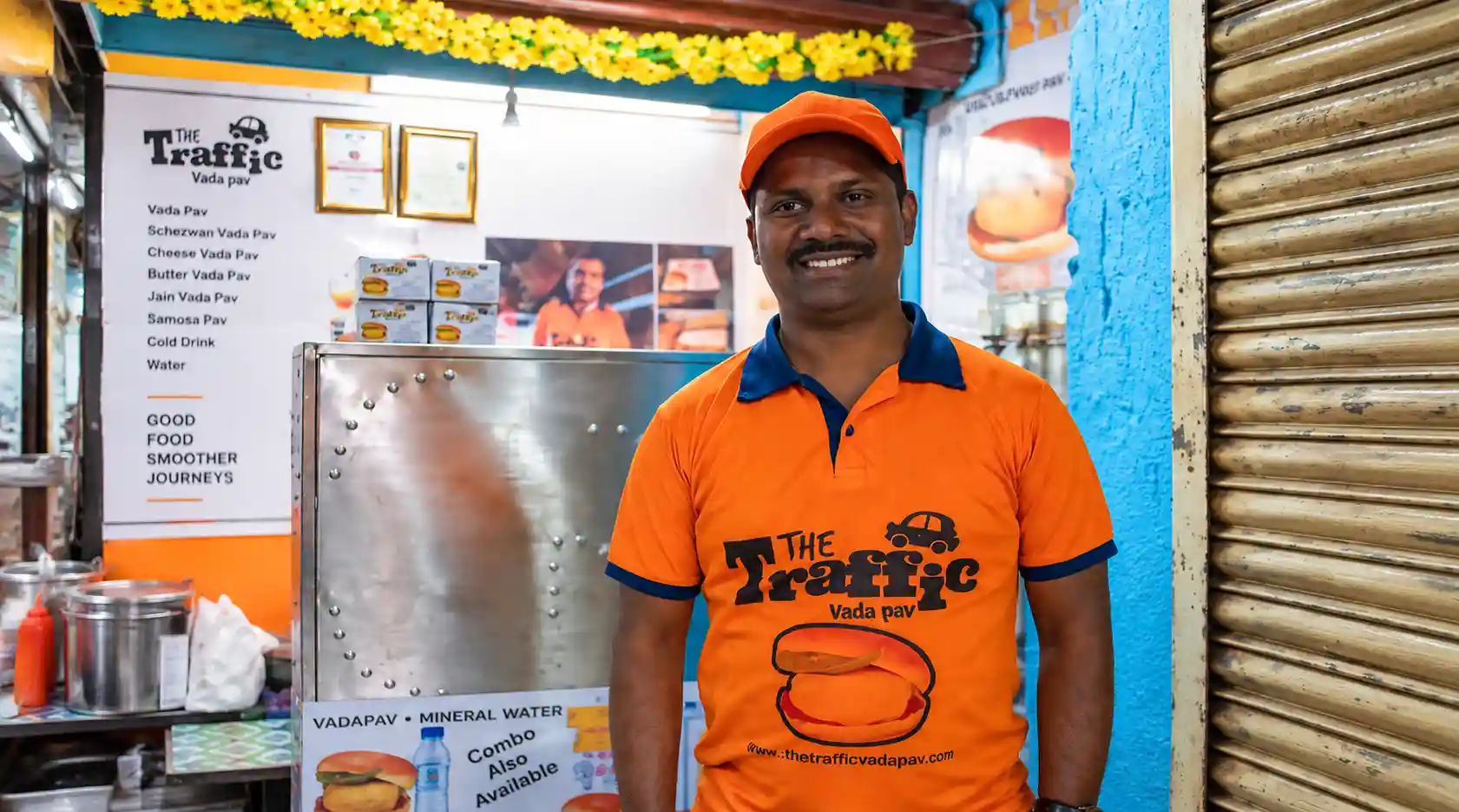

Every evening, thousands of commuters idled at the Teen Hath Naka signal in Thane saw the same thing: a traffic jam. Gaurav Londhe saw a captive audience of hungry, tired people with nowhere to go for at least a few minutes - and decided that was a business.
Londhe's own experience with that frustration went back years before he acted on it. In 2009, he worked as a pizza delivery boy, commuting from Andheri to Thane, a roughly 24-kilometre stretch that should have taken about an hour but regularly stretched to three because of traffic. "Stuck in the traffic snarls, I always felt hungry and craved for a quick snack to help me survive the journey," he told The Better India in a 2021 interview. Over the following decade, he stayed in the same line of work and moved up to a managerial role, earning around ₹35,000 a month, according to his mother Ranjana's account to the same publication.
It was a different traffic jam, on a trip to Mumbai roughly a decade later, that turned the memory into a business idea. Stuck for what felt like hours, Londhe was approached by a roadside vendor selling small packets of roasted peanuts - a small thing, but enough to get him through the wait. That moment, he has said, is what convinced him people stuck in Thane's own notorious traffic could use something similar: a quick, ready-to-eat snack sold directly to them while they waited.
From Idea to a ₹20 Box
Vada pav, Mumbai's ubiquitous fried-potato-fritter sandwich, was the obvious choice - cheap to make, familiar to nearly everyone, and easy to eat one-handed inside a car or on a bike. Londhe's mother's recipe became the product. In July 2019, he quit his job and launched The Traffic Vada Pav with an initial batch of 50 packed boxes, according to a case study published in the OPJU Business Review and corroborated by The Better India's reporting.
Each box was priced at ₹20 and contained a vada pav, a small water bottle, tissue paper, green chilli and chutney - a complete, self-contained snack designed to be handed through a car window or to someone on a two-wheeler without any fuss. He worked the Teen Hath Naka flyover signal in Thane during the city's peak evening traffic window, roughly 5 pm to 10 pm, when demand was highest and captive.
His family was not immediately convinced. Ranjana told The Better India she was upset when her son quit a stable job, and doubted a business model that involved selling food boxes in the middle of traffic, given how many similar vendors already existed. Londhe addressed the trust problem the way most small food businesses have to: consistency and visible hygiene. He has said he insisted on sourcing the oil, flour and potatoes himself, made a point of keeping the product fresh and homemade, and used the packaging itself - a sealed box rather than a loose wrapped snack - as a signal of cleanliness to skeptical first-time customers navigating traffic.
How the Numbers Actually Grew
By the end of the business's first two years, according to the OPJU Business Review case study, monthly sales had risen to about 800 vada pavs, generating roughly ₹2 lakh a month in revenue - figures that should be read as a snapshot from around 2021, not a current one. Reporting from that period also described a team of five to eight people supporting the business, including Londhe's mother and brother, working out of a rented kitchen near the signal itself.
It's worth being direct about what isn't verified: widely circulated social media posts and reels about Traffic Vada Pav in the years since have sometimes attached bigger, more dramatic numbers - crore-scale revenue, broader chain expansion - to the story. This account did not find those figures in any credible, sourced reporting, and they should not be treated as confirmed. The two verifiable data points available - roughly 800 units and ₹2 lakh in monthly revenue by 2021 - come from an academic case study and contemporaneous journalism, not from a recent, updated disclosure by Londhe or his business. Likewise, while Traffic Vada Pav's story has been widely shared and reposted on social media as an example of grassroots entrepreneurship, this account did not find a verified, direct statement or endorsement from industrialist Harsh Goenka specifically referencing the business, despite that association circulating in some retellings - a claim readers should treat with caution absent a primary source.
Why the Model Worked
The business logic behind Traffic Vada Pav is simple and, in hindsight, fairly elegant. Fixed costs were low: no storefront rent, no seating, no waitstaff beyond family and a couple of helpers, and a menu limited to one product made in bulk from a rented home kitchen. The location strategy solved the two hardest problems most food vendors face - finding customers and getting their attention - by planting the business directly inside a captive, immobile crowd that had nowhere else to look for several minutes at a stretch. And because the target customer was already stationary and mildly bored or hungry, the actual selling process required none of the marketing a conventional stall would need; proximity and timing did the work.
A Case Study, and a Lesson for Other Small Entrepreneurs
Traffic Vada Pav's appeal beyond Thane comes largely from how legible its lesson is. Londhe didn't invent a new product, source rare ingredients, or need significant capital - vada pav is one of the most common street foods in Maharashtra, and 50 boxes is a modest first batch by any standard. What he changed was distribution: identifying an everyday inconvenience - traffic - that thousands of people already experienced, and building a business around serving people at exactly the moment and place where that inconvenience was most acute. The venture has since been documented as a teaching case in at least one Indian business-school journal, used to illustrate how a low-investment, low-technology idea can succeed by solving a real, specific, repeatedly-occurring problem rather than by scale or novelty.
What's Confirmed About Where Things Stand Now
Publicly available, verifiable reporting on Traffic Vada Pav is concentrated in 2020 and 2021, around the time the business first drew media attention, with an academic case study following in 2023 that relied on the same underlying figures. This account did not find a recent, independently verified update on the business's current scale, revenue, expansion into other locations, or whether the original model - a single vendor at Teen Hath Naka - has grown into something larger. Readers encountering newer claims about the business online should weigh them against the absence of comparably sourced, current reporting, rather than assume continuity or dramatic growth from the numbers reported four to five years ago.
Further reading and useful links
Reader questions
Frequently asked questions
What is Traffic Vada Pav?
Traffic Vada Pav is a small business founded by Gaurav Londhe in Thane that sells pre-packaged ₹20 boxes containing a vada pav, water bottle, and condiments directly to commuters stuck in traffic.
Where does Traffic Vada Pav operate?
The business originally operated by selling to captive commuters idling at the notoriously busy Teen Hath Naka signal in Thane, Maharashtra.
How much revenue does Traffic Vada Pav generate?
As of verified reports and academic case studies from 2021, the business was generating roughly ₹2 lakh a month in revenue. Newer, larger claims on social media remain unverified by credible sources.
Nexuswild welcomes factual corrections. Email [email protected] with evidence and the article URL.