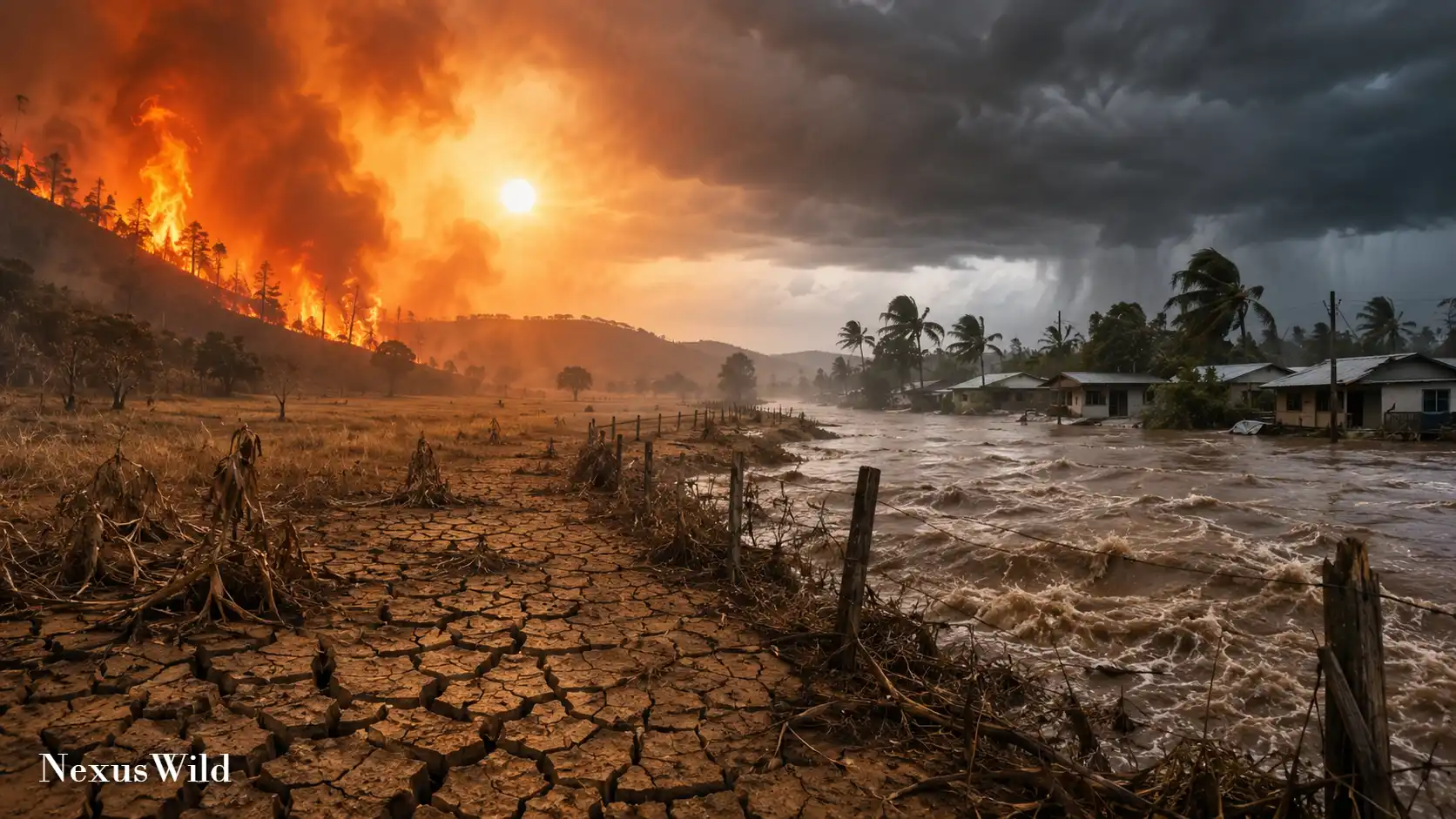

Extreme heat, drought, wildfires and destructive floods have affected large parts of the world during 2026. The events have not shared a single cause, but they have unfolded against an unusually warm global climate and, since midyear, a strengthening El Niño.
As of August 31, the clearest scientific conclusion is not that climate change caused every disaster. Weather systems, ocean cycles, local geography, land management, ignition sources and patterns of human settlement remain decisive. Human-caused warming, however, has raised background temperatures and increased the probability or severity of several types of extreme heat, drought and fire-weather conditions.
Global temperatures remain near record levels
July 2026 was among the warmest months measured globally. NOAA classified it as the joint-warmest July, tied with July 2024, while the Copernicus Climate Change Service ranked it joint second-warmest. The difference reflects variations in datasets and analytical methods.
Copernicus calculated a global average surface-air temperature of 16.90°C, which was 0.67°C above the 1991-2020 July average and approximately 1.47°C above the estimated 1850-1900 pre-industrial level. The 12 months from August 2025 through July 2026 averaged approximately 1.45°C above the pre-industrial reference period.
This does not mean the Paris Agreement’s 1.5°C long-term threshold has formally been crossed. That target refers to sustained warming over decades, not one month or year.
Global sea-surface temperatures outside the polar regions were the highest recorded for July. Arctic sea-ice extent was the sixth-lowest July extent in the satellite record, according to Copernicus. North America, Africa and Asia experienced their warmest July in NOAA’s regional series. The ten warmest Julys globally have all occurred since 2016.
Heatwaves reached five continents
Western Europe experienced its warmest June-July period in the Copernicus record, averaging 21.62°C, or 2.79°C above the 1991-2020 average. By mid-August, parts of the region were experiencing their fifth heatwave since May.
June alone was Western Europe’s warmest recorded June, with a regional average of 20.74°C, 3.05°C above normal. Germany recorded 41.7°C at Coschen on June 28. France’s national daily average reached a record 30°C on June 24, while Pulluau reached 43.8°C. Spain’s Fabra Observatory in Barcelona measured 40.5°C on July 8, its highest temperature in more than a century of observations.
Mortality figures require caution. Europe recorded 10,650 excess deaths from all causes during the week of June 22-28, according to national mortality data compiled by Reuters. Excess deaths are not the same as individually certified heat deaths, although the increase coincided with the peak heatwave. Spain’s official MoMo mortality system separately attributed 1,029 excess deaths to heat during June. These estimates remain subject to revision.
Asia also experienced prolonged heat. South Korea classified its early-August heatwave as a national disaster after authorities linked 19 deaths to the conditions. Yangsan reached 42.5°C, the country’s highest temperature in 122 years of observations, while 2,025 heat-related illnesses had been reported since May 15. Japan and South Korea broke multiple records during early August. Eastern China experienced sustained heat that drove residents in cities including Hangzhou toward public cooling shelters.
In North America, the contiguous United States recorded its hottest month in the 131-year national record. The July average was 76.89°F, or 24.94°C, narrowly exceeding July 1936, according to NOAA. Heatwaves repeatedly affected the central and eastern United States, the Northeast and later the Southeast. At times, high humidity pushed forecast heat-index values toward 115°F, or 46°C.
WMO reported exceptional heat across Central Asia, North Africa, the Middle East and parts of Latin America as well. Africa’s continental July average was the highest in NOAA’s record. In the Middle East and North Africa, temperatures above 40°C strained electricity and water systems, although consistent regional mortality data were not available by August 31.
Drought intensified water and agricultural pressure
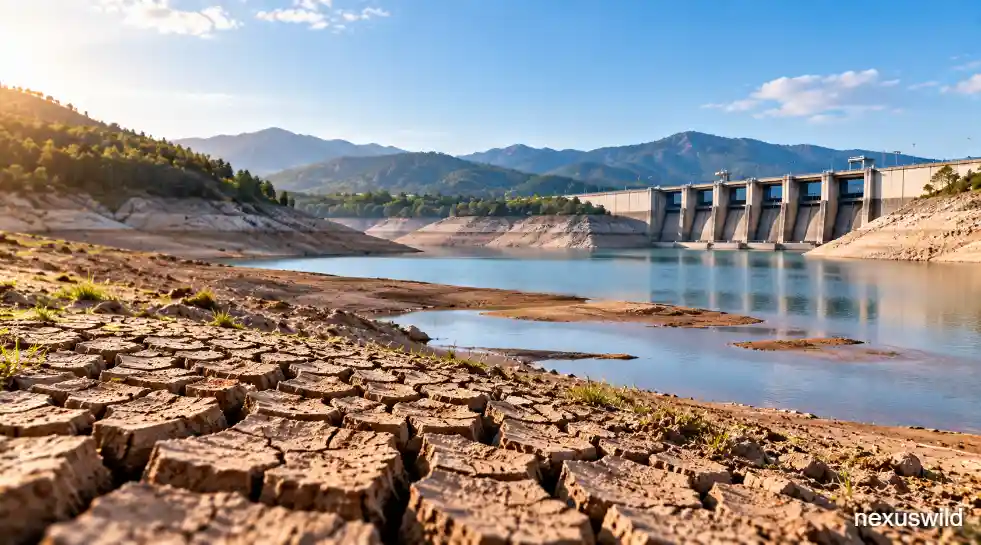
Europe’s heat occurred alongside exceptionally low rainfall and soil moisture. France, Spain, Germany, Britain, Romania, Greece, Hungary and the Netherlands were among the affected countries. The European Drought Observatory described drought conditions across much of the continent as critical in mid-August.
Flows on the Seine, Rhine and Danube fell well below normal. At Kaub, a major Rhine shipping point in Germany, the water level dropped below 10 centimetres in early August, compared with the previous low of 25 centimetres in 2018. Ships were forced to carry smaller loads, raising freight costs and disrupting supplies of grain, minerals, coal and petroleum products.
France faced the possibility of its smallest maize crop in 50 years. Romania restricted irrigation access, the Netherlands declared a water shortage, and seven Greek islands declared drought emergencies. England reported drought across almost three-quarters of its territory in August. Aquaculture losses were also recorded as shallow lakes and fish ponds warmed or dried.
South Asia faced a different but related risk. India’s August monsoon rainfall was 16 percent below normal. On August 31, the India Meteorological Department forecast September rainfall at less than 91 percent of the long-term average. Weak rain during crop development could reduce cotton, soybean, maize and pulse yields and leave insufficient soil moisture for wheat and rapeseed planting. Nearly half of Indian farmland lacks irrigation.
Heat worsens drought by increasing evaporation from water bodies and soils and by raising plants’ demand for moisture. Vegetation loses water more quickly, while dry grasses, leaves, branches and peat become more flammable. A dry period that might once have remained manageable can consequently produce deeper soil-moisture deficits under higher temperatures.
A 2026 rapid attribution analysis found that the European rainfall shortage itself could not be attributed to climate change with confidence. It concluded instead that human-caused warming sharply increased atmospheric evaporative demand. Agricultural soil drought conditions were estimated to be five times more likely in Western Europe and 11 times more likely in Eastern Europe than in a pre-industrial climate.
Wildfires spread across several major regions
European Union fires had burned approximately 636,100 hectares by August 30, according to the European Forest Fire Information System. That was below the record pace of 2025 but more than double the 2006-2025 average recorded by August 26. EFFIS had detected 1,861 fires of approximately 30 hectares or larger. These mapped burned areas must not be confused with satellite hotspots, which can include industrial heat sources, duplicate detections or fires of uncertain extent.
France, Spain, Greece, Portugal, Belgium and several Balkan countries suffered major fires. A July fire in France’s Gironde region burned about 40,000 hectares, destroyed at least 240 homes and contributed to large-scale evacuations. Two firefighters were confirmed killed on Crete in late July. Belgium’s High Fens fire burned approximately 3,000 hectares, its largest fire since satellite measurements began.
In the United States, 52,253 fires had burned 8.24 million acres, or about 3.33 million hectares, by August 31. The National Interagency Fire Center reported 93 large incidents under active suppression and more than 22,000 personnel assigned. Canada had burned about 4 million hectares by early August, while more than 20,000 people were ordered to leave communities threatened by the Bald Range fire in British Columbia.
Indonesia’s fire season accelerated sharply as El Niño strengthened. Forestry Ministry data showed 202,004 hectares affected between January and July, including nearly 95,000 hectares in July alone. On August 31, officials said fires covering 11,047 hectares had been identified within concessions operated by 19 companies under investigation.
Indonesia deployed 34 firefighting aircraft, more than 1,400 volunteers and personnel from its 48,000-member disaster-response force. Thick haze closed schools and affected air quality in Indonesia, Malaysia and Singapore. Peat fires are particularly difficult to extinguish because they can continue burning below ground.
Fire hotspots do not prove that every detection is a separate wildfire. Nor does climate change ignite most fires. Lightning, machinery, agricultural burning, arson and other human activity often provide the ignition. Climate influences how dry fuel becomes and how rapidly a fire can spread after ignition.
Floods struck South Asia and the Himalayas
A below-normal seasonal monsoon did not prevent dangerous local downpours. Seasonal averages can conceal short periods of extreme rainfall.
During July, flooding and landslides killed at least 82 people across northeastern India, Pakistan and Afghanistan. Bangladesh’s Cox’s Bazar district, including densely populated refugee camps, experienced prolonged monsoon flooding. Typhoon Noul forced the evacuation of about 700,000 people in China, while South Korea experienced successive rounds of heavy rain and flooding.
The most destructive event came on August 26 along the Nepal-Tibet border. As of August 31, Nepal had confirmed 903 deaths and listed 4,247 people as missing. Chinese authorities reported 16 confirmed deaths and 546 missing in Gyirong County. These figures must remain separate because missing people cannot be counted as deaths.
A glacier collapse is thought to have released ice, rock, water and mud into Himalayan valleys. Eleven hydropower projects were affected, with 933 workers among those missing. More than 90,000 people were estimated to have been affected, and over 10,000 had been rescued. Scientists said long-term warming can destabilise high-mountain ice and rock, but the precise trigger and sequence were still being investigated. It would be premature to assign the entire disaster to climate change.
A local telephone warning gave one Nepalese school about 14 minutes to evacuate more than 900 students and 16 staff before the building was destroyed. The survival of the school community demonstrated the value of even basic upstream communication, while the overall disaster exposed serious gaps in cross-border glacier, river and landslide monitoring.
A warmer atmosphere can hold roughly 7 percent more water vapour for every 1°C of warming, provided moisture is available. Storms can therefore produce heavier rainfall, although atmospheric circulation, terrain, ocean conditions and storm tracks determine where and when rain falls. Warming does not mean every region becomes wetter. It can intensify both water loss during dry periods and rainfall when moist air rises and condenses.
Climate change, El Niño and attribution
El Niño is a natural warming of the central and eastern equatorial Pacific that changes global atmospheric circulation. By August, NOAA reported a July Niño-3.4 anomaly of 1.4°C and said the event was strengthening. WMO forecast a strong El Niño through August-October, alongside a developing positive Indian Ocean Dipole.
El Niño tends to increase drought risk in Indonesia, Australia, India, parts of Central America and northern South America. It can favour wetter conditions in the southern United States, parts of South America, Central Asia and the Greater Horn of Africa. These are probabilities, not guarantees, and every El Niño develops differently.
Human-caused climate change and El Niño are not interchangeable. Greenhouse gases create persistent long-term warming. El Niño redistributes heat between the ocean and atmosphere and temporarily changes regional rainfall and temperature patterns.
Attribution studies provide event-specific evidence. World Weather Attribution found Western Europe’s June heatwave would have been virtually impossible under the climate of 1976. Comparable daytime temperatures would have been about 3.5°C cooler then. Its analysis of July fire weather estimated that conditions of the observed severity were at least twice as likely in southwestern France and at least 20 times as likely in central Spain because of human-caused warming. These findings concern heat and fire-weather conditions, not the ignition of individual fires.
Outlook and adaptation for the rest of 2026
WMO’s August-October outlook favours above-normal temperatures across most land areas. Drier-than-normal conditions are more likely over India, northern Europe, southern and eastern Australia, southern Central America, the Caribbean and northwestern South America. Wetter conditions are favoured in the Greater Horn of Africa, parts of Central Asia, southern Europe, western North America south of 45°N and southeastern South America. These seasonal forecasts describe probabilities, not individual storms or disasters.
Governments have expanded heat alerts, cooling centres, wildfire aircraft deployments, cloud seeding, water restrictions, evacuation systems and international firefighting support. Longer-term adaptation requires heat-resilient buildings, shaded urban areas, efficient irrigation, drought-resistant crops, restored wetlands, diverse forests, fuel management, safer development around rivers and forests, and faster cross-border sharing of hydrological and glacier data.
The remainder of 2026 is likely to remain unusually warm, while El Niño increases the chance of sharply contrasting rainfall patterns. The outcome in each region will depend on local weather and preparedness. The scientific evidence supports stronger risk management, but it does not justify attributing every fire, flood or drought to a single global cause.
Further reading and useful links
Reader questions
Frequently asked questions
Did climate change cause all the extreme weather events in 2026?
Not entirely. While human-caused warming has raised background temperatures and increased the probability or severity of extreme heat and fire-weather conditions, natural weather systems, ocean cycles like El Niño, and local geography remain decisive factors.
How has El Niño affected the weather in 2026?
A strengthening El Niño has altered global atmospheric circulation, increasing drought risk in places like Indonesia, India, and Australia, while favoring wetter conditions in areas like the southern United States and the Greater Horn of Africa.
What were the main drivers of the severe 2026 wildfires?
While human activity and lightning often provide the ignition, extreme heat and drought severely dried out vegetation and peat. This made the landscapes highly flammable and allowed fires to spread rapidly once ignited.
Nexuswild welcomes factual corrections. Email contact@nexuswild.com with evidence and the article URL.