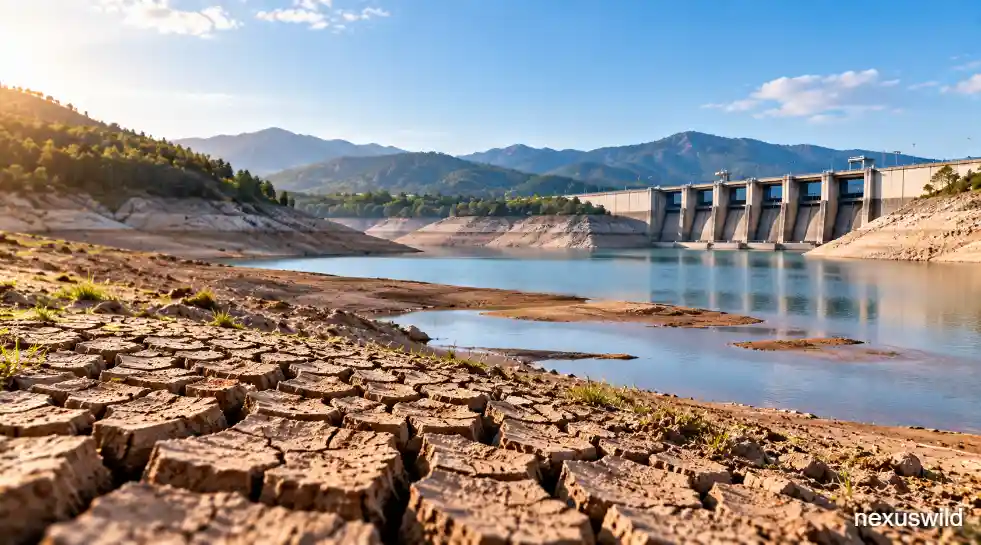

Rivers can recover after drought. Aquifers can recharge. Reservoirs can refill. Wastewater can be treated and reused. Yet growing demand, groundwater over-extraction, pollution and a more volatile climate are making reliable supplies harder to manage in many regions.
The latest global data do not suggest that the world is simply about to “run out” of freshwater.
They show something more complicated: usable water is unevenly distributed, demand is concentrated in particular sectors, groundwater is being withdrawn faster than it can recover in some areas, and climate change is making the timing of rainfall, snowmelt and river flows less predictable.
UN-Water estimates that only about 0.5% of all water on Earth is usable and available freshwater. Agriculture remains the largest user, while cities, industry and energy systems are adding pressure of their own.
Global Water Stress Is Uneven
The latest FAO data put global water stress at 17.6% in 2023.
That figure measures freshwater withdrawals relative to available renewable freshwater resources after accounting for environmental water needs. A global average, however, hides enormous regional differences.
Western Asia and Northern Africa face much more severe conditions, with water stress increasing by about 6% since 2015.
Agriculture accounted for 72% of global freshwater withdrawals in 2023, followed by industry at 15% and services at 13%.
That makes food production central to the water challenge.
Irrigation allows farmers to maintain yields where rainfall is insufficient or unreliable, but it can also place heavy pressure on rivers and aquifers when withdrawals consistently exceed replenishment.
FAO says about 1.2 billion people live in agricultural areas facing severe water constraints.
Climate Change Is Making Water Availability Less Predictable
Freshwater pressure is not only about the total amount of water used.
It is increasingly about when and where that water arrives.
The World Meteorological Organization reported in September 2026 that 2025 was one of the driest years for global river discharge in 35 years.
The past seven years have also recorded unusually abnormal river flows, while the amount of water stored on the Earth's land surface has declined over the past decade.
Widespread glacier loss continued across every glacier region for a fourth consecutive year.
These changes matter because glaciers, seasonal snow, rivers, lakes and groundwater are connected parts of the same hydrological system.
Warmer temperatures can increase evaporation and crop water demand. Changes in precipitation can produce longer dry periods in one region and severe flooding in another.
That is why climate change does not translate simply into “less water everywhere.”
Instead, it increases variability and can make existing water systems less dependable.
Groundwater Has Become a Critical Buffer
When rivers and reservoirs decline, households and farmers frequently turn to groundwater.
Groundwater accounts for about 99% of the Earth's liquid freshwater and provides roughly half of the water withdrawn globally for domestic use. It also supplies around one-quarter of irrigation water.
Its ability to act as a reserve during drought makes groundwater extremely valuable.
The problem arises when pumping consistently exceeds recharge.
India illustrates the scale of both the dependence and the management challenge.
The country's official 2025 groundwater assessment estimated annual groundwater extraction at 247.22 billion cubic metres, compared with 407.75 billion cubic metres of annual extractable resources nationally.
The national average extraction rate was about 60.6%, but conditions differed sharply by location.
Of 6,762 assessment units, 730, or 10.8%, were classified as over-exploited, meaning extraction exceeded annually replenishable groundwater. Another 201 were rated critical.
The figures also show that national averages can be misleading. Some regions have relatively secure groundwater while others are withdrawing far beyond sustainable local recharge.
California Shows How Groundwater Supports Drought Resilience
California provides another example of groundwater's role as an emergency buffer.
The state's Department of Water Resources says groundwater normally supplies around 40% of statewide water demand, rising to almost 60% during dry years.
Severe drought between 2020 and 2022 increased pumping and caused hundreds of wells to go dry in parts of the state.
Conditions have since improved after wetter periods and expanded recharge efforts, but California says many groundwater systems have not fully recovered.
The experience demonstrates a wider problem.
Groundwater can protect economies during drought, but repeated dependence on aquifers without sufficient recharge can gradually reduce that protection.
Physical Scarcity Is Not the Same as Poor Water Access
Water discussions often combine several different problems.
Physical water scarcity occurs when withdrawals approach or exceed the renewable water physically available in a region.
Seasonal scarcity occurs when water may be plentiful during part of the year but insufficient during dry periods, particularly when demand peaks at the same time.
Poor access to safe water is different again. A country or region may have freshwater resources while households still lack reliable drinking water because of inadequate pipes, treatment plants, financing, governance or contamination.
The distinction is important.
WHO and UNICEF estimate that 2.1 billion people lacked safely managed drinking-water services in 2024, even though global coverage improved from 68% in 2015 to 74% in 2024.
That statistic describes access to water that is available when needed, located on premises and free from contamination.
It does not mean 2.1 billion people live in places with no physical water resources.
Seasonal Scarcity Is Already Affecting Developed Economies
Europe demonstrates how water scarcity can appear seasonally even in regions with extensive infrastructure.
The European Environment Agency estimates that about 30% of EU land experiences seasonal water scarcity each year.
Southern European countries are particularly exposed during spring and summer, when lower rainfall can coincide with increased irrigation, tourism and other water demand.
Seasonal shortages can affect more than household supply.
Reduced water availability can limit irrigation, raise industrial costs and constrain hydroelectric or thermal power production.
This makes water management increasingly relevant to energy and industrial planning as well as environmental policy.
Pollution Can Turn Available Water Into Unusable Water
Quantity is only half of the freshwater problem.
Pollution can make otherwise available water unsuitable for drinking, agriculture or ecosystems.
UN data from 120 reporting countries showed that only 56% of monitored water bodies were classified as having good ambient water quality in 2023.
Wastewater is one major source of pressure.
The latest UN-Water monitoring estimates that around 56% of household wastewater was safely treated in 2024, meaning a large share still entered the environment without adequate treatment.
Industrial data are considerably less complete.
A 2024 UN assessment covering 22 reporting countries found that only 27% of industrial wastewater in that limited sample was safely treated. Because those countries represented only a small share of the global population, the number should not be interpreted as a worldwide industrial-treatment rate.
Agricultural runoff can add fertilisers, pesticides and nutrients to waterways, while mining and industrial activity can introduce additional contaminants.
Pollution therefore reduces the amount of freshwater that can safely be used even when the physical volume has not changed.
Population and Economic Growth Are Increasing Demand
The world's population grew from about 6.2 billion in 2000 to 8.2 billion in 2024.
Urbanisation and rising incomes have also increased demand for water-intensive food, manufacturing, electricity and municipal services.
Long-term demand estimates remain uncertain.
An often-used UN projection suggests global water demand could be 20% to 30% higher by 2050 than late-2010s levels if historic trends continue. This is a projection, not current demand and not a guaranteed outcome.
FAO separately says freshwater demand could rise around 25% by 2050 while agriculture faces pressure to produce substantially more food, feed and fibre.
Future demand will depend heavily on efficiency, crop choices, population trends, industrial technologies and water policy.
Efficient Irrigation Could Reduce the Largest Source of Demand
Because agriculture dominates freshwater withdrawals, improvements in irrigation can have an outsized effect.
Drip irrigation, soil-moisture monitoring, better scheduling, drought-resistant crops and improved canal management can reduce unnecessary withdrawals.
But efficiency must be managed carefully.
A farmer who saves water per hectare may still increase total consumption if lower costs encourage expansion of irrigated acreage.
Effective agricultural water policy therefore requires both more efficient technology and limits that reflect the amount of water actually available.
Water pricing, metering and groundwater monitoring can also help align withdrawals with local resource conditions.
Wastewater Is Increasingly Being Treated as a Resource
Cities and industries are also looking beyond conventional freshwater sources.
Properly treated wastewater can be reused for irrigation, industrial processes, cooling, groundwater recharge and, with more advanced treatment, drinking-water systems.
UN-Water estimates the currently untapped potential for wastewater reuse at around 320 billion cubic metres per year, though realizing that potential would require substantial treatment and distribution infrastructure.
Reuse cannot solve every scarcity problem.
Treatment requires investment and energy, and water quality must match the intended use.
But in water-stressed cities, recycling the same water more than once can reduce pressure on rivers and aquifers.
Better Groundwater Management Is Essential
Aquifers often receive less attention than reservoirs because their decline happens underground.
Improved monitoring is therefore fundamental.
Governments need reliable information about extraction, water levels, recharge and contamination before they can set sustainable pumping limits.
California's groundwater programme increasingly combines monitoring wells, recharge projects and local sustainability plans.
India has moved to annual national groundwater assessments to identify areas where withdrawals exceed renewable supply.
Artificial recharge can also help where geology is suitable.
Capturing floodwater or heavy seasonal rainfall and allowing it to infiltrate underground can replenish aquifers while storing water with much lower evaporation losses than many surface reservoirs.
Infrastructure Remains as Important as Natural Supply
Water scarcity is partly a natural-resource problem, but it is also an infrastructure problem.
Treatment facilities, reservoirs, distribution pipes, drainage systems and wastewater networks determine how much available water actually reaches users.
A 2026 UN-Water assessment found that among 20 countries reporting sufficiently detailed financing data, available funding for water, sanitation and hygiene systems was 46% below identified needs.
The same reporting countries averaged 39% non-revenue water, meaning large quantities of treated water were lost or otherwise not billed before reaching paying users. The figures apply only to participating countries and should not be treated as global averages.
Reducing leakage can effectively create additional usable supply without extracting more from rivers or groundwater.
Freshwater Pressure Does Not Mean Freshwater Will Disappear
The language used around water matters.
Earth will not simply lose all of its freshwater.
Water continually moves through evaporation, precipitation, rivers, soils, groundwater and oceans.
The problem is maintaining enough clean, accessible freshwater in the right locations and at the right times for people, economies and ecosystems.
A region can experience serious scarcity while another is dealing with floods.
An aquifer can be depleted while national water availability remains adequate.
A city can sit beside a river and still lack safe drinking water because its treatment and distribution system is insufficient.
Those differences explain why there is no single global water crisis with one solution.
Conclusion
Pressure on the world's freshwater resources is increasing because several trends are occurring at the same time.
Agriculture still accounts for roughly 72% of global freshwater withdrawals. Groundwater is supporting households and farms but is being over-extracted in some major agricultural regions. Pollution is reducing water quality, while population growth and economic development continue to increase demand.
Climate change is making the challenge harder by altering rainfall, snow and river flows. The WMO's latest assessment found that 2025 was among the driest years for global rivers in more than three decades and that terrestrial freshwater storage has been declining over the past decade.
Yet the outlook is not predetermined.
More efficient irrigation, wastewater recycling, better groundwater management, reduced leakage, pollution control and investment in treatment and distribution infrastructure can substantially improve water security.
The central challenge is therefore not that the planet is about to run out of freshwater.
It is whether societies can manage a limited and increasingly variable resource efficiently enough to provide reliable water for people, food production, industry and ecosystems at the same time.
Nexuswild welcomes factual corrections. Email contact@nexuswild.com with evidence and the article URL.