
Critical minerals have moved from a specialist mining issue to the centre of energy, technology and national economic strategy.
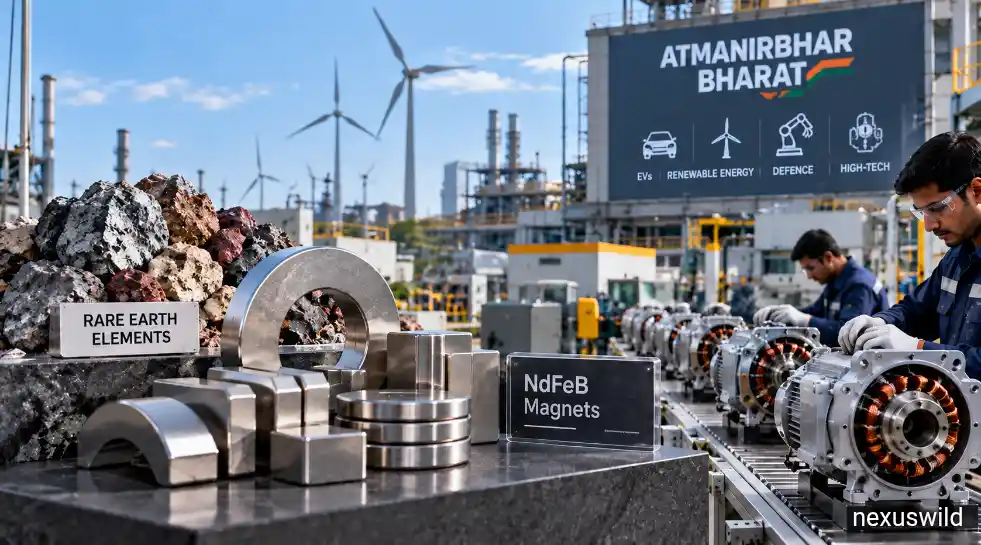
Lithium and graphite are essential to most lithium-ion batteries. Nickel and cobalt remain important in higher-energy battery chemistries. Copper connects electricity grids, renewable plants, data centres and industrial equipment. Rare earth elements are used in powerful permanent magnets found in electric motors, wind turbines and advanced electronics.
A wider group of materials, including gallium, germanium, tungsten and antimony, is also important to semiconductors, telecommunications, aerospace and defence equipment.
What has changed is not simply demand.
Governments are paying much greater attention to where minerals are mined, where they are processed, who controls the technology required to refine them and how quickly alternative supplies could be created if trade is disrupted.
The International Energy Agency says energy-related demand for key minerals continued rising strongly in 2025, with global battery demand increasing by more than 35% to above 1.5 TWh. Energy technologies accounted for around 75% of demand growth across major energy minerals during the year.
That growth is occurring inside supply chains that remain highly concentrated.
Batteries Are Reshaping Mineral Demand
Electric vehicles and stationary battery storage are major sources of demand for lithium, graphite, nickel and cobalt.
Battery chemistry matters.
Lithium iron phosphate batteries use lithium and graphite but generally avoid nickel and cobalt. Nickel-rich chemistries require substantial nickel and, depending on the design, cobalt.
The rapid growth of LFP has therefore moderated some longer-term cobalt expectations without reducing demand for lithium.
According to the IEA, lithium demand has increased by roughly 25% per year on average over the past two years. Battery metals and other key energy minerals have recently grown at close to 10% annually on average, compared with around 1% for conventional base-metal demand.
But batteries are only part of the story.
Copper is fundamental to electricity grids, motors, transformers and charging systems. Rare-earth magnets are important in high-performance electric motors and some wind turbines. Graphite is a major battery-anode material.
The semiconductor industry adds another group of strategically important minerals, including gallium and germanium.
Copper Shows Why the Race Extends Beyond Batteries
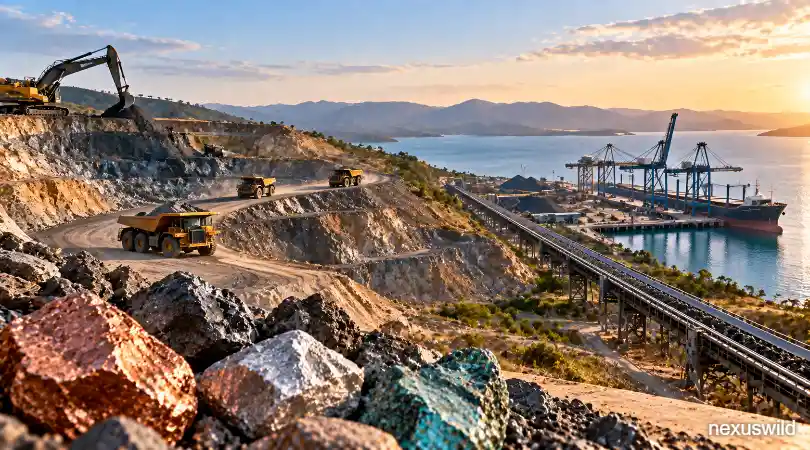
Copper has a much larger existing market than lithium or cobalt.
Chile remained the world's largest copper-producing country in 2025. Chile's Copper Commission reported global mine production of roughly 23.7 million tonnes in 2025, including about 5.4 million tonnes from Chile and 2.7 million tonnes from Peru.
China produced about 1.9 million tonnes of mined copper, but its influence becomes much greater further along the processing chain.
The IEA says China accounted for more than 90% of the growth in global copper-smelting capacity since 2005, lifting its share of capacity from around 15% to approximately 50% by 2025.
That highlights an increasingly important distinction.
Owning mineral deposits is not the same as controlling the supply chain.
Mining, concentrating, refining, chemical conversion and component manufacturing can happen in different countries.
Processing Is More Concentrated Than Mining
The biggest strategic concern is often not geological scarcity but processing concentration.
The IEA says the largest refining country accounted for an average 70% of refined supply across key energy minerals in 2025, up from 68% in 2020.
Indonesia is the leading refiner for nickel. China leads most of the other major energy-mineral processing chains.
For graphite, manganese and nickel, virtually all recent refined-supply growth came from the dominant supplier.
The concentration is even higher for several strategically sensitive materials.
China accounts for more than 90% of global refining supply for graphite, gallium and magnet-related rare earths, according to the IEA's 2026 assessment.
That does not mean other countries have no mineral resources.
It means creating alternative supply chains requires much more than opening mines. Countries also need chemical-processing facilities, specialised machinery, technical expertise, qualified workers and downstream manufacturers willing to buy their output.
China Remains Central to Global Mineral Supply Chains
China's position is particularly strong in mineral processing and downstream manufacturing.
Its role developed over decades through mining investment, refining capacity, infrastructure and manufacturing scale.
The IEA says China is the leading refiner for most key energy minerals outside nickel and that its share of battery recycling is also substantial. China accounts for more than three-quarters of global battery pre-treatment capacity and about 90% of material-recovery capacity.
China has also introduced export controls on several strategically important minerals and processing technologies since 2023.
Controls announced in 2025 covered heavy rare earths and parts of the graphite and battery-material supply chain. The IEA says the number of mineral tariff codes covered by Chinese export controls has tripled since 2023.
China is not the only producer using trade policy.
The Democratic Republic of Congo, the world's dominant cobalt miner, introduced restrictions including a cobalt export quota, while Zimbabwe has imposed restrictions affecting lithium and Mozambique has introduced measures affecting graphite.
These developments have encouraged consuming countries to focus increasingly on diversification.
The United States Is Expanding Domestic Processing
The United States is directing public money toward mining, mineral recovery, processing and recycling.
In August 2026, the US Department of Energy selected seven projects for $500 million in funding aimed at expanding domestic critical-mineral processing, battery manufacturing and recycling.
The programme covers minerals including lithium, graphite, nickel and copper used across energy, transportation, manufacturing and defence supply chains.
The Energy Department separately selected nine projects for $162 million in August to recover materials including copper, antimony, rare earths and scandium from industrial sources.
US policy has also increasingly linked critical minerals to defence procurement and supply-chain security, including requirements aimed at expanding sourcing from the United States and allied countries.
Europe Is Trying to Build More of the Supply Chain at Home
The European Union's Critical Raw Materials Act takes a similar approach.
The framework is designed to increase extraction, processing and recycling within Europe while reducing dependence on single external suppliers.
The European Commission designated its first group of strategic projects in 2025, covering materials including lithium, graphite, rare earths, nickel, cobalt and copper both inside and outside the EU.
A second application round closed in January 2026 after receiving more than 160 project applications. Strategic status can help projects with permitting, financing and access to public support.
Europe's challenge is particularly difficult because alternative projects can be more expensive.
The IEA estimates capital costs for refining projects outside dominant supply centres can be 20% to more than 150% higher, while operating costs average about 50% higher.
Australia Is Moving Into Strategic Stockpiling
Australia already has significant mineral resources, particularly lithium, but is trying to capture more value from processing while becoming a more reliable supplier to allied economies.
In 2026, the government moved ahead with a Critical Minerals Strategic Reserve.
The programme draws on $1 billion from Australia's expanded Critical Minerals Facility, alongside funding for selective stockpiling.
Initial focus materials include antimony, gallium and rare earth elements. The reserve can use tools including long-term offtake agreements, forward contracts, price-support mechanisms and physical stockpiling.
The structure illustrates how governments are beginning to treat mineral security more like energy security: not only encouraging production, but creating mechanisms designed to keep strategically important supply available during disruptions.
India Is Expanding Exploration and Recycling
India is also attempting to reduce dependence on imported minerals.
Under its National Critical Mineral Mission, the country is expanding domestic exploration, mineral auctions, overseas sourcing and recycling.
By June 2026, India's Ministry of Mines said 56 critical and strategic mineral blocks had been successfully auctioned, covering materials including graphite, rare earths, vanadium and titanium. A further auction round launched in July included lithium, graphite, rare earths, gallium and tungsten among the minerals on offer.
India has also created a ₹1,500 crore critical-mineral recycling incentive programme covering spent lithium-ion batteries, electronic waste and other scrap.
By April 2026, 58 companies had qualified under the programme, collectively proposing about 850,000 tonnes a year of recycling capacity.
Recycling Is Becoming a Strategic Source of Supply
Recycling cannot replace mining immediately because most minerals installed in vehicles, grids and equipment remain in use for years.
But its importance will rise as larger volumes of batteries, electronics, motors and energy equipment reach end of life.
The IEA estimates that average recycling rates across major energy minerals could increase from around 10% today to almost 20% by 2040 under current policy settings.
Copper and cobalt already have relatively developed recycling streams. Lithium, nickel and rare-earth magnet recycling remain at earlier stages but are expected to expand as more material becomes available.
Recycling offers another advantage: it can reduce dependence on newly mined material and shorten some supply chains.
But recycling itself has a concentration problem, with much of today's large-scale battery recovery capacity located in China.
Mining Projects Still Take Years to Develop
Governments can announce strategies more quickly than mines can produce minerals.
Mining projects require exploration, environmental assessment, engineering, financing, permitting, infrastructure construction and community engagement.
Some major projects can take well over a decade from discovery to commercial output.
Processing facilities can also face long permitting and construction timelines.
These delays matter because mineral markets are cyclical.
High prices encourage investment, but new mines may not enter production until market conditions have changed. Low prices can then discourage investment even when long-term demand remains strong.
The problem was visible in 2025.
The IEA says critical-mineral investment fell 9%, ending several years of growth. Investment by battery-material companies declined more than 20%, and lithium-focused companies reduced spending by roughly 40%.
Copper investment, by contrast, increased 8%.
Environmental and Social Constraints Cannot Be Ignored
Diversification also carries environmental costs.
Mining can require substantial land, energy and water. Processing can generate waste and emissions. New projects may affect ecosystems and communities.
Many mineral deposits are located in regions facing water stress, biodiversity concerns or complex land-rights questions.
Governments therefore face a difficult trade-off.
Accelerating projects can strengthen supply security, but poorly designed permitting or weak environmental standards can create long-term damage and community opposition that ultimately delay development.
Responsible mineral strategy therefore involves more than producing greater volumes. It also requires environmental safeguards, transparent permitting and credible engagement with affected communities.
Today's Markets Do Not Show One Simple Shortage Story
High strategic importance does not mean every critical mineral is currently scarce.
Battery-material markets experienced substantial oversupply and falling prices during 2023 and 2024 before prices recovered in 2025 and early 2026.
Lithium prices more than doubled from their depressed levels as storage demand strengthened and supply conditions tightened. Cobalt prices increased roughly 130%, heavily influenced by the DRC's export restrictions.
Nickel, lithium, cobalt and graphite can all move between surplus and tighter conditions as new production enters the market.
Supply security is therefore different from simple scarcity.
A market can have enough total material globally while remaining vulnerable because most processing takes place in one country.
Long-Term Demand Is Still Expected to Rise Strongly
The longer-term outlook is more demanding.
Under the IEA's Stated Policies Scenario, overall demand for key critical minerals nearly doubles by 2040.
Lithium demand increases more than threefold. Nickel, graphite and rare-earth demand rises roughly 50% to 90%, while copper records the largest absolute increase, adding about 7 million tonnes of annual demand by 2040.
These are projections based on stated policies and technology assumptions, not guaranteed outcomes.
Demand could change as battery chemistry evolves, technologies become more material-efficient, recycling expands or energy policies shift.
Supply can change too.
New projects in the DRC and Zambia, for example, have already improved the IEA's copper outlook. Its projected 2035 copper supply gap has narrowed from around 30% in last year's assessment to about 25% based on currently announced projects.
That gap is a scenario comparison between expected primary supply and projected requirements. It is not a prediction that one-quarter of copper demand will inevitably go unserved.
Conclusion
The global race for critical minerals is accelerating because modern economies depend on a surprisingly concentrated group of mining and processing supply chains.
Lithium, graphite, nickel and cobalt underpin batteries. Copper is fundamental to electricity infrastructure. Rare earths enable high-performance magnets, while other strategic minerals support semiconductors, aerospace and defence technologies.
Demand from electric vehicles, renewable energy, grids, batteries and digital infrastructure is rising.
But the central strategic concern is not simply whether the Earth contains enough minerals.
It is whether countries can mine, refine, recycle and manufacture them through supply chains resilient enough to withstand trade restrictions, geopolitical disruptions and sudden shifts in demand.
The United States is supporting domestic processing and recycling. Europe is accelerating strategic projects. Australia is establishing a mineral reserve. India is expanding exploration, auctions and recycling. Producing countries are seeking to retain more value from their resources.
China, meanwhile, remains central to the global system because of its dominant position in refining and downstream processing, while Indonesia, the DRC, Chile, Peru, Australia and other resource-rich economies remain crucial sources of mined material.
A global mineral shortage is not inevitable.
But with demand increasing and processing still highly concentrated, governments increasingly see diversification, recycling, strategic partnerships and stockpiles not as optional industrial policies, but as economic insurance for an increasingly electrified and technology-dependent world.
Nexuswild welcomes factual corrections. Email contact@nexuswild.com with evidence and the article URL.