
ESA's Hera spacecraft is not flying in circles around the asteroid system it has come to study. It is tracing a series of rectangular loops, turning ninety degrees every few days as it inches around Didymos and Dimorphos. The unusual path is not a navigation error. It is a deliberate solution to the problem of orbiting objects whose gravity is almost too weak to hold a spacecraft.
The manoeuvre has drawn attention because a recent ScienceDaily headline described Hera as "flying rectangles" around NASA's asteroid crash site. That phrase refers to the spacecraft's trajectory, not to rectangular shapes on the asteroid. Hera's first detailed images of Dimorphos were still expected on 25 November 2026, after this article was prepared. Any claim that Hera has already found boxy terrain on the asteroid would be premature.
Hera arrived at the binary asteroid system in November 2026 to investigate the aftermath of NASA's DART mission, which struck Dimorphos in 2022. Its job is to turn a dramatic one-off impact into a measurement that can improve planetary defence. The rectangular orbits are how it buys time and stay safe while doing that work.
What "flying rectangles" actually means
ESA says Hera is moving around the common centre of gravity of the Didymos-Dimorphos system at about 12 centimetres per second. That is roughly walking pace, and at interplanetary scales it is almost imperceptible. Every three days, then every four days, the spacecraft fires thrusters to make a ninety-degree turn. Seen from above, the path resembles a rectangle rather than an ellipse.
The spacecraft is flying at distances of roughly 25 to 30 kilometres from the system. That is close enough for its cameras and spectrometers to examine the bodies, but far enough that the gravitational pull is extremely small. A conventional circular orbit would require constant correction and would be unstable in such a weak and irregular gravity field.
ESA developed the technique from experience with the Rosetta comet mission. Rosetta also had to operate around a small body with complex gravity. The rectangular approach is inherently safe: if a planned turn fails, the spacecraft drifts away rather than crashing into the asteroid. It is also efficient because the craft coasts along long straight segments and fires thrusters only at the corners.
The next phase will use a different pattern. ESA describes bowtie-shaped hyperbolic arcs beginning at around 20 kilometres. Those paths will allow different viewing geometries and measurements of the system's mass distribution.
Why Hera cannot simply orbit in a circle
Planetary gravity is what keeps a spacecraft in orbit around a planet. Didymos is about 780 metres across by ESA's estimate, and Dimorphos about 151 metres. NASA uses slightly different figures, roughly 805 metres and 170 metres. Either way, the two bodies are tiny. Their combined gravity is millions of times weaker than Earth's.
A spacecraft near such a body does not experience a neat, central gravitational field. The shape of each asteroid, the way mass is distributed inside rubble piles and the gravitational pull of the companion all distort the environment. Orbits that would be stable around a spherical planet can decay, drift or collide with the surface.
Hera's rectangular loops are therefore a form of controlled drifting. The spacecraft follows an approximate straight line, then resets its direction. Each turn is a small correction made with thrusters. Over weeks, these corrections build a survey pattern that gives scientists repeated views under different lighting conditions.
The slow speed is also useful for imaging. At 12 centimetres per second, the spacecraft changes position gradually enough for careful observations. That matters for a mission trying to measure a crater, map boulders and understand how the DART impact changed Dimorphos.
The first close look at Didymos and Dimorphos
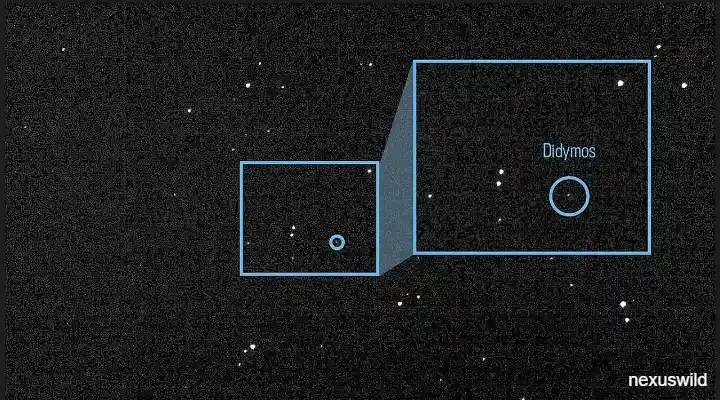
Hera launched on 7 October 2024 and reached the asteroid system in November 2026. ESA announced the start of its early characterisation phase on 11 November. A first resolved image of the two bodies was released on 18 October from about 1,280 kilometres away, with Dimorphos only about one pixel across.
A closer image of Didymos was released around 16 and 17 November. ESA described the asteroid as having a distinctive equatorial ridge and rotating roughly every 2.2 hours. The much sharper images of both bodies, including the crater left by DART, were scheduled for 25 November at an event in Berlin.
This timing is crucial for understanding what has and has not been discovered. Hera's instruments are already surveying the system, but the definitive post-impact visual record had not been released at the time of writing. The rectangular-orbit story is about how the spacecraft is operating, not about a newly discovered asteroid shape.
Phys.org reported that the asteroid framing camera can resolve about 2.7 metres per pixel from 28.5 kilometres. That is a useful scale. A car-sized boulder would be visible, but fine details of the crater floor will require the closer phase.
What DART changed in 2022
NASA's Double Asteroid Redirection Test struck Dimorphos on 26 September 2022. The 580-kilogram spacecraft hit the asteroid at about 6.1 kilometres per second. DART was the first full-scale test of kinetic impactor planetary defence: the idea that a spacecraft can deflect an asteroid by crashing into it.
The immediate result was clear. Dimorphos's orbit around Didymos shortened by about 33 minutes and 15 seconds. The new orbital period is roughly 11 hours, 22 minutes and 3 seconds. The mean separation between the two bodies is now about 1,152 metres, roughly 37 metres closer than before.
The deflection was larger than simple models predicted. That is where Hera comes in. DART could measure the change in orbital period from Earth, but it could not directly measure the crater, the asteroid's mass, the amount of ejecta or the internal structure. Those missing quantities determine whether the kinetic impactor technique can be predicted reliably for a future threat.
NASA's earlier analysis suggested Dimorphos is a rubble pile rather than a solid rock. A loosely bound body responds to impact differently: some material is blasted away, some is redistributed, and the whole object may deform. Hera will test that interpretation directly.
The instruments now doing the survey
Hera carries twelve payloads. The Asteroid Framing Camera provides monochrome navigation and science images. HyperScout H records 25 spectral bands from visible light into the near infrared, allowing researchers to infer surface composition. The Thermal Infrared Imager, or TIRI, was supplied by JAXA and can detect heat patterns that are invisible in ordinary images.
The thermal instrument is especially useful because part of Dimorphos is often in shadow from Didymos. Optical cameras struggle there. TIRI can still measure the cooler surface and help determine whether boulders, fine dust or exposed rock dominate.
ESA describes the instrument suite as giving Hera a kind of superhuman vision. That is fair in the sense that the spacecraft combines imaging, spectroscopy, thermal sensing, laser ranging and radio science in one platform. It does not see everything at once; each instrument answers a different part of the question.
Two small CubeSats, Juventas and Milani, are part of the mission but are expected to be deployed early in 2027. They will take measurements closer to the asteroids than the main spacecraft can safely go. Juventas is designed to study the interior and gravity field, while Milani will examine dust and surface composition.
Why Dimorphos looks stranger than expected
Before DART, Dimorphos was modelled as an oblate spheroid, something like a squashed ball. After the impact, analysis of light curves, radar and images favoured a triaxial ellipsoid, often described as an oblong watermelon. That change was inferred from remote data, not direct post-impact imaging.
The 2024 modelling work suggested the impact might have reshaped a significant fraction of the asteroid. Some simulations produced a shape resembling an M&M sweet with a bite taken out. Those were models, not photographs, and different assumptions produced different amounts of ejected and redistributed material.
A 2026 preprint refined the picture. It suggests that roughly 13% of Dimorphos's mass may have been ejected, with much of it falling back onto the surface. The ejecta blanket could be more than eight metres thick near the impact site and tens of centimetres thick at the antipode. Local gravity may have changed by about 10%.
Hera will test these numbers. If the asteroid is heavily reaccumulated rather than simply cratered, its surface should show unusual layering, smooth regions and large displaced boulders. That would affect how scientists model future impacts.
The heliocentric-orbit result
In March 2026, a separate Science Advances paper reported that DART changed not just Dimorphos's orbit around Didymos but the binary system's orbit around the Sun. Using 22 stellar occultations observed between October 2022 and March 2025, plus radar data, the team found that the 770-day solar orbit shortened by about 0.15 seconds.
That sounds tiny, but the corresponding velocity change was roughly 11.7 micrometres per second, about 1.7 inches per hour. The momentum enhancement factor, often called beta, was about two. That means ejecta contributed roughly as much momentum as the spacecraft itself.
The result was published before Hera's arrival and was based on telescopic observations rather than spacecraft measurements. The lead author was Rahil Makadia of the University of Illinois Urbana-Champaign. His adviser, Siegfried Eggl, noted that this was the first time a human-made intervention measurably changed an asteroid's orbit around the Sun.
Hera will refine the mass and density estimates that underpin that calculation. A better mass estimate changes the inferred momentum transfer and improves predictions for future kinetic impactor missions.
What Hera will measure next
The central question is straightforward: how exactly did DART move Dimorphos? To answer it, Hera needs the asteroid's mass, shape, surface properties and crater geometry. Those quantities are linked. A crater in a loose rubble pile behaves differently from one in solid rock, and ejecta that falls back changes the surface we see.
Hera's cameras will map the crater and the surrounding terrain. Its spectrometer will look for compositional differences between fresh material and older surface. Thermal data will reveal roughness and grain size. Laser ranging and radio science will constrain the orbit and mass distribution.
The spacecraft's rectangular survey path gives repeated looks from different angles. That helps with stereo reconstruction and with separating real topographic changes from lighting effects. The coming bowtie phase will add other perspectives.
The 25 November images are the next major milestone. They should show Dimorphos in enough detail to see whether the post-impact shape models were right. If the asteroid is heavily deformed, the images will look very different from a simple cratered sphere.
The CubeSats and the next phase
Juventas and Milani are scheduled for deployment early in 2027. They will operate closer to the asteroids and provide measurements the main spacecraft cannot. Juventas will attempt to probe Dimorphos's interior and gravitational field. Milani will study dust and the surface at small scales.
The CubeSats add risk as well as value. Small spacecraft have limited power, communication and propulsion, and operating near a tiny body is difficult. If they succeed, they could provide the first direct evidence of the internal structure of an asteroid moonlet.
The main spacecraft will continue its survey regardless. ESA's plan is to move through different orbit geometries over the mission, gradually building a three-dimensional picture. The early rectangular loops are therefore a beginning, not the final operating pattern.
This staged approach reflects the uncertainty of the environment. Mission teams cannot assume that every planned path is stable. They must observe, adjust and learn as they go.
Why planetary defence needs this mission
DART proved that a spacecraft can change an asteroid's orbit. Hera is designed to find out why the change was as large as it was. That distinction matters for planetary defence. If a future asteroid threatens Earth, mission planners will need to know how much deflection a given impactor can deliver.
The uncertainty lies in ejecta. When DART hit Dimorphos, material flew away in a plume. That material carried momentum. But the amount and direction depended on the asteroid's density, strength, porosity and surface texture. Those are exactly the quantities Hera is measuring.
A better model means a better chance of choosing the right spacecraft size and impact speed in a future emergency. It also helps scientists interpret telescopic observations of past impacts and compare different asteroid types.
Planetary defence is not only about dramatic last-minute interception. It is about building a database of how real asteroids respond. Hera is turning one experiment into a calibration point.
What remains uncertain
Several figures still differ between agencies and papers. ESA gives Didymos and Dimorphos sizes of about 780 and 151 metres, while NASA uses about 805 and 170 metres. Those differences reflect different analysis methods and definitions, not necessarily a disagreement about the objects themselves.
ScienceDaily published one item saying an image was taken from 60 kilometres while its own caption said 600 kilometres. Such inconsistencies are a reminder to rely on the original ESA captions where possible.
The 13% ejected-mass figure comes from a simulation and preprint, not from Hera's direct observations. The 2024 figure of about 1% ejected came from a different model. Both can be useful, but they should not be merged into a single claim.
The exact arrival day is also less precise in ESA's primary article than in some summaries. What is clear is that Hera was in the early characterisation phase by 11 November 2026.
Another uncertainty is how representative Dimorphos is. It is a small moonlet orbiting a larger asteroid, and its rubble-pile structure may differ from that of a standalone near-Earth asteroid of the kind that would pose a direct impact threat. Hera's results will still be valuable, but scientists will need to translate them carefully rather than apply one number to every object.
There is also the question of surface age. The boulders and fine material visible in the new images may record billions of years of small impacts, or they may have been rearranged recently by DART. Distinguishing those possibilities requires combining images with thermal and spectral data. A fresh exposure may look brighter or have a different mineral signature, but space weathering and lighting can mimic such differences.
Finally, the spacecraft's measurements will have to be reconciled with ground-based observations. Telescope light curves were used to infer Dimorphos's shape before Hera arrived, and those inferences were surprisingly accurate in some respects. Comparing them with direct imaging will show where remote techniques can be trusted and where they need spacecraft calibration. That lesson will matter for future asteroid missions that cannot afford a long rendezvous.
What the 25 November images could reveal
The next release should answer several questions at once. Is Dimorphos still roughly oblong, or has the impact produced a more complex shape? How large is the crater, and how sharp are its edges? Did ejecta settle in thick deposits, or was most of it lost into space? Are there fresh exposures of material that differ in colour from the older surface?
The answers will test both the 2024 and 2026 models. They will also help mission planners interpret DART's orbital result. If the asteroid's surface is loosely bound and highly porous, a large momentum enhancement makes sense. If it is denser and more coherent, researchers may need another explanation.
For now, Hera's rectangular orbits are a practical curiosity with a serious purpose. They keep a small spacecraft alive and moving around a pair of tiny worlds while its instruments gather the evidence needed to make planetary defence predictable. The shapes being mapped are on the asteroids. The rectangle belongs to the path Hera flies.
Nexuswild welcomes factual corrections. Email contact@nexuswild.com with evidence and the article URL.