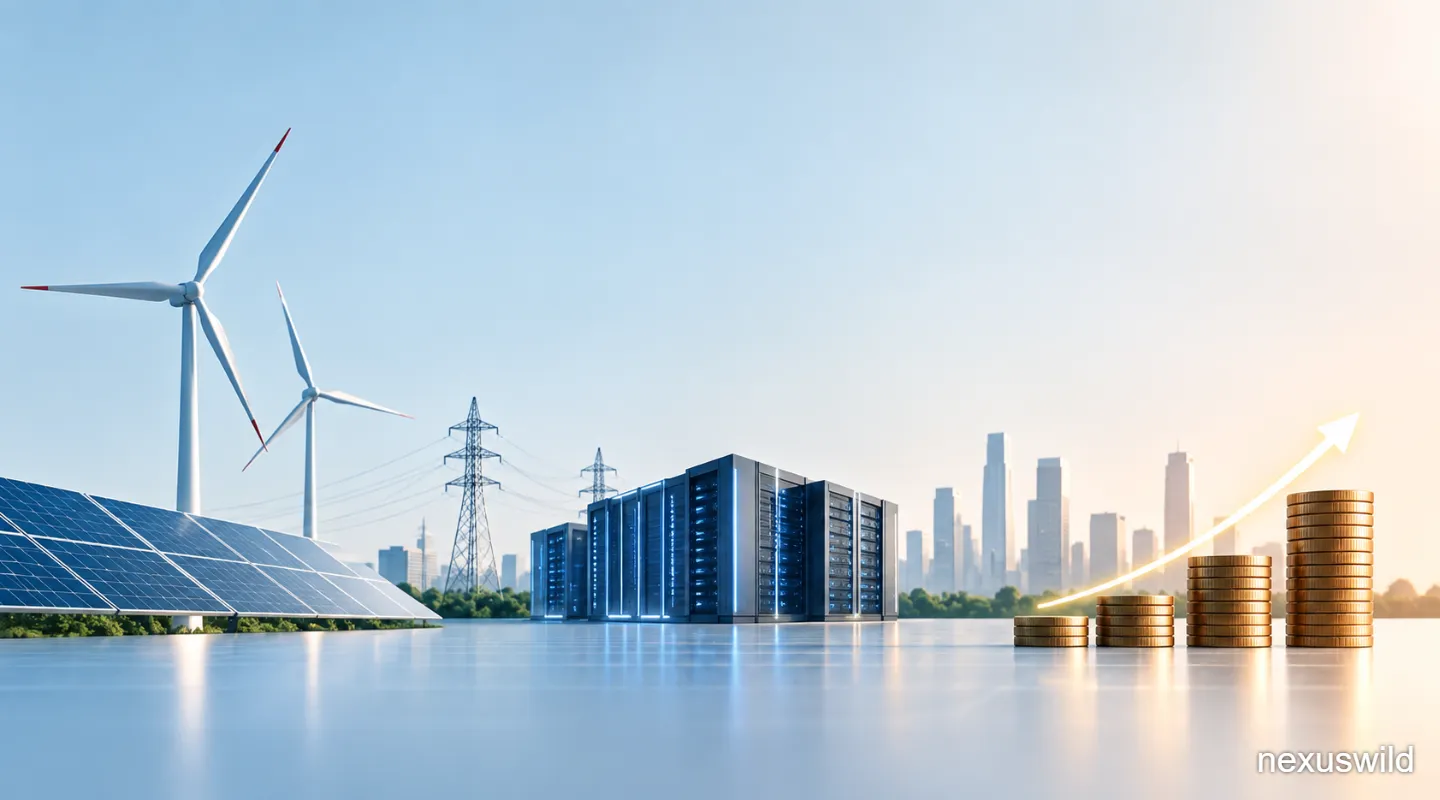

Software companies worried about engineers and servers. Semiconductor manufacturers worried about fabrication equipment and process yields. Cloud providers competed over computing performance, network reach and the cost of hardware.
Electricity was essential, but rarely the headline.
That is changing.
Artificial-intelligence data centres are concentrating enormous amounts of computing hardware in single locations. Semiconductor plants consume power continuously. Cloud infrastructure is expanding alongside AI, while the wider digital economy is becoming more dependent on energy-intensive computing.
At the same time, the price of electricity has become more volatile across major markets.
The International Energy Agency said disruptions to LNG supply through the Strait of Hormuz in 2026 pushed Asian and European natural-gas prices to their highest levels since the 2022-23 energy crisis. In the second quarter of 2026, average spot wholesale electricity prices in the European Union and Japan were more than 30% higher than a year earlier. The United States was much less exposed to that particular shock, with average wholesale prices broadly unchanged year on year, while India's increase was below 10%.
For technology companies, those regional differences are becoming economically significant.
Energy prices now influence where infrastructure is built, how long-term contracts are structured, which power technologies attract corporate capital and how companies think about the operating cost of AI.
AI Is Making Electricity a Larger Part of the Technology Cost Base
AI infrastructure has intensified the relationship between computing and energy.
The world's data centres used roughly 460 terawatt-hours of electricity in 2024, according to the IEA. In its base case, the agency projects that consumption could exceed 1,000 TWh by 2030. That is a projection, not a confirmed future outcome, and it depends heavily on how quickly AI deployment grows and how efficiently future hardware and software operate.
The direction, however, is already visible.
Ireland provides one of the clearest measured examples. Its Central Statistics Office reported that data centres consumed 7,663 GWh in 2025, up 10% in a year, and accounted for 23% of all metered electricity consumption in the country. That share was just 5% in 2015.
When electricity becomes that large a part of local demand, the price and availability of power can materially affect decisions about new data-centre investment.
A cloud company deciding where to build no longer looks only at fibre connectivity, tax incentives and land. It also has to consider wholesale power markets, grid queues, transmission capacity, local generation and the likelihood that future electricity costs will remain competitive.
This is particularly important for AI facilities because accelerator-heavy systems can consume far more power per rack than conventional enterprise computing.
Energy cost therefore becomes part of the economics of each unit of computing delivered.
Electricity Prices Differ Dramatically Across Regions
There is no single global electricity price.
That is one reason energy is starting to influence the geography of technology investment.
Eurostat reported that average electricity prices for medium-sized non-household consumers in the European Union were €18.37 per 100 kWh in the second half of 2025, down 3.5% from the first half. Yet the differences between countries were substantial.
Ireland recorded an average of €25.52 per 100 kWh, while Finland was at €7.48 and Sweden at €9.70. These statistics cover a defined category of non-household consumer rather than hyperscale data-centre contracts, but they illustrate how different the underlying electricity-cost environment can be across Europe.
The United States offers another picture.
According to the US Energy Information Administration, the nationwide average commercial electricity price was 14.53 cents per kWh in July 2026, up from 14.05 cents a year earlier. The average industrial price was 9.77 cents per kWh, compared with 9.33 cents in July 2025. Again, large data centres and factories may negotiate rates very different from these broad averages, but the national figures show that electricity costs are rising for many business users.
Those price differences affect operating expenses over the life of a technology facility.
Data centres and semiconductor plants are not short-term assets. A large computing campus or chip fab can operate for many years. Even modest differences in electricity prices can therefore compound into a meaningful cost disadvantage.
Semiconductor Manufacturing Is Particularly Exposed
The semiconductor industry illustrates why energy prices matter beyond data centres.
Modern fabrication plants run expensive process tools, clean-room systems, pumps, air-handling equipment, water treatment and other infrastructure continuously.
Samsung Electronics' semiconductor division consumed 30,426 GWh of electricity in 2025, up from 28,996 GWh the previous year. The company describes semiconductor manufacturing as highly energy-intensive and says it is working to improve equipment efficiency while increasing renewable-energy use.
Samsung's semiconductor division reported that renewable electricity represented 26.2% of its electricity consumption in 2025, up from 24.8% in 2024.
Taiwan Semiconductor Manufacturing Company makes the financial risk even more explicit.
In its latest annual filing, TSMC says semiconductor production requires extensive amounts of electricity and warns that utility-price increases can raise manufacturing costs and adversely affect financial performance. The company also identifies power outages, shortages and grid interruptions as operational risks because a reliable electricity supply is essential to keeping fabrication plants running.
That means energy prices can influence semiconductor economics in two ways.
The first is direct: electricity becomes part of the cost of producing a wafer.
The second is indirect: reliable electricity infrastructure can determine whether additional manufacturing capacity can be built in a particular region at all.
As countries compete for new chip fabs, energy policy is therefore becoming part of industrial policy.
AI Infrastructure Is Increasing Competition for Long-Term Power
Large technology companies are responding by becoming more directly involved in electricity procurement.
For years, companies such as Google and Microsoft signed long-term renewable power-purchase agreements to support new wind and solar projects.
The AI infrastructure cycle is expanding that approach.
The technology sector accounted for around 40% of corporate renewable PPAs signed worldwide in 2025, according to the IEA.
Long-term power agreements can serve several purposes.
They may give developers greater revenue certainty to finance new generation, while technology buyers gain a contractual framework for securing electricity or its environmental attributes over many years.
That does not necessarily mean the data centre is physically connected to one dedicated solar or wind farm. Electricity usually flows through a regional grid.
The economic relationship, however, can help determine which generation projects get built.
This approach is now expanding beyond conventional renewables.
Nuclear Power Has Become Part of the AI Infrastructure Strategy
Few developments demonstrate the change more clearly than the technology industry's renewed interest in nuclear energy.
Microsoft signed a 20-year power-purchase agreement with Constellation that supports the planned restart of the former Three Mile Island Unit 1 in Pennsylvania, now called the Crane Clean Energy Center.
The facility is expected to restore 835 MW of generation to the PJM grid. Constellation now says the plant could return to service as early as 2027, subject to the necessary regulatory approvals.
The electricity does not travel through a private wire directly into one Microsoft server hall. Instead, Microsoft will use the plant's output under the PPA to help match electricity consumption associated with its regional data centres.
Google has taken a different nuclear approach.
Its agreement with Kairos Power creates a path for up to 500 MW of advanced nuclear generation by 2035. The first project is the planned Hermes 2 reactor in Tennessee, which is expected to supply up to 50 MW to the Tennessee Valley Authority grid beginning around 2030 and support Google's data-centre demand in Tennessee and Alabama.
These projects remain future generation rather than electricity operating today.
That distinction is important.
Advanced nuclear is attracting significant technology-sector capital, but most new reactor concepts still face long development, construction and regulatory timelines.
Meta has gone further in scale.
In January 2026, it announced agreements with Vistra, TerraPower and Oklo that, together with an earlier Constellation agreement, could support up to 6.6 GW of existing and new nuclear power by 2035.
Part of that involves preserving or expanding existing nuclear plants. Other parts depend on advanced reactors that have not yet been commercially deployed at scale.
The IEA says conditional nuclear offtake arrangements associated with data-centre operators and small modular reactor projects have grown from about 25 GW at the end of 2024 to 45 GW in 2026. That figure represents a project pipeline, not operating generating capacity.
Renewables Remain the Largest New Clean-Power Response
Nuclear may attract attention because of its ability to produce power around the clock, but wind and solar remain central to technology-sector energy procurement.
The IEA projects renewable energy will meet nearly half of additional global data-centre electricity demand through 2030 in its base case.
That expectation reflects both the falling cost of renewable generation and the speed with which solar and wind projects can often be deployed compared with large thermal or nuclear plants.
Google, for example, has backed a 1 GW pipeline of solar projects in Taiwan through a partnership involving New Green Power. The company has said part of that capacity could also be offered to semiconductor suppliers and equipment manufacturers in the region.
That is particularly relevant because Google's supply chain depends on energy-intensive semiconductor manufacturing.
In effect, some technology companies are beginning to think about energy not only for their own data centres but also for the factories producing the hardware those data centres use.
Natural Gas Is Filling the Speed Gap
Renewables and nuclear do not solve every short-term power problem.
New data centres can sometimes be designed and built faster than utilities can construct the grid infrastructure required to serve them.
That mismatch is pushing some developers toward onsite generation.
The IEA says developers, particularly in the United States, are advancing a significant number of projects using onsite natural-gas generation because of slow grid connections. Many of those projects remain at an early stage and face technical and financial challenges.
Natural gas already plays a large role in American data-centre electricity supply.
The IEA estimates gas currently provides more than 40% of the electricity physically serving US data centres. Renewables account for roughly 24%, nuclear about 20% and coal around 15%.
Gas can provide dispatchable power quickly compared with new nuclear projects.
The trade-off is exposure to fuel prices.
That became particularly visible in 2026 when global LNG disruptions sent gas prices sharply higher in Europe and Asia.
Markets more dependent on LNG experienced larger wholesale electricity-price increases, while the United States, with substantial domestic gas production, was comparatively insulated from the same international shock.
Energy-price volatility therefore becomes another reason technology companies want a diversified electricity portfolio rather than dependence on one fuel.
Battery Storage Is Changing the Value of Cheap Power
Low electricity prices are not always available at the moment a technology facility needs them.
Solar generation may be abundant in the afternoon and scarce after sunset. Wind production can vary from hour to hour.
Battery storage helps move electricity across time.
Global battery-storage deployment reached 108 GW of new capacity in 2025, up 40% from the previous year, according to the IEA. About 80% of those additions were utility-scale projects.
Costs have also fallen substantially.
The IEA says battery-storage project costs fell by about 40% in 2024 to roughly $150 per kWh, while average battery pack prices declined again in 2025.
For technology infrastructure, batteries serve several functions.
They can smooth renewable generation, provide short-duration backup, respond quickly to fluctuations in data-centre demand and help reduce consumption during expensive peak periods.
Battery-based uninterruptible power-supply capacity associated largely with data centres rose by around 30% to 45 GW in 2025, according to the IEA. These systems generally provide short-duration backup rather than long-term energy storage.
Storage does not remove the need for generation.
It changes when electricity can be economically consumed.
That matters increasingly in markets where wholesale power prices can fall very low, or even negative, during periods of abundant renewable output and rise sharply several hours later.
Efficiency Is Becoming a Financial Strategy
Technology companies can respond to high energy prices by buying more electricity.
They can also use less.
This is why energy efficiency has moved from an environmental metric into core infrastructure economics.
For data centres, one common measure is power usage effectiveness, which compares total facility energy with the power consumed directly by computing equipment.
More efficient cooling, better power systems and higher server utilisation can reduce the amount of electricity required for each unit of useful computing.
Microsoft, for example, says changes to cooling controls in its Phoenix data centres reduced water-use effectiveness by 23% year on year in fiscal 2025. While this is a water metric rather than a direct electricity-price measure, it illustrates how operators are redesigning data centres at the facility level as resource constraints become more important.
Semiconductor companies are doing something similar.
Samsung says it has reduced standby electricity consumption in chip-production equipment by shutting down unnecessary components and optimising tools during periods of low utilisation.
The financial logic is straightforward.
When electricity becomes more expensive, the value of every avoided kilowatt-hour rises.
High Energy Prices Can Influence Where Technology Gets Built
Energy costs do not determine every investment decision, but they can change the relative economics between locations.
A semiconductor fab needs skilled workers, water, supply-chain access and political support.
A data centre needs fibre, customers, land and network connectivity.
But two otherwise comparable regions with dramatically different electricity prices can produce different operating-cost outcomes over many years.
The European numbers show the scale of that variation.
In the second half of 2025, the average non-household electricity price in Ireland was more than three times Finland's.
That does not mean every company should move computing to Finland. Grid capacity, latency, taxes, customer proximity and climate all matter.
It does mean electricity price has become a more visible factor in the industrial geography of digital infrastructure.
The same principle applies to semiconductor manufacturing.
Countries seeking advanced fabrication capacity increasingly have to demonstrate that they can supply not merely cheap electricity but stable electricity at industrial scale.
TSMC's own risk disclosures make clear that reliability can be just as important as price.
Governments Are Being Pulled Into Technology-Energy Planning
The connection between energy and technology also changes the role of governments.
A data-centre cluster requiring gigawatts of new demand cannot be treated as an ordinary commercial building project.
Utilities may need new substations and transmission lines. Regulators have to decide how grid-upgrade costs are allocated. Governments may have to approve additional generation.
This creates a difficult policy balance.
Technology investment can bring construction, employment and tax revenue.
But policymakers also have to ensure that large new customers do not undermine reliability or shift disproportionate infrastructure costs onto households and smaller businesses.
The 2026 electricity-price shock shows why this matters.
The same LNG disruption produced markedly different wholesale-price effects depending on each region's generation mix and fuel exposure.
Energy resilience is therefore becoming part of technology competitiveness.
A region with diverse generation, adequate transmission and flexible demand may be better positioned to absorb large new AI loads without exposing the rest of the economy to severe price pressure.
The Cloud Economy Is Becoming More Physical
One of the broader consequences is conceptual.
The cloud once sounded almost weightless.
In economic terms, it never was.
Every cloud service ultimately depends on land, servers, fibre, cooling, electricity and physical power infrastructure.
AI has simply made those dependencies harder to ignore.
Energy prices affect the cost of running a server. They affect semiconductor manufacturing. They affect cooling infrastructure, backup generation and the location of data-centre campuses.
Fuel prices can move wholesale electricity costs across entire regions.
That does not mean every increase in electricity prices will immediately appear as a higher cloud-computing bill. Major providers use long-term contracts, hedging, efficiency measures and large-scale procurement to manage costs.
It does mean electricity is becoming a larger strategic variable inside the economics of digital infrastructure.
Energy Volatility Is Also Creating Investment Opportunities
The relationship works in the other direction as well.
Technology demand is reshaping the energy industry.
Hyperscalers are helping finance solar projects, nuclear restarts, advanced reactors and storage.
Battery developers are building systems specifically suited to fast-growing data-centre regions.
Utilities are considering new generation because they can see large customers arriving years in advance.
The IEA expects global electricity demand to grow 3.6% in 2026 and 3.8% in 2027, after 3% growth in 2025, driven partly by industry, electric vehicles, cooling and data centres. Those 2026 and 2027 figures are forecasts, not completed outcomes.
For energy companies, that load growth creates a potentially durable source of demand.
For technology companies, it creates a new dependency.
The two industries are becoming more economically intertwined.
Energy Prices Will Not Move in One Direction
It would be a mistake to assume that electricity will simply become steadily more expensive.
Energy markets do not work that way.
Fuel prices rise and fall. Renewable generation can push wholesale prices sharply lower during particular hours. Battery costs have declined. New nuclear or gas capacity can increase supply. Transmission investment can reduce congestion.
Eurostat's figures show EU non-household electricity prices actually fell 3.5% between the first and second halves of 2025, even though prices in many parts of Europe remained above pre-energy-crisis levels.
Then the 2026 LNG shock pushed wholesale prices sharply higher again in parts of Europe and Asia.
The important point for technology companies is therefore not that energy prices are guaranteed to rise.
It is that energy price exposure matters more when electricity consumption itself is expanding quickly.
Conclusion
Energy is becoming part of the strategic architecture of the technology economy.
AI data centres are increasing electricity demand. Semiconductor fabrication already consumes enormous amounts of power. Cloud computing continues to expand, while the hardware behind that cloud requires its own energy-intensive industrial supply chain.
At the same time, electricity prices differ dramatically between regions and can change quickly when fuel markets are disrupted.
Technology companies are responding in several ways.
They are signing renewable power agreements, supporting nuclear plants, funding advanced reactors, investing in efficiency and using battery storage to manage increasingly complex power systems.
Governments, meanwhile, are being forced to think about digital infrastructure and energy infrastructure together.
The outcome will not be a simple division between places with cheap electricity and places with expensive electricity.
Reliability, grid capacity, generation mix, regulation, fibre connectivity, labour, water and customer proximity all remain important.
But energy has moved much closer to the centre of technology economics.
For the next generation of AI systems, cloud infrastructure and advanced chips, the question is no longer only how much computing power a company can build.
Nexuswild welcomes factual corrections. Email contact@nexuswild.com with evidence and the article URL.