
Astronomers Spot Three Feeding Black Holes in One Early Galaxy
JWST spectroscopy has revealed evidence of three actively accreting black holes in a galaxy seen when the universe was about 1.2 billion years old — a rare system that may shed light on how the first supermassive black holes grew.
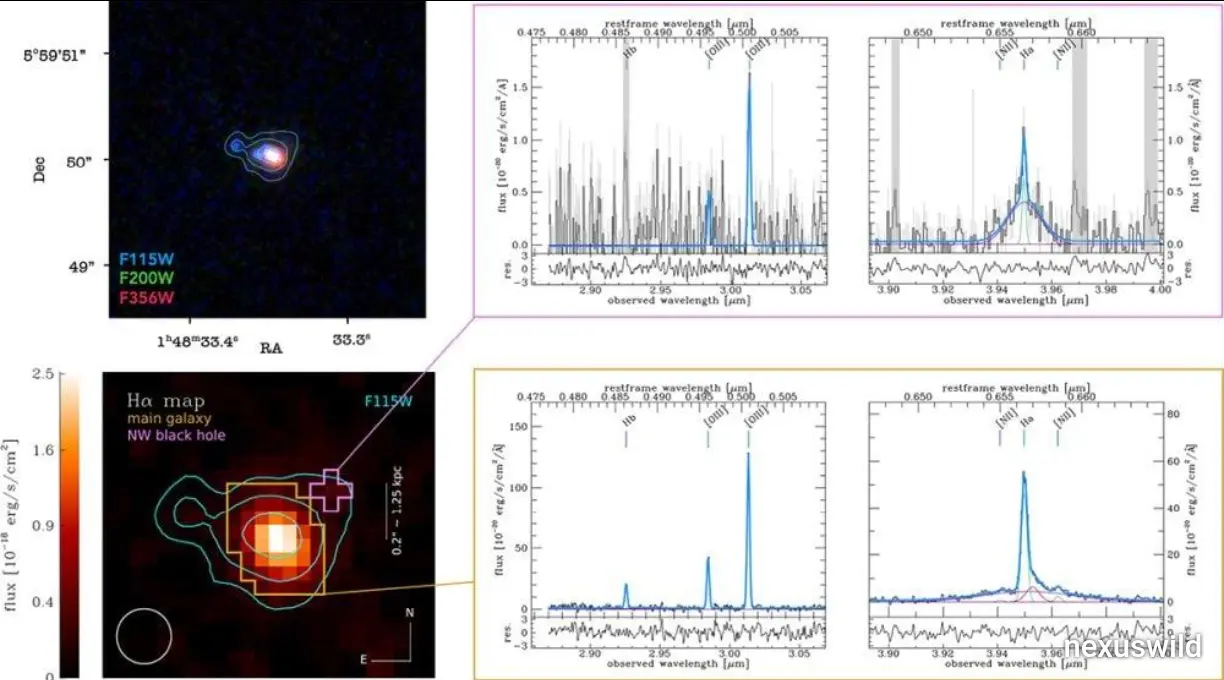
Astronomers have identified evidence of three actively feeding black holes in a single distant galaxy, giving researchers a rare opportunity to study how these powerful objects grew during the universe's early history. The discovery was made using the James Webb Space Telescope (JWST), whose infrared spectroscopy capabilities helped scientists distinguish signals from three black hole candidates within galaxy J0148-4214.
The galaxy is more than 12.5 billion light-years from Earth. Because its light has travelled for billions of years to reach us, astronomers observe it as it appeared when the universe was approximately 1.2 billion years old. The findings were reported by an international research team led by the Max Planck Institute for Extraterrestrial Physics and published in the journal Astronomy & Astrophysics.
Three black holes, one early galaxy
The researchers estimate that the three black holes have masses of approximately 80 million, 600,000 and two million times the mass of the Sun. Two are located close together in the galaxy's central region, while the third lies farther away from the centre.
The two central objects are separated by a projected distance of about 620 light-years. The third is approximately 5,500 light-years from the galaxy's centre. These distances are estimates based on observations from our perspective, rather than direct measurements of the objects' complete three-dimensional positions.
The result is notable because identifying three actively accreting black holes in one galaxy at such an early cosmic epoch offers a rare view of a system that may be shaped by galaxy interactions and mergers. Researchers have proposed that mergers could help explain how some black holes became massive relatively early in cosmic history.
However, the discovery does not establish that all early supermassive black holes formed through mergers. It adds evidence to an ongoing scientific question about the processes that allowed black holes to grow so quickly in the young universe.
How JWST identified the black holes
Black holes do not emit light in the same way as stars. Astronomers therefore often identify actively feeding black holes by studying radiation from material around them. Gas moving at high speeds in the region near a black hole can produce distinctive emission-line signatures.
For J0148-4214, the research team used the Near-Infrared Spectrograph, or NIRSpec, aboard JWST. Its Integral Field Unit mode, known as NIRSpec-IFS, captures spatially resolved spectra, providing information about how light varies across different parts of a target.
The researchers examined broad hydrogen-alpha, or Hα, emission lines. The shape and location of these spectral features suggested that the central emission could not be adequately explained by a single black hole alone.
A technique called spectro-astrometry helped the team separate the signals. It measures subtle changes in the apparent position of emission across different parts of a spectrum. This allowed researchers to infer the presence and positions of two closely spaced central sources even though the telescope did not resolve them as two distinct points of light.
The team also examined alternative explanations, including supernovae, shocks, stellar winds and very massive stars. Based on the additional spectral evidence, the researchers concluded that actively accreting black holes were the most likely explanation for the observed features.
The distinction matters: this was not a photograph showing three black holes. It was a spectroscopic detection in which researchers interpreted the signatures of material surrounding the objects. The spatial information provided by NIRSpec-IFS was essential to the analysis.
The smallest black hole is growing unusually quickly
One of the most striking results concerns the black hole estimated to have a mass of around 600,000 Suns. Although it is much smaller than the roughly 80-million-solar-mass central black hole, the researchers estimate that it is accreting material at a rate that exceeds the Eddington limit.
The Eddington limit is a theoretical benchmark for the balance between gravity pulling material inward and radiation pressure pushing outward. In simplified models, it describes a maximum steady accretion rate for a given black hole mass under specified assumptions.
Exceeding this limit is often described as super-Eddington accretion. It is important to understand that this does not mean the black hole has broken the laws of physics. Rather, it indicates that the inferred feeding rate is higher than the benchmark predicted by a simplified model, and that the details of the accretion process require careful interpretation.
The mass estimates in the study are not exact measurements without uncertainty. They are inferred using relationships between emission-line properties and black hole mass, and the researchers note that applying these calibrations to distant galaxies can introduce substantial uncertainty. The finding is therefore evidence of unusually rapid feeding, not a precise measurement of how far beyond the Eddington limit the object is operating.
The contrast between the three objects is also informative. The most massive black hole is estimated to be accreting at a lower rate than its smaller central companion. This suggests that black hole mass alone does not determine how quickly an object is currently growing.
What the system reveals about galaxy mergers
Galaxies can interact and merge over cosmic time. When galaxies containing central black holes come together, their black holes may eventually form pairs and, under the right conditions, merge as well. Such processes are among the possible routes by which black holes can gain mass.
The two central black holes in J0148-4214 are close enough that the researchers expect them to merge within the next few hundred million years, based on their interpretation of the system. That is a prediction rather than an event that has already been observed.
The third black hole's position raises a separate question. It may be a remnant of an earlier merger that was displaced from the galaxy's centre by gravitational recoil, or it may be moving inward. The present observations do not conclusively determine which explanation is correct.
If future observations confirm the system's structure and clarify its motion, J0148-4214 could help scientists test models of how black holes interact in the early universe. It may also provide clues about the kinds of systems that eventually produce massive black hole mergers.
Those mergers can generate gravitational waves — ripples in spacetime that are detectable under suitable conditions. Future space-based observatories such as the planned Laser Interferometer Space Antenna (LISA) are expected to investigate gravitational waves from massive black hole systems. J0148-4214 is a potential example of the kind of early-universe system that could inform this broader research, although a future detection from these specific objects is not guaranteed.
Why the discovery matters
The study demonstrates the scientific value of spatially resolved infrared spectroscopy. Without the detailed spectral mapping provided by JWST's NIRSpec-IFS instrument, the three sources could have been interpreted as a single active black hole, according to the research team.
The findings also give astronomers a way to examine the relationship between black hole growth and galaxy evolution when the universe was still young. Researchers can compare the estimated black hole masses with the galaxy's stellar mass, which the team puts at approximately 1.3 billion solar masses, and investigate how these objects acquired their mass over time.
The discovery does not by itself require a complete overhaul of existing cosmic evolution models. Instead, it provides a particularly useful observational case for testing and refining theories about black hole growth, galaxy mergers and the formation of massive black holes in the early universe.
Further observations will be important for improving the mass estimates, examining the system's dynamics and determining the nature of the off-centre object. Astronomers will also need to study other distant galaxies to establish how frequently similar systems occur.
For now, J0148-4214 offers an unusual snapshot of three actively feeding black holes in one young galaxy. By revealing sources that would otherwise have been difficult to distinguish, JWST has expanded the evidence available to scientists investigating how some of the universe's most massive objects formed and evolved.
Nexuswild welcomes factual corrections. Email contact@nexuswild.com with evidence and the article URL.