
Key Takeaways
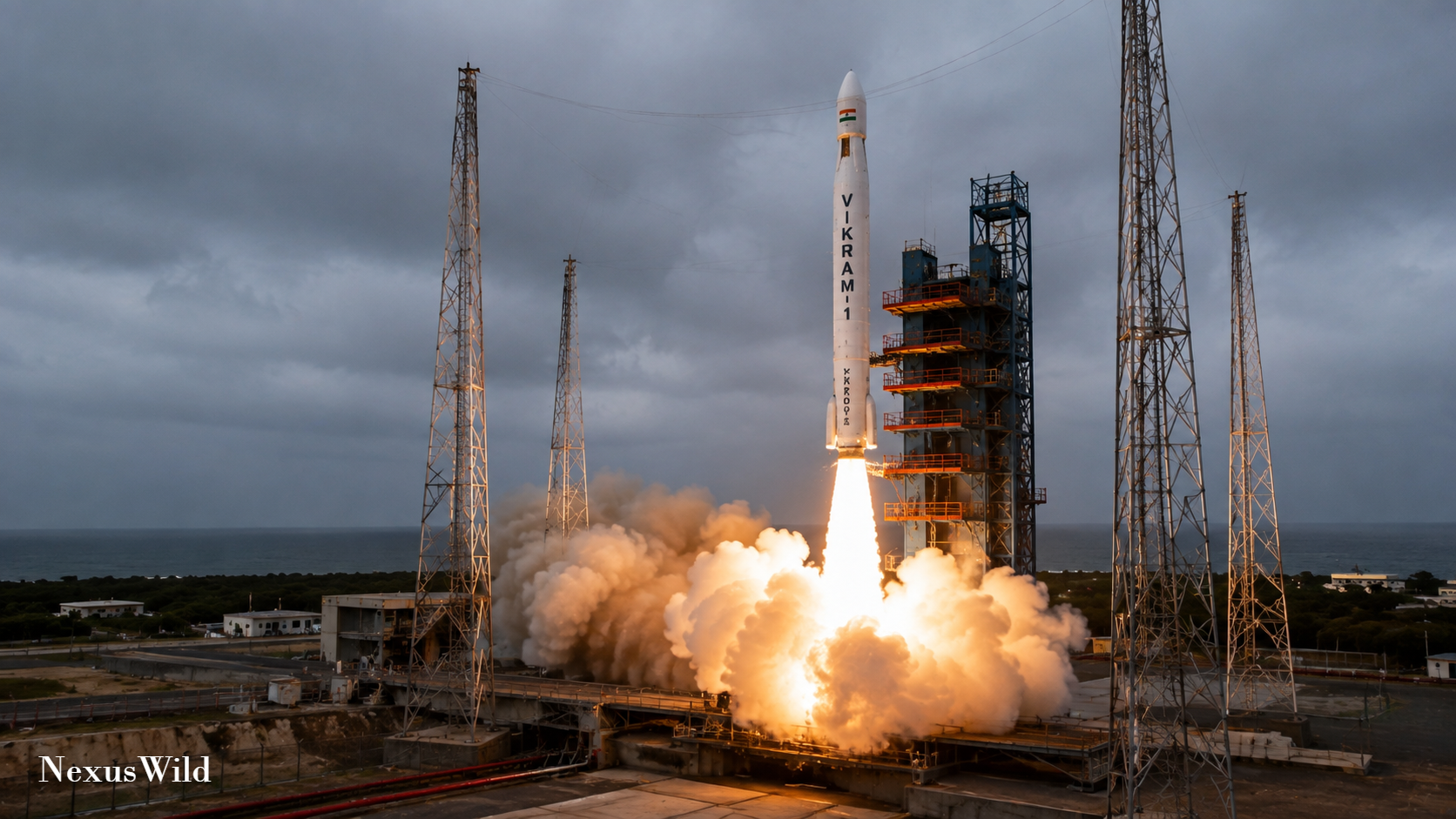
- Commercial Milestone: Skyroot Aerospace's Mission Aagaman successfully deployed diverse LEO payloads via the Vikram-1, establishing India as the third nation with independent private orbital delivery capabilities.
- Rapid Turnaround Engineering: Vikram-1's advanced all-carbon composite airframe and highly stable solid-propellant architecture (Kalam series) support an unprecedented 24-hour launch capability.
- Strategic Reality vs. Capability: While mechanically prepared for rapid turnaround, India lacks the standardized modular satellite stockpiles and instantaneous launch authorities necessary for full Operationally Responsive Space (ORS).
- Policy Evolution: The landmark 2023 Space Policy and IN-SPACe deregulation successfully offloaded small-lift commercial logistics to private NGEs, allowing ISRO to focus strictly on human spaceflight and deep space exploration.
Introduction to a New Era in Orbital Dynamics
On July 18, 2026, the global aerospace sector witnessed a fundamental shift in the geopolitical and commercial space landscape as Skyroot Aerospace successfully executed Mission Aagaman, placing a diverse suite of miniaturized payloads into a Low Earth Orbit (LEO). Launching from the First Launch Pad at the Satish Dhawan Space Centre (SDSC) in Sriharikota, the Vikram-1 launch vehicle lifted off at exactly 12:05:30 PM Indian Standard Time. The liftoff occurred thirty-five minutes later than the initially scheduled 11:30 AM slot due to a brief, planned hold required to clear minor navigation parameters, demonstrating the rigorous safety tolerances applied to the vehicle's maiden flight.
The mission, which operated seamlessly through fourteen distinct flight phases over a duration of 15.46 minutes, injected its cargo into a 450-kilometer orbit at a 60-degree inclination. This historic trajectory effectively made India the third nation - following the United States and China - to possess a private commercial enterprise capable of independent orbital payload delivery.
However, beyond the commercial validation of India's newly liberalized space sector, the successful launch of Vikram-1 has ignited a profound strategic dialogue regarding India's potential for "Operationally Responsive Space" (ORS). The core question permeating defense, intelligence, and aerospace policy circles is whether the Republic of India now possesses the intrinsic capability to replace a critical satellite in a matter of days.
The concept of operationally responsive space refers to the strategic and tactical ability to rapidly prepare, launch, and operate a spacecraft within an operationally relevant timeframe, typically to replace a damaged, disabled, or destroyed space asset during a national emergency or escalating armed conflict. While traditional satellite launch campaigns require years of meticulous planning, bespoke payload integration, and scheduled queueing on heavy-lift vehicles, the ORS doctrine seeks to compress this extensive timeline to a matter of days or even hours. Skyroot Aerospace advertises the Vikram-1 as a highly agile, on-demand launch vehicle capable of being fully assembled and launched within twenty-four hours of its arrival at the launch pad, assuming pre-flight conditions are met.
This comprehensive report provides an exhaustive analysis of India's nascent rapid-launch capabilities. It assesses the meticulous engineering architecture of the Vikram rocket family, evaluates the historical and doctrinal framework of space reconstitution globally, and cross-examines the commercial realities of the expanding Indian space industry against the stringent, unforgiving military requirements of true operationally responsive space.
The Engineering Architecture of the Vikram Launch Vehicles
To accurately understand the viability of rapid satellite replacement, one must first deconstruct the launch vehicle facilitating it. The physical properties, chemical propulsion choices, and structural characteristics of a rocket dictate its integration timeline, its storage constraints in military bunkers, and its launch infrastructure requirements.
Vikram-1 - named in honor of Dr. Vikram Sarabhai, the visionary architect of the Indian space program - is a four-stage, small-lift orbital launch vehicle designed specifically to serve the burgeoning global small satellite market. The vehicle stands approximately 24 meters tall (roughly equivalent to a seven-story building) with a uniform diameter of 1.7 meters, presenting a highly optimized, compact physical profile that enables logistical transportability. The vehicle is engineered to deliver payloads of up to 350 kilograms to a 500-kilometer Low Earth Orbit at a 45-degree inclination, and up to 260 kilograms into a Sun-Synchronous Polar Orbit (SSPO).
Carbon Composite Manufacturing and Structural Agility
One of the most critical engineering deviations Vikram-1 makes from legacy launch vehicles is its structural composition. The rocket is constructed utilizing an all-carbon composite airframe, establishing it as India's first fully carbon-fiber orbital rocket. Traditional state-manufactured rockets often rely on heavy metallic alloys, such as aerospace-grade aluminum-lithium, which require extensive metallurgical processing, precision welding, and heavy structural reinforcement to survive aerodynamic stress.
In stark contrast, carbon composite materials drastically minimize the structural mass of the rocket, thereby maximizing the payload mass fraction and overall fuel efficiency. The manufacturing of the vehicle's stages involved multi-axis, high-precision robotic winding and curing processes, allowing Skyroot Aerospace to construct structures that are both ultra-lightweight and capable of withstanding extreme combustion pressures. The developmental timeline of these composites was rigorous. On July 4, 2023, the company successfully completed the carbon-fiber winding and curing of the Stage-1 motor case, which, at 1.7 meters in diameter and 10 meters in length, constituted the largest hardware the company had manufactured in-house up to that point. During subsequent ground testing on December 18, 2023, this first stage composite motor case (designated Kalam-1200) successfully withstood extreme internal combustion pressures of 82.5 atmospheres.
The utilization of advanced composites is highly conducive to rapid scalability and mass production. According to corporate projections, Skyroot’s 200,000-square-foot Infinity Campus in Hyderabad - inaugurated by Prime Minister Narendra Modi in November 2025 - is designed to scale production to a cadence of one orbital rocket per month. This industrialized, assembly-line approach to rocket manufacturing is a fundamental prerequisite for responsive space.
Propulsion Systems: The Supremacy of Solid Fuels for Rapid Launch
The propulsion architecture of Vikram-1 is heavily biased toward solid propellants, which acts as the defining factor in its advertised twenty-four-hour rapid launch capability. The vehicle utilizes three solid-fuel primary stages and a specialized liquid-fueled fourth stage for precise orbital insertion and payload deployment.
The developmental lineage of the solid stages, named the "Kalam" series after former Indian President and renowned rocket scientist Dr. A.P.J. Abdul Kalam, reflects a methodical scaling of thrust capabilities. The first major milestone occurred on December 22, 2020, when Skyroot conducted a successful test firing of a solid rocket stage demonstrator named 'Kalam-5'.
| Stage Designation | Propulsion Type | Engine/Motor Name | Maximum Thrust | Propellant Composition | Burn Characteristics |
|---|---|---|---|---|---|
| First Stage | Solid Motor | Kalam-1200 | 1,000 kN (120 tonnes) | Solid Propellant | High-thrust ascent burn |
| Second Stage | Solid Motor | Kalam-250 | 250 kN | Solid Propellant | Mid-altitude atmospheric transit |
| Third Stage | Solid Motor | Kalam-100 | 100 kN | Solid Propellant | 108-second burn time to exoatmosphere |
| Fourth Stage | Liquid Kick Stage | 4 x Raman-I | 3.4 kN (combined) | N2O4/MMH (Hypergolic) | Precision orbital insertion and adjustment |
The reliance on solid propulsion for the primary ascent stages is strategically paramount for the concept of operationally responsive space. Liquid-fueled rockets, particularly those utilizing cryogenic propellants like liquid oxygen (LOX) and liquid hydrogen (LH2), require complex and delicate ground support equipment (GSE). Cryogenic fuels cannot be stored at room temperature; they boil off into atmospheric gas and must be actively fueled into the rocket mere hours before launch.
Solid rocket motors, conversely, are cast with their propellant integrated directly into the carbon composite motor casing during the manufacturing process. They are highly stable, can be stored in climate-controlled warehouses or military bunkers for years without significant chemical degradation, and require zero fueling time on the launch pad. Furthermore, the fourth stage of Vikram-1 utilizes hypergolic liquid propellants. Hypergolic fuels possess the unique chemical property of igniting spontaneously upon physical contact, completely eliminating the need for complex ignition mechanisms, and they are safely storable at room temperature.
Mobile Launch Infrastructure and Separation Mechanics
To further compress the launch timeline, Vikram-1 is engineered for deployment via a mobile launch pad, technically designated in military and aerospace parlance as a Transporter, Erector, and Launcher (TEL). The vehicle's architecture is built around minimal infrastructure reliance, utilizing ultra-low-shock pneumatic separation systems to discard stages, and highly autonomous modular avionics for real-time navigation.
The ability to operate from a mobile launcher negates the necessity for massive, fixed umbilical towers and permanent concrete flame trenches. Consequently, a Vikram-1 rocket could theoretically be launched from austere or newly established launch sites - a critical requirement for military reconstitution if primary spaceports are compromised.
Comparative Assessment of Global Small-Lift Vehicles
To properly contextualize the operational viability and economic disruption of Vikram-1, it must be evaluated against contemporary global equivalents operating in the highly competitive small-satellite launch market.
| Launch Vehicle | Manufacturer / Origin | Payload to LEO | Estimated Cost per Launch | Primary Propulsion Architecture | Minimum Launch Turnaround |
|---|---|---|---|---|---|
| Vikram-1 | Skyroot Aerospace (India) | 350 kg | $5 - $10 Million | Solid / Hypergolic | 24 Hours |
| Electron | Rocket Lab (New Zealand/US) | 300 kg | $7.5 Million | Liquid (RP-1/LOX) | Days to Weeks |
| SSLV | ISRO (India) | 500 kg | $4 - $6 Million | Solid / Liquid | ~72 Hours |
| Alpha | Firefly Aerospace (US) | 1,000 kg | $15 Million | Liquid (RP-1/LOX) | Variable (Demonstrated 27h) |
Vikram-1 competes directly with Rocket Lab's Electron vehicle and the Indian Space Research Organisation's (ISRO) own Small Satellite Launch Vehicle (SSLV). While Electron relies heavily on liquid propulsion, Vikram-1’s solid-state architecture presents distinct logistical advantages for rapid turnaround and austere deployment.
The Strategic Doctrine of Operationally Responsive Space (ORS)
While Skyroot Aerospace has demonstrated the mechanical and thermodynamic capability to launch a rocket quickly and reliably, assessing whether India can genuinely "replace a satellite in days" requires a deep, historically grounded understanding of the military and strategic doctrine of space reconstitution.
The Evolution and Historical Precedents of the ORS Concept
Operationally Responsive Space is not a novel concept born in the 2020s; it traces its origins to the shifting dynamics of orbital warfare during the Cold War and the increasing vulnerability of highly expensive space assets. The United States formalized its approach to this vulnerability in 2007. Recognizing the severe threat posed by Anti-Satellite (ASAT) weapons - highlighted prominently by the People's Republic of China's successful kinetic ASAT test that same year - the U.S. Congress mandated the creation of the Operationally Responsive Space Office.
This U.S. initiative resulted in several high-profile technological demonstrations, such as the 2013 ORS-3 mission. However, the Soviet Union and subsequent Russian Federation had already demonstrated highly advanced aspects of this capability long before the West codified it. During the 1991 Desert Shield operation, analysts noted that the Russians possessed an impressive "launch-on-demand" infrastructure.
More recently, the U.S. Space Force's modernized iteration of the ORS program, now known as "Tactically Responsive Space" (TacRS), executed the Victus Nox mission in 2023. Partnering with Firefly Aerospace, the military provided the payload, and Firefly executed the launch just 27 hours after receiving the final deployment order, establishing the contemporary gold standard for responsive space.
Space Reconstitution and the Resiliency Mandate
The primary strategic driver behind ORS is space reconstitution - the ability to swiftly restore critical space-based capabilities after they have been degraded, jammed, or physically destroyed. Adversaries employ a diverse and increasingly sophisticated array of counterspace tactics, including:
- Kinetic Kill Vehicles (KKVs): Direct-ascent ballistic missiles designed to physically obliterate a satellite through sheer force of impact.
- Directed Energy Weapons (DEWs): High-powered, ground-based lasers utilized to dazzle or permanently blind delicate optical sensors on reconnaissance satellites.
- Electronic Warfare (EW): Sophisticated uplink and downlink jamming systems meant to sever the command and control communication between the satellite and its ground control stations.
- Co-orbital ASATs: Maneuverable "killer satellites" that navigate close to a target in orbit to disable, grapple, or hijack it.
Reconstitution serves as a powerful psychological and strategic deterrent. If an adversary calculates that an expensive, politically volatile ASAT strike will only blind a nation for 48 hours before a replacement satellite is successfully launched, the strategic utility and calculus of initiating the attack is severely diminished.
The Paradigm Shift in India's Space Policy
The rapid, unencumbered development of Vikram-1 is not an isolated engineering anomaly; it is the direct result of an aggressive, calculated policy pivot by the Government of India. For decades, ISRO held an absolute, state-backed monopoly over orbital launches, planetary exploration, and satellite manufacturing within the country.
The 2020 Reforms and the Landmark Space Policy of 2023
Recognizing the explosive, exponential growth of the global space economy - projected by the Indian government to scale massively from $8.4 billion to an estimated $44 billion by the year 2033 - New Delhi initiated sweeping space sector reforms beginning in 2020, which culminated in the formalization of the Indian Space Policy of 2023.
The policy formally and comprehensively liberalized the space value chain, allowing Non-Government Entities (NGEs) to undertake end-to-end space activities with legal protection and state backing. The policy established several crucial structural pillars, notably IN-SPACe (Indian National Space Promotion and Authorization Centre), which acts as the single-window regulatory authority, and massive FDI liberalization to attract global capital.
Strategic Division of Labor: ISRO’s Pivot to Deep Space
The most profound strategic outcome of these reforms is a clear division of labor within the Indian aerospace sector. By empowering agile private companies like Skyroot Aerospace and Agnikul Cosmos to handle the high-frequency, commercial, and low-margin Small Satellite Launch Vehicle (SSLV) tasks, ISRO is effectively unburdened.
Relieved of the mundane necessity to launch commercial LEO payloads week after week, ISRO can now focus intensely on the Gaganyaan human spaceflight program, the highly anticipated 2028 Venus orbiter mission, and the overarching, multi-decade goal of establishing an independent Bharatiya Antariksh Station (Indian Space Station) by 2035.
Mission Aagaman and the Commercial Realities of Space Logistics
The July 18, 2026, maiden orbital flight of Vikram-1, designated Mission Aagaman (Sanskrit for "Arrival"), served as a high-fidelity microcosm of this new public-private synergy. The complex payload manifest explicitly highlighted the commercial viability of the platform, demonstrating that Vikram-1 is not merely a test vehicle, but a fully operational logistics platform.
Payload Manifest and Precision Orbital Deployment
During its maiden flight, Vikram-1 hosted several intricate technology demonstration payloads, effectively showcasing its ride-share capability and the precision of its Raman-I liquid kick stage. The payloads successfully deployed into LEO included:
- SCOPE: Skyroot’s proprietary satellite, designed to monitor the launch vehicle's orbital insertion parameters.
- EMBRACE: A sophisticated robotic arm technology demonstration provided by Cosmoserve Space, indicating India's growing interest in on-orbit servicing and space debris removal.
- Grahaa Space Payloads: Bengaluru-based technology demonstrators focused on validating new bus architectures.
- DCUBED: An on-orbit demonstration from a German space technology company, proving Skyroot's appeal to international commercial clients.
- Additional Micro-Satellites: Including SOLARAS S3, UD3PP, mD3RN, COSMIC BLOOM, and MICRO ART TRIBUTE.
The Dual-Use Nature of Small Launchers
While Skyroot operates strictly as a commercial entity seeking profit, the dual-use nature of its technology cannot be ignored by strategic analysts. In a hypothetical crisis scenario where an Indian military reconnaissance satellite is blinded by a terrestrial laser or disabled by an electronic warfare attack, the military does not inherently need a proprietary, state-built rocket to replace it. It can simply contract a private provider like Skyroot, utilizing a stockpiled military payload and a commercially available Vikram-1 launch vehicle to restore capability within days.
Can India Replace a Satellite in Days? An Analytical Reality Check
Returning to the primary inquiry: does the successful launch of Vikram-1 immediately give India the capability to replace a satellite in days? The highly nuanced, analytical answer is that while the launch vehicle itself possesses the theoretical and mechanical readiness to launch within 24 hours, the Indian defense apparatus does not yet possess a comprehensive, end-to-end Operationally Responsive Space system.
To replace a satellite in days, several stringent criteria must be completely satisfied long before the rocket is ever wheeled out of the hangar onto the launch pad.
- Strategic Framework of ORS Readiness
The discrepancy lies in the strict definition of ORS. A responsive space capability is an exhaustive architectural pipeline, not merely a fast rocket. To replace a satellite in days, several stringent criteria must be satisfied:
1. The Requirement for Standardized, Modular Satellite Buses: In traditional spaceflight, satellites are bespoke, artisanal creations. Operationally Responsive Space absolutely requires "plug-and-play" architectures. To launch on demand, India’s defense and space agencies would need to maintain a massive stockpile of standardized, modular satellite buses sitting in clean-room storage. Currently, while India has a rapidly burgeoning private satellite manufacturing sector, the military lacks a dedicated, mass-produced inventory of modular tactical satellites sitting ready for immediate integration.
2. Pre-Approved Launch Authority and Range Operations: In traditional spaceflight, range clearing, airspace deconfliction, and telemetry frequency allocations typically require weeks. For India to replace a satellite in 24 to 48 hours, pre-agreed approvals and standing military launch authorities must be legally established and routinely exercised by the Defence Space Agency (DSA).
3. Payload Storage and Integration Facilities: For a responsive launch to occur in under 30 hours, the payload must be mated to the rocket, encapsulated in the carbon composite payload fairing, transported to the pad, erected, and launched within a matter of hours. Conducting rapid payload integration requires specialized, highly secure military clean-room facilities located directly adjacent to the launch pad.
Future Trajectories and Technological Roadblocks
The success of Vikram-1 is a commencement, not a culmination. Skyroot Aerospace and the broader Indian space sector face several technological and operational milestones in the coming decade to mature this capability.
The Development of Vikram-II and Cryogenic Complexities
Skyroot’s corporate roadmap outlines the introduction of the next-generation Vikram-II, projected for maiden flight in 2027. Crucially, the third stage of Vikram-II will abandon the solid fuel of the Kalam series in favor of the Dhawan-II cryogenic engine, a 3D-printed marvel that utilizes Liquid Oxygen and Liquid Natural Gas (LOX/LNG). While a cryogenic upper stage drastically improves payload capacity, it introduces thermal and logistical complexities that directly contradict the principles of rapid ORS launch.
The Pursuit of Reusability
To truly dominate the economics of space access, expendable rockets must eventually give way to reusable systems. Skyroot has boldly outlined a 2030 objective to demonstrate reusable first-stage technology. However, reusability often directly conflicts with responsive space doctrine. Refurbishing a rocket takes time, and a true tactical response capability will likely always rely on highly reliable, expendable, and easily stored solid rockets.
Supply Chain Resiliency and Quality Assurance
As Skyroot aims to capture an ambitious 10% of the global small-satellite launch market by 2030, the primary bottleneck will not be orbital mechanics, but terrestrial supply chain logistics. Sustaining a commercial launch cadence of one rocket per month requires an immaculate, zero-defect supply chain across its vast network of over 400 Indian vendors.
Conclusion
The successful orbital deployment of Skyroot Aerospace's Vikram-1 under Mission Aagaman on July 18, 2026, undeniably shifts the paradigm of India's aerospace capabilities on the global stage. Technologically, the seamless integration of multi-axis carbon composite structures, highly reliable solid-state boosters (the Kalam series), and precise hypergolic kick stages (Raman-I) presents an architectural platform inherently capable of rapid assembly and launch.
Does India possess the capability to replace a satellite in days? Mechanically, the launch vehicle hardware is undoubtedly capable of a 24-hour physical turnaround. However, doctrinally and institutionally, India has not yet fielded a true, operational Responsive Space system. True space reconstitution requires an end-to-end architecture encompassing pre-authorized military launch authorities, standardized modular payloads in perpetual storage, and instantaneous range-clearing protocols.
Nevertheless, Vikram-1 provides the indispensable foundational layer for this capability. The landmark Indian Space Policy of 2023 and the regulatory stewardship of IN-SPACe have successfully nurtured a commercial ecosystem that mirrors the agility of modern technology sectors. As production scales at the Infinity Campus, India's latent ORS capability is positioned to mature from a theoretical commercial promise into a definitive strategic reality.
Nexuswild welcomes factual corrections. Email [email protected] with evidence and the article URL.