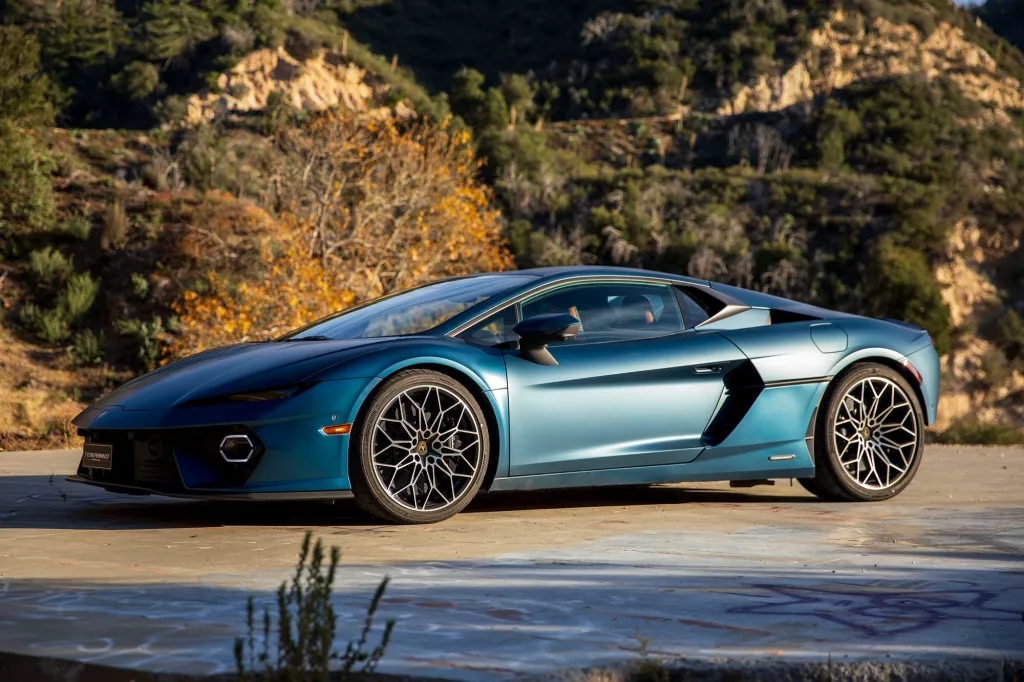

SANT’AGATA BOLOGNESE, Sept. 17, 2026 - Lamborghini’s newest mid-engined super sports car is also one of the clearest explanations of how the company thinks about its business.
The Temerario is a 920 CV plug-in hybrid with a newly developed 4.0-litre twin-turbo V8, three electric motors, all-wheel drive and an engine capable of reaching 10,000 rpm. It accelerates from 0 to 100 km/h in 2.7 seconds and has an official top speed of 343 km/h.
Those numbers explain the engineering. They do not fully explain why buyers wait for the car, personalize it heavily and pay far beyond the cost of basic transportation.
In a May 2026 interview, Lamborghini Chairman and CEO Stephan Winkelmann summarized the company’s position in a few words: Lamborghini is selling dreams, not mobility.
That distinction is central to understanding the Temerario.
A Lamborghini is not optimized to move a person from one place to another at the lowest possible cost. Its economic value is built around emotion, scarcity, identity, performance, craftsmanship and the experience of owning something deliberately unnecessary.
The Temerario takes that philosophy into a new era.
The quote is really a business model
“Selling a dream” can sound like marketing language. Lamborghini’s financial results show that it is also a measurable commercial strategy.
The company delivered 10,747 vehicles globally in 2025, its highest annual total. Revenue reached €3.20 billion. Operating income was €768 million. Return on sales was 24%.
Those are strong economics for a manufacturer producing only around ten thousand vehicles a year.
The logic is not maximum volume. It is value per vehicle.
Lamborghini does not need to compete for mass-market share because its customer is not buying primarily for transport utility. The product is intentionally scarce, ownership is heavily personalized and supply is managed so that demand usually exceeds immediate availability.
That is what “dream, not mobility” means financially.
Temerario is the newest expression of that strategy
The Temerario sits at the center of Lamborghini’s transition from combustion-only super sports cars to a fully hybridized regular model range.
Its combustion engine is a 3,995.2 cc flat-plane-crank V8 with two turbochargers. It produces 800 CV between 9,000 and 9,750 rpm and 730 Nm between 4,000 and 7,000 rpm.
Three electric motors lift combined output to 920 CV.
One motor sits between the engine and gearbox, while two motors power the front axle.
The result is not merely more peak power. The hybrid system fills torque gaps, enables all-wheel drive and supports active torque distribution.
Electricity is being used as performance hardware.
Why 10,000 rpm matters
The most unusual technical feature is the engine speed.
Lamborghini says the Temerario is the first production super sports car engine capable of reaching 10,000 rpm.
That number matters because turbocharged engines often gain torque while losing some of the high-revving character associated with naturally aspirated performance engines.
Lamborghini therefore had to replace not only an engine architecture but an emotional experience.
The V8 uses a flat-plane crankshaft and motorsport-derived design principles to maintain response and rev capability despite turbocharging.
If Lamborghini were only selling mobility, 10,000 rpm would be difficult to justify.
If it is selling emotion, the engineering makes sense.
Hybridization is being used to add, not subtract
The battery and electric motors add complexity and mass, but they also add immediate torque, front-axle torque vectoring and stronger traction.
The motor positioned between the engine and gearbox fills interruptions during gear changes.
The two front motors can distribute torque across the front axle.
The architecture is therefore designed around vehicle response rather than electric range alone.
That matters because the company’s customers historically value the engine as part of the emotional identity of the car.
Lamborghini is trying to lower emissions without making the driving experience feel secondary.
Why Lamborghini is not rushing into a fully electric core supercar
Winkelmann’s “dreams, not mobility” statement came in the context of electrification.
He said the company had examined customer demand, regulation and the acceptance curve for fully electric super sports cars and concluded that the market was not yet ready for one of its core cars to become fully electric.
That does not mean Lamborghini is avoiding electrification.
Its regular line-up is now hybridized.
The strategic question is how far electrification can go before the customer experience changes too much.
For a mass-market vehicle, efficiency and operating cost may dominate the purchase decision.
For a super sports car, sound, mechanical response, design, drama and occasion matter more.
The chassis had to be redesigned around the new system
The Temerario is not an old structure with a hybrid system inserted into it.
Lamborghini created a new aluminum spaceframe to package the V8, battery, electric motors and updated dynamic systems.
The company says structural component count was reduced by 50% and heat-weld length by around 80% compared with the previous architecture.
Torsional stiffness increased by more than 20%, with some company material citing roughly 25% depending on the comparison.
A stiffer chassis gives the suspension and steering a more stable platform and helps manage the higher loads created by the hybrid system.
The objective is to hide complexity from the driver.
The business is increasingly built around personalization
The dream business does not stop at the base car.
Lamborghini’s Ad Personam program allows customers to choose custom colours, materials, stitching and trim.
In 2025, the company said 94% of delivered cars were personalized in at least one element.
That is financially important.
Personalization increases average revenue per vehicle without requiring a proportional increase in production volume.
It also increases emotional attachment because customers are not simply buying a model. They are building a specific version of it.
The Temerario has already become a platform for this strategy, including bespoke Ad Personam configurations and the 2026 Tricolore interpretation.
Lamborghini’s growth model is intentionally constrained
Most manufacturers celebrate higher unit volume.
Lamborghini is more cautious.
The company has repeatedly emphasized sustainable growth rather than maximum production.
Global deliveries reached a record 10,747 cars in 2025.
EMEA accounted for 4,650, the Americas 3,347 and Asia Pacific 2,750.
That geographic balance reduces dependence on one region while maintaining scarcity.
The business depends on being available, but not commonplace.
India is small in volume but strategically important
India shows the difference between present scale and future strategic value.
Lamborghini delivered 111 vehicles in India in 2025, compared with 113 in 2024.
For a mass-market automaker, that number would be irrelevant.
For Lamborghini, the relevant variables are wealth creation, entrepreneurship, infrastructure and the population able to buy highly discretionary luxury products.
Francesco Scardaoni, Lamborghini’s Asia Pacific region director, has described India as a strategic market and has pointed to the country’s growth and expanding wealth base.
The company continues to evaluate dealer expansion cautiously rather than adding outlets ahead of demand.
That is consistent with the global model: grow access without weakening exclusivity.
Temerario is already part of the revenue story
Customer deliveries of the Temerario began in the first quarter of 2026.
In the first half of 2026, Lamborghini reported revenue of €1.74 billion, up 7.4% year on year, even though deliveries declined 4.6% to 5,422.
Operating profit was €395 million and return on sales was 22.7%.
That is an important signal.
Revenue can rise while deliveries fall if pricing, customization and product mix improve.
That is precisely the type of economics a luxury manufacturer wants.
The company also reported an overall order book representing roughly one year of waiting time.
The queue is not merely an operational problem.
It is part of the exclusivity model.
Temerario demand was strong before full deliveries began
By the third quarter of 2025, Lamborghini said the Temerario order bank was equivalent to roughly one year of production.
That happened before the model reached full customer-delivery scale.
A new powertrain architecture always creates risk.
Customers could have rejected the move to a twin-turbo hybrid V8.
The early order bank suggested they did not.
The technology changed, but the promise remained recognizable: spectacle, sound, extreme design and exclusivity.
Software now shapes the emotional experience
The Temerario uses the second generation of Lamborghini Integrated Vehicle Dynamics.
This coordinates chassis systems, hybrid powertrain, torque distribution and braking.
Modern performance cars increasingly rely on software to make extreme hardware usable.
Nine hundred and twenty horsepower is not valuable if the driver cannot deploy it effectively.
The paradox is that the most analogue-feeling experience increasingly depends on digital control underneath.
The driver feels immediacy.
Software manages the complexity.
Drift Mode shows how performance is becoming software-defined
The Temerario introduces a dedicated Drift Mode with multiple levels.
The same electric motors used for stability and traction can be managed to allow controlled oversteer.
That means the car’s character can change through software and torque control.
Future performance differentiation may depend less on simply adding horsepower and more on how precisely software controls behavior.
Lamborghini is behaving more like a luxury company than a transport company
The company’s economics increasingly resemble luxury rather than conventional mobility.
Its 24% return on sales in 2025 and 22.7% in the first half of 2026 are supported by scarcity, personalization, brand power and product mix.
Mobility is usually optimized around efficiency, cost, reliability and scale.
Luxury is optimized around desirability, identity, exclusivity and emotional value.
The Temerario obviously has to function as a car.
But its business value is created by everything beyond basic transportation.
The biggest risk is losing emotion during technology change
Lamborghini’s hybrid strategy is working commercially so far.
The harder test comes later.
Regulations will continue changing. Battery technology will improve. Electric performance will increase. Customer expectations will shift.
At some point, Lamborghini may decide a fully electric super sports car can provide enough emotion to carry the badge.
The risk is not that electric motors are too slow.
The risk is that speed alone is not what customers are buying.
A car can be objectively faster while feeling less special.
That is why Lamborghini is moving cautiously.
Scarcity also has to remain credible
The second strategic risk is overexpansion.
Luxury brands can weaken if rapid production growth makes the product too common.
Lamborghini crossed 10,000 annual deliveries again in 2025.
The company now has to increase revenue while protecting the scarcity that helped create its pricing power.
Personalization is one answer.
Higher-value variants are another.
Disciplined allocation is a third.
The Temerario therefore has to succeed without becoming ordinary.
The strict conclusion
The Lamborghini Temerario is easy to understand as a machine.
It has a 4.0-litre twin-turbo V8.
Three electric motors.
920 CV.
A 10,000-rpm engine.
0 to 100 km/h in 2.7 seconds.
A 343 km/h top speed.
But those numbers are only half the product.
The other half is the business model behind them.
Lamborghini sold 10,747 cars in 2025 and generated €3.20 billion of revenue with a 24% return on sales.
Ninety-four percent of those vehicles included at least one personalized element.
In the first half of 2026, revenue rose even while deliveries fell.
That is what a dream business looks like financially.
The company is not trying to solve transportation.
It is trying to preserve desire while the technology underneath the car changes completely.
The Temerario is the test.
If customers accept a turbocharged hybrid V8 with the same emotional intensity they gave the previous generation, Lamborghini will have proved that its core asset was never one particular engine.
It was the feeling customers believed the engine represented.
Reader questions
Frequently asked questions
Who said Lamborghini is selling a dream, not mobility?
The statement was made by Automobili Lamborghini Chairman and CEO Stephan Winkelmann in a May 2026 interview. It should not be attributed to Asia Pacific regional director Francesco Scardaoni.
What is the Lamborghini Temerario?
The Temerario is Lamborghini’s newest mid-engined High Performance Electrified Vehicle, combining a 4.0-litre twin-turbo V8 with three electric motors and all-wheel drive.
How much power does the Lamborghini Temerario produce?
The combined hybrid system produces 920 CV. The combustion engine alone produces 800 CV between 9,000 and 9,750 rpm.
How fast is the Lamborghini Temerario?
Lamborghini lists 0-100 km/h acceleration at 2.7 seconds and an official top speed of 343 km/h.
Why does the Temerario use a hybrid system?
The hybrid system adds immediate electric torque, front-axle torque vectoring, all-wheel drive and torque filling during gear changes while retaining a high-revving combustion engine.
How many cars did Lamborghini deliver in 2025?
Lamborghini delivered 10,747 vehicles worldwide in 2025, an all-time company record.
Why is personalization important to Lamborghini?
In 2025, 94% of delivered cars were personalized in at least one element, increasing customer attachment and revenue per vehicle without requiring mass-market production volumes.
Nexuswild welcomes factual corrections. Email [email protected] with evidence and the article URL.