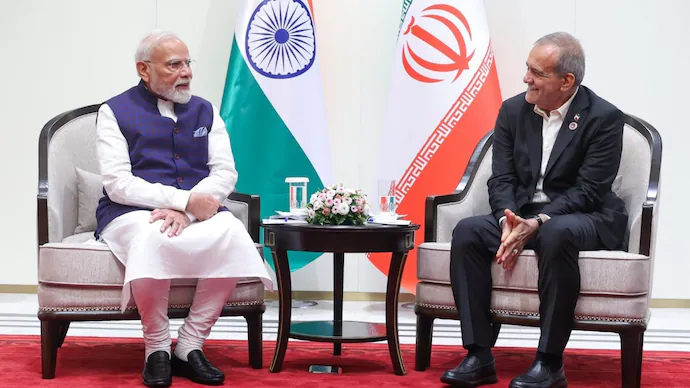

BISHKEK — Prime Minister Narendra Modi met Iranian President Masoud Pezeshkian on Monday on the sidelines of the 26th Shanghai Cooperation Organisation Summit in Bishkek, Kyrgyzstan, marking their first in-person meeting in two years, according to ANI and India's Ministry of External Affairs.
Writing on X after the meeting, Modi said: "Met President Masoud Pezeshkian in Bishkek. Reiterated our commitment to strengthening India's long-standing friendship with Iran across diverse sectors. We want to expand and diversify our trade basket in the times to come. We had a discussion on the prevailing situation in the region. India will continue to support all efforts aimed at ensuring lasting peace."
MEA spokesperson Randhir Jaiswal said the two leaders discussed various aspects of bilateral relations and reviewed recent developments in West Asia. "Prime Minister reiterated India's consistent position that all issues must be resolved through dialogue and diplomacy," Jaiswal said, adding that Modi "underlined the need for continued efforts to ensure peace and stability in the region, and for safeguarding freedom of navigation and commerce," according to The Tribune's report on the readout.
Neither the MEA statement nor Modi's own remarks referenced a specific new trade agreement, investment figure, or target for the bilateral trade basket; the readouts describe an intention to expand and diversify trade rather than any concluded deal. The two leaders also did not, according to available official statements, confirm discussion of Chabahar Port, oil imports, sanctions relief or the specific status of the Strait of Hormuz. Some pre-meeting commentary had speculated these could come up given their relevance to India-Iran ties, but that speculation should not be read as confirmation of what was actually discussed.
Continuing a Conversation That Predates Bishkek
Monday's meeting was not the first contact between the two leaders this year. Modi and Pezeshkian spoke by phone on March 21, when Modi conveyed Eid and Nowruz greetings and, according to India's state broadcaster, condemned attacks on critical infrastructure in the region and reiterated the importance of safeguarding freedom of navigation and secure shipping lanes. The two leaders discussed the West Asia security situation in detail during that call, ANI reported.
The leaders spoke again more recently by phone, a conversation in which Pezeshkian briefed Modi on developments in West Asia and the way forward; Modi welcomed what ANI described as "the understanding reached to end the conflict" and reiterated the need for continued efforts toward lasting peace and stability. Iran's own position on the broader conflict, as conveyed to Modi in these exchanges, has centered on briefing India on developments and the path toward de-escalation, based on the available Indian readouts; a fuller, independently sourced statement of Iran's position was not available at the time of writing.
Why Shipping and Regional Stability Matter to India
India has repeatedly framed regional stability in West Asia as tied to its own economic and human interests: the region is a major source of energy imports, a transit corridor for Indian trade, and home to a large Indian expatriate and seafaring population. That framing was consistent in Monday's meeting, with Modi's emphasis on "freedom of navigation and commerce" echoing language he has used in prior calls with regional leaders this year. India has not indicated it is playing a formal mediating role in the conflict; its public statements consistently describe support for dialogue and diplomacy conducted by the parties involved, rather than an Indian mediation effort.
Iran's broader significance to India extends beyond bilateral trade. It offers India a geographic link toward Afghanistan and Central Asia, a strategic interest connected to projects such as Chabahar Port, though Monday's official readouts did not specify Chabahar as a topic of this particular conversation.
The Wider Summit
The Bishkek meeting came during a busy day of diplomacy for Modi at the SCO summit, where he also held bilateral talks with Armenian Prime Minister Nikol Pashinyan on strengthening cooperation in defence, economic ties, pharmaceuticals, science and technology, and education, according to The Tribune. Modi is also attending the opening ceremony of the 6th World Nomad Games during his visit to Kyrgyzstan.
For India-Iran relations, the substance of Monday's meeting was less about any single announcement and more about signaling continuity: a reaffirmation of a decades-long relationship, an expressed intent to grow trade over time, and a repeated call for the West Asia conflict to be resolved through dialogue rather than escalation. Given the absence of a new agreement or specific commitments in the official record, the meeting is best understood as a diplomatic reset after two years without an in-person engagement between the two leaders, rather than a turning point in the bilateral relationship itself.
Further reading and useful links
Reader questions
Frequently asked questions
What was the significance of the meeting between PM Modi and President Pezeshkian in Bishkek?
It marked the first in-person meeting between the Indian Prime Minister and the Iranian President in two years, signaling diplomatic continuity, mutual intent to diversify bilateral trade, and support for de-escalation in West Asia.
Were any specific trade deals or Chabahar Port agreements announced?
No. Official statements and readouts from the MEA and PM Modi did not confirm any specific trade targets, investment agreements, or discussions regarding Chabahar Port or oil imports.
What is India's position on the ongoing conflict in West Asia?
India maintains that all regional issues should be resolved through dialogue and diplomacy, emphasizing the need for peace, stability, and the safeguarding of freedom of navigation and commercial shipping lanes.
Nexuswild welcomes factual corrections. Email contact@nexuswild.com with evidence and the article URL.