
Scientists from NASA and the University of California, Los Angeles (UCLA) have identified compelling evidence of an ancient water reservoir in the Kuiper Belt, the distant region of the Solar System extending beyond Neptune. The discovery comes from the analysis of just 12 microscopic interplanetary dust particles collected high above Earth, demonstrating how extremely small extraterrestrial materials can preserve chemical information about planetary formation billions of years ago.
The research, announced by NASA on November 18, 2026, examines the mineral structures and oxygen-isotope compositions of particles recovered from Earth's stratosphere. Researchers traced the particles' likely origins to the distant outer Solar System using microscopic tracks left by energetic particles emitted by the Sun.
The investigation identified minerals that had formed when water interacted with rocky dust during the early history of the Solar System. Their chemical signatures indicate that the ancient water was strongly depleted in oxygen-16 and relatively enriched in heavier oxygen isotopes.
The findings provide evidence that water in the early Solar System was not distributed or mixed uniformly. They also offer new information about how the formation of giant planets may have influenced the movement of water-rich material between the inner and outer planetary regions.
The study was published in the scientific journal Science Advances. Its significance lies not simply in identifying water-related minerals, but in recovering a distinctive chemical record that points towards a distant reservoir whose existence scientists had previously suspected but had struggled to establish directly.
How researchers traced the particles to the Kuiper Belt
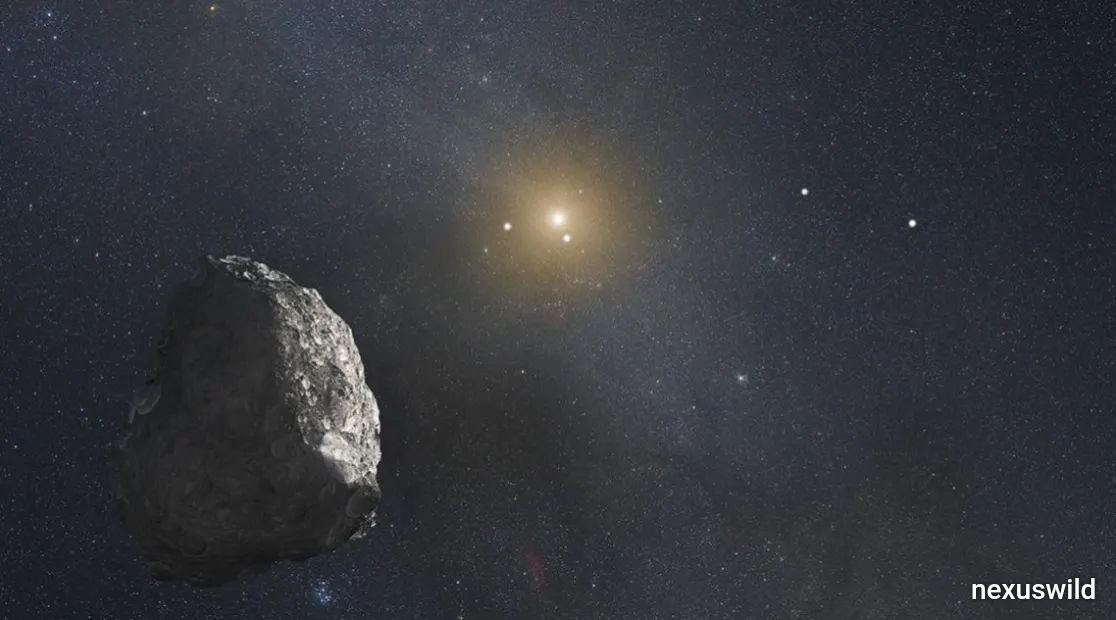
The Kuiper Belt is a broad region beyond Neptune containing icy bodies, dwarf planets, and smaller remnants left over from the formation of the Solar System. Objects in this region preserve material from the system's early history, making the Kuiper Belt an important destination for planetary scientists studying how planets and smaller bodies developed.
Obtaining physical samples from such distant objects is technically demanding. The NASA–UCLA research used a different route: instead of collecting material directly from a Kuiper Belt object, scientists examined microscopic interplanetary dust particles that had entered Earth's atmosphere.
The 12 particles were collected from the stratosphere by NASA's ER-2 high-altitude research aircraft. Their small size made them difficult to analyse, but they retained microscopic evidence of their exposure to energetic particles during their journey through space.
Solar energetic particles are high-energy particles associated with activity on the Sun. When these particles interact with solid materials, they can leave microscopic damage tracks. The density of these tracks can provide clues about how long a grain was exposed to the space environment.
In this investigation, the unusually high concentrations of solar energetic-particle tracks helped the researchers infer that the grains had spent a prolonged period exposed to the space environment and were consistent with an origin in the distant Kuiper Belt.
This distinction is important. The team did not retrieve a rock or ice sample from a named Kuiper Belt object. Instead, it used the particles' physical characteristics and chemical composition to establish a likely outer-Solar-System origin.
The method illustrates how naturally transported cosmic dust can become a scientific archive. Tiny particles that eventually reach Earth's upper atmosphere can carry information about environments that are otherwise extremely difficult to investigate.
Two laboratories, complementary scientific techniques
The investigation required specialised capabilities at NASA's Johnson Space Center in Houston and UCLA.
At NASA's Johnson Space Center, researchers Lindsay Keller and Christopher Snead examined the particles' mineral structures and chemical compositions. Advanced electron microscopy enabled the team to investigate the microscopic materials and identify evidence of alteration through interaction with water.
The work then moved to UCLA, where researchers used a highly sensitive ion microprobe to measure the oxygen isotopes preserved in the particles. The instrument used for the analysis was a CAMECA ims-1290.
The measurements were important because oxygen has three stable isotopes: oxygen-16, oxygen-17, and oxygen-18. These isotopes have different numbers of neutrons, and their relative abundances can preserve clues about where materials originated and how they changed over time.
The relative proportions of oxygen isotopes in planetary materials are not identical throughout the Solar System. Scientists use these differences to investigate the history of dust, water, meteorites, asteroids, and other materials.
Ming-Chang Liu, a researcher in UCLA's Department of Earth, Planetary, and Space Sciences, led the oxygen-isotope measurements, working with UCLA Research Professor Kevin McKeegan and NASA scientists Keller and Snead.
The collaboration brought together the ability to collect and examine extraterrestrial dust with the specialised laboratory techniques required to measure extremely small isotopic variations.
The resulting analysis allowed researchers to investigate not only what minerals were present, but also the chemical character of the water that had interacted with the original material.
Why oxygen isotopes matter
Oxygen-isotope analysis is a powerful tool in planetary science because the relative abundance of oxygen-16, oxygen-17, and oxygen-18 can reveal information about a material's history.
Oxygen-16 is the most abundant of the three stable isotopes. A sample with a relatively lower proportion of oxygen-16 compared with oxygen-17 and oxygen-18 can therefore have a distinctive isotopic signature.
The NASA–UCLA team found that the water responsible for altering the particles' original minerals was strongly depleted in oxygen-16. In other words, the ancient water was relatively enriched in the heavier oxygen isotopes.
This result is significant because scientists have long predicted that water in parts of the early outer Solar System should have an isotopic composition different from that of many rocky materials found closer to the Sun.
Earlier investigations of meteorites and samples returned from carbon-rich asteroids had provided clues about such water, but the evidence had remained limited. The new measurements provide additional evidence associated with particles whose origins are consistent with the Kuiper Belt.
Researchers compared the findings with established oxygen-isotope measurements, including reference data from NASA's Genesis mission. Genesis collected solar-wind particles to help scientists understand the Sun's isotopic composition and establish a reference for studying the origins of Solar System materials.
The comparison helps place the dust-particle measurements within a broader framework of Solar System chemistry.
The researchers did not simply detect water molecules preserved as liquid or ice inside the grains. Instead, they identified secondary minerals formed through earlier water–rock interactions and used the mineral and isotope evidence to infer the composition of the water involved.
That distinction matters when interpreting the discovery. The particles preserve chemical evidence of ancient water, rather than functioning as intact containers of a frozen reservoir.
What the findings reveal about the early Solar System
One of the most important implications of the study concerns how material moved through the young Solar System.
The early Solar System was a dynamic environment containing gas, dust, ice, and growing planetary bodies. Material was transported, heated, altered, and incorporated into objects as the planets formed.
Scientists have been investigating whether water and other volatile materials were distributed evenly across this environment or whether different regions retained distinct chemical characteristics.
The new isotope measurements support the view that the inner and outer Solar System preserved differences in their water reservoirs.
The researchers noted that the distinctive isotopic signature found in the particles is largely absent from meteorites originating closer to the Sun. This scarcity suggests that material from the distant reservoir did not mix freely with the inner Solar System.
The formation and growth of giant planets may help explain that separation.
As large planets developed, their gravity and influence on surrounding material could have changed the paths of dust, ice, and other small bodies. Their formation may have restricted the inward movement of water-rich material from the outer regions.
The research discusses the possible role of Saturn and potentially Uranus and Neptune in limiting the transport of material. The broader comparison also considers the influence of giant-planet formation on the movement of material across the planetary system.
The findings should not be interpreted as proof that Jupiter and Saturn formed a permanent or completely impermeable barrier. Planetary migration, gravitational interactions, and the movement of smaller bodies are complex processes. The study provides evidence consistent with restricted mixing, rather than a complete reconstruction of every transport pathway.
Nevertheless, the isotope signature offers a valuable constraint for scientists developing models of how the Solar System evolved.
Why the Kuiper Belt matters to planetary science
The Kuiper Belt is more than a distant collection of icy objects. It contains remnants of the material from which the outer Solar System developed.
Because many objects in the region have experienced different thermal and geological histories from planets closer to the Sun, they can preserve information about the conditions that existed during early planetary formation.
Studying these materials can help researchers investigate the distribution of water and other volatile compounds, the evolution of small bodies, and the processes that shaped the giant planets and their surrounding environments.
The new findings add an isotopic dimension to that research.
A chemical signature preserved in a microscopic particle can help scientists distinguish between materials that formed or were altered in different parts of the Solar System. That makes isotope analysis useful not only for identifying a possible origin, but also for testing models of planetary evolution.
The research could also inform future investigations of icy bodies and the outer planetary system. Scientists studying the origins of water on planets and moons need to understand how water was distributed before and during the formation of those bodies.
However, the findings do not establish the current quantity of water in the Kuiper Belt, identify a particular icy object as the source of the particles, or demonstrate that the same water reservoir directly supplied Earth's oceans.
Those questions require additional evidence and different lines of investigation.
The scientific value of stratospheric dust collection
The study also highlights the continuing value of collecting extraterrestrial dust from Earth's upper atmosphere.
NASA's ER-2 aircraft operates at high altitudes and can support the collection of particles from the stratosphere. Such material can include microscopic dust originating beyond Earth, providing researchers with samples that can be examined using laboratory instruments.
This approach does not replace dedicated spacecraft missions or sample-return programmes. A spacecraft can target a particular object, study its environment, and potentially return material with a known geological context.
Stratospheric dust collection offers a different scientific opportunity. It can provide access to naturally delivered particles without requiring a spacecraft to travel to the source region and return a sample.
The challenge is that the origins and histories of individual grains must be established through careful analysis. Researchers need to distinguish extraterrestrial material from terrestrial contamination, identify its mineral structure, and assess whether its physical and chemical properties support a particular origin.
The NASA–UCLA study demonstrates how multiple methods can be combined to address these challenges.
The 12 particles were not valuable because of their size or quantity. Their value came from the information preserved in their tracks, minerals, and isotopic composition.
The result is a reminder that important scientific evidence does not always require large samples. With sufficiently sensitive instruments and a reliable interpretation framework, microscopic materials can provide insights into planetary environments separated from Earth by billions of kilometres.
It would be premature, however, to claim that this approach has been shown to deliver equivalent results at a fraction of the cost of a deep-space sample-return mission. The announcement does not provide a quantified cost comparison or establish that atmospheric dust collection can replace targeted exploration.
What the discovery does not establish
The findings are important, but their scope should be understood carefully.
First, the research does not represent a direct sample-return mission from the Kuiper Belt. The particles were collected in Earth's stratosphere, and their distant origin was inferred from their energetic-particle tracks and other evidence.
Second, the team examined 12 particles. The results are scientifically significant, but they should not be treated as a complete survey of the Kuiper Belt or every water-bearing region in the early Solar System.
Third, the isotope signature does not establish the present-day distribution or volume of water ice in the Kuiper Belt. It provides evidence about ancient water that interacted with the particles' original minerals.
Fourth, the proposed role of giant planets in limiting material mixing remains an interpretation supported by the chemical evidence. It does not prove that planetary migration and gravitational interactions followed one simple pathway.
Finally, the discovery does not directly explain the origin of Earth's oceans. Understanding the sources of terrestrial water requires comparing multiple reservoirs and tracing the movement of materials through the early Solar System.
These qualifications do not diminish the result. They define what the measurements can reliably tell scientists and where further research is needed.
What comes next for outer-Solar-System research
The discovery creates opportunities for additional work on the chemical history of extraterrestrial dust.
Researchers can continue examining stratospheric particles to determine whether similar isotopic signatures appear in other grains. Larger datasets could help establish how representative the measured particles are and whether different populations preserve distinct histories.
Further comparisons with meteorites, carbon-rich asteroid samples, and material studied by planetary missions could help refine models of water distribution.
The results may also inform the scientific questions considered by future missions to icy bodies and the outer planets. Understanding how water and other volatile materials were distributed during planetary formation is relevant to the study of dwarf planets, icy moons, comets, and other small bodies.
The research does not announce a new mission or identify a specific spacecraft target. Its contribution is more fundamental: it provides an additional chemical constraint that future observations and models can test.
A new chemical clue to the Solar System's earliest history
The NASA–UCLA discovery shows how a dozen microscopic dust particles can reveal evidence of an ancient water reservoir far beyond Neptune.
By combining particle collection, electron microscopy, mineral analysis, and high-precision oxygen-isotope measurements, the researchers identified a chemical signature consistent with water from the early outer Solar System.
The findings support the idea that the Solar System developed with distinct water reservoirs and that the formation of giant planets may have restricted the mixing of material between its inner and outer regions.
The research does not replace direct exploration of the Kuiper Belt, nor does it settle every question about the origin and movement of water. It provides something equally important for planetary science: a measurable piece of evidence that helps researchers test how the Solar System formed.
As scientists continue to investigate the chemical records preserved in meteorites, dust particles, asteroids, and icy bodies, discoveries like this will help build a more detailed picture of the environment from which the planets emerged.
Nexuswild welcomes factual corrections. Email contact@nexuswild.com with evidence and the article URL.