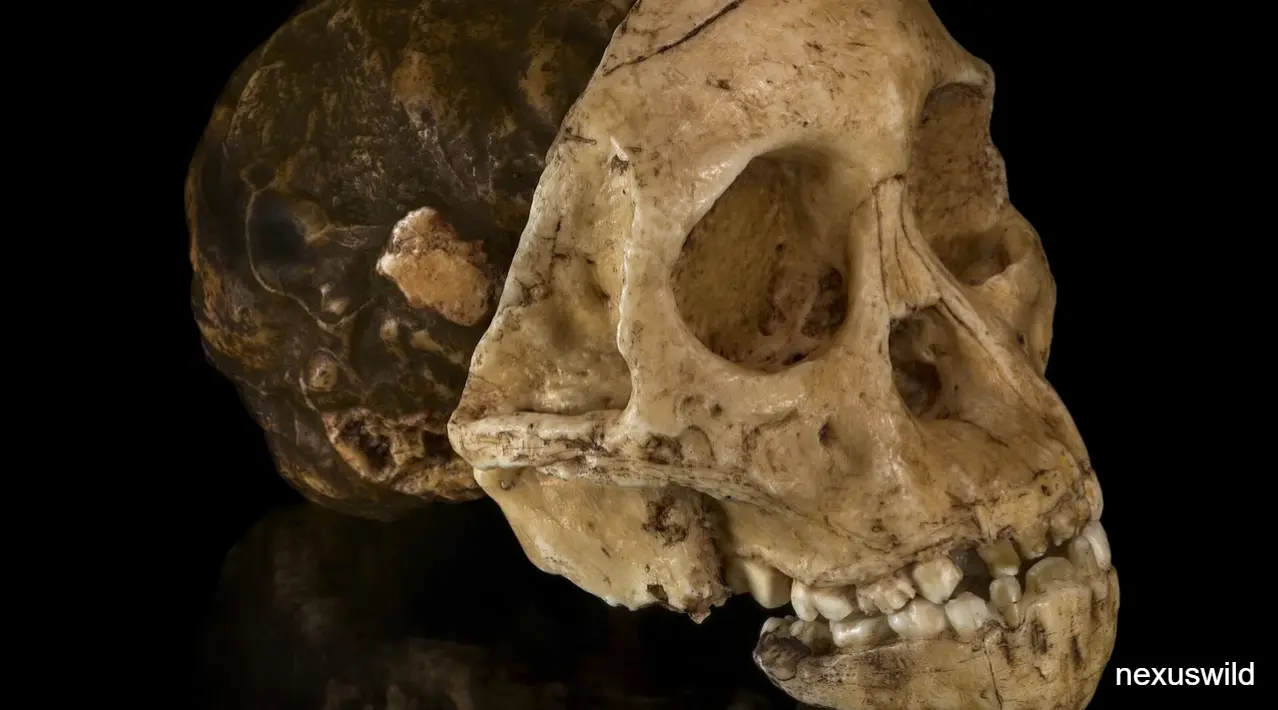

The Taung Child, one of the most famous fossils in human evolution, has been given a new minimum age and a more complicated scientific role. A study published in npj Palaeoecosystems reports that the South African skull is at least 2.96 million years old, older than many earlier estimates. By comparing tooth and brain growth with living apes and other fossils, the researchers argue that several adults long filed alongside it probably belong to different species.
The paper does not name a new species or announce a spectacular new fossil. Its claim is subtler and potentially more consequential: the Taung Child may be the only specimen that can be securely assigned to Australopithecus africanus. If that is right, the species defined by the child is far less certain than textbooks have suggested, and the southern African hominin record looks more like a branching bush than a tidy ladder.
The findings have been reported in some headlines as a rewrite of the human family tree. That is directionally fair, but it needs qualification. The study proposes an interpretation; it does not settle the classification of every fossil, and its climate and hybridisation narrative remains untested. The strongest part of the work is the combination of new dating and detailed growth comparisons.
Why the Taung Child still matters
The Taung Child was found in 1924 at the Buxton Limeworks quarry in Taung, in South Africa's North West province. The fossil consists of a juvenile skull and a natural endocast, a cast of the braincase formed by sediment. It was described by Raymond Dart in 1925 as the type specimen of Australopithecus africanus, the species that helped establish Africa as the cradle of human evolution.
The exact spot within the quarry was lost during mining, which limits what can be said about the fossil's geological context. That is one reason its age has been debated. Estimates have ranged widely, from less than a million years to just over three million. The new study does not eliminate that problem, but it puts a firmer floor under the age.
The fossil's importance is not just historical. Because it is a child, it shows what an early hominin looked like before adulthood. That makes it uniquely useful for testing whether adult fossils assigned to the same species could plausibly have grown from a child like Taung. The new paper uses that logic in reverse. If certain adults could not have developed from a Taung-like juvenile, perhaps they were never members of the same species.
A new minimum age for a century-old fossil
The study reports a new minimum age of 2.962 million years, with an uncertainty of plus or minus 0.059 million years. That number comes from uranium-lead dating of a flowstone layer above the fossil-bearing deposit. A flowstone forms after the deposit it covers, so its age gives a minimum rather than a direct age for the fossil itself.
The researchers combined that minimum with an existing palaeomagnetic maximum of about 3.03 million years. That yields a working range of roughly 2.96 to 3.03 million years. The paper is careful about this distinction. It does not claim to have directly dated the child.
Earlier work had suggested much younger ages, including estimates near 942,000 years. Those have now been superseded by the flowstone result. The study also tried to find datable carbonate below the fossil by drilling, but no suitable lower layer was recovered. Without that, there is no radiometric upper bound.
This matters because evolutionary comparisons depend on time. If the Taung Child were substantially younger, it could overlap with later hominins in ways that change the interpretation. Pushing its minimum age close to three million years places it in a different landscape of southern African hominin diversity.
How the dating was done
The team used uranium-lead isochron dating based on the decay of uranium-235 to lead-207. That method was chosen because the alternative uranium-238 to lead-206 system would require a large correction for initial disequilibrium beyond about 1.5 million years. Such a correction would introduce too much uncertainty for this question.
The flowstone sample produced a tight isochron, reported with a mean squared weighted deviation of 0.7. That statistic indicates the measurements fit the expected relationship well. It is one of the reasons the researchers treat the minimum age as robust.
The result is not without assumptions. Uranium uptake in carbonates can be complicated, and the method assumes a particular history for the sample. A specialist commentary notes that the two uranium-lead systems do not fully agree and that the uranium-gain assumption remains untested. The paper acknowledges that no upper radiometric constraint was obtained.
The honest summary is that the child is at least about 2.96 million years old and probably no older than about 3.03 million years. That is a much stronger statement than the old broad range, but it is not the same as a direct date.
Teeth as a growth record
One of the study's main lines of evidence comes from tooth mineralisation. The researchers scored stages of dental development from radiographs and CT scans, then compared those scores across living chimpanzees, gorillas and humans, as well as fossil hominins. The comparative samples included 158 chimpanzees, 50 gorillas and 560 humans, alongside 11 Australopithecus fossils and 16 Paranthropus fossils.
The pattern matters because teeth develop on a fairly reliable schedule. If a fossil child's teeth are at a certain stage, researchers can estimate how much growth remained. Taung's first molar and incisor development suggested a slower post-molar stage than typical apes, hinting at an incipient childhood phase. That supports the idea that Taung may genuinely be a child rather than a juvenile with an adult-like developmental schedule.
The study also examined the dentino-enamel junction of the first molar using three-dimensional geometric morphometrics. This internal boundary preserves shape information even when the outer tooth is worn. The analysis placed Taung at the edge of the Australopithecus cluster, roughly equidistant between a fossil usually assigned to A. africanus and a Paranthropus robustus specimen known as SK 61.
The result is not a clean membership test. The first two principal components captured less than 38% of the variation, and the fossil samples were small. The authors themselves say that no clear picture emerges from the tooth data alone. That caution is important because some coverage has treated the shape analysis as decisive.
Brain shape, not just brain size
The second major line of evidence concerns the shape of the braincase. The researchers reconstructed fossil brains digitally and compared 935 landmarks and semilandmarks on endocasts. They built growth series from 101 chimpanzees and 84 gorillas, then modelled how the Taung Child's brain might have changed into adulthood.
The key finding was that brain shape, rather than simple volume, carries taxonomic information. Under ape-like growth models, Taung could develop into a shape resembling the adult fossils Sts 5, often nicknamed Mrs Ples, or Sts 60. It could not develop into the shapes seen in Sts 71, StW 505 or MLD 37 and MLD 38.
That has direct implications for classification. Those adult fossils have often been grouped with Taung under A. africanus. If they could not have grown from a Taung-like child, then either Taung is not the species's juvenile form or the adults have been misassigned. The paper argues for the second possibility.
The analysis is not infallible. It depends on ape growth models because no complete Australopithecus growth series exists. It also relies on a limited number of adult endocasts, some reconstructed from CT scans. The first two shape axes accounted for about half of the observed variation, leaving a substantial amount unexplained.
Which adults fit, and which do not
The study's most provocative conclusion is that A. africanus is a poorly defined taxon. Because Taung is the type specimen, any fossil assigned to that species should be comparable to it. The growth modelling suggests that several well-known adults are not.
This does not mean those adult fossils are unimportant. It means they may represent other species that lived in the same region and period. The paper points to "little doubt about species diversity at Sterkfontein," the cave site that has produced many of the comparison fossils.
The Taung Child itself sits near the centre of adult shape variation despite being a juvenile. That is unusual and suggests that its species identity is stable even while the broader assignment is not. In other words, the child may be secure while the category built around it is not.
The tooth evidence complicates the picture. Taung's first molar places it near the edge of the A. africanus group and closer than expected to Paranthropus robustus on some measurements. That does not make it a Paranthropus. It shows that early hominin species shared ancestral features and that single traits rarely settle taxonomy.
A tangled family tree, not a ladder
The phrase "chaotic, tangled bush" has been widely quoted from the university press release accompanying the study. The underlying idea is that hominin evolution in southern Africa was not a straight progression from one species to the next. Several lineages may have overlapped, shifted with climate and perhaps interbred.
The paper frames this as an eco-evolutionary range-dynamics model. Hominin populations may have tracked changing habitats, becoming isolated in some periods and reconnecting in others. Drift and occasional hybridisation are proposed as possible mechanisms for the mixture of traits seen in the fossils.
That is a plausible and useful framework, but it is not demonstrated by direct genetic evidence. No hominin DNA or proteins were recovered from these fossils. Hybridisation is described with cautious language in the paper, including the word "probably." Press accounts that state interbreeding as fact go beyond the evidence.
The value of the model is that it gives researchers testable expectations. If southern African hominins were repeatedly fragmented and reconnected by climate, their fossils should show mosaic traits and uneven geographic patterns. That is broadly what the record shows, though the causes remain debated.
Climate, habitat and the range-dynamics idea
The study drew on marine and lake climate records, known eccentricity cycles of roughly 400,000 years and a transient climate model. The aim was to see whether environmental variability could explain why hominin diversity appears to rise and fall.
The idea is that wet and dry periods moved vegetation zones across southern Africa. Forest patches, savanna and wetlands would have expanded and contracted. Hominin populations following those habitats could have been separated by barriers such as the Limpopo region and later come back into contact.
This is where the paper connects the Taung Child to the broader question of how Homo eventually emerged. If several Australopithecus and Paranthropus lineages coexisted and occasionally mixed, the origin of our own genus may have been less like a clean branching event and more like a tangled process.
The climate story remains a hypothesis. The authors describe it as a first glimpse rather than a conclusion. It is an example of how palaeontology increasingly combines fossils with climate modelling, but it should not be presented as settled fact.
What the pollen evidence really says
The paper also examined fossil pollen from two bulk sediment samples associated with the Taung deposits. The samples were small, about 172 grams and 230 grams, and only 30 grains were counted from each. They were not directly dated.
The pollen indicated a mix of freshwater wetland and open savanna, with more woody cover than today's landscape. It included Podocarpus, a conifer now found roughly 400 kilometres east of Taung. That suggests wetter conditions or different biogeographic connections in the past.
Some press coverage described the environment as heavily forested. That is stronger than the paper supports. The authors state that the extent of forest cover is unclear and reconstruct a savanna with relatively more trees, not a dense rainforest. The number of Podocarpus grains was not reported in a way that would justify a dramatic claim.
This is a case where the underlying study is more interesting than the simplified headline. A mixed landscape of wetland, wooded patches and savanna is exactly the kind of environment that could create varied selection pressures and fragmented populations.
What the study does not prove
It does not prove that the Taung Child was a direct ancestor of humans. It does not identify a new species or formally reassign any adult fossil. It does not provide a direct age for the skull, and it does not establish that climate shifts caused speciation.
It also does not resolve a long-standing disagreement. A 2006 facial-growth simulation found that Taung was closer to Sts 71 than to Sts 5, the opposite of the new brain-shape result. The new paper does not fully reconcile that difference. Both studies rely on models, and different anatomical regions can give different answers.
The sample limitations are real. There is no australopith growth series, the living ape samples are used as proxies, and only a handful of adult endocasts were available. The study uses sophisticated statistics, but sophisticated statistics cannot create missing fossils.
None of these caveats makes the work unimportant. They define what has been shown and what remains open. The strongest claim is that the Taung Child's development does not match several adults traditionally assigned to its species. The weakest claim is that climate and hybridisation explain everything.
It is also worth separating the scientific result from the language used to sell it. A fossil can be genuinely important without overturning every textbook sentence at once. The Taung study changes the confidence level of one species assignment and adds weight to a view of hominin evolution that many researchers already suspected. That is a substantial contribution, even if the final family tree remains unfinished.
Future work will likely focus on the fossils that sit uncomfortably close to Taung in the shape analyses. Better CT scans, more complete endocasts and direct dating of associated deposits could test whether those adults form a distinct lineage. Until then, the sensible position is to treat A. africanus as a hypothesis under revision rather than a settled category.
Why the find reshapes future fieldwork
If A. africanus is poorly defined, palaeontologists need better tools for identifying it. That means more complete juvenile and adult specimens, better dating of old sites and renewed attention to geological context. Taung's exact quarry location was lost, which is a reminder that a famous fossil can still have an incomplete provenance.
The study also shows the value of re-examining museum collections with modern imaging. CT scans, digital endocasts and geometric morphometrics can extract new information from fossils that have been studied for a century. Many questions in palaeontology may be answered not by new discoveries alone but by asking sharper questions of existing material.
For South Africa's Cradle of Humankind, the implication is that the record may be more diverse than a single-species label suggests. Sterkfontein, Makapansgat and Taung may represent different populations and lineages whose relationships are still being worked out.
The enduring value of an old fossil
The Taung Child was found by quarry workers and brought to scientific attention by Raymond Dart. It became a symbol of Africa's central place in human origins. A century later, it is still changing the debate.
That is unusual in science. Fossils are often treated as fixed evidence that accumulates dust while theories move on. Taung has instead become more informative as methods improve. Its juvenile status, once a source of uncertainty, is now a tool for testing adult diversity.
The new study does not simplify human evolution. It makes the picture messier, but in a productive way. A tangled family tree is harder to draw, yet it is likely to be more faithful to what actually happened. The Taung Child, at least 2.96 million years old, remains at the centre of that effort.
Nexuswild welcomes factual corrections. Email contact@nexuswild.com with evidence and the article URL.