
For decades, astronomers have struggled to draw a definitive line between the largest planets and the smallest stars. Nature, it seems, loves a gray area. Now, the James Webb Space Telescope has peered into a nearby stellar nursery and found objects that blur this boundary more than ever before.
According to a joint NASA and ESA release on September 15, 2026, astronomers using the world’s most powerful space observatory have identified a cluster of tiny, free-floating objects in a star-forming region known as IC 348. These objects are classified as brown dwarfs, but what makes this specific James Webb Telescope 2026 discovery so extraordinary is their weight.
Researchers have identified brown dwarfs with masses of roughly twice that of Jupiter. Finding objects this small existing on their own, untethered to a host star, challenges our fundamental understanding of how celestial bodies form from the dust and gas of deep space.
What James Webb Discovered
During a deep survey of the IC 348 cluster, the telescope’s sensitive instruments picked up the faint heat signatures of several isolated objects drifting through the cosmic dust. After analyzing the light from these bodies, scientists realized they were looking at a handful of brown dwarfs that are shockingly small.
While brown dwarfs have been observed for years, they typically range from 13 to 80 times the mass of Jupiter. The objects detailed in this latest space discovery 2026 sit at the extreme bottom of that scale - just about two Jupiter masses. Because they are not orbiting a star, they cannot easily be classified as exoplanets in the traditional sense, forcing researchers to rethink the lower limits of mass required for an object to form on its own.
Where the Discovery Happened
This James Webb Space Telescope discovery took place within IC 348, a young star cluster located in the constellation Perseus. Sitting approximately 1,000 light-years away from Earth, this region is a bustling cosmic nursery.
The cluster is only about five million years old, which is a blink of an eye in cosmic terms. This youth is precisely why astronomers targeted it. When brown dwarfs form, they generate a small amount of heat from their own gravitational contraction. Because they lack the mass to sustain nuclear fusion, they gradually cool and fade over billions of years. By looking at a cluster only five million years old, researchers were able to catch these Jupiter-mass brown dwarfs while they were still glowing warmly, making them visible to Webb’s specialized cameras.
What Are Brown Dwarfs?
To understand the significance of this brown dwarf discovery, it helps to understand what these strange objects actually are.
Often referred to colloquially as "failed stars," brown dwarfs form the same way stars do: a dense knot of gas and dust in a molecular cloud collapses under its own gravity. However, a brown dwarf simply doesn't gather enough mass for its core to become hot and dense enough to ignite the sustained nuclear fusion of ordinary hydrogen, which is the process that powers our Sun.
Yet, they are not quite planets, either. Unlike planets, which form from the leftover disks of material swirling around a newborn star, true brown dwarfs form independently in space. They inhabit a strange middle ground - too massive to be typical planets, but too small to shine like stars.
Why Objects This Small Matter
The physics of star formation dictates that a cloud of gas can only collapse under its own gravity if it has a certain amount of mass. As the mass gets smaller, the cloud’s internal pressure pushes back, resisting collapse.
For years, astrophysicists have debated the absolute lower mass limit for this star-like formation process. Can a cloud fragment small enough to create a two-Jupiter-mass object successfully collapse, or would it be ripped apart by the gravitational forces of larger, neighboring stars? Finding these tiny brown dwarfs IC 348 proves that nature finds a way to form objects much smaller than standard theories of gravitational collapse comfortably allow.
How Webb Made the Discovery
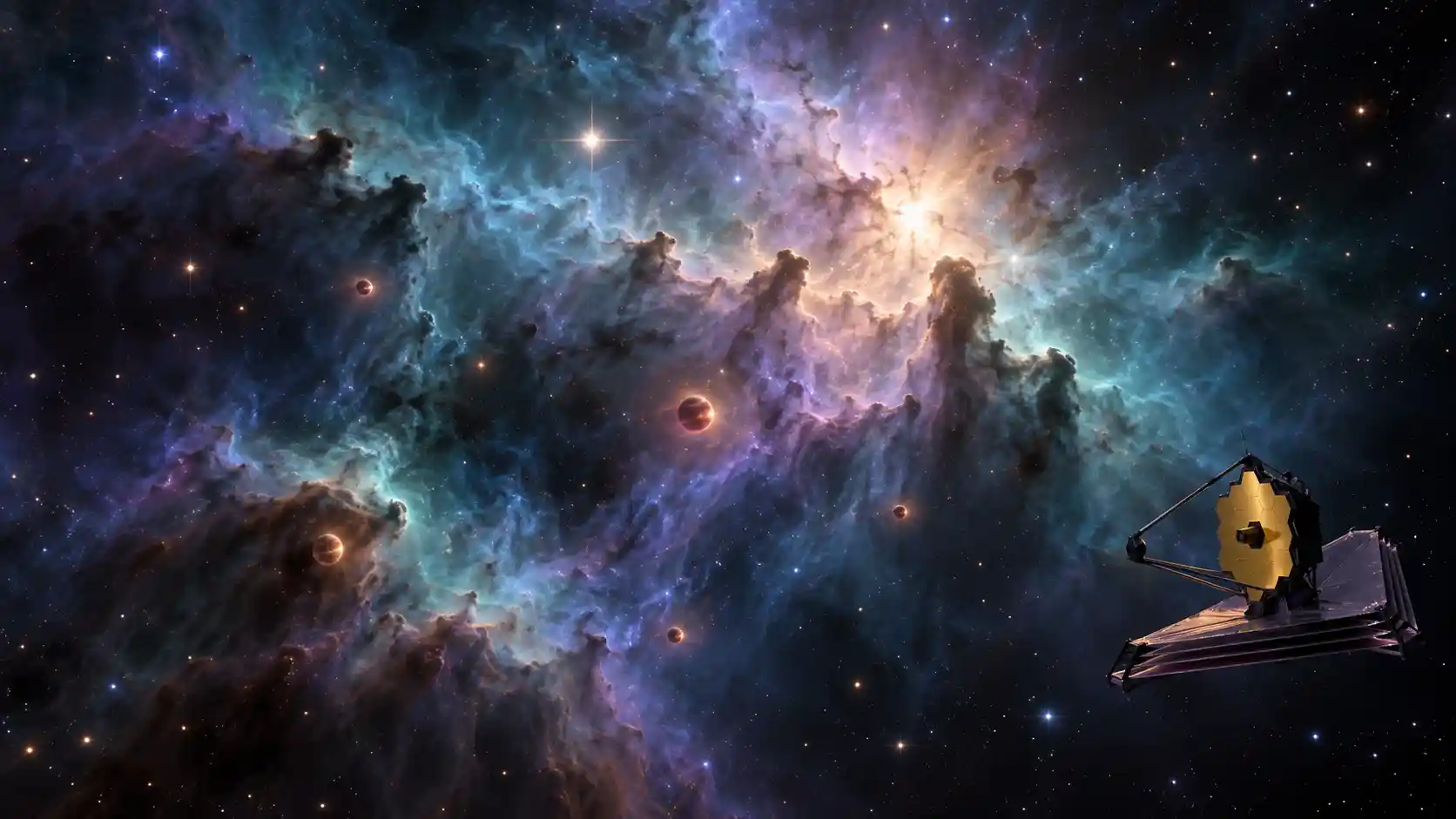
Spotting objects this small and dim is a nearly impossible task for visible-light telescopes like Hubble. This is where James Webb astronomy excels. Because brown dwarfs emit almost all of their energy as infrared heat, Webb is uniquely equipped to find them.
The research team relied on two primary instruments. First, the Near-Infrared Camera (NIRCam) was used to survey the IC 348 cluster, picking out the faint, red dots against the background of glowing nebular gas.
Once the candidates were identified, the team used the Near-Infrared Spectrograph (NIRSpec). By splitting the light from these objects into a spectrum, NIRSpec allowed researchers to read their chemical fingerprints. The spectra revealed a specific, unknown atmospheric profile that confirmed these objects had the cool temperatures and low masses characteristic of borderline substellar bodies, cementing their status as Jupiter-mass brown dwarfs.
What It Reveals About Star Formation
This NASA Webb discovery 2026 throws a fascinating wrench into the mechanics of star formation research. If objects this small can form through the direct collapse of a gas cloud, it suggests that the mechanisms creating stars are far more efficient and capable of scaling down than previously thought.
Alternatively, if these objects formed like planets within a disk around a larger star and were somehow violently ejected into space, it would mean that young star clusters are highly chaotic environments, routinely flinging giant planets out into the dark. However, given their specific chemical signatures and the dynamics of the cluster, researchers currently lean toward the idea that these are indeed true, independently formed brown dwarfs.
What Scientists Still Don’t Know
While the observations are clear, the interpretations open up new mysteries. Scientists still do not know exactly how many of these ultra-low-mass brown dwarfs exist. Are they rare anomalies, or is the Milky Way teeming with them?
Furthermore, the exact boundary where a brown dwarf ends and a rogue planet begins remains blurry. Webb has given researchers the data they need to study the atmospheres of these objects, but distinguishing a star-like collapse from a planet-like ejection requires even more comprehensive surveys of different star-forming regions.
Researcher and NASA/ESA Views
The official releases surrounding this discovery highlight the shock and excitement within the astronomical community. Researchers noted that finding objects with masses just twice that of Jupiter independently floating in space pushes the limits of current astrophysical models.
According to the September 2026 NASA and ESA statements, scientists emphasized that Webb’s unprecedented sensitivity is finally allowing humanity to see the lowest-mass products of the star-formation process. The research team noted that these observations are crucial for understanding the mass distribution of the universe - essentially helping us answer how many tiny, hidden objects exist for every large, bright star we can easily see.
Conclusion
The James Webb Space Telescope continues to pull back the curtain on the universe’s most elusive objects. By identifying Jupiter-mass brown dwarfs in the IC 348 cluster, this latest optical and infrared survey has redefined what it means to be a star-like body. As astronomers continue to analyze the data from this remarkable NASA Webb discovery 2026, the textbooks on star formation and planetary science will undoubtedly need to be updated. It is a powerful reminder that the universe is far more diverse - and capable of producing far smaller wonders - than we ever imagined.
Further reading and useful links
Reader questions
Frequently asked questions
What did the James Webb Space Telescope discover in the IC 348 cluster?
Webb discovered free-floating brown dwarfs with masses of roughly twice that of Jupiter, setting a new record for the smallest independently formed substellar objects.
What is the IC 348 cluster and where is it located?
IC 348 is a young, 5-million-year-old star-forming region located approximately 1,000 light-years away in the constellation Perseus.
Why are these Jupiter-mass brown dwarfs unusual?
Traditional brown dwarfs typically range from 13 to 80 times the mass of Jupiter. Finding objects only twice the mass of Jupiter existing on their own challenges current theories of how gas clouds collapse to form stars.
Which Webb instruments were used to make this discovery?
Researchers used Webb's Near-Infrared Camera (NIRCam) to survey the cluster and the Near-Infrared Spectrograph (NIRSpec) to analyze their infrared spectra and confirm their low masses.
Nexuswild welcomes factual corrections. Email [email protected] with evidence and the article URL.