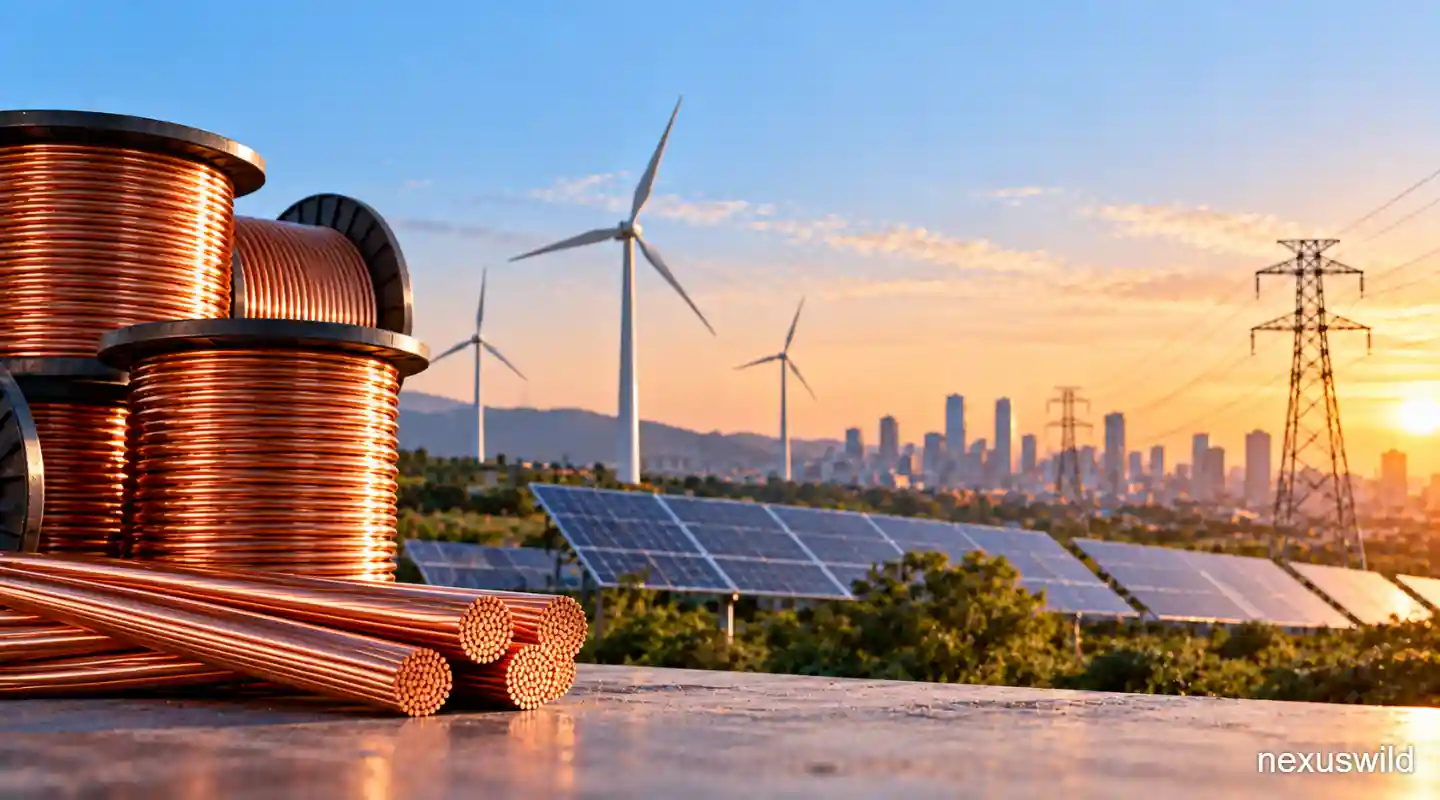

Copper has been an industrial metal for thousands of years, but the global shift toward electrification is giving it a new strategic importance.
Electricity grids need copper in cables, transformers, substations and other equipment. Electric vehicles use it throughout motors, wiring, power electronics and charging systems. Wind and solar projects require extensive electrical connections. Batteries use copper in current collectors and power connections, while the rapid construction of data centers is creating another source of electricity-infrastructure demand.
This does not mean the world is already running out of copper.
The International Copper Study Group currently expects the refined market to remain slightly oversupplied in 2026. The longer-term question is different: whether mining, refining and recycling capacity can expand quickly enough as electricity systems become larger and more interconnected.
The International Energy Agency expects copper to record the largest absolute demand increase among the major energy-transition minerals it tracks, adding about 7 million tonnes of annual demand by 2040 under its stated-policy scenario.
That is why copper is moving from a traditional industrial commodity toward a strategic input for the emerging electricity economy.
Copper Demand Is Already Enormous
Unlike lithium or cobalt, copper does not depend primarily on one new technology.
It already has a large global market across construction, electronics, machinery, telecommunications and transportation.
The latest International Copper Study Group forecast puts global refined copper usage at about 28.66 million tonnes in 2026, up an expected 1.6% from the previous year.
Global refined production is forecast at approximately 28.76 million tonnes, leaving a relatively small projected surplus of around 96,000 tonnes.
Mine production is expected to reach roughly 23.56 million tonnes in 2026, an increase of about 1.6%.
Those are forecasts for the full year rather than completed 2026 totals.
They are also a useful reminder that long-term concerns about copper availability should not be confused with an immediate physical shortage. ICSG currently expects supply to exceed refined usage slightly this year.
Copper prices nevertheless remain historically elevated.
Published London Metal Exchange data showed copper at about $14,355 per metric tonne on October 2, 2026. Earlier in the year, copper reached record levels as supply concerns and growing electrification demand supported the market.
Electricity Grids Are at the Center of the Copper Story
The simplest reason copper matters to the energy transition is its ability to conduct electricity efficiently.
Modern power systems depend on large quantities of conductive material.
Copper is used in underground and subsea cables, transformers, distribution equipment, switchgear, substations, generators and the wiring that carries electricity into buildings and industrial facilities.
As more economic activity becomes electrified, grids have to move greater quantities of electricity across longer distances.
Electric vehicles increase demand on distribution networks. New wind and solar installations need connections to population centers. Batteries have to be connected to grids. Data centers can require new substations and high-capacity transmission links.
The IEA has repeatedly identified expansion of electricity networks as one of the strongest structural sources of future copper demand. In its 2025 copper assessment, clean-technology demand was already estimated at about 7.7 million tonnes in 2024, with grids, renewable power, electric vehicles and energy storage among the major uses.
The importance of grids means copper demand is not tied solely to the pace of EV sales.
Even if individual technologies develop differently than expected, the broader movement toward an electricity-based energy system still requires extensive network investment.
Electric Vehicles Use Copper Throughout the Powertrain
Electric vehicles add another layer of demand.
Copper appears in electric motors, battery connections, high-voltage cables, inverters, onboard chargers and conventional vehicle electronics.
The charging infrastructure outside the vehicle adds further copper requirements through cables, distribution upgrades and connections to the wider power system.
Batteries themselves also use copper.
In conventional lithium-ion cells, copper foil commonly serves as the current collector on the anode side. Battery packs additionally contain electrical connections and busbars that move power between cells and the vehicle or storage system.
Copper therefore benefits from battery deployment without being one of the principal electrochemical materials such as lithium, nickel or graphite.
This distinction also makes copper less dependent on which battery chemistry eventually dominates. An LFP battery and a nickel-rich lithium-ion battery may have very different cathode materials, but both still need electrical connections.
Solar and Wind Expand the Electrical Network
Renewable generation is another significant source of copper demand.
Solar installations require cabling, inverters, transformers and grid connections.
Wind turbines use copper in generators, internal electrical systems and cables connecting turbines to substations and power networks. Offshore wind can require particularly long subsea connections.
The copper demand created by renewables therefore extends well beyond the generating equipment itself.
Building more renewable capacity often requires parallel investment in transmission, distribution and energy storage.
This is one reason the IEA says energy technologies were responsible for about 75% of the growth in demand for key energy minerals in 2025, even though traditional industrial uses still account for a large part of overall copper consumption.
AI and Data Centers Add a New Demand Driver
Artificial intelligence is introducing another source of electricity infrastructure demand.
Data centers need extensive internal power distribution as well as transformers, switchgear, backup systems and high-capacity grid connections.
The copper demand comes not only from servers themselves but from the physical infrastructure needed to deliver electricity to large computing campuses.
The IEA projects global electricity consumption by data centers could roughly double from around 460 TWh in 2024 to more than 1,000 TWh by 2030 in its base case. That is a projection rather than a guaranteed outcome, with considerable uncertainty around AI adoption and hardware efficiency.
ICSG now explicitly lists digitalisation and data centers among the factors supporting global copper demand.
AI therefore joins an already long list of copper-intensive trends rather than replacing older demand sources.
Copper Mining Is Concentrated in a Few Major Regions
Supplying that demand begins with mines.
The US Geological Survey estimates global copper mine production at approximately 23 million tonnes in 2025.
Chile remained the world's largest producer at about 5.3 million tonnes, followed by the Democratic Republic of Congo at 3.2 million tonnes and Peru at 2.7 million tonnes.
China produced about 1.8 million tonnes, while Russia produced around 1.3 million tonnes and the United States about 1 million tonnes.
The geography changes significantly at the refining stage.
China produced an estimated 14 million tonnes of refined copper in 2025, close to half of the USGS estimate of 29 million tonnes of global refinery output.
That creates a different kind of supply-chain concentration. Copper mining is spread across South America, Africa, Asia and other regions, but a much larger share of processing capacity is concentrated in China.
The IEA says China accounted for more than 90% of the growth in global copper-smelting capacity since 2005, lifting its share of capacity from roughly 15% to around 50% by 2025.
New African Supply Is Improving the Long-Term Outlook
Not all supply trends point toward greater scarcity.
The Democratic Republic of Congo has rapidly expanded copper output and has become the world's second-largest producer.
Zambia is also attracting investment intended to increase production.
The IEA's 2026 outlook says progress on new projects, particularly in the DRC and Zambia, has improved the expected long-term supply picture.
Its estimated 2035 copper supply gap has fallen from around 30% in the previous year's analysis to approximately 25% under the latest project pipeline.
That is still a substantial projected gap, but it is important to understand what the number means.
It compares expected mine supply from currently operating and announced projects with projected primary copper requirements under the IEA's stated-policy scenario.
It is not a prediction that 25% of global copper demand will inevitably go unmet.
Higher prices, additional mines, recycling, efficiency, material substitution or slower demand growth could change the balance considerably before 2035.
New Copper Mines Take a Long Time to Build
The difficulty is how slowly new supply can respond.
The IEA estimates that a new copper project takes about 17 years on average from discovery to production.
The challenge is not simply obtaining permission to dig.
Developers must identify and define a resource, complete engineering studies, raise large amounts of capital, obtain environmental and other permits, build roads and power infrastructure, secure water, construct processing facilities and then ramp up production.
Projects can face additional delays because of community concerns, legal challenges, financing conditions or changing commodity prices.
Copper supply therefore cannot increase as quickly as production of many manufactured goods.
A surge in demand today may take years to produce an equivalent response from entirely new mines.
Declining Ore Grades Make Existing Supply Harder to Expand
The quality of copper deposits adds another problem.
The IEA estimates that the average grade of copper mines globally has declined around 40% since 1991.
Lower ore grades mean miners must process more rock to obtain the same quantity of copper.
That can require more energy, equipment and water while producing larger amounts of waste.
The industry is also finding fewer major new deposits.
According to the IEA, only about 5% of copper deposits discovered during the past 35 years were discovered in the most recent decade.
Capital requirements are rising at the same time. The agency estimates the capital intensity of expanding existing copper mines has increased around 65% since 2020, approaching the cost levels historically associated with entirely new projects.
These factors do not prevent new production.
They make supply expansion slower and more expensive.
Recycling Could Become a Much Larger Source of Copper
Copper has one major advantage over some newer energy materials: it already has a mature recycling industry.
The metal can be repeatedly recycled while retaining its fundamental properties.
The IEA estimates that recycled and reused copper supplied about 4.4 million tonnes in 2024. Under its stated-policy scenario, that could increase to about 8.7 million tonnes by 2040.
Its 2026 critical-minerals outlook expects secondary supply to become increasingly important, with recycling rates across the major energy minerals potentially rising from around 10% today to close to 20% by 2040. Copper is already among the minerals with comparatively established recycling systems.
Greater recovery of old cables, motors, electronics, vehicles, transformers and buildings could reduce the amount of new material that needs to be mined.
But recycling cannot immediately replace primary production.
Much of the copper installed today will remain in electrical networks and buildings for decades before becoming available as scrap.
Copper Supply Is a Question of Investment, Not Geological Exhaustion
The long-term copper debate is sometimes framed as though the planet is simply running out of metal.
Available geological data do not support that conclusion.
USGS estimates global copper reserves at roughly 980 million tonnes, compared with current annual mine production of about 23 million tonnes.
Reserves are also not fixed.
They change with exploration, technology, prices and improvements in mining economics.
The more immediate challenge is whether economically viable resources can be developed quickly enough, with acceptable environmental and social impacts, in the regions where new supply is available.
Water availability is particularly important in major mining regions, including parts of Chile and Peru.
Lower-grade deposits can require more water and energy, strengthening the case for improved processing technology and responsible resource management.
Near-Term Surplus and Long-Term Tightness Can Coexist
The current copper market demonstrates an important distinction.
ICSG expects a modest refined-copper surplus in 2026 and a larger one in 2027.
The IEA, looking much further ahead, sees a potential supply gap in the 2030s if the currently announced mine pipeline is not expanded.
Both can be true.
A commodity market can have enough material this year while still requiring substantial investment to meet demand a decade from now.
The time needed to develop copper mines makes that gap particularly important for policymakers and industry.
Waiting until physical shortages emerge would leave relatively little time to bring large new projects online.
Conclusion
Copper is becoming critical to the global energy transition because almost every major electrification trend eventually connects to a wire, motor, transformer or power network.
Electricity grids are expanding. Renewable generation needs new connections. Electric vehicles require copper inside the vehicle and throughout charging networks. Batteries use copper in their electrical architecture, while AI and cloud computing are driving construction of increasingly power-intensive data centers.
Current supplies are not exhausted, and a global copper shortage is not inevitable.
ICSG actually expects refined production to slightly exceed consumption in 2026.
The strategic issue lies further ahead.
Copper mines take many years to develop, average ore grades are declining and new discoveries have slowed. At the same time, the IEA expects millions of additional tonnes of annual demand as global electricity systems expand.
New production in countries including the DRC and Zambia is improving that outlook, while recycling could become a much larger source of supply.
Copper's future will therefore depend on more than opening mines.
It will require a combination of new production, efficient use, expanded recycling, diversified refining capacity and infrastructure investment.
That is what makes copper increasingly strategic: it is not simply another material used by the energy transition. It is one of the basic conductors connecting much of that transition together.
Nexuswild welcomes factual corrections. Email contact@nexuswild.com with evidence and the article URL.