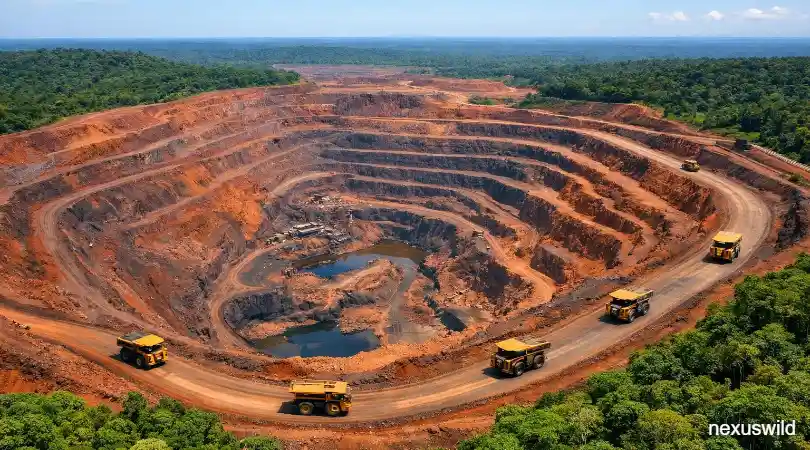

Mining companies are looking beyond familiar resource markets as the race to secure critical minerals reshapes investment decisions across the global economy. The shift reflects growing concern over concentrated supply chains, changing industrial demand and the difficulty of ensuring reliable access to materials needed for modern infrastructure and manufacturing.
For mining businesses, the opportunity is not simply to discover more minerals. It is to build a portfolio of resources that can remain commercially viable through changing commodity prices, political uncertainty and evolving customer requirements.
Supply security is becoming a business priority
Mineral production and processing remain concentrated in a limited number of countries. This creates potential vulnerabilities when trade restrictions, geopolitical tensions or operational disruptions affect major suppliers.
The International Energy Agency's analysis of critical-mineral supply chains found that the average share of the three largest refining countries for key energy minerals increased from approximately 82% in 2020 to 86% in 2024. The trend highlights the difficulty of creating alternative sources even as governments and businesses pursue diversification.
Mining companies can respond by exploring additional deposits, investing in new jurisdictions or partnering with local resource holders. These strategies can broaden access to supply, although new projects often face infrastructure, regulatory and financing challenges.
Changing demand is influencing exploration decisions
The growing use of electricity networks, renewable-energy systems, batteries and energy storage has strengthened the importance of several minerals, particularly copper and lithium.
Yet stronger long-term demand does not guarantee that every mineral project will attract investment. Commodity prices, oversupply and changing technology can alter the commercial outlook quickly.
The IEA reported that critical-mineral investment declined by 9% in 2025. Investment by copper-focused companies rose 8%, while lithium specialists cut investment by around 40%. These contrasting movements show how businesses are adjusting their strategies according to the economics of individual commodities.
As a result, companies are evaluating both new geographic markets and the financial merits of specific deposits before committing significant capital.
New regions offer opportunities and risks
Recent developments illustrate how resource businesses are broadening their reach.
On October 19, 2026, Kodal Minerals announced an agreement that gives it the right to earn up to an 80% interest in Ghana's 156-square-kilometre Asamankese lithium project through staged investment and development milestones. The company said initial exploration work would help identify targets for further drilling. The agreement represents an expansion of its regional portfolio, not confirmation that the new project is ready for commercial production.
Investor Meet Company
Regional partnerships are also becoming important to mineral sourcing. In October 2026, Traxys and Uzbekistan announced expanded cooperation across the critical-minerals value chain, including opportunities for investment and resource development. Such arrangements can connect resource-rich regions with international expertise, financing and customers.
However, moving into a new market requires more than identifying a promising geological formation. Businesses must assess permitting requirements, infrastructure, operating costs, environmental obligations and relationships with local communities.
The economics of diversification remain challenging
Developing alternative supply can be more expensive than expanding established operations. New projects may require roads, power connections, processing facilities, skilled workers and years of exploration before production becomes possible.
The IEA's 2025 outlook estimated that capital costs for projects in diversified regions are typically around 50% higher than those of incumbent producers. Higher costs, combined with commodity-price volatility, can make it difficult to attract private investment. IEA Blob Storage
This creates a strategic trade-off. A company may accept higher initial costs to secure a more diverse resource portfolio, but it still needs a credible path to profitability.
Joint ventures, staged investments and long-term supply agreements can help distribute risk. They cannot eliminate uncertainty about mineral quality, development costs or future prices.
Exploration today will shape tomorrow's supply
The industry also faces a longer-term challenge: identifying enough commercially viable deposits to support future production.
Exploration budgets do not automatically translate into discoveries, and discoveries do not automatically become operating mines. Projects must pass through technical evaluation, financing, permitting and construction before they can contribute meaningful supply.
Companies therefore need to balance investment near existing operations, where infrastructure and geological knowledge may reduce risk, against earlier-stage exploration that could identify future resources.
For governments and manufacturers, encouraging alternative supply may also require investment in processing, infrastructure and partnerships rather than focusing on mining alone.
What comes next for the mining industry?
The next phase of resource diversification will be measured by concrete results rather than the number of new market announcements. Exploration findings, independently assessed mineral resources, financing commitments, permits and construction decisions will help reveal which opportunities can progress.
Mining companies are unlikely to abandon established resource markets wholesale. Existing operations remain important because they often provide proven deposits, established infrastructure and experienced workforces.
Instead, the industry is pursuing a more selective approach: maintaining productive assets while exploring additional sources that could strengthen long-term supply security.
The companies best positioned to benefit will be those that can combine geological potential with disciplined investment, responsible operations and reliable routes to market. In an increasingly competitive resource landscape, access to minerals matters, but the ability to develop them profitably will determine which opportunities endure.
Nexuswild welcomes factual corrections. Email contact@nexuswild.com with evidence and the article URL.