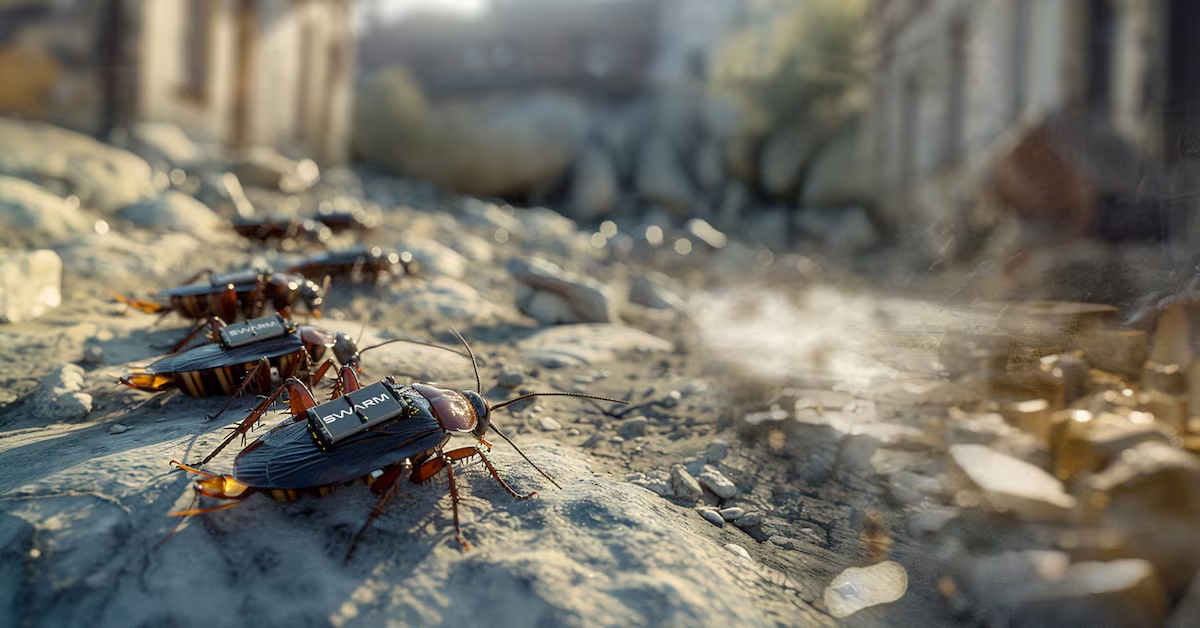

BERLIN, Sept. 16, 2026 - A living cockroach carrying a camera, radio, sensors and onboard computing sounds like science fiction. It is not.
German startup SWARM Biotactics is building bio-robotic systems around living insects fitted with miniature electronic backpacks. The company says the insects can be guided through electrical neural interfaces, coordinated as swarms, equipped with edge AI and secure communications, and sent into places that conventional robots, drones or people may struggle to reach.
That includes rubble, tunnels, collapsed buildings, confined industrial spaces and other GPS-denied environments.
The technology is real.
The more dramatic claim that "NATO is using AI cockroach spies" needs more precision.
SWARM Biotactics says it has paying customers from NATO countries and has specifically named the German Armed Forces, the Bundeswehr, among its defence customers. The company has also said its systems have been field-tested in European and U.S. operating environments.
But as of September 2026, NATO itself has not publicly announced that the alliance as an institution has procured or operationally deployed SWARM Biotactics' cockroach systems.
That distinction matters.
The verified story is already remarkable without exaggerating it.
What SWARM Biotactics is building
SWARM Biotactics was founded in 2024 and is headquartered in Kassel, Germany, with a U.S. subsidiary in San Francisco.
Its core product combines a living insect with a custom electronic backpack.
The company describes the system as a bio-robotic swarm platform.
The insect supplies the locomotion.
The electronics supply sensing, control, communication and computation.
The software coordinates multiple units and combines their sensor data.
SWARM calls its command-and-control layer SWARM OS.
According to the company, SWARM OS handles mission control, swarm autonomy and sensor fusion.
That means the value is not simply one steerable insect.
The larger ambition is to coordinate many low-signature mobile sensors as one distributed intelligence network.
Why use a cockroach at all?
The strongest engineering argument is that millions of years of evolution have already solved locomotion problems that are difficult for miniature robots.
Cockroaches can move across rough surfaces, squeeze through narrow gaps, recover from collisions and navigate cluttered spaces.
A conventional miniature ground robot needs motors, transmissions, structural components, batteries and control systems simply to move.
A cyborg insect uses the animal itself as the mechanical platform.
The electronic backpack can therefore spend much of its limited energy budget on sensing, communication and control instead of leg movement.
Peer-reviewed research on insect-machine hybrids supports that basic engineering logic.
Researchers have demonstrated Madagascar hissing cockroaches carrying miniature electronic backpacks, wireless communications, cameras and stimulation circuitry while navigating complex terrain.
The backpack is the machine layer
SWARM does not publish the full proprietary hardware specification of every operational backpack.
Its public material says the platform can carry modular sensors, edge AI, communications hardware and the neural interface used for control.
Sensor configurations can vary according to the mission.
Potential payloads include visual cameras, microphones and environmental sensors.
The company presents the backpack as modular rather than fixed.
That is important because reconnaissance in a collapsed building may require a different sensor package from industrial inspection or perimeter monitoring.
Independent academic systems illustrate the physical scale involved.
Peer-reviewed research has demonstrated Madagascar hissing cockroach backpacks weighing only a few grams, with microcontrollers, wireless links, rechargeable batteries and miniature sensing hardware.
One 2025 Nature Communications study used a 2.3-gram backpack and reported that adult Madagascar hissing cockroaches in the study could carry substantially more payload than the electronics alone required.
That does not mean SWARM uses the same design.
It shows that the underlying payload physics are technically credible.
How a living insect can be steered
The cockroach is not being controlled by replacing its brain with software.
The system influences natural behaviour through electrical stimulation.
Cockroaches use sensory structures such as antennae and cerci to understand their surroundings.
Researchers have shown for years that carefully applied electrical signals can influence turning or acceleration.
For example, stimulating one antenna can trigger a turn away from the perceived contact.
Other control methods stimulate structures near the rear of the insect to influence forward movement.
The electronics therefore act more like a navigation cue than a conventional motor controller.
The animal still produces its own walking motion.
This is one reason the term "cyborg insect" is more technically accurate than "robot cockroach."
It is a biological organism integrated with electronics.
This science predates the defence startup
The fundamental concept has been studied for more than a decade.
Researchers demonstrated remotely guided cockroaches with electronic backpacks as early as the 2010s.
More recent work has become far more sophisticated.
A 2024 Nature Communications study demonstrated swarm navigation using Madagascar hissing cockroaches equipped with control and wireless systems.
The researchers developed decentralized navigation methods for groups of cyborg insects moving through unknown, obstructed terrain.
A separate 2025 Nature Communications paper demonstrated automated assembly of insect-computer hybrid robots.
Its system used robotic vision and automated electrode placement, producing a cyborg insect in 68 seconds.
In tests, a four-insect group covered 80.25% of an obstructed area in 10 minutes and 31 seconds.
Another published system combined a cockroach with an infrared camera and machine-learning model for autonomous search-and-rescue exploration.
The scientific foundation is therefore not speculative.
What SWARM Biotactics is trying to commercialize is the transition from laboratory systems to deployable mission hardware.
Where AI actually enters the system
The phrase "AI cockroach" can create the wrong mental picture.
The insect itself is not running an artificial mind.
AI operates in the electronic and software layers around it.
SWARM says its backpacks support edge AI.
Edge processing means some sensor analysis can occur close to the insect rather than sending every raw data stream to a distant server.
That can be valuable in environments where bandwidth is limited or communications are unreliable.
For example, a sensor system may be able to identify a relevant object, sound or environmental signal locally and transmit only useful information.
At the swarm level, AI can also help with route selection, coordination and sensor fusion.
SWARM OS is intended to combine the observations of multiple insects into one operational picture.
This is closer to a distributed sensor network than to a group of independent robotic minds.
Why military users are interested
The main defence use case is intelligence, surveillance and reconnaissance in spaces where larger machines have difficulty operating.
A small flying drone may struggle inside narrow tunnels.
Rotor wash, noise and collision risk can make flight difficult in enclosed structures.
A wheeled ground robot may be blocked by rubble, stairs or narrow openings.
Sending a person into the same space can create obvious danger.
A cockroach can move through gaps and clutter using a body already adapted for that environment.
That creates a possible "last metres" reconnaissance tool.
A squad could theoretically release several bio-robotic units outside a structure and receive sensor information from rooms, voids or passages before people enter.
The same capability has civilian applications.
After an earthquake or building collapse, small bio-robotic sensors could search spaces inaccessible to rescue teams.
Industrial operators could potentially use them for confined inspections.
Is NATO actually using them?
This is where the public evidence needs careful wording.
In a 2026 company statement, SWARM Biotactics said it had paying NATO customers and specifically identified the Bundeswehr among its defence customers.
It also said the systems had undergone field validation in European and U.S. operating environments.
Those are company claims.
They are meaningful because naming a national military customer is more specific than simply saying the technology is being tested.
But they should not be expanded into a claim that NATO headquarters or NATO as an institution has purchased and deployed the system.
A search of NATO's public material shows the alliance actively testing emerging military technologies in 2026, including drones, ground robots, autonomous systems, communications and swarm concepts.
NATO has publicly documented experimentation under initiatives such as its Eastern Flank Deterrence Initiative.
However, NATO's public pages reviewed for this article do not identify SWARM Biotactics or cockroach bio-robots as an alliance-operated system.
So the accurate formulation is simple.
SWARM says it works with paying customers from NATO countries, including the German military.
There is no public NATO confirmation reviewed here that the alliance itself is operating cyborg cockroach units.
The Bundeswehr claim is also company-sourced
The company has specifically stated that the Bundeswehr is among its paying defence customers.
That is stronger than anonymous market speculation.
But no public Bundeswehr procurement document located for this article independently specifies quantities, contract value, operational unit or deployment location for the cockroach system.
That means several details remain unknown.
How many units have been purchased?
Are they used only for evaluation?
Are they attached to a specific reconnaissance or engineering unit?
Have they been used outside controlled exercises?
The public record does not establish those points.
A high-authority account should stop where the evidence stops.
SWARM has raised €13 million
The business behind the technology is also real.
In June 2025, SWARM Biotactics announced a €10 million seed round, bringing total capital raised to €13 million including an earlier €3 million pre-seed round.
The company said the funding would be used to scale sensor-backpack production, neural-interface technology, swarm infrastructure, engineering and international deployment.
It named investors from Europe, the United States and Australia.
The company also said it had grown to more than 40 engineers and scientists across Germany and the United States by early 2026.
The size of the financing is modest compared with major defence programs.
For an early bio-robotics company, however, it is enough to move from academic-style prototypes toward manufacturing, field trials and customer integration.
Why swarm operation matters more than one insect
A single cockroach carrying a camera has obvious limitations.
Its field of view is tiny.
Its route can be unpredictable.
It can become blocked.
Its radio can lose connection.
Its battery is limited.
The swarm concept addresses those weaknesses through redundancy.
Instead of relying on one perfect unit, a mission can deploy many inexpensive units.
Some can fail while others continue.
Different insects can explore different paths.
Their sensor observations can be combined into a wider map.
This is conceptually similar to distributed computing.
Reliability comes from the group rather than from demanding that every individual node be flawless.
Academic research has already demonstrated decentralized cyborg-insect swarm navigation.
Commercial deployment is an attempt to make that principle rugged enough for field use.
Biology also creates limitations
Using living animals solves some engineering problems and creates new ones.
Insects are not deterministic machines.
Their behaviour can vary.
They can become less responsive to repeated electrical stimulation.
They can stop moving.
They can react to temperature, humidity, fatigue or environmental chemicals.
Academic studies have specifically investigated habituation to electrical control signals.
Researchers have developed alternate stimulation methods because repeated signalling can reduce responsiveness.
This means a bio-robotic swarm needs software that tolerates imperfect control.
The system cannot assume every insect behaves like a precision motor.
Communications remain a hard problem
A tiny backpack has limited antenna size and power.
That matters underground, inside reinforced buildings and around metal structures.
The very environments where cockroaches are most useful can also be hostile to radio communication.
SWARM says its systems use secure communications, but it does not publicly disclose every operational range or radio architecture.
A practical deployment may therefore require relay nodes, local gateways or mesh networking.
The intelligence value of the insect depends on getting sensor data back to the operator.
An unreachable sensor is not useful simply because it reached the target.
Battery life shifts rather than disappears
The insect's locomotion is biologically powered.
The electronics are not.
Cameras, radios, processors and neural-interface circuits still need batteries.
This is one of the major advantages and limits of the hybrid design.
The system avoids spending battery power on electric motors for walking.
That can extend endurance.
But the electronic payload still has a finite operating life.
Academic backpacks have demonstrated operation measured in hours.
Independent endurance figures for SWARM's current fielded units are not publicly available.
Ethics cannot be treated as an afterthought
Bio-robotics raises questions that ordinary robotics does not.
The platform is a living animal.
Electrodes or other interfaces influence its nervous or sensory system.
Backpacks add physical load.
Repeated control signals can affect behaviour and metabolism.
Academic teams working on cyborg insects generally operate under institutional animal or research approvals appropriate to their jurisdiction.
Commercial defence deployment creates a different ethical context.
Insects do not receive the same legal protections as vertebrate laboratory animals in many countries, but that does not remove the welfare question.
There is also an ecological issue.
A field deployment involving living organisms has to consider recovery, containment and the possibility of insects escaping into environments where they do not belong.
Those issues become more important if deployment scales from dozens to thousands.
The technology is not a weapon by definition
A sensor-equipped cyborg cockroach is primarily a reconnaissance platform.
The public SWARM material focuses on intelligence gathering, security, search and rescue, industrial inspection and access to denied environments.
That is different from an armed autonomous system.
There is no public evidence in the sources reviewed here that SWARM's cockroaches carry lethal payloads.
Their value comes from access and sensing.
What has actually changed in 2026
The biggest change is not the underlying science.
Cyborg insects have existed in research for years.
The change is commercialization.
SWARM Biotactics says it has moved from founding to field-tested systems, paying defence customers and deployable mission kits in roughly a year.
Its website now presents a full mission architecture rather than a laboratory prototype: living units, modular payloads, mission control, swarm autonomy, sensor fusion and deployment kits.
That is the transition worth watching.
Defence technology often changes when an idea moves from a paper to a procurement budget.
SWARM says that transition has begun.
The exact scale remains commercially and militarily opaque.
The strict conclusion
Yes, AI-equipped cyborg cockroaches are real.
Living Madagascar hissing cockroaches can carry electronic backpacks, be influenced through electrical stimulation, transmit sensor data and operate in coordinated groups.
Peer-reviewed research independently validates the underlying bio-robotics.
SWARM Biotactics is commercializing that concept for defence, security, search-and-rescue and inspection missions.
The company has raised €13 million and says its systems are field-tested and being used by paying customers from NATO countries, including the Bundeswehr.
What is not established publicly is equally important.
There is no NATO announcement reviewed here confirming that NATO itself has procured or operationally deployed these insects.
There is no public count of units in military service.
There is no disclosed battlefield deployment.
And there is no independent public benchmark establishing the full performance of SWARM's current operational product.
So the accurate story is more interesting than the sensational one.
These are not imaginary "spy cockroaches."
They are living bio-robotic sensor platforms built on real neuroscience, miniature electronics, edge AI and swarm software.
And the defence world appears to be moving them out of the laboratory and into field evaluation faster than most people expected.
Reader questions
Frequently asked questions
Are AI-controlled cockroaches real?
Yes. Researchers have demonstrated living cockroaches carrying electronic backpacks with wireless control, sensors and onboard processing. SWARM Biotactics is commercializing this broader bio-robotics concept for defence, security and rescue missions.
How are cyborg cockroaches controlled?
Electrical stimulation is used to influence sensory or neural structures that affect natural movement. The cockroach still walks using its own muscles and nervous system; the electronics provide directional cues rather than mechanically driving its legs.
What is inside the tiny backpack?
SWARM says its modular backpacks can include the neural interface, sensors, edge AI processing and secure communications. Exact payloads vary by mission and the company does not publicly disclose every operational hardware specification.
Is NATO using cockroach spies?
SWARM Biotactics says it has paying customers from NATO countries and has named the German Bundeswehr as a defence customer. However, no public NATO source reviewed here confirms that NATO itself has procured or operationally deployed SWARM's cockroach systems.
Why use a cockroach instead of a small robot?
Cockroaches naturally navigate rubble, narrow gaps and complex surfaces while using biological energy for locomotion. That lets the backpack devote more battery capacity to sensing, communication and control rather than motors.
How much funding has SWARM Biotactics raised?
The company announced a €10 million seed round in June 2025, bringing total disclosed funding to €13 million including an earlier €3 million pre-seed round.
Are the cockroaches armed?
The public material reviewed here describes them as sensing, reconnaissance, security, rescue and inspection platforms. There is no public evidence in these sources that SWARM's cockroaches carry lethal payloads.
Nexuswild welcomes factual corrections. Email [email protected] with evidence and the article URL.