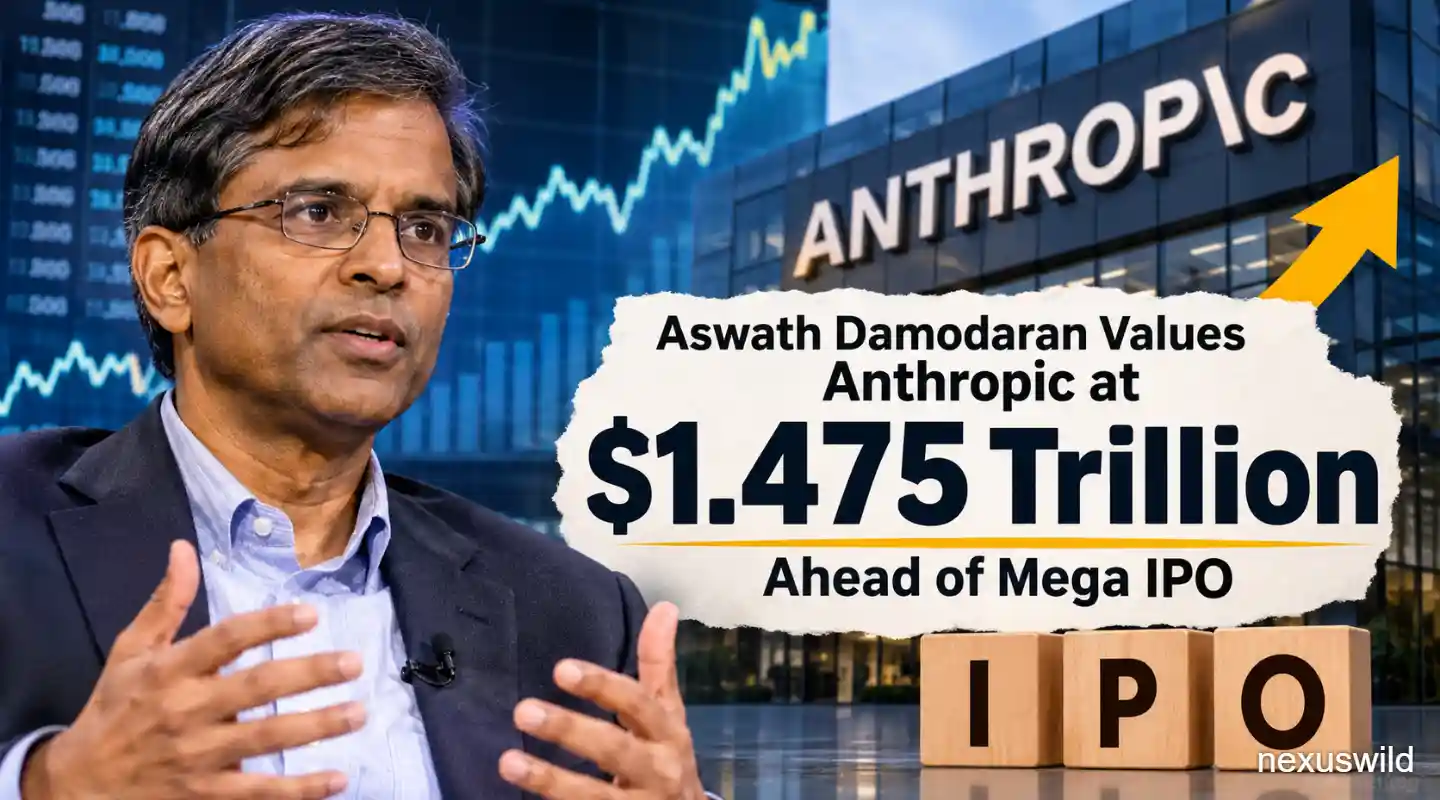

Valuation expert Aswath Damodaran has estimated Anthropic's equity value at $1.475 trillion ahead of its proposed initial public offering, placing his assessment just below the widely reported $1.5 trillion to $2 trillion IPO pricing range. His optimistic valuation assumes the Claude developer can approach $1 trillion in annual revenue by 2036 while achieving a 27.5% operating margin. However, Damodaran also highlights significant risks, including expensive computing commitments, competition, customer concentration and governance arrangements that limit public shareholder influence. His analysis provides a useful framework for understanding the financial expectations surrounding one of the most closely watched potential AI listings.
Dean of Valuation Aswath Damodaran Values Anthropic at $1.475 Trillion Ahead of Mega IPO
Anthropic's anticipated stock market debut is bringing a major question into focus for technology investors: how much should a company developing advanced artificial intelligence be worth when its future market could be significantly larger than its current business?
As investors examine the proposed listing of the company behind Claude, renowned valuation expert Aswath Damodaran has offered his own assessment. The New York University Stern School of Business finance professor, widely known as the Dean of Valuation, estimates Anthropic's equity value at approximately $1.475 trillion.
His estimate, published on October 28, 2026, comes after Anthropic filed a preliminary registration statement with the US Securities and Exchange Commission on October 26. Damodaran's valuation sits slightly below the widely reported IPO pricing range of $1.5 trillion to $2 trillion.
The difference is significant because it highlights the gap between what financial modelling suggests a business could be worth and what investors might be willing to pay when its shares enter public markets.
Damodaran's analysis is not simply a bet on artificial intelligence becoming more popular. It is built around assumptions about future revenue, operating margins, computing infrastructure, reinvestment requirements and regulatory costs. He also presents scenarios in which Anthropic's equity could become worthless or reach approximately $4.04 trillion, depending on how its business develops.
The central message is that Anthropic's enormous potential comes with equally important financial and operational uncertainties.
Sources: Aswath Damodaran's original valuation analysis and Anthropic's preliminary SEC registration statement.
- Why Damodaran's $1.475 Trillion Valuation Matters
A valuation of $1.475 trillion would place Anthropic among the world's largest publicly traded companies if it were achieved in the market. However, Damodaran's estimate is a fundamental equity valuation based on projected financial performance, not an official IPO price or a guaranteed market capitalisation.
His estimate is particularly notable because it is slightly below the widely reported $1.5 trillion to $2 trillion range associated with the proposed offering.
The difference between valuation and pricing is important. Valuation attempts to estimate what a business is worth based on its expected future cash flows and risks. Pricing reflects what investors are prepared to pay at a particular moment, which can be influenced by demand, market sentiment, scarcity of shares and expectations about future growth.
In his analysis, Damodaran says he would remain on the sidelines if the IPO were priced materially above his estimate. He argues that investors should make their own assessments rather than automatically accepting the market's expectations.
The proposed listing has attracted considerable attention because Anthropic operates in one of the fastest-developing areas of technology. Its Claude models are used for software development, enterprise productivity, research and other business applications.
But a large potential market does not automatically justify a trillion-dollar valuation. The company must convert technological adoption into durable revenue, sustainable profitability and cash generation.
- Anthropic's Revenue Growth Is the Biggest Argument Supporting Its Valuation
Anthropic's financial disclosures provide a major reason investors are examining its potential market value so closely.
According to its SEC registration statement, the company generated revenue of $16.286 billion in the first six months of 2026, compared with $1.163 billion during the same period in 2025. That represents approximately 1,300% year-on-year growth.
Its annual revenue had already increased from $41 million in 2023 to $386 million in 2024 and $4.585 billion in 2025.
The company has also expanded its enterprise customer base. As of September 30, 2026, Anthropic reported more than 1,900 customers generating at least $1 million in trailing twelve-month revenue, including approximately 250 customers generating at least $10 million.
These figures suggest that Claude is becoming more deeply integrated into business operations rather than being used exclusively for individual experimentation.
Enterprise customers can represent an attractive source of recurring business because they may incorporate AI systems into software development, customer support, internal research and other workflows.
However, rapid revenue expansion comes with a qualification. Damodaran noted that revenue growth slowed in the third quarter of 2026. He identified competition from OpenAI, limited computing capacity and a shift by some enterprise customers towards cheaper open-source models as potential pressures.
Customer concentration also remains relevant. Damodaran highlighted that Anthropic's five largest customers account for approximately 25% of revenue. This means changes in spending by a relatively small group of customers could have a meaningful financial impact.
The company therefore faces two simultaneous tasks: expanding its enterprise customer base and reducing its dependence on a limited number of major accounts.
Source: Anthropic SEC filing, financial statements and enterprise customer disclosures.
- The $1 Trillion Revenue Assumption Behind the Valuation
The most ambitious part of Damodaran's model is his expectation that Anthropic could approach $1 trillion in annual revenue by 2036.
That projection depends on his assessment of the potential market for artificial intelligence products and services. He believes advanced AI systems could disrupt multiple industries, particularly through automation of highly paid professional and knowledge-based work.
In this scenario, AI would not be limited to helping employees complete tasks more quickly. It could increasingly perform activities currently handled by specialised workers and service providers.
Such a shift could create a substantial commercial market for advanced models and AI agents.
Damodaran estimates that the overall market for AI products and services could exceed $5 trillion. He sees Anthropic as a potential leader in the premium segment, where businesses pay for more capable models, enterprise-specific applications and advanced AI services.
Another potential opportunity is Anthropic's interest in expanding into businesses affected by its own technology. Damodaran discusses the possibility of the company using AI agents in areas such as pharmaceutical research and testing, potentially capturing revenue from activities traditionally provided by specialised businesses.
However, reaching $1 trillion in annual revenue would require extraordinary growth over the next decade. It would also require Anthropic to maintain a meaningful competitive position while the technology, pricing structures and customer expectations continue to evolve.
The projection should therefore be understood as a central assumption in Damodaran's optimistic valuation, not a confirmed company revenue target or a guaranteed outcome.
- Profitability Could Decide Whether the Valuation Is Sustainable
High revenue growth is not enough to support a trillion-dollar company if operating expenses rise at a similar or faster pace.
AI companies face significant costs associated with computing infrastructure, advanced chips, research and development, technical employees and customer services. These expenses can be particularly substantial when companies are developing and operating frontier AI models.
Anthropic's SEC filing shows how quickly its cost structure has expanded. Compute and infrastructure expenses reached $8.945 billion in the first half of 2026, compared with $2.334 billion during the same period in 2025.
The company reported an operating loss of $693 million for the first six months of 2026. However, its company-defined adjusted operating income was positive at $1.618 billion, equivalent to an adjusted operating margin of approximately 10%.
Its reported net loss was substantially larger, at $80.748 billion. A major part of that figure reflected a $72.388 billion non-cash change in the fair value of convertible notes, derivative liabilities and other financing instruments. This accounting adjustment was largely driven by the increase in Anthropic's estimated enterprise value.
The distinction matters because the reported net loss does not represent an equivalent amount of cash spent during the period.
For his valuation, Damodaran assumes Anthropic can ultimately achieve a 27.5% operating margin after accounting for an estimated regulatory impact. His model starts with a higher potential premium-market margin but reduces it to reflect future compliance and regulatory costs.
This assumption is central to the $1.475 trillion figure. If competition forces Anthropic to reduce prices or if infrastructure expenses remain higher than expected, its long-term profitability could be considerably lower.
Sources: Anthropic SEC financial disclosures and Damodaran's profitability assumptions.
- Computing Infrastructure Is Both a Competitive Advantage and a Financial Risk
The artificial intelligence industry depends on access to increasingly powerful computing infrastructure. Training advanced models and serving large numbers of enterprise users require substantial computing resources, specialised chips, electricity and data-centre capacity.
For Anthropic, securing sufficient computing power is essential to maintaining its model-development ambitions and supporting customer demand.
However, this infrastructure comes with major financial commitments.
Damodaran highlights that Anthropic has disclosed hundreds of billions of dollars in future computing commitments. He argues that these obligations can become a major source of operating and financing risk because they create costs that the company may need to meet even when revenue growth weakens.
His analysis also points out that computing equipment requires continuous investment. Chips become outdated, new models demand additional resources and data-centre expansion can face energy, land and regulatory constraints.
The SEC filing reinforces the importance of this issue. Anthropic reported $6.2 billion in total indebtedness as of June 30, 2026, primarily associated with convertible promissory notes issued by Amazon through AWS. The company also disclosed substantial future compute-related commitments and financing risks.
Damodaran assumes that Anthropic can generate three dollars of additional revenue for every dollar invested in capital over time. This reinvestment assumption helps determine how much of its future cash flow can be retained rather than spent on further expansion.
If computing becomes more efficient and costs fall relative to revenue, the company could improve profitability. But if computing requirements rise faster than expected, the financial burden could become much heavier.
This is one of the most important uncertainties for investors evaluating Anthropic. Its access to advanced computing power could support its market position, but the cost of maintaining that advantage may also restrict future cash generation.
Sources: Anthropic SEC filing, debt and infrastructure disclosures and Damodaran's reinvestment analysis.
- Damodaran's Scenarios Show How Wide Anthropic's Valuation Range Could Be
One of the most important aspects of Damodaran's analysis is that he does not present $1.475 trillion as the only possible outcome.
Instead, he outlines three different scenarios based on different assumptions about revenue growth, operating margins, computing efficiency, capital requirements and regulation.
Scenario
Key assumptions
Estimated equity value
Downside
$200 billion revenue in 2036, 10% operating margin and expensive computing
-$373 billion
Optimistic base case
Around $1 trillion revenue in 2036 and 27.5% operating margin
$1.475 trillion
Upside
$1.5 trillion revenue in 2036, 40% operating margin and improved computing efficiency
$4.04 trillion
The negative equity value in the downside case is a modelling result indicating that the business would not remain financially viable under those assumptions. It does not mean a publicly traded share price could literally fall below zero.
The difference between the downside and upside outcomes demonstrates how much Anthropic's valuation depends on future business performance rather than its current revenue alone.
In the optimistic case, continued enterprise adoption, high-value AI products and improved computing efficiency support substantial long-term cash flows.
In the downside case, weaker revenue growth, higher computing costs and greater regulatory pressure undermine the company's ability to meet its financial obligations.
This makes the valuation particularly sensitive to changes in the assumptions used by investors. Small differences in long-term growth, margins and capital requirements can produce enormous differences in estimated equity value.
Source: Damodaran's three Anthropic valuation scenarios.
- Governance Could Become a Major Concern for Public Investors
Anthropic's financial prospects are only one part of the proposed IPO story. Its corporate structure also raises questions about how much influence public shareholders would have after the company lists.
Anthropic is organised as a Delaware public benefit corporation. Its stated purpose is to support the responsible development and maintenance of advanced artificial intelligence for the long-term benefit of humanity.
This structure requires the company to balance shareholder financial interests with its stated public-benefit purpose and the interests of people affected by its activities.
Its preliminary prospectus also describes five classes of shares with different voting and economic rights.
One particularly important feature is the arrangement under which the founders' holding entity will control 50.1% of the company's voting power through Class F shares. The Long-Term Benefit Trust will also have authority connected to the appointment and removal of a majority of the board through its special voting rights.
Class A shares offered to public investors carry one vote per share, while Class N shares generally have no voting rights.
Damodaran has criticised this arrangement, arguing that public investors could have limited influence over decisions made by the founders and the trust. He also questions how the company's public-benefit obligations may affect shareholder interests.
These concerns are relevant because the value of a public company is not determined solely by revenue and profit. Investors also consider management accountability, voting rights and their ability to influence major corporate decisions.
Anthropic's structure reflects its stated mission, but investors will need to evaluate whether they are comfortable holding shares in a company where conventional shareholder influence is limited.
Sources: Anthropic's preliminary prospectus and capital structure and Damodaran's governance analysis.
- The IPO Price Could Differ Significantly From Fundamental Value
The proposed Anthropic listing is attracting attention because the company could become one of the largest AI-focused businesses to enter public markets.
However, an important distinction must be made between the reported pricing expectations and the official offering terms.
Damodaran discussed a widely reported $1.5 trillion to $2 trillion IPO pricing range. Yet Anthropic's preliminary SEC prospectus, filed on October 26, still contains blank fields for the number of shares being offered, the final price range and other transaction details.
The filing itself states that the securities cannot be sold until the registration statement becomes effective.
This means the reported valuation range should not be treated as a confirmed final offering price.
For investors, the difference between the initial market price and fundamental value could be substantial. Demand for AI stocks, the level of investor participation, market conditions and expectations about future model capabilities may influence trading once shares become available.
Damodaran's position illustrates this distinction. He says he is willing to wait rather than purchase shares at a price substantially above his own valuation estimate. He also acknowledges that market prices can remain different from his assessment for an extended period.
The listing could therefore become a test of how public investors value future AI growth, infrastructure commitments and the risks associated with a rapidly changing technology industry.
Sources: SEC preliminary prospectus and Damodaran's IPO pricing discussion.
What Happens Next?
Anthropic's next important milestones will involve the progress of its IPO registration, the final offering details and its ability to demonstrate that revenue growth can translate into durable profitability.
Investors are likely to focus on several indicators: enterprise customer spending, revenue growth after the first half of 2026, operating margins, computing commitments, financing requirements and the company's ability to compete with other advanced AI developers.
The proposed listing could also establish a benchmark for how public markets value AI companies with large infrastructure requirements and ambitious long-term revenue targets.
However, the final market valuation will depend on the offering terms and investor demand rather than Damodaran's model alone.
Conclusion
Aswath Damodaran's $1.475 trillion valuation places Anthropic among the most closely watched potential IPOs in the technology industry. His analysis recognises the company's extraordinary revenue growth and its opportunity to become a major provider of enterprise AI products and services.
At the same time, it highlights the financial pressures that could limit that opportunity. Computing commitments, customer concentration, competition, regulation and governance arrangements all influence the company's long-term value.
The most important takeaway is that Anthropic's potential valuation is built on what the company could become over the next decade, not simply what it earns today. Its ability to sustain rapid growth while improving profitability will determine whether a trillion-dollar valuation can be supported by its business fundamentals.
For investors, the difference between a compelling AI growth story and a sustainable public-market investment will ultimately come down to execution, cash generation and the price paid for future expectations.
Nexuswild welcomes factual corrections. Email contact@nexuswild.com with evidence and the article URL.