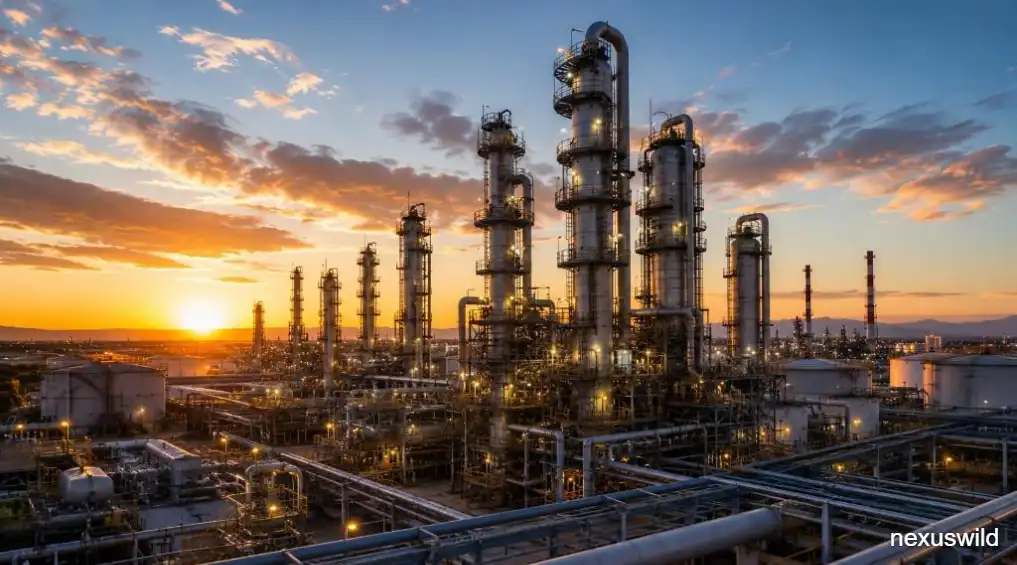

Economic uncertainty usually creates pressure across global markets. Businesses face costs consumers become more cautious and investors reassess financial risks.. Energy companies can sometimes report stronger profits during these same periods particularly when disruptions to oil and gas supplies push up prices and increase the value of available fuel.
Recent financial results illustrate this contrast. Shell reported quarter 2026 adjusted earnings of $10.814 billion nearly double the $5.432 billion recorded a year earlier. TotalEnergies reported adjusted income of $9.1 billion, an increase of 127% year over year. Both companies benefited from strong refining margins and changes in global energy supply.
The results highlight a feature of the energy industry: uncertainty does not affect every business in the same way. While higher prices can benefit producers and traders disruptions can also damage infrastructure reduce output and increase costs.
Supply disruptions can change the economics of energy
Oil and gas markets depend on a network of production facilities, pipelines, shipping routes, refineries and distribution systems. When an important part of that network is disrupted the effects can spread across markets.
Supply shortages can push up prices for oil, natural gas and refined products. Companies with production, processing capacity or access to alternative supplies may benefit from the resulting market conditions.
The effects are not uniform. A company that cannot deliver its products may lose revenue when prices rise. Another business with facilities and access to customers may be able to sell at more favourable prices.
This explains why investors examine business segments rather than assuming that every energy company benefits equally from a supply crisis.
Refining margins can be more important than oil prices alone
Refining is one of the examples of how energy companies can earn more during market disruption.
Refineries convert oil into products such as diesel, gasoline and jet fuel. Their profitability depends partly on the difference between the cost of oil and the value of the refined products they sell. This difference is known as the refining margin.
When supplies of fuels tighten product prices can rise relative to crude costs increasing refining profitability.
In the quarter of 2026 Shell reported a refining margin of $42 per barrel while TotalEnergies reported $33.20 per barrel. Both figures were four times their year-earlier levels according to reported company results.
TotalEnergies refining and chemicals division generated $3.6 billion in profit than five times the level recorded a year earlier. The company also benefited from refining throughput allowing it to process more crude while capturing strong margins.
These results show why a company can earn more from processing and selling fuel even when the broader economy faces uncertainty.
Natural gas and trading provide sources of earnings
Energy companies with diversified operations may also benefit from changes in natural gas prices liquefied natural gas demand and trading conditions.
TotalEnergies reported $1.9 billion in income from its liquefied natural gas division during the quarter. Average gas prices increased 20% compared with the quarter while trading activities also supported results.
Integrated energy companies often operate across stages of the value chain, including production, transportation, refining, trading and retail distribution. These businesses can respond differently to changes in commodity prices.
Diversification can therefore provide earnings opportunities although it does not eliminate exposure to geopolitical events or operational disruption.
Higher profits do not mean every operation is performing better
The relationship between uncertainty and energy earnings is more complicated than rising prices
Shells oil and gas production fell 17% during the nine months of 2026 compared with the same period a year earlier mainly because disruptions in the Middle East reduced output from Qatar. The company also reported damage affecting its Pearl gas-to-liquids facility and impairments in parts of its business.
These developments illustrate the difference between profitability and operational performance. Higher prices and refining margins may offset some losses. Prolonged production interruptions can eventually limit the benefits.
Companies must also contend with shipping costs, insurance expenses, maintenance requirements, taxes and the risk that high margins will not last.
For energy businesses the challenge is to capture market conditions without allowing short-term earnings to obscure longer-term operational risks.
What higher energy profits mean for the economy
Strong earnings can strengthen corporate cash flow support debt reduction and provide funds for investment or shareholder distributions. Shell raised its share buyback to $5 billion following its third-quarter results while TotalEnergies maintained its planned fourth-quarter buyback and announced an additional programme for early 2027.
However higher profits for energy producers can coincide with costs for households and other businesses. Expensive fuel can raise transport costs increase manufacturing expenses and place additional pressure on inflation.
The distribution of the benefits is therefore uneven. Energy companies may gain from margins while consumers, airlines, logistics operators and fuel-intensive manufacturers face more expensive inputs.
The wider economic outcome depends on how long disruptions persist, how quickly supplies recover and how businesses and consumers adjust to changing prices.
Can energy companies maintain these earnings?
Exceptional profits during a period of disruption should not automatically be treated as a trend.
If production and shipping recover fuel supplies may improve and refining margins may decline. Weaker economic activity can also reduce demand for oil and gas limiting the ability of companies to maintain prices.
Investors will therefore monitor production levels, refining margins, natural gas prices operating cash flow and capital expenditure in quarters.
Companies with diversified operations, reliable infrastructure and disciplined financial management may be better placed to manage volatility. Nevertheless their future earnings will depend on market conditions than on uncertainty alone.
The central lesson
Energy companies can earn more during periods of uncertainty because disruptions sometimes increase the value of available fuel and processing capacity. Strong refining margins, higher gas prices and trading opportunities can produce earnings even when other parts of the economy face pressure.
The relationship is conditional. Supply disruptions can also reduce production, damage facilities and increase costs while weaker economic growth can eventually undermine demand.
The strongest conclusion is not that uncertainty guarantees energy profits. It is that energy companies with the assets, market access and operational flexibility can sometimes benefit from conditions that create significant challenges, for the wider economy.
Nexuswild welcomes factual corrections. Email contact@nexuswild.com with evidence and the article URL.