
Most humanoid robots are built around a familiar engineering idea: put electric motors at the joints, connect them through gears or transmissions, and use software to coordinate the resulting mechanical body.
Clone Robotics is attempting something fundamentally different.
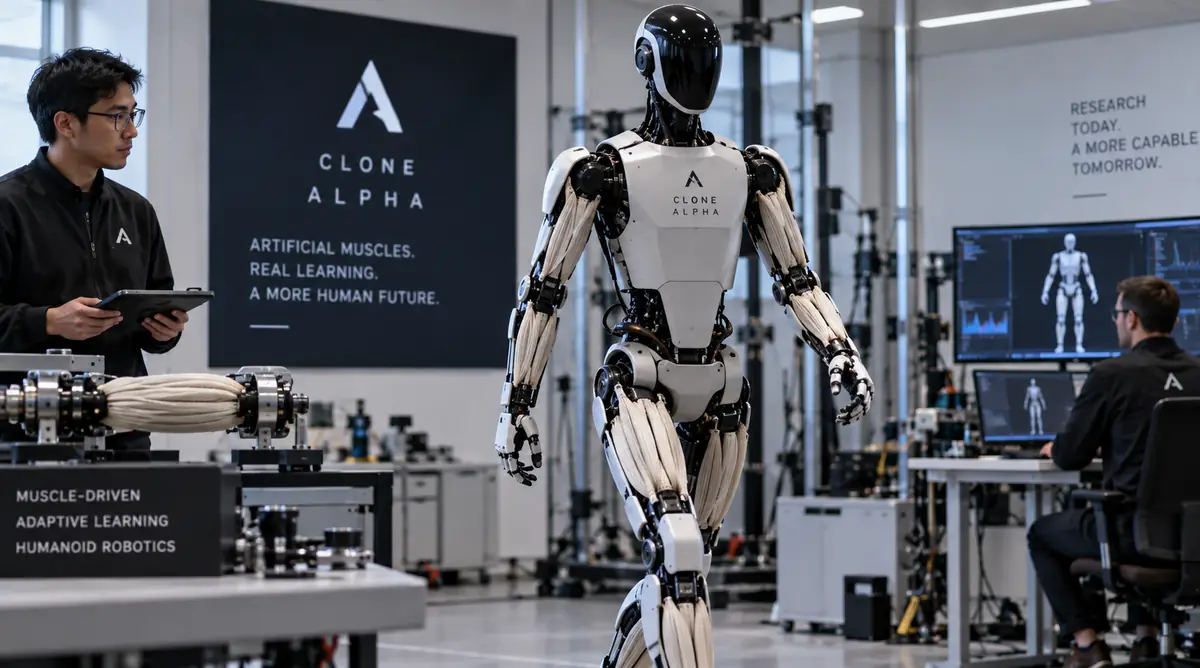
Its Clone Alpha android is designed around a synthetic version of human anatomy. Instead of using a conventional electric motor at every shoulder, elbow, wrist or finger joint, Clone attaches artificial muscles to a skeleton in roughly the same places biological muscles attach to human bones. Those muscles contract when pressurized fluid moves through them.
The result is a robot that looks unusual even before software becomes involved. Its arms do not simply rotate around obvious mechanical hinges. Tendon-like structures pull on bones. Opposing muscles work against one another. The body is intended to flex rather than behave like a collection of rigid industrial actuators.
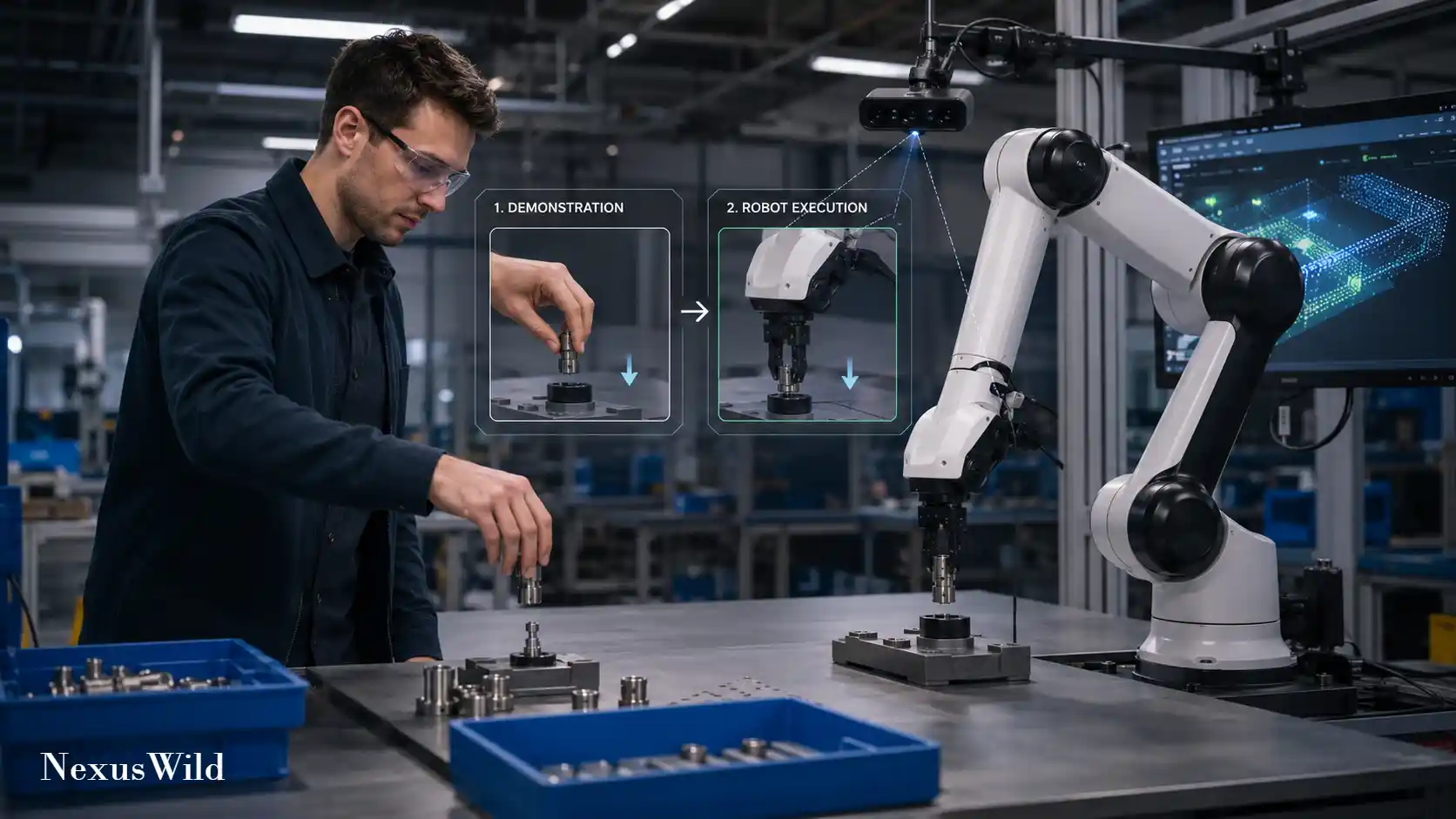
And then comes the more ambitious claim: Clone wants owners to be able to demonstrate a new task and teach the robot to reproduce it, rather than waiting for engineers to manually program every movement.
That combination, artificial muscles plus learning from demonstration, is what makes Clone Alpha one of the more unconventional experiments in the current humanoid race.
It also requires an important reality check.
Clone Alpha remains a development-stage product. Clone's own terms say it has not yet been fully introduced to the market, while the company is planning only 279 Alpha Edition units. Many of its promised household abilities remain company targets rather than independently demonstrated consumer capabilities.
It does not use motors in the usual humanoid sense
Saying Clone Alpha has “no motors” is almost correct, but needs qualification.
It does not depend on conventional rotary electric motors at its joints in the way most modern humanoids do.
There is still electrical machinery inside the system. The hydraulic architecture ultimately needs an electrically powered pump to move fluid through the body.
What makes Clone different is where the actuation happens.
In a conventional robot, an electric motor spins. Gears or belts convert that rotation into movement at a joint.
Clone instead uses its proprietary Myofiber artificial muscles. The company says these fibers are arranged as musculotendon units attached to anatomically appropriate points on the skeleton.
When hydraulic pressure enters a Myofiber, the structure contracts. That contraction pulls on the skeleton much like biological muscle pulls on bone.
It is closer to building a synthetic muscular system than simply hiding motors beneath a humanoid shell.
A three-gram artificial muscle can pull about a kilogram
Clone makes unusually ambitious performance claims for Myofiber.
The company says an individual synthetic fiber weighing roughly three grams can produce at least one kilogram of contraction force, shorten by more than 30% of its unloaded length, and respond in under 50 milliseconds.
Those are company-reported figures rather than broad independent certification of an entire humanoid system.
Still, they illustrate why artificial muscle is attractive.
Human movement requires an unusual combination of power, compliance and dexterity.
A finger must be strong enough to grip an object but soft enough not to crush it. A shoulder has to generate significant force while moving through multiple axes. A person can absorb an accidental impact without behaving like a rigid machine.
Soft actuators can provide some of that mechanical compliance naturally.
Clone argues this could be particularly important inside homes, where a robot may work close to children, pets, glassware, furniture and people.
The robot has something resembling a vascular system
The analogy with human anatomy goes further.
Clone describes the machine as containing synthetic muscular, skeletal, nervous and vascular systems.
The vascular system distributes pressurized fluid to the artificial muscles.
Earlier full-body prototype reporting described a 500-watt electric pump acting somewhat like a mechanical heart and circulating fluid through the actuator system. The Protoclone V1 prototype contained more than 1,000 artificial muscles, according to independent reporting by Ars Technica.
So the robot is not magically moving without energy.
Electricity powers the pumping system.
The key difference is that electrical energy is converted into hydraulic pressure centrally and then distributed to muscle-like actuators rather than sending a separate electric motor to every major joint.
That architecture comes with advantages and new problems.
Fluid systems can leak.
Pressure must be controlled precisely.
Valves must operate reliably thousands or millions of times.
Pumps consume power.
Manufacturing hundreds of muscle units consistently is different from demonstrating a laboratory prototype.
Clone is effectively replacing decades of mature motor-and-gear engineering with a new set of biological-inspired engineering problems.
Why copy the human skeleton so closely?
Clone's argument is that the world has already been designed for humans.
Doors, stairs, chairs, tools, cupboards, kitchen counters and appliances are built around human dimensions.
If a robot's skeleton and hand geometry closely resemble ours, it may be able to use the same environment without requiring homes to be redesigned.
That is particularly visible in Clone's hands.
The company's robotic hand uses Myofibers arranged around an anthropomorphic structure with a highly articulated thumb, fingers and wrist. Clone argues that reproducing human anatomy can make the system compatible with tools already designed for people.
Conventional humanoid makers are pursuing the same general goal through different hardware.
Tesla, Figure, Boston Dynamics, Unitree and others use sophisticated electric actuation and increasingly dexterous hands.
Clone's disagreement is essentially architectural.
Instead of asking software to make a machine move like a human, it wants the mechanics themselves to behave more like biology.
Then comes the stranger part: teaching it
Clone's consumer pitch contains a sentence that sounds almost impossible: perform something yourself, then let the robot learn it.
The company calls the training system Telekinesis.
Clone says Alpha will ship with the platform so users can teach it new skills. Its product page lists proposed pre-installed abilities including pouring drinks, making sandwiches, handling laundry, vacuuming, setting a table, loading a dishwasher and retrieving objects.
The concept is not supernatural.
It belongs to a rapidly developing field known as learning from demonstration, or imitation learning.
Instead of engineers writing a detailed program such as:
move the shoulder 17 degrees, close the fingers to a specific force, move the elbow, rotate the wrist, detect contact, then release,
a human demonstrates the complete activity.
The robot records observations and actions and a machine-learning system attempts to learn the relationship between what it sees and what it should do.
How a robot can learn by watching a person
Modern robot learning often begins with teleoperation.
A human remotely controls the robot while cameras and sensors record what happens.
Imagine teaching a robot to place a cup in a dishwasher.
The training data might include camera images showing the cup and dishwasher, joint positions, hand movement, pressure readings and the actions performed by the human operator.
After enough examples, a neural network can learn a policy that maps the robot's observations to actions.
The approach has become a major area of robotics research because many real-world tasks are easier for a person to demonstrate than for an engineer to specify mathematically.
Peer-reviewed robotics research continues to describe imitation learning as particularly valuable for manipulation tasks because expert demonstrations can provide trajectories directly rather than requiring programmers to define every behavior.
That is the serious technical foundation underneath Clone's futuristic marketing.
Clone has an unusual advantage: its body resembles ours
Teaching a robot from human movement contains a major problem.
A human body and a conventional robot body may have very different geometries.
If a person bends a wrist in a particular way but the robot has only a simple two-axis gripper, the human demonstration cannot be copied directly.
Clone's biomimetic design could reduce that embodiment gap.
A human-like shoulder maps more naturally to a synthetic shoulder.
A human hand can potentially map more directly to Clone's hand.
A human elbow can correspond to a similarly structured artificial elbow.
That does not eliminate the software problem, but it could simplify the translation between human movement and robot movement.
This may ultimately be more important than the robot's strange appearance.
Clone is designing its hardware partly around the needs of machine learning.
But “show it once and it remembers forever” is not established yet
This is where an authoritative assessment has to separate vision from demonstrated capability.
Clone's marketing says owners will be able to teach Alpha new skills through Telekinesis.
Its own current preorder language is more cautious, describing the platform as intended to attempt to teach the robot new skills.
That wording matters.
Learning a household task from one demonstration and then executing it reliably under different conditions remains an extremely difficult robotics problem.
Move the cup.
Change its color.
Place it somewhere else.
Change the lighting.
Put another object in the way.
Use a different dishwasher.
Now ask the robot to perform the same skill.
Humans generalize naturally across those changes.
Robots frequently do not.
Current robotics research continues to describe generalization from demonstrations as an active challenge, especially when robots encounter objects or environments outside their training data.
So Clone's vision is technically plausible as a direction.
Its strongest version is not yet a proven consumer capability.
The sensors become the robot's nervous system
Artificial muscles alone cannot create intelligent movement.
The robot has to know what its body is doing.
That requires feedback.
Clone has shown depth cameras for visual perception and sensor systems intended to measure joint position and muscle pressure. Earlier reporting on Protoclone described four depth cameras, 70 inertial sensors and 320 pressure sensors.
Pressure feedback can be particularly useful in a muscle-driven robot.
If the hand grips a glass, the system needs to know how much force is being applied.
If an arm encounters unexpected resistance, the control system should detect it.
Humans do something similar continuously through proprioception and touch.
We do not need to look at our elbow to know roughly where it is.
Robots need an engineered equivalent.
Why Clone Alpha moves so strangely
Footage of Clone prototypes can look both natural and unsettling.
That reaction comes partly from the actuation system.
A normal industrial robot exposes clean geometric relationships: one joint rotates, another follows.
A muscle-driven skeleton contains many interacting pulls.
Muscles can span several joints.
Opposing actuators work simultaneously.
The spine can deform across multiple segments.
The shoulder is not a single hinge.
That creates motion with more of the small secondary movements people associate with biology.
Clone's full-body Protoclone demonstration became widely viewed partly for that reason.
But the famous prototype footage also showed an important limitation: the robot was suspended from a support structure rather than independently walking around a home.
Independent coverage emphasized that the system remained at an early prototype stage.
Clone is taking the harder hardware route
There is a reason almost everyone else uses electric motors.
Motors are efficient, mature, controllable and mass produced.
Engineers understand their failure modes.
Suppliers exist.
Software tools exist.
Years of robotics research are built around them.
Clone is betting that those advantages become less important when the objective shifts from industrial automation to a highly dexterous general-purpose android.
That is a risky thesis.
If Myofiber proves durable, cheap and easy to manufacture, Clone could have a genuinely differentiated robotics platform.
If hydraulic complexity, maintenance, leakage or actuator lifetime become major problems, conventional electric systems could remain economically superior even if they look less biological.
Only 279 Alpha units are planned
Clone says its first Alpha Edition is limited to 279 units.
More importantly, the company's legal terms still describe Clone Alpha as being in development and not yet fully introduced to the market.
That should shape how every extraordinary claim around the robot is interpreted.
Clone has demonstrated compelling hands, artificial muscles, torso systems and a suspended full-body prototype.
It has described an ambitious household product.
Those are not yet the same thing as hundreds of autonomous robots washing clothes and making sandwiches in ordinary homes.
The robotics industry is full of impressive demonstrations.
The harder milestone is reliable daily work.
Why Clone Alpha still matters
Clone does not need every claim to be proven today for its work to matter.
The company is asking an important question.
What if humanoid robotics has been attacking the intelligence problem with bodies that are mechanically too unlike humans?
AI is becoming dramatically better at vision, language and planning.
But a brilliant model controlling a stiff or mechanically limited hand still cannot perform human-level manipulation.
Clone is attacking that bottleneck from the opposite direction.
Build the bones.
Build the muscles.
Build the tendons.
Build the sensory feedback.
Then teach the machine through demonstration.
If it works, software would not need to fake biological movement through rigid machinery because much of that behavior would already be encoded in the physical body.
That is an unusually ambitious approach.
And it explains why Clone Alpha looks less like a normal robot project and more like an attempt to engineer an artificial organism.
The most remarkable claim is not that it lacks motors at its joints.
It is that Clone believes a body built more like ours could eventually learn more like ours.
Whether that idea survives the transition from extraordinary prototype videos to ordinary homes is now the real test.
Reader questions
Frequently asked questions
Does Clone Alpha use motors?
Clone Alpha does not rely on conventional rotary electric motors at its joints. Instead, an electrically powered hydraulic system pressurizes Myofiber artificial muscles that contract and move the skeleton.
What are Clone Robotics Myofibers?
Myofibers are Clone Robotics’ proprietary artificial muscles. The company says they contract under hydraulic pressure and are attached to the robot’s skeleton in arrangements inspired by human muscles.
How does Clone Alpha learn new skills?
Clone says its Telekinesis platform is intended to let users teach the robot through demonstration. This is related to imitation learning, where robot policies are trained from human or teleoperated demonstrations.
Can Clone Alpha learn a task after seeing it once?
Clone presents rapid skill teaching as part of its product vision, but reliable one-shot learning and generalization across unfamiliar real-world environments are not yet established consumer capabilities.
How many Clone Alpha robots will be made?
Clone says the initial Alpha Edition is limited to 279 units.
Is Clone Alpha already a finished consumer robot?
No. Clone’s own terms describe Clone Alpha as a product still in development and not yet fully introduced to the market.
Nexuswild welcomes factual corrections. Email [email protected] with evidence and the article URL.