
SINGAPORE, Sept. 17, 2026 - A new international research programme is trying to solve one of robotics’ hardest problems: how to make AI useful when intelligence has to leave the screen and act safely in the physical world.
The four-year project, Embodied AI for Human-Robot Collaborative Task Execution, brings together researchers from France and Singapore to develop robots that can perceive, reason, plan, manipulate objects and work alongside humans on real tasks.
The programme began in January 2026 and runs through December 2029. It is jointly coordinated by CNRS@CREATE and Singapore’s National Robotics Programme, with support from the National Research Foundation under the Campus for Research Excellence and Technological Enterprise programme.
The project was formally launched at a January 28 meeting in Singapore attended by 20 participants from CNRS, NRF, NRP, NTU, NUS and SMU.
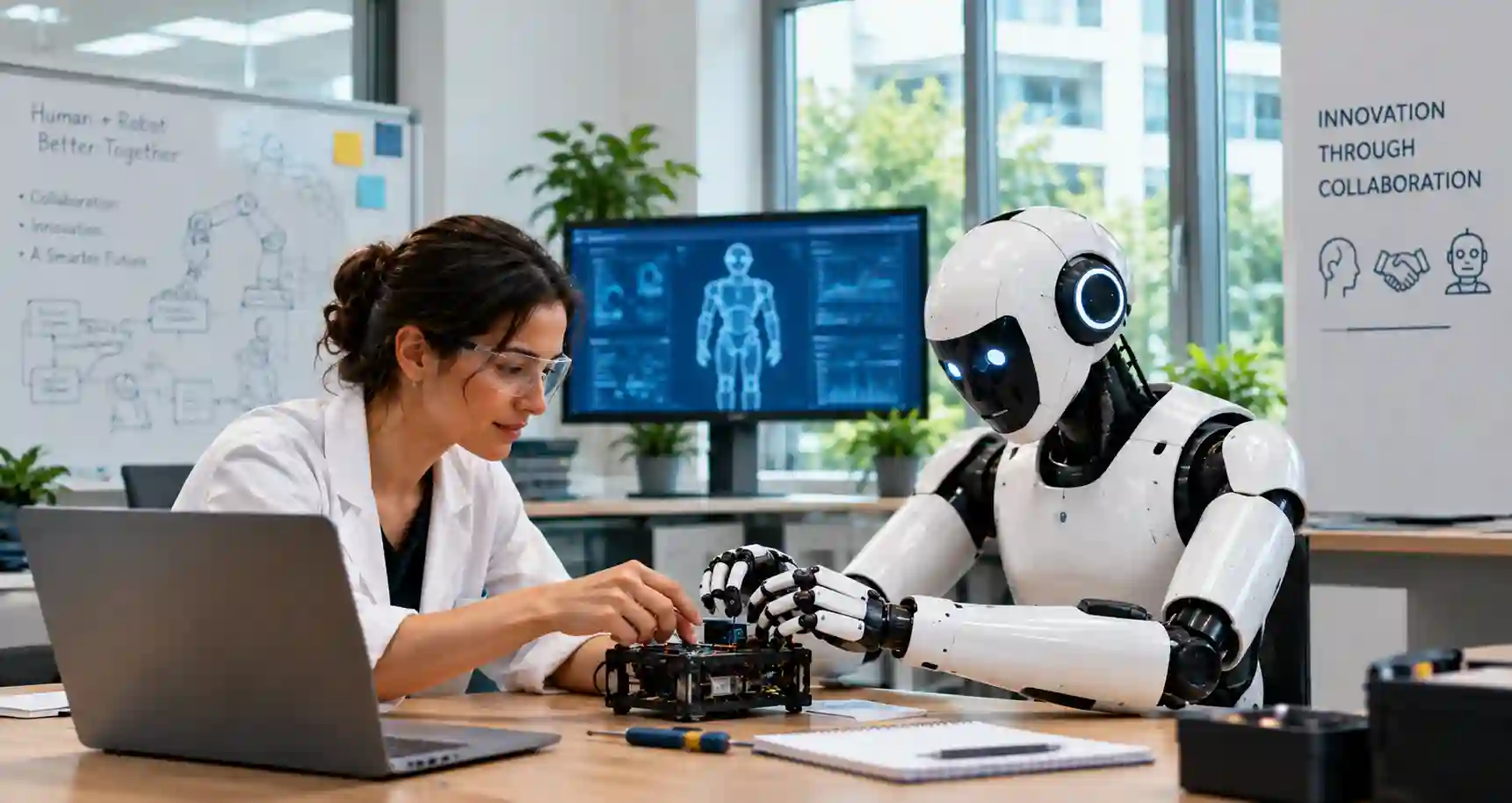
The immediate objective is not a humanoid robot that replaces a worker. The project is focused on a more practical model: a robot that behaves like an adaptive apprentice during complex maintenance and repair work.
That means understanding instructions, recognizing tools and parts, planning intermediate steps, manipulating objects safely, adapting to changing conditions and coordinating with a human partner.
What embodied AI actually means
Most modern AI systems operate on information. They read text, analyze images, generate software or answer questions.
Embodied AI adds another requirement: the system must act through a physical body.
That body may be a robotic arm, a mobile manipulator, a humanoid platform or another machine equipped with sensors and actuators.
The AI therefore has to connect perception to action.
A robot may need to identify a tool, understand what a person is trying to do, choose a safe grasp, move into position, regulate force and recover when the environment differs from its training examples.
Physical intelligence is unforgiving.
A language model can generate a poor answer and try again. A robot applying the wrong force can damage equipment or injure someone.
That is why embodied AI combines modern foundation models with control systems, reinforcement learning, sensing, planning and safety engineering.
Four technical work packages
The project is organized into four major research areas.
The first focuses on multimodal training data. Useful robotic datasets can include camera feeds, depth, joint positions, force measurements, human motion, language instructions and environmental context.
The programme plans to use AI-enhanced augmentation, sensing and mixed reality to create richer training material.
The second work package focuses on advanced robotic foundation models.
These systems are intended to connect perception, language, reasoning and planning so a robot can generalize beyond one hard-coded task.
The third develops AI-enhanced techniques for joint human-robot task execution.
This is where the robot has to understand what a human partner needs and coordinate its own behavior with that person.
The fourth focuses on interactive and collaborative execution in the real world.
The structure moves deliberately from data, to models, to coordination, to physical deployment.
Why robotic foundation models matter
Traditional industrial robots are highly effective when the environment is controlled.
The robot knows where an object will be. The tool is fixed. The motion is repeated. The task rarely changes.
Embodied AI targets the opposite situation.
A worker may put a component in a different orientation. A repair sequence may change after inspection. A tool may be missing. A person may need assistance before explicitly asking for it.
That is why the programme is studying robotic foundation models, including vision-language and vision-language-action approaches.
The goal is to create models that can connect what a robot sees, what it is told and what it should physically do.
Vision-language-action systems are central
A vision-language-action model extends multimodal AI into movement.
Vision interprets the environment.
Language helps the system understand instructions and concepts.
The action layer produces robot behavior.
Imagine a worker asking a robot to hold a panel while a connector is removed.
The robot has to identify the correct panel, understand the intention, choose a safe grasp, move into position, maintain the right force and react if the human changes posture.
For a person, that may be routine.
For a robot, it requires continuous coordination across perception, reasoning, planning and control.
Official project recruitment material confirms research on VLA models, mobile manipulation and whole-body control.
Reinforcement learning handles short-term physical control
Foundation models are useful for broad reasoning.
They are not naturally optimized for every low-level control decision.
A robot still has to calculate trajectories, regulate contact forces, avoid collisions and recover from errors.
The project is therefore combining robotic foundation models with reinforcement-learning and control-based approaches.
One official description explains the intended division: foundation models are used for generalized reasoning and policy formulation, while reinforcement learning helps generate trajectories and manipulation behavior.
The goal is to connect medium-term reasoning with fast physical control.
That hybrid architecture is likely to be important because reliable robots will need more than one class of model.
The robot as an intelligent apprentice
The most interesting part of the programme is its operating model.
The robot is not primarily framed as an autonomous replacement for a skilled worker.
It is framed as an intelligent apprentice.
The research use case focuses on complex industrial maintenance and repair.
The robot should learn from limited demonstrations, adapt to the preferences of an operator, understand the constraints of a specific task and provide physical or cognitive assistance without every action being manually programmed.
That changes the objective from full automation to collaborative intelligence.
For many industrial jobs, that may be more realistic than trying to remove people entirely.
Why maintenance is a demanding test case
Maintenance and repair are very different from repetitive assembly.
Equipment fails in unexpected ways.
Access can be awkward.
Parts may be worn, dirty or damaged.
Documentation may not match the exact condition of the machine.
Workers frequently rely on experience and judgment.
These conditions make maintenance a difficult robotics problem.
They also make it a useful one.
If a robot can assist reliably in a changing maintenance environment, many of the underlying capabilities can transfer to other sectors.
Those capabilities include object recognition, tool use, bimanual manipulation, instruction following, uncertainty handling and safe collaboration.
A broad France-Singapore research network
The official programme lists investigators from Singapore Management University and Ecole Centrale de Lyon as lead researchers.
Other principal investigators and co-investigators are affiliated with Nanyang Technological University, the National University of Singapore, A*STAR, the University of Montpellier, the University of Toulouse, Ecole Centrale de Nantes, CNRS and ENSTA.
French laboratories participating in the broader effort include groups working on robotics, control and embodied intelligence.
This breadth matters because embodied AI is inherently multidisciplinary.
A strong language model is not enough.
A strong robot mechanism is not enough.
The system also needs perception, control, hardware integration, efficient computing, safety and human factors.
Singapore’s CREATE programme provides the institutional base
The project is supported through Singapore’s National Research Foundation under the CREATE framework.
CREATE is an international research platform designed to bring global research organizations into long-term collaboration in Singapore.
Its stated mission is to support research that can translate into practical economic and societal outcomes.
Embodied AI is a natural fit.
Singapore has advanced manufacturing, logistics, infrastructure and service sectors where collaborative robots could be tested in structured but human-centered environments.
That creates potential pathways from research prototypes to operational systems.
The total project funding has not been publicly disclosed
The programme is officially described as supported by the National Research Foundation, Prime Minister’s Office, Singapore, through CREATE.
However, the official project sources reviewed for this article do not disclose a total funding amount for the four-year programme.
That number should not be inferred from other robotics grants or broader CREATE budgets.
The scale of the effort is better measured through its four-year duration, institutional participation, recruitment and technical scope.
Hiring shows a deployment-oriented programme
The project moved beyond its launch meeting during 2026.
CNRS@CREATE posted multiple research positions tied directly to Embodied AI.
Those roles reveal what the project is trying to build.
One focuses on efficient embodied AI for robotic platforms and edge devices.
The description includes robotic perception, planning, accelerated training for multimodal models and implementation on embedded systems such as the Jetson family.
Another role focuses on robotic manipulation using foundation models and VLA systems, including mobile manipulation and whole-body control with safety constraints.
A separate engineering role includes system integration, robot-mounted sensors, wearable sensors and mixed-reality platforms.
These are deployment problems, not only academic modeling problems.
Edge computing matters because robots cannot wait
A cloud-based AI service can sometimes tolerate delay.
A robot holding a component beside a person cannot.
Physical control decisions often need to happen locally and quickly.
That is why the programme is also studying optimized inference on embedded robotic hardware.
The challenge is significant.
Large multimodal models can require substantial computing resources.
A mobile robot has limited power, thermal capacity and onboard compute.
Researchers therefore have to reduce latency and memory requirements without removing the capabilities that make foundation models useful.
Embodied AI will scale only if intelligence can run close enough to the machine to remain responsive.
Mixed reality can expand training data
Real robot data is expensive.
Experiments require equipment, people, setup time and safety controls.
Hardware can break.
The first work package therefore includes mixed-reality data generation.
Mixed reality can capture how people move and react inside simulated or partially simulated tasks.
That data can help train robotic systems before expensive physical testing.
Synthetic and augmented data do not replace real-world data.
The challenge is ensuring that simulated experience transfers reliably into physical environments.
Safety is a core technical requirement
Human-robot collaboration sets a higher bar than ordinary AI.
A robot may work close to a person.
It may handle tools.
It may carry components.
It may operate near expensive equipment.
That means intelligence has to operate inside safe physical constraints.
Project roles explicitly mention whole-body control with safety constraints and learning systems for real-robot manipulation.
A useful embodied AI system cannot simply optimize for task completion.
It has to optimize within limits on force, motion, collision risk and human proximity.
The safest robot is not necessarily the fastest one.
Learning from limited demonstrations
Manual robot programming does not scale well to thousands of changing tasks.
The project therefore aims to enable robots to learn from a relatively small number of demonstrations.
A technician might show a robot how to hold a component during maintenance.
The robot should then generalize when the position, worker or equipment state changes.
That is harder than replaying a recorded motion.
The machine has to identify which parts of the demonstration are essential and which are accidental.
Foundation models may provide representations broad enough to support that generalization.
Human preference is part of the problem
Two skilled workers may perform the same repair differently.
One may want a tool passed from the left.
Another may want it placed on a surface.
One may prioritize speed.
Another may prefer additional checks.
The project explicitly aims to adapt assistance to individual operators.
That pushes robotics beyond task planning.
The robot has to model the human collaborator.
This could become one of the most important parts of workplace robotics.
A machine that understands the task but ignores the person may still be difficult to work with.
Embodied AI remains an immature field
The excitement around physical AI can obscure how much remains unsolved.
Robots still struggle with tasks humans consider trivial.
Cables deform.
Objects slip.
Drawers jam.
Tools vary.
Lighting changes.
Instructions can be ambiguous.
Physical mistakes have consequences.
The France-Singapore programme should therefore be understood as foundational research, not evidence that general-purpose collaborative robots are already solved.
Its four-year timeline reflects the difficulty of the problem.
What success would look like
The strongest outcome may not be one flagship robot.
It may be reusable methods.
Better multimodal datasets.
More efficient VLA models.
Safer manipulation.
Better anticipation of human intent.
Faster onboard inference.
More reliable whole-body control.
And demonstrations showing that a person and robot can complete complicated tasks together with less manual programming.
If those capabilities transfer across robotic platforms, the impact can extend well beyond maintenance.
The business significance comes later
The programme is research-led rather than a commercial product launch.
Still, its targets map directly to some of the biggest bottlenecks in industrial robotics.
Manufacturers want robots that can handle more variation.
Infrastructure operators want machines that can assist with inspection and repair.
Service industries want robots that can work in spaces designed around people.
The economic value will depend on whether embodied AI reduces the engineering effort required for each new task.
If every deployment requires months of custom programming, general-purpose robotics remains expensive.
If robots can learn more from demonstrations, language and shared foundation models, deployment economics change substantially.
The strict conclusion
The Embodied AI project launched in Singapore in January 2026 is an ambitious attempt to connect modern AI with the realities of physical work.
It is a four-year France-Singapore collaboration coordinated by CNRS@CREATE and the National Robotics Programme Singapore and supported through the National Research Foundation’s CREATE programme.
The research focuses on multimodal data, robotic foundation models, joint human-robot execution and real collaborative behavior.
Its central use case is industrial maintenance and repair.
Its central idea is the intelligent apprentice: a robot that learns from limited demonstrations, reasons about a task, manipulates objects safely and adapts to the person working beside it.
The programme does not prove that general-purpose embodied intelligence has arrived.
It shows where serious robotics research is concentrating.
The next major step in AI is not simply making models better at answering questions.
It is making machines understand enough about the physical world to be useful inside it.
Reader questions
Frequently asked questions
What is the Embodied AI project launched in Singapore?
It is a four-year research programme called Embodied AI for Human-Robot Collaborative Task Execution, focused on developing robots that can perceive, reason, manipulate objects and collaborate with people on physical tasks.
Who is coordinating the Embodied AI project?
The project is jointly coordinated by CNRS@CREATE and Singapore’s National Robotics Programme.
How long will the project run?
The official project period is January 2026 through December 2029.
Who funds the project?
The research is supported by the National Research Foundation, Prime Minister’s Office, Singapore through the CREATE programme. The official sources reviewed do not disclose a total project funding amount.
What technology is the project developing?
The programme is researching multimodal training data, robotic foundation models, vision-language-action systems, reinforcement learning, robot manipulation, embedded AI and safe human-robot collaboration.
What jobs are the robots expected to perform?
The core research use case is collaborative maintenance and repair of complex industrial equipment, where a robot would assist a human worker rather than simply repeat a fixed automated sequence.
What is a vision-language-action model?
A vision-language-action model connects what a robot sees and understands from language with the physical actions it should perform, helping it move from perception and instruction to manipulation.
Is the project building robots to replace human workers?
The official research concept emphasizes collaborative execution. The robot is described as an intelligent apprentice that learns from demonstrations and assists a human operator during complex tasks.
Nexuswild welcomes factual corrections. Email [email protected] with evidence and the article URL.