
European governments have continued a sustained build-up of military spending and capability through 2025 and 2026, driven by an assessment shared across NATO and European Union institutions that Russia's war in Ukraine and related hostile activity require a stronger, faster and more coordinated continental defence posture. From record national defence budgets in Germany and Poland to a new European Union loan instrument for joint weapons procurement and an ongoing NATO air-defence operation along the alliance's eastern flank, the measures span national, alliance-wide and EU-level action. This article sets out what has been confirmed by governments, NATO and the European Commission, distinguishes those confirmed actions from stated targets and future plans, and explains the security context, Russian reaction and broader implications involved.
Latest European Defence Developments
Germany has emerged as one of the most significant examples of the shift in European defence spending. Chancellor Friedrich Merz's government approved a draft 2026 federal defence budget of approximately €108.2 billion, combining roughly €82.7 billion in regular Bundeswehr funding with a €25.5 billion allocation from Germany's dedicated "Zeitenwende" special fund, established after Russia's 2022 invasion of Ukraine. The increase would raise German defence spending to approximately 2.8 percent of GDP in 2026, up from a level that only just met NATO's previous 2 percent guideline in 2024. Merz has said Germany intends to raise defence spending further, to 3.5 percent of GDP by 2029, with total annual spending projected to reach around €162 billion by that year. To fund the increase, Germany plans to issue approximately €174.3 billion in new government debt in 2026 for combined infrastructure and military investment. Reported procurement plans tied to this budget include the purchase of up to 1,000 Leopard 2A8 main battle tanks, 3,500 Boxer armoured vehicles, 5,000 Patria 6x6 trucks and approximately 20 additional Eurofighter jets. In July 2026, Merz met with the leaders of Latvia, Estonia and Lithuania in Berlin as part of preparations for a NATO summit held in Ankara on July 7 and 8, 2026, saying that the security of the Baltic states is "directly linked" to German and European security and that he wants to see NATO become "more European" while remaining a transatlantic alliance.
Poland has also confirmed a record national defence budget. Deputy Prime Minister and Defence Minister Władysław Kosiniak-Kamysz announced that Poland will allocate 200 billion zlotys, or approximately 48 billion dollars, to defence in 2026, equivalent to 4.8 percent of GDP and representing a tripling of Poland's defence budget since 2022. This makes Poland NATO's largest military spender relative to the size of its economy. Kosiniak-Kamysz has separately called on NATO members to reach the alliance's 5 percent of GDP defence spending target by 2030, five years earlier than the date currently agreed by the alliance, arguing that waiting until 2035 risked leaving the alliance underprepared.
The three Baltic states, Estonia, Latvia and Lithuania, have set among the highest relative defence spending targets in Europe. Estonia's Defence Minister Hanno Pevkur said Estonia is committed to allocating approximately 5.4 percent of GDP annually to defence from 2026 through 2029. Lithuania's president, Gitanas Nausėda, confirmed a decision by the country's National Defence Council to raise defence spending to more than 5 percent of GDP by 2026, in part to accelerate the development of an armoured division and tank battalion. Latvia has signalled a similar intention without yet confirming a fixed timeline. The three countries have also continued joint work on the Baltic Defence Line, a coordinated fortification and defence infrastructure initiative along their shared border regions with Russia and Belarus, which they have sought to fund in part through European Union mechanisms.
NATO and Regional Security
NATO's collective defence posture has been reinforced both through formal alliance-level commitments and through direct military deployments along its eastern flank. At the alliance's summit in The Hague on June 24 and 25, 2025, NATO members agreed a new defence spending target of 5 percent of GDP annually by 2035, split between 3.5 percent on core defence spending, up from the alliance's previous 2 percent guideline, and 1.5 percent on broader defence and security-related investment, including infrastructure and cyber capabilities. NATO defence ministers separately agreed a set of Capability Targets in June 2025, intended to guide how individual member states close specific gaps in collective defence capability.
Following a Russian drone incursion into Polish airspace on September 9 and 10, 2025, in which Poland's government said approximately 20 Russian military drones crossed into its territory during a night of Russian strikes on Ukraine, Polish and allied aircraft shot down several of the drones, the first time NATO forces had taken such action since Russia's 2022 invasion of Ukraine began. Poland invoked Article 4 of the North Atlantic Treaty, which allows any member state to request consultations when it believes its territorial integrity, political independence or security is threatened. NATO Secretary General Mark Rutte announced the launch of Operation Eastern Sentry on September 12, 2025, describing the incursion as "reckless and unacceptable" and stating that the operation was designed to reinforce air and missile defence along NATO's entire eastern flank, from the Baltic states to Romania and Bulgaria. NATO's Supreme Allied Commander Europe, US Air Force General Alexus Grynkewich, said the alliance intended to "defend every inch" of allied territory. Denmark, France, the United Kingdom and Germany were among the first countries to commit aircraft and other military assets to the operation, with additional allies joining in the following days. As of this report, Operation Eastern Sentry remains active, with no announced end date.
Russia has disputed Poland's characterization of the drone incursion as deliberate. Russia's ambassador to the United Nations, Vasily Nebenzya, told the UN Security Council that the drones involved had a maximum range that made it "physically impossible" for them to have reached Polish territory intentionally, a position Poland and its allies have rejected.
Defence Spending and Military Modernisation
Beyond the national budget increases described above, European nations have pursued military modernisation through a mix of national procurement and new EU-level financing mechanisms. The European Commission, under President Ursula von der Leyen, presented the ReArm Europe Plan on March 4, 2025, later rebranded Readiness 2030, alongside a White Paper for European Defence published on March 19, 2025. The plan is intended to help mobilise up to €800 billion in additional European defence spending, primarily by allowing EU member states to use the "national escape clause" of the EU's Stability and Growth Pact, permitting temporarily higher deficit spending specifically for defence investment, alongside a greater role for the European Investment Bank Group in financing security-related projects.
The central financing pillar of this plan is the Security Action for Europe instrument, known as SAFE, a €150 billion EU loan facility adopted by the Council of the European Union on May 27, 2025, with its founding regulation entering into force on May 29, 2025. SAFE allows the European Commission to borrow on capital markets, using the EU's credit rating to secure favourable terms, and then lend the proceeds to member states for joint defence procurement, with a particular focus on air and missile defence, drones and other strategic capabilities. Member states were required to submit national investment plans by November 30, 2025. On January 16, 2026, the European Commission approved the first wave of SAFE loan plans, covering Belgium, Bulgaria, Denmark, Spain, Croatia, Cyprus, Portugal and Romania, with this initial group entitled to approximately €38 billion once loan agreements are finalised. Poland's confirmed first disbursement under the programme was listed at approximately €6.56 billion. According to reporting citing the Financial Times, the first tranche of SAFE payments, expected to total approximately €22.5 billion, was scheduled to begin in March 2026. The European Council separately approved the start of negotiations with the United Kingdom and Canada regarding possible participation in SAFE procurement, though the United Kingdom later decided not to proceed, concluding that joining the EU-wide procurement framework was not cost-effective for its own defence industry.
Despite this scale of announced spending, independent policy analysis has raised questions about whether increased spending alone translates directly into deployable military capability. Analysis published by the Brussels-based organisation Friends of Europe noted that fragmented national procurement priorities across European countries have historically limited the continent's ability to convert higher budgets into coherent, interoperable military capacity, while separate research from the European Defence Agency has estimated that a lack of cooperation between EU member states results in annual inefficiencies of approximately €25 billion. These are assessments from policy researchers rather than official government positions, and this article presents them as such.
Russia's Response
Russian officials have consistently characterised Europe's defence build-up as directed against Russia, while also stating that it does not, in their assessment, constitute a serious threat given Russia's own military capacity. Kremlin spokesman Dmitry Peskov said in March 2025, following the EU's announcement of the ReArm Europe plan, that "all this militarization is mainly directed against Russia," adding that the EU's approach was a cause for concern that Russia would need to respond to with its own security measures.
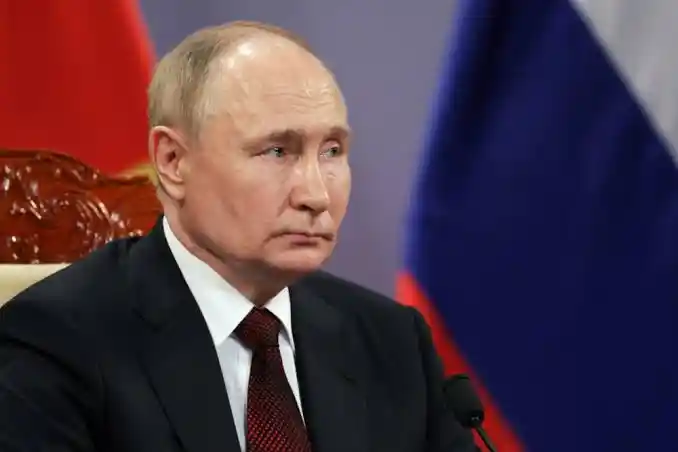
Russian President Vladimir Putin addressed the issue directly at a press conference in Saint Petersburg on June 19, 2025, days before NATO's Hague summit. "We do not consider any rearmament by NATO to be a threat to the Russian Federation, because we are self-sufficient in terms of ensuring our own security," Putin said, adding that Russia was "constantly modernising our armed forces and defensive capabilities." He acknowledged that an increase in NATO defence spending to 5 percent of GDP would create what he called "specific challenges" for Russia, but said such spending "makes no sense" for NATO's own members. "We will counter all threats that arise. There is no doubt about that," he said.
Russian Deputy Foreign Minister Alexander Grushko offered a more pointed assessment in comments to the Russian news agency RIA Novosti, stating that NATO's rearmament, reformed command structure and creation of new commands were "largely tailored to prepare for a military clash with Russia." Russia's Foreign Ministry has separately stated that Moscow remains open to dialogue with NATO, but said any such dialogue would need to occur "on equal terms."
Expert and Official Views
Officials across the countries increasing their defence spending have consistently framed the measures as necessary responses to an assessed Russian threat rather than preparation for offensive action. Germany's Chancellor Merz has tied Germany's spending increases directly to the security of NATO's Baltic members, stating that their security is "directly linked" to German and broader European security. Poland's Kosiniak-Kamysz has argued that Europe possesses sufficient economic capacity to meet higher spending targets but needs clearer prioritisation, warning that delaying full implementation of NATO's targets until 2035 risked leaving the alliance unprepared if Russia's military posture continues to strengthen on a faster timeline.
Independent research organisations focused on European security have offered more cautious assessments of the continent's overall preparedness. A policy brief from the Centre for European Reform noted that a number of European intelligence agencies assess that Russia may attempt to test NATO's collective defence commitment by 2030, and identified persistent gaps in European military mobility infrastructure, including roads and bridges not built to the standards required to move heavier NATO-standard military equipment, as an area requiring further investment alongside headline spending increases. This represents an assessment from an independent research organisation rather than an official NATO or government position, and this article presents it accordingly. Separately, research published in the academic journal Intereconomics has documented that European countries closer to Russia and Ukraine, including the Baltic states and Poland, have increased their defence spending as a share of GDP by significantly larger margins since 2014 than countries in Western and Southern Europe, a pattern researchers described as a "distance-decay" dynamic linked to geographic proximity to the conflict.
Economic and Strategic Implications
The scale of Europe's defence spending increases carries clear economic implications alongside their strategic aims. Germany's plan to issue approximately €174.3 billion in new debt in 2026 to fund infrastructure and military investment represents a significant shift in German fiscal policy, a country that has historically maintained more conservative approaches to public borrowing. Poland's tripling of defence spending since 2022 and commitment to a record 2026 budget similarly represents a substantial reallocation of public resources toward the military sector. Across the EU, the SAFE loan instrument's structure as debt rather than grant funding means that participating member states will carry repayment obligations for the defence investments financed through the programme, a factor governments will need to weigh against other fiscal priorities in the coming years.
Strategically, the shift toward higher defence spending has been explicitly linked by several European governments to reducing reliance on the United States for European security guarantees, a theme Chancellor Merz raised directly in calling for NATO to become "more European." At the same time, the SAFE programme and broader Readiness 2030 framework have been designed to prioritise joint procurement across EU member states specifically to reduce fragmentation in European defence industrial capacity, an area independent researchers have identified as a persistent weakness even as headline spending has increased. Whether this joint procurement approach successfully translates rising budgets into more coherent and interoperable European military capability, as opposed to the historically fragmented outcomes independent analysts have documented, remains to be determined based on how the SAFE programme and national procurement plans are implemented over the coming years. This article does not predict that outcome.
Conclusion
European nations have pursued a sustained, multi-track increase in defence spending and military readiness through 2025 and 2026, spanning record national budgets in Germany and Poland, some of the highest relative defence spending commitments in Europe from the Baltic states, a new €150 billion EU loan instrument for joint procurement under the SAFE programme, and an ongoing NATO air-defence operation along the alliance's eastern flank launched in response to a confirmed Russian drone incursion into Polish airspace. These measures have been consistently framed by European and NATO officials as necessary responses to Russia's war in Ukraine and related security concerns, while Russian officials have characterised the build-up as directed against Russia even as they maintain that it does not constitute an existential threat given Russia's own military capacity. Independent researchers have cautioned that translating higher spending into coherent, interoperable military capability remains an ongoing challenge for Europe, distinct from the scale of the financial commitments themselves. How these parallel national, EU and NATO-level efforts develop over the coming years will depend on decisions and implementation details that have not yet been finalised, and this article does not speculate about their eventual outcome.
Further reading and useful links
Reader questions
Frequently asked questions
Which European countries are leading the increase in defense spending?
Germany and Poland have each confirmed record 2026 defense budgets of approximately €108.2 billion and 200 billion zlotys ($48 billion) respectively, while Estonia, Latvia, and Lithuania have set targets exceeding 5 percent of GDP.
What is NATO's new defense spending target?
At its June 2025 Hague summit, NATO agreed on a new defense spending target of 5 percent of GDP annually by 2035, significantly up from its previous 2 percent guideline.
What is the EU's SAFE loan instrument?
The Security Action for Europe (SAFE) is a €150 billion EU loan facility adopted in May 2025 designed to fund joint defense procurement across member states, particularly focusing on air and missile defense and drones.
Nexuswild welcomes factual corrections. Email [email protected] with evidence and the article URL.