
Russia is grappling with a deepening domestic fuel crisis after a sustained campaign of Ukrainian drone strikes knocked out a large share of the country's oil-refining capacity, forcing regional authorities to ration gasoline and diesel and pushing Moscow to seek refining capacity abroad. The disruption, which has built steadily since August 2025 and intensified through the summer of 2026, has become one of the most economically significant elements of Ukraine's long-range strike campaign against Russia.
What the Strikes Have Hit
Reuters reported this week that three of Russia's six largest diesel-producing refineries have halted or sharply cut output in September 2026. Those six facilities, the Kirishi refinery in Leningrad Oblast, NORSI in Nizhny Novgorod, Taneco in Tatarstan, the Omsk refinery in Siberia, the Perm refinery in Perm Krai and the Volgograd refinery, together account for roughly half of Russia's total diesel production, according to Reuters' analysis of market data cited by the Kyiv Independent. Kirishi has shut down completely, while NORSI and the Volgograd refinery are running at only about a quarter of capacity, sources told Reuters.
The Kirishi refinery, also known as KINEF and ranked as Russia's second-largest by capacity, fully stopped processing on September 2, 2026, according to reporting by the Kyiv Post. Separately, the Carnegie Endowment for International Peace reported that Ukrainian drones struck the Ust-Luga export terminal repeatedly over a two-week period, damaging sixteen of its fifty-four storage tanks, with five suffering severe damage, and that a similar pattern of damage followed attacks on the Grushovaya oil depot near Novorossiysk.
The Kyiv Post, citing figures it attributed to tracking of the strikes, reported that Ukrainian drones have hit Russian oil refineries at least 70 times since the start of 2026. This figure comes from Kyiv Post's own reporting and has not been independently verified by this publication against an official count from either government.
Effect on Russia's Domestic Fuel Supply
The disruption has visibly strained Russia's domestic fuel market. By the end of August 2026, gasoline production covered only around 70% of domestic demand, according to the Kyiv Post, leaving a reported shortfall of roughly 30,000 tons per day. Al Jazeera reported in July that an unnamed energy analyst told the outlet "indirect evidence indicates that Ukrainian drone attacks have disabled about a quarter of Russia's oil refining capacity," a claim attributed specifically to that analyst rather than confirmed by official Russian data.
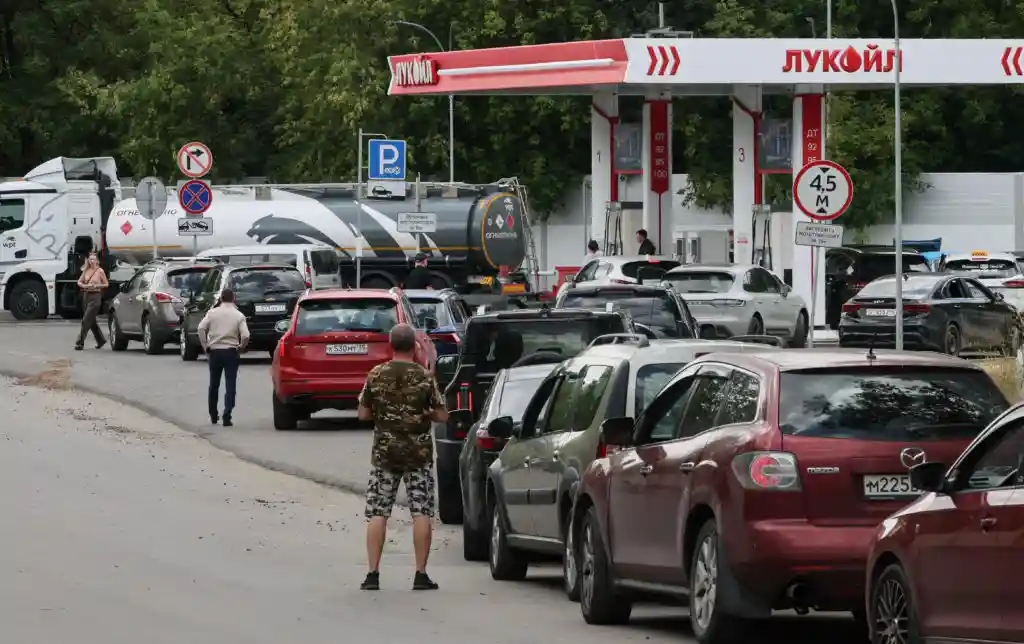
At least 17 Russian regions have introduced fuel-sale restrictions, the Kyiv Post reported, including limits of 30 to 40 liters per vehicle in some areas and "odd-even" purchase systems tied to license plate numbers. In Leningrad Oblast, where the Kirishi refinery has halted operations, regional governor Alexander Drozdenko said on September 15 that newly introduced fuel limits at gas stations were intended as a temporary measure, according to Reuters' reporting via the Kyiv Independent. Crimea, under Russian control, declared a state of emergency in June 2026 and banned fuel sales at one point, according to Wikipedia's summary of contemporaneous reporting on the crisis, a step that reflected how acute shortages had become in some regions.
Russia's Response
Russian President Vladimir Putin acknowledged the scale of the disruption directly. According to the Kyiv Post's reporting on comments he made around September 3, Putin said Russia was "mistaken" in its preparedness for the wave of Ukrainian strikes on oil refineries, and said Russian oil companies were working to strengthen defenses around their facilities and restore damaged production.
At a government level, Moscow has extended a ban on diesel exports through the end of September as part of what CNBC described as a push to stabilize domestic fuel supplies. Radio Free Europe/Radio Liberty reported on September 1 that Russia had also struck a deal to use a small private refinery in Kazakhstan to process crude oil abroad, as domestic refining capacity remained constrained.
Ukraine's Position and Strategic Rationale
Ukraine has not disguised the intent behind the campaign. According to the Kyiv Independent's characterization of the strategy, Ukraine has increasingly targeted Russian refineries specifically to disrupt fuel supplies and reduce the energy revenues that help finance Moscow's war effort, a strategic rationale widely reported but attributed to Ukraine's broader stated approach to long-range strikes rather than to a single official statement quoted in the sources reviewed here.
The strikes have also become a point of friction with the United States. CNBC reported that President Donald Trump, during an official visit to Ireland, said Ukrainian President Volodymyr Zelenskyy "has to stop knocking out diesel fuel in Russia," adding: "Let him go after targets but not diesel fuel because he's causing a shortage of diesel." CNBC reported that a spokesperson for Ukraine's Foreign Ministry was not immediately available to comment when contacted. This is a specific, attributed political statement from Trump, not confirmation of any change in Ukrainian strategy.
Wider Market and Export Effects
The disruption has shifted the composition of Russia's oil trade. The Carnegie Endowment noted that crude exports have risen even as exports of refined oil products have fallen, since Ukraine's shift in targeting toward refineries has made it harder for Russia to refine oil domestically in the first place. CNBC also reported that the situation has contributed to record diesel prices and that oil markets are approaching what one cited analyst described as an "inflection point," a characterization attributed to that named commentary rather than presented as an independent market conclusion.
What Remains Uncertain
Several aspects of the crisis remain disputed or unconfirmed. Estimates of exactly how much refining capacity has been disabled vary by source, ranging from roughly a quarter of capacity, per the Al Jazeera-cited analyst, to more specific figures tied to individual refineries reported by Reuters. No independently verified, comprehensive nationwide damage assessment from a neutral third party was identified in the sources reviewed for this article, and figures on the total number of strikes and their cumulative effect should be treated as best current estimates from named news organizations rather than confirmed totals.
Outlook
With diesel export bans extended through September, regional fuel rationing in place across at least 17 regions, and several of Russia's largest refineries still operating at reduced capacity or fully offline, the near-term outlook for Russia's domestic fuel market remains constrained. Whether Russia can restore refining capacity faster than Ukraine can continue targeting it is likely to remain the central, unresolved question shaping the fuel market in the months ahead.
Further reading and useful links
Reader questions
Frequently asked questions
Why is Russia facing a fuel crisis?
A sustained campaign of Ukrainian drone strikes on Russian oil refineries since August 2025 has knocked out or reduced output at several major facilities, cutting domestic gasoline and diesel production and forcing fuel rationing in multiple regions.
Which Russian refineries have been most affected?
Reuters reported that three of Russia's six largest diesel-producing refineries, including Kirishi in Leningrad Oblast, NORSI in Nizhny Novgorod and the Volgograd refinery, halted or sharply cut output in September 2026. Kirishi has shut down completely.
How has Russia responded to the fuel shortages?
Moscow has extended a ban on diesel exports through the end of September 2026, introduced regional fuel rationing measures, and arranged to process some crude oil at a refinery in Kazakhstan, according to Reuters and RFE/RL.
Has Russia confirmed how much refining capacity has been lost?
No official, verified nationwide figure has been confirmed. Estimates vary by source, with one analyst cited by Al Jazeera suggesting roughly a quarter of capacity has been disabled, while other outlets report facility-specific disruptions.
Is the fuel crisis affecting global oil markets?
CNBC has reported that the disruption has contributed to record diesel prices and that some analysts describe oil markets as nearing an "inflection point," though this reflects named analyst commentary rather than a confirmed market consensus.
Nexuswild welcomes factual corrections. Email [email protected] with evidence and the article URL.