
BHUBANESWAR/JAKARTA, Sept. 11, 2026 - What began as an extraordinary wildlife sighting in coastal Odisha has, within three days, become an international conservation and trafficking case involving Indian investigators, Indonesian authorities, veterinarians and wildlife regulators.
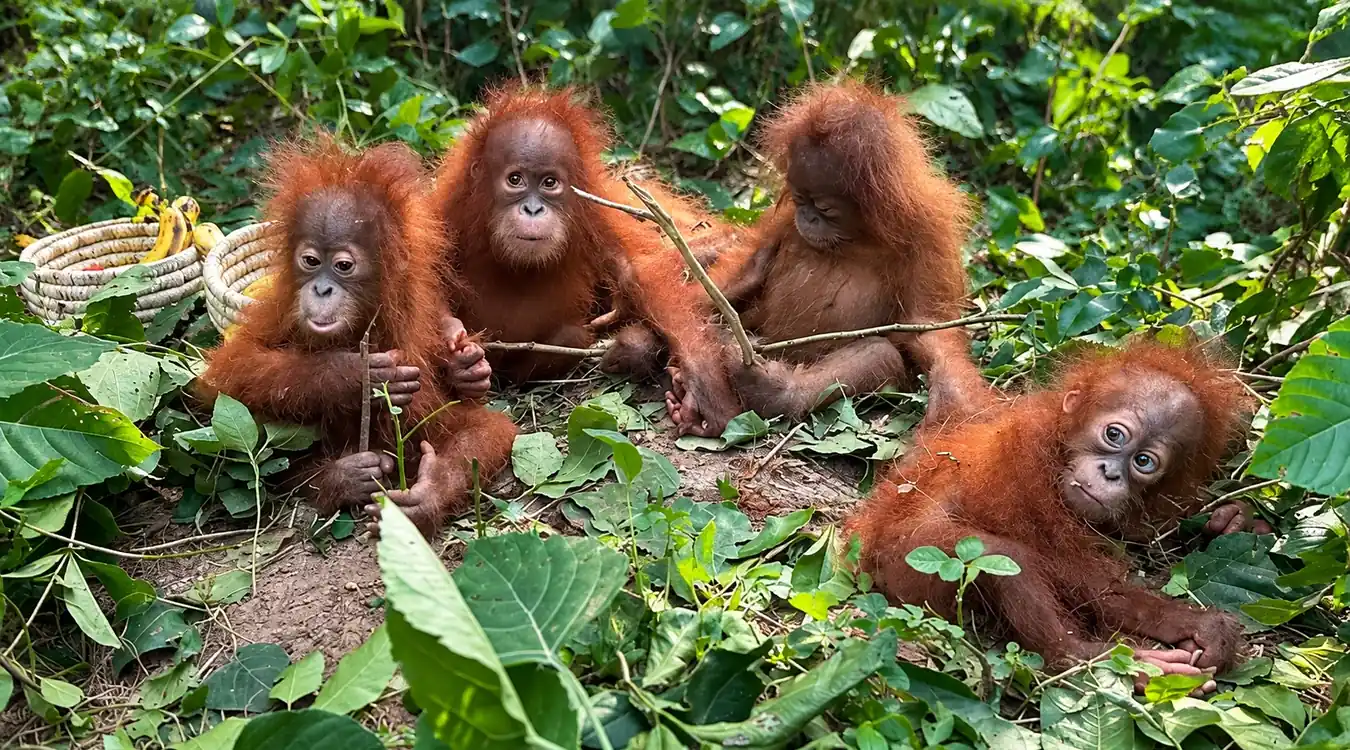
Five juvenile orangutans were found on September 8 in the Bichitrapur-Udaipur forest belt of Balasore district, close to the West Bengal border. Orangutans are not native to India. Their natural range is restricted to parts of Indonesia and Malaysia, which means their presence in an Odisha forest cannot be explained by natural migration.
That immediately made the case more than a rescue.
It became a suspected wildlife-trafficking investigation.
The five animals were moved to Nandankanan Zoological Park in Bhubaneswar, placed in quarantine and assigned dedicated keepers and veterinary supervision. Since then, authorities have been trying to answer three questions: where the animals came from, how they reached India and what should happen to them next.
Indonesia has now entered the process formally and is seeking repatriation if the animals’ origin is confirmed.
September 8: Five orangutans appear in Balasore
The case began when local people and forest personnel encountered five young orangutans in a casuarina forest in the Bhograi-Udaipur area of Balasore.
The animals were grouped together and were clearly outside their natural range.
Forest personnel secured them as crowds gathered and initially moved them into local forest custody for observation.
The basic biological fact was enough to raise alarm.
India has no wild orangutan population and no ecological corridor connecting Odisha to Sumatra or Borneo.
The five juveniles had been transported by people at some stage.
What remained unknown was who moved them, from where and for what purpose.
September 8 night: Shift to Nandankanan
The animals were moved to Nandankanan Zoological Park in Bhubaneswar on Tuesday night and placed in quarantine.
The zoo established a controlled care routine because young orangutans are highly dependent animals.
Dedicated keepers were assigned in shifts.
Veterinary staff monitored temperature, hydration, appetite and behaviour.
The infants were kept together, which may help reduce stress because they appear strongly bonded as a group.
Zoo staff also used biosecurity precautions. Great apes can be vulnerable to human pathogens, so keepers were assigned specifically to the orangutans and instructed to minimise cross-contact with other animals.
Their feeding schedule included fruits, milk and other age-appropriate food, with frequent feeding for the youngest individuals.
September 9: The case becomes a wildlife-crime investigation
By September 9, the focus had expanded from rescue to law enforcement.
Odisha’s Special Task Force began investigating how the animals reached Balasore.
The Forest Department and wildlife-crime authorities were also brought into the case.
The investigation has to reconstruct more than the final road journey.
If the animals came from Sumatra, the route would involve international movement from Indonesia into India.
If they came from Borneo, another international pathway would be involved.
Authorities are examining possible interstate and international links, vehicle movements and local evidence.
What is not yet publicly established is the full trafficking chain.
No complete route has been confirmed.
No final buyer has been identified publicly.
And no authoritative account has yet explained why the animals were left in the Balasore forest.
The age of the animals is still being assessed
Different early reports have given different age estimates.
Some Indian assessments described the animals as roughly six months to one year old.
Indonesian reporting based on ministry information described them as about one-and-a-half years old.
That discrepancy does not change the central fact that all five are juveniles.
Precise age in confiscated wildlife is often estimated from body development, dentition and veterinary examination.
The more important biological point is that young orangutans remain dependent on their mothers for years.
Finding five juveniles without adult females therefore raises a serious conservation question.
What happened to their mothers is not yet known.
It would be irresponsible to claim they were killed without evidence.
But the absence of mothers is itself a major warning sign in any suspected live great-ape trafficking case.
September 9 and 10: Quarantine and intensive care
At Nandankanan, the immediate priority became stabilisation.
The orangutans were kept in a temperature-controlled quarantine environment.
Three keepers were assigned exclusively to them, working in shifts.
Veterinary supervision continued around the clock.
Officials said the animals were gradually becoming more active and playful, although they were also showing anxiety as they adjusted to unfamiliar surroundings.
The youngest animals required particularly frequent care.
This is an important part of the case because evidence collection cannot come at the expense of welfare.
That became clear when authorities considered DNA sampling.
September 10: DNA testing is postponed
DNA testing is necessary because physical appearance alone cannot conclusively establish species or geographic origin.
Indonesia’s Forestry Ministry has said preliminary physical characteristics suggest the five may be Sumatran orangutans.
That is not yet a confirmed identification.
Nandankanan authorities postponed DNA sampling for at least 10 days after veterinary experts advised that the animals had not fully stabilised emotionally.
The decision highlights a basic tension in wildlife-crime investigations.
Investigators need biological evidence.
Veterinarians need to minimise stress.
The animals’ welfare has to come first.
Once samples are collected, genetics could help determine whether they are Sumatran orangutans and may provide clues about their geographic origin.
September 10: Indonesia starts formal repatriation effort
Indonesia’s Ministry of Forestry issued an official statement on September 10 confirming that it was coordinating with Indian authorities.
The ministry said it was pursuing three immediate objectives:
verify the animals’ origin, ensure appropriate care, and seek repatriation if Indonesian origin is established.
The ministry said communication had begun with the Indian government through the Indian Embassy in Jakarta.
It also said conservation organisations were being contacted to support rehabilitation.
That changed the case from a domestic wildlife seizure into a bilateral conservation issue.
Why Indonesia suspects Sumatran orangutans
Indonesia’s preliminary view is based on physical characteristics.
The Sumatran orangutan, Pongo abelii, is critically endangered and native to Sumatra.
The Bornean orangutan, Pongo pygmaeus, occurs on Borneo.
The Tapanuli orangutan, Pongo tapanuliensis, is restricted to a small area of northern Sumatra.
All three are listed in CITES Appendix I, the convention’s highest level of trade protection.
That means commercial international trade in wild-caught animals is generally prohibited except under narrow circumstances allowed by the convention.
If the five animals prove to be wild-origin Sumatran orangutans, the conservation stakes are particularly high.
Orangutans reproduce slowly.
Removing even a small number of young animals from the wild can have an outsized effect on a population.
September 11: India and Indonesia now face a custody decision
By September 11, two possible futures had emerged.
Indonesia was seeking repatriation.
At the same time, the Odisha government had asked the Central Zoo Authority for permission to keep the animals at Nandankanan.
As of the latest public information, the CZA had not announced a final decision.
This does not mean India has rejected Indonesia’s request.
It also does not mean the animals will remain permanently in Odisha.
The outcome depends on several unfinished processes:
species identification, origin verification, wildlife-crime investigation, CITES coordination, Central government decisions, zoo-regulatory approval, veterinary fitness, quarantine, and the availability of an appropriate rehabilitation plan.
Until those steps are complete, any definitive claim about permanent custody would be premature.
Repatriation is more complicated than simply sending the animals home
Returning confiscated wildlife across borders is a technical process.
Authorities need to establish identity and origin.
They need health clearance.
They need documentation and regulatory coordination.
They need a receiving institution capable of caring for the animals.
And they need to decide whether eventual release is possible.
For young orangutans, rehabilitation can take years.
Animals raised by people may have to learn natural feeding, climbing, nest-building and avoidance of human dependence.
The conservation goal is therefore not simply to transfer them to another country.
It is to maximise their long-term welfare and, if possible, conservation value.
The investigation may be more important than the seizure
The most important law-enforcement question extends beyond these five animals.
Moving live great apes across international borders usually requires more than one person.
There can be capture teams, intermediaries, transporters, holding locations, documents, vehicles, brokers and buyers.
If investigators can reconstruct the chain, the case could reveal a trafficking network rather than only the people who handled the animals in Odisha.
That is why coordination between state police, forest officials, wildlife-crime authorities and international counterparts matters.
A rescue saves the animals already found.
A successful investigation can reduce the chance that more animals are taken.
The social-media market is part of the wider risk
CITES has repeatedly warned that live great apes can be trafficked for private collections, entertainment and commercial display.
Young apes are especially vulnerable because they attract buyers and social-media attention.
That demand creates a hidden conservation cost.
An infant orangutan is rarely separated from its mother under normal conditions.
The capture of a young animal can therefore represent more ecological damage than the single animal visible in a seizure.
Why this case is so unusual
India has zoos and institutions that legally keep exotic wildlife.
Finding five orangutan infants together in an Odisha forest is completely different.
There is no natural population.
There is no migration route.
There is no plausible ecological mechanism that would place them there.
The scientific question is not how they migrated.
The investigative question is who moved them.
What is confirmed as of September 11
Five juvenile orangutans were found in Balasore district on September 8.
They were shifted to Nandankanan Zoological Park.
They are in quarantine under specialist care.
Indian authorities are investigating suspected wildlife trafficking.
Indonesia has formally begun coordination with India and is seeking repatriation if Indonesian origin is confirmed.
Preliminary physical assessment suggests they may be Sumatran orangutans.
DNA testing has been delayed temporarily to reduce stress.
Odisha has separately asked the Central Zoo Authority for permission to keep them at Nandankanan.
No final custody decision has been announced.
What is still unknown
The exact species.
The precise geographic origin.
The exact age of each animal.
The route used to bring them into India.
The people who captured or transported them.
The intended buyer or destination.
Why they were left in Balasore.
Whether they will ultimately remain in India or return to Indonesia.
Those gaps are important.
Suspicion should not be presented as proven fact.
The strict conclusion
Three days ago, the five orangutans were an unexplained sighting in an Odisha forest.
Today, they are under quarantine, India is investigating a suspected trafficking network, Indonesia is seeking their return, DNA testing is pending and the Central Zoo Authority has yet to determine their long-term placement.
The facts already establish one extraordinary point.
These animals did not reach Odisha naturally.
The decisive next step is to reconstruct the human route that brought them there.
Reader questions
Frequently asked questions
When were the five baby orangutans found in Odisha?
They were found on September 8, 2026 in Balasore district, Odisha.
Are orangutans native to India?
No. Wild orangutans are native to parts of Indonesia and Malaysia, not India.
Where are the rescued orangutans now?
They are in quarantine at Nandankanan Zoological Park in Bhubaneswar.
Are they confirmed to be Sumatran orangutans?
Not yet. Their physical characteristics suggest Sumatran orangutans, but DNA testing is needed for confirmation.
Will they be returned to Indonesia?
Indonesia is seeking repatriation if their origin is confirmed, but the final outcome depends on genetic verification, legal coordination, animal health and decisions by Indian authorities.
Nexuswild welcomes factual corrections. Email [email protected] with evidence and the article URL.