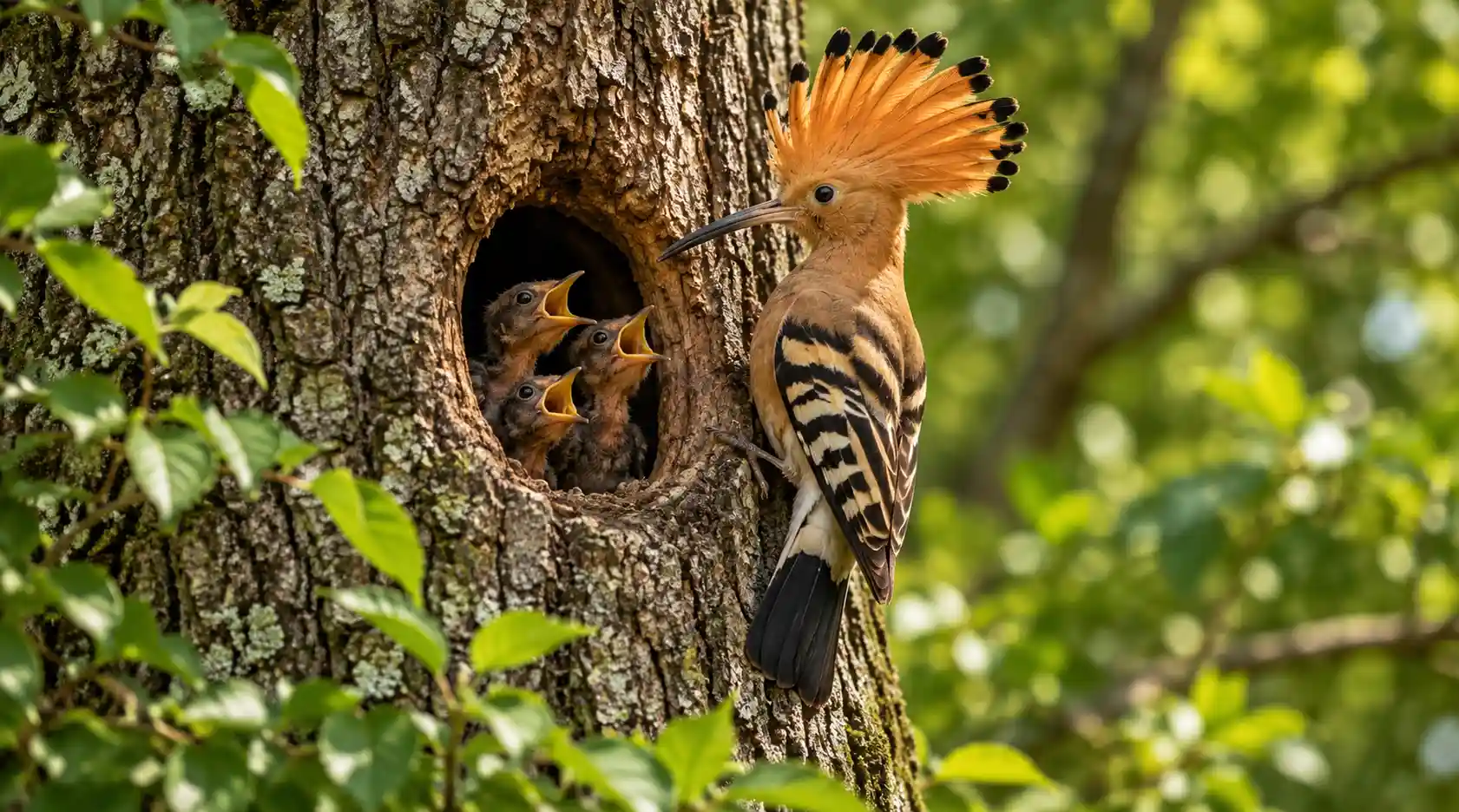

A snake or small carnivore probing a tree cavity for an easy meal of nestlings doesn't usually expect to be met with the smell of decay. But approach an active hoopoe nest and that's roughly what happens - an odour closer to rotting flesh than to baby birds, wafting from a hole that, on the surface, looks like any other tree cavity. It isn't a trick of decomposition. It's a deliberate biological output, produced by the female hoopoe and her chicks, and it's one of the more unusual defence strategies documented in birds.
A Family-Level Trait
The behaviour is best studied in the Eurasian hoopoe (*Upupa epops*), a widespread, crested, black-and-white-winged bird found across Europe, Asia and Africa, with the African hoopoe reported to show similar habits. The trait isn't unique to hoopoes alone, though - it's shared with their closest relatives, the woodhoopoes of the family Phoeniculidae, including the green (or red-billed) woodhoopoe. Together, hoopoes and woodhoopoes appear to be the only birds known to rely on this particular combination of glandular secretion and bacterial partnership, making it a family-level trait rather than a one-species oddity, and still genuinely rare across the roughly 11,000 living bird species.
The Source of the Smell
The source of the smell is the uropygial gland, also called the preen gland, a structure at the base of the tail that nearly all birds use to produce the oily secretion they spread through their feathers while preening, mainly to keep plumage flexible and water-resistant. In most birds this secretion is pale and largely odourless. In breeding female hoopoes, the gland swells noticeably and begins producing something different: a thick, dark brown, strongly malodorous liquid.
The female works this into her own feathers and rubs it onto her eggs. Roughly six days after hatching, the chicks develop the ability to produce a version of this same secretion themselves, and continue doing so until shortly before they leave the nest.
Chemically, the smell has been tied to dimethyl sulfide, a compound strongly associated with decaying organic matter, identified within the secretion by researchers at Iran's University of Isfahan. That's a large part of why the comparison to rotten meat keeps coming up in descriptions of the species - it isn't a loose metaphor, but a reasonably specific chemical resemblance. Importantly, though, the odour doesn't come from actual decomposing flesh anywhere near the nest; it's generated by the gland's secretion chemistry itself.
Symbiotic Bacteria and Nest Hygiene
What makes the hoopoe's version of this secretion unusual isn't just its smell, but where that smell - and its antimicrobial punch - actually comes from. Peer-reviewed work on the gland's microbiology has identified symbiotic bacteria living inside it, including strains of *Enterococcus faecalis*, which produce antimicrobial compounds known as bacteriocins. Research summarized by Birds of the World describes this as the only confirmed example among birds of a species gaining antibiotic protection through this kind of bacterial partnership housed in the preen gland. In other words, the secretion isn't simply a chemical the bird's own gland tissue manufactures - its dark colour, pungent odour and antimicrobial properties appear to depend substantially on the bacteria living inside the gland, a genuinely unusual arrangement even by the standards of animal-microbe symbiosis.
Nest hygiene plays into this in a way that's specific to hoopoes among cavity-nesting birds. Many hole-nesting species regularly remove fecal sacs and debris to keep the nest relatively clean, reducing the buildup of material that pathogens can exploit. Hoopoes, by contrast, tend to reuse the same cavities across breeding seasons and are notably lax about clearing out feces and food remains, according to research on the seasonal microbiota of the hoopoe uropygial secretion.
Left unmanaged, that kind of buildup would normally raise infection risk considerably in a confined, humid cavity. The prevailing scientific interpretation is that the antimicrobial bacteria in the glandular secretion offset some of that risk, effectively seeding the nest environment with compounds that suppress harmful microbes the accumulated debris might otherwise encourage. Between the unmanaged nest debris and the secretion itself, hoopoe nests end up with a distinctly stronger, more complex smell than the tidier cavities kept by many other hole-nesting birds.
An Antimicrobial Shield for Eggs
The eggs get a related, separate layer of protection. Researchers in Spain found that hoopoe eggshells carry microscopic surface pits that catch and retain the bacteria-laden secretion as the female applies it. Science writer Ed Yong, summarizing the findings, described the effect as the microbes and the antimicrobial compounds they produce forming a kind of living shield on the shell surface - one that appears positioned to intercept harmful bacteria before they can travel through the shell's natural pores to reach the developing embryo.
Last-Resort Physical Defences
Beyond the chemical and microbial defences, hoopoe chicks have their own more direct, behavioural repertoire once a threat gets close. Field and natural history accounts describe nestlings hissing in a manner that resembles a snake, striking out with their bills, and directing jets of feces toward an approaching intruder's face - a set of responses collectively aimed at making the encounter unpleasant enough that a predator gives up. These behaviours appear early in a chick's development, well before it's capable of flight, and are described consistently across wildlife references, though they've been documented less rigorously in controlled, peer-reviewed experiments than the gland's chemistry and microbiology have been.
How well any of this actually works against real predators in the wild is harder to pin down precisely. The antimicrobial side of the story has fairly solid peer-reviewed backing - the identification of specific bacteria, the bacteriocins they produce, and the eggshell-pit mechanism all come from published research. The predator-deterrent function is more of a well-supported working hypothesis than a measured outcome: it's inferred from the secretion's precise timing (appearing only during the vulnerable nesting period, in females and chicks specifically, and stopping once chicks are close to fledging) and from comparative evidence across the hoopoe-woodhoopoe lineage, rather than from a controlled study quantifying how often the smell or the fecal-spray response actually turns away a snake or a small carnivore in the field.
Taken together, the hoopoe's defence illustrates something broader about how vulnerable, flightless young birds cope with being effectively trapped in one place for weeks at a time. Unable to flee and only partially able to fight, hoopoe chicks - and their mothers - appear to have evolved a layered strategy that blends microbiology, chemistry and behaviour: a bacterial partnership that helps manage infection risk in an unusually unhygienic nest, a byproduct odour that plausibly discourages predators from investigating further, and a set of last-resort physical responses if something gets past all of that. It's an unusual solution to a common problem in the bird world, and one that happens to have evolved, so far as researchers have found, in only one small corner of it.
Further reading and useful links
Reader questions
Frequently asked questions
Why do hoopoe nests smell like rotting meat?
The smell comes from a dark, foul secretion produced by the uropygial (preen) gland of breeding females and nestlings. It contains dimethyl sulfide and symbiotic bacteria that create a pungent odor to deter predators.
How do hoopoes protect their eggs from bacteria?
Female hoopoes rub their bacteria-rich preen gland secretion onto their eggs. Microscopic pits in the eggshells trap the fluid, allowing the symbiotic bacteria to form a living, antimicrobial shield that intercepts harmful pathogens.
What other defenses do hoopoe chicks use against predators?
If a predator gets too close, hoopoe chicks will hiss like snakes, strike out with their bills, and can direct jets of foul-smelling feces squarely at the intruder's face.
Nexuswild welcomes factual corrections. Email [email protected] with evidence and the article URL.