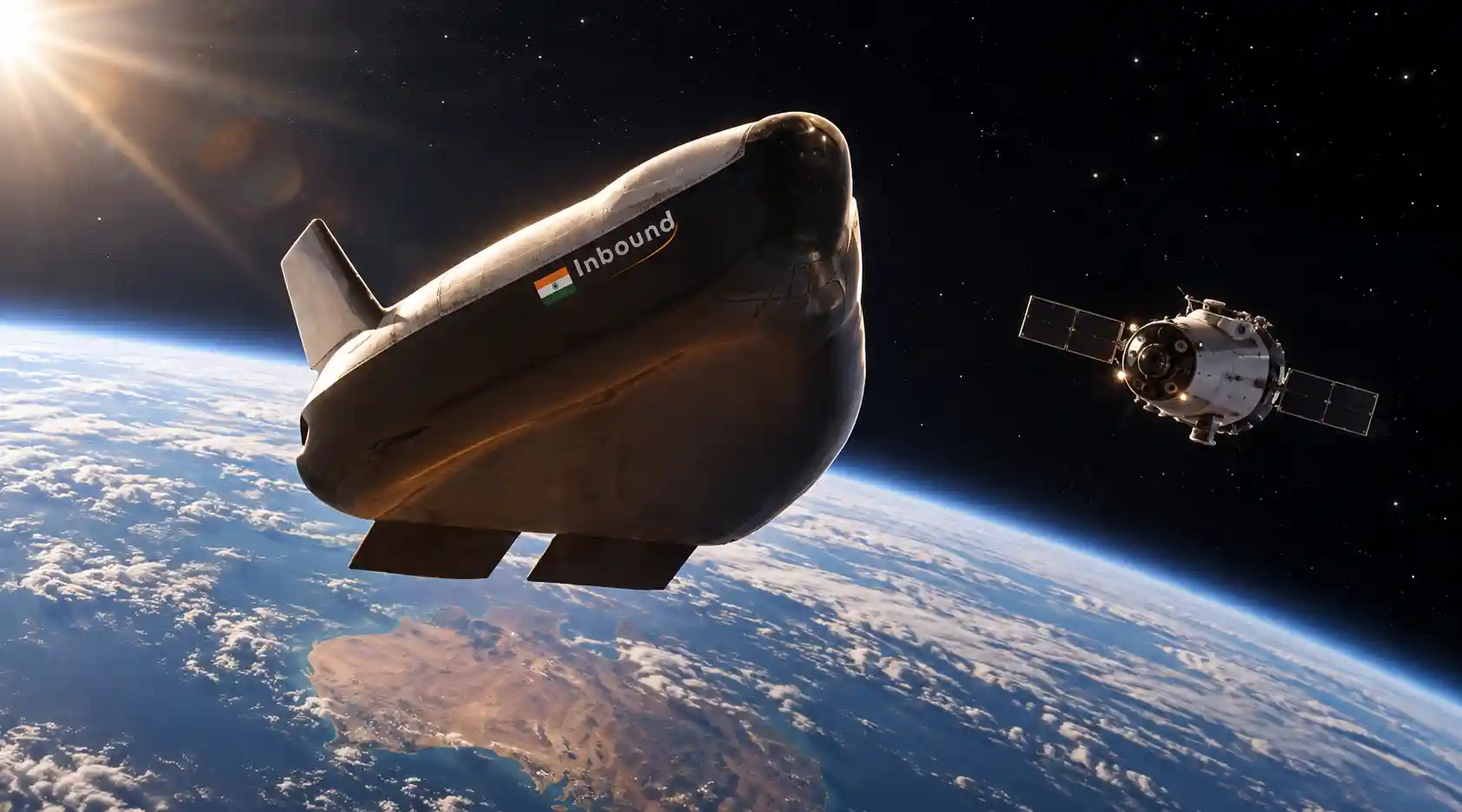

BENGALURU - Chennai-based startup Inbound Aerospace and Australia's Space Angel Group have signed a memorandum of understanding to explore joint work on spacecraft recovery, testing and spaceport infrastructure - one of five new Australia-India space-industry agreements unveiled on September 8, 2026, at the Bengaluru Space Expo. The deal is described in company and industry reporting as a five-year MoU, with an initial three-year framework set aside to assess how Space Angel's ground infrastructure in Australia could support flight testing and eventual recovery of Inbound's re-entry spacecraft.
It is important to be precise about what has actually been signed. This is a memorandum of understanding, not a binding commercial contract. It commits the two companies to jointly evaluate collaboration across flight and drop testing, high-altitude and near-space trials, recovery operations, spaceport infrastructure and mission planning, with scope for further technology development, pilot projects and market expansion in both countries. No specific missions, launch dates, spacecraft counts or financial terms have been disclosed by either company.
The Economics of Spacecraft Recovery
Spacecraft recovery - bringing a vehicle or payload back from orbit intact rather than letting it burn up or be discarded - has become one of the more commercially significant problems in the space industry as more companies look to fly experiments and manufacturing processes in microgravity and then return the results to Earth for analysis or sale. A capsule that can survive re-entry and be retrieved cleanly allows customers in pharmaceuticals, materials science and biotechnology to run repeatable experiments in orbit without needing a crewed space station. That need is expected to grow more acute as the International Space Station approaches its planned decommissioning around 2030, a gap Inbound Aerospace has cited as part of its own rationale for building a recoverable platform.
Who Are the Partners?
Inbound Aerospace, incubated at IIT Madras and founded by Aravind I B, Vishal Reddy and retired navy captain Abhijit Bhutey, is developing an autonomous, unmanned, reusable spacecraft intended for low-Earth-orbit missions lasting roughly three months, aimed at microgravity research, in-orbit technology demonstrations, in-space manufacturing and payload return, along with precision-landing capabilities the company says are relevant to defence and disaster-response applications. The company raised just over $1 million in a pre-seed round in July 2025, led by Speciale Invest with participation from Piper Serica, and has said it is targeting its first mission launch by early 2028 - a separate, company-stated timeline not explicitly tied to the Space Angel MoU. The startup has not yet flown a spacecraft.
Space Angel Group, on the Australian side, is building spaceport and launch-and-recovery infrastructure under what it calls the Australis corridor in Western Australia, positioning the project around the technology priority areas of the AUKUS Pillar II framework - including hypersonics, autonomy and aerospace capabilities. The company describes its planned facilities as supporting inland launch and sealed-runway recovery for glide vehicles and spaceplanes, alongside ground, tracking, telemetry and communications infrastructure kept under Australian control, and a custody-chain pathway tied to the US-Australia Technology Security Agreement. Its work is framed around Australia's Space (Launches and Returns) Act 2018 and Western Australia's state space strategy for 2024-30. Under the MoU, this is the kind of ground and recovery infrastructure Inbound's spacecraft would be tested against, though neither company has publicly named a specific recovery zone or confirmed which of Space Angel's facilities would handle Inbound's vehicles.
Australia's Growing Role in Space Recovery
Australia's appeal as a recovery destination is not new, and other operators have already put it to use. In August 2026, the Australian Space Agency coordinated the recovery of a SpaceX Starship upper stage off Christmas Island after the vehicle made a controlled Indian Ocean splashdown and remained largely intact through more than three weeks at sea. Separately, US-based Varda Space Industries has carried out multiple capsule returns at Southern Launch's Koonibba Test Range in South Australia, including a landing in May 2026. Australia's large, sparsely populated landmass, remote coastal and outback zones, and an established legal framework for handling returning space objects have made it an increasingly attractive site for exactly this kind of controlled re-entry work - the backdrop against which the Inbound-Space Angel MoU was signed.
Other Expo Deals and the Broader Picture
The agreement was one of several announced together at the expo. Space Angel Group also entered a related arrangement with Vijayawada-based Red Balloon Aerospace covering future recovery of spacecraft and resources from asteroids and other celestial bodies, while separate deals brought in Australia's LatConnect 60, which will provide satellite tracking services to India's NewSpace India Limited, and a research and education partnership between the University of Western Australia and the Space Industry Association of India. At least one industry report attributed a similar Inbound Aerospace tie-up to a different Australian company, Space Machines, rather than Space Angel Group - a discrepancy that appears to reflect some inconsistency in how the day's multiple announcements were reported rather than a confirmed second deal, and one that has not been resolved by either company at the time of writing.
The bigger picture is a commercial space sector increasingly organised around reusability - not just reusable launch vehicles, but reusable and recoverable spacecraft that can fly repeated missions for in-space manufacturing and research customers. For that model to work at any scale, companies need dependable, repeatable places to bring their vehicles down, which is precisely the gap agreements like this one are meant to address.
But the practical challenges are substantial and unresolved: Inbound Aerospace has yet to fly a test vehicle, autonomous re-entry and precision landing remain technically demanding even for well-funded incumbents, and converting an exploratory MoU into funded, scheduled recovery operations will require separate regulatory clearances in both countries, including Australia's launch and return permitting regime and India's space authorisation process through IN-SPACe and NSIL. For now, what exists is a framework for two young ventures to test whether their capabilities fit together - not a confirmed operational recovery service.
Further reading and useful links
Reader questions
Frequently asked questions
What is the MoU between Inbound Aerospace and Space Angel Group?
It is a five-year memorandum of understanding to evaluate collaboration on flight testing, recovery operations, and spaceport infrastructure for Inbound Aerospace's reusable spacecraft in Australia.
Why is spacecraft recovery important?
Recovering spacecraft intact allows companies in sectors like pharmaceuticals and materials science to run repeatable experiments and manufacturing processes in microgravity and return the results to Earth for analysis or sale.
Why is Australia an attractive location for spacecraft recovery?
Australia offers a large, sparsely populated landmass, remote coastal and outback zones, and an established legal framework (such as the Space Launches and Returns Act 2018) that makes it highly suitable for safe, controlled spacecraft re-entry and recovery.
Nexuswild welcomes factual corrections. Email [email protected] with evidence and the article URL.