
MUMBAI, Sept. 14, 2026 - JioPC is no longer simply an idea for turning a television into a computer.
It is becoming a broader cloud-computing product that can be accessed through a Jio set-top box or through a browser on an existing laptop or desktop, moving much of the computing itself away from the local device and into Jio’s cloud infrastructure.
The concept is straightforward. Instead of buying a more powerful computer every time local hardware becomes slow or outdated, a user connects to a virtual computer running remotely in the cloud. The screen, keyboard and mouse stay with the user. The CPU, memory, storage and operating environment are delivered as a service.
That changes the economics of personal computing.
A conventional PC requires an upfront hardware purchase and eventually becomes limited by its processor, RAM, storage and operating-system support. JioPC turns those components into a subscription.
As of September 2026, Jio lists a one-month JioPC plan at ₹599 plus GST with unlimited usage, 8 GB RAM and 500 GB storage. Longer-duration promotional plans include ₹1,499 plus GST for three months plus one additional month, ₹2,499 plus GST for six months plus two additional months, and ₹4,599 plus GST for 12 months plus three additional months.
The current product page also lists a second configuration with 8 virtual CPUs, 16 GB RAM and 1 TB of storage, although a public retail price for that higher configuration is not displayed on the same page.
The significance is larger than the price.
JioPC is an attempt to separate the useful life of a computer from the useful life of the device sitting on a desk.
What JioPC actually is
Jio’s own terms define JioPC as a virtual desktop interface platform operated by Jio Platforms Limited.
The service provides virtual desktop access, application streaming and cloud storage.
There are now two main ways to access it.
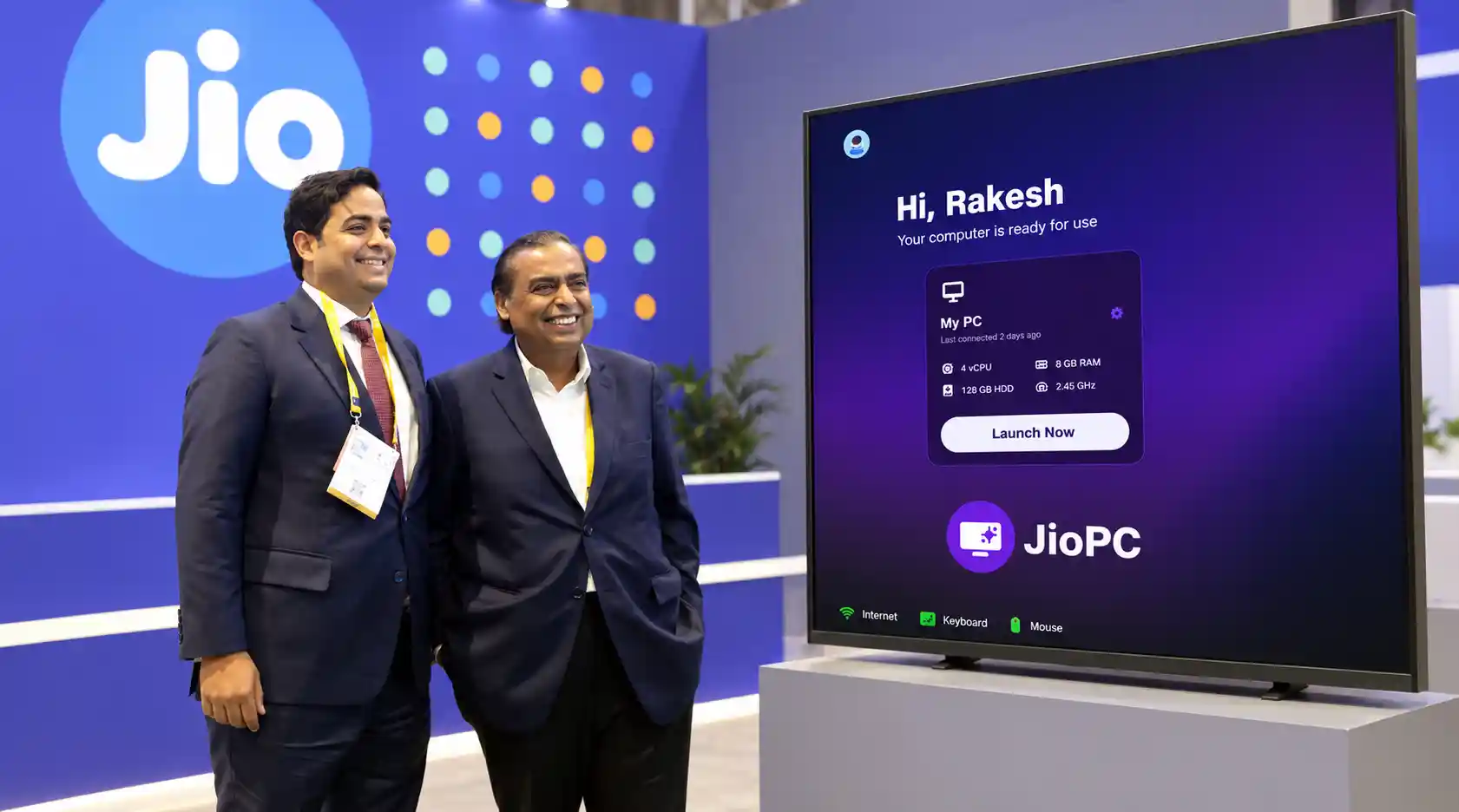
The first is through a Jio set-top box connected to a television or monitor. A user adds a keyboard and mouse and launches the JioPC environment.
The second is through the JioPC progressive web application, or PWA, in a supported browser on an existing laptop or desktop.
That second access model materially expands the addressable market.
Jio’s current documentation says browser access works on any broadband or internet connection and does not require JioFiber or JioAirFiber. Registration can also be completed with a non-Jio mobile number.
That means the service is no longer limited conceptually to households already using Jio’s home broadband and television hardware.
The cloud desktop can now be used to extend the working life of an old computer as well.
The technical architecture is simple from the user side
The user does not need to manage a local operating system image or upgrade physical RAM.
When a JioPC session starts, the operating environment runs remotely.
Jio’s current configuration documentation lists Ubuntu Linux as the operating system.
The standard paid configuration on the main plan cards includes four virtual CPUs, 8 GB of RAM and 500 GB of storage.
A second configuration is listed with eight virtual CPUs, 16 GB RAM and 1 TB storage.
The desktop environment includes common productivity software and browser access to online applications.
Jio lists LibreOffice as part of the environment and highlights browser-based productivity and creative applications.
This makes JioPC best understood as desktop-as-a-service for consumers rather than as a physical PC.
The local device becomes the interface.
The cloud provides the compute.
The set-top box model is strategically important
The television version is where JioPC differs most from the usual personal-computer buying model.
A household that already has a compatible Jio set-top box and television does not need to buy another display or a conventional desktop tower.
The basic hardware requirement is a keyboard and mouse.
Jio currently sells a Keyboard Activation Pack for ₹1,111. The pack includes a wireless keyboard and mouse, 30 days of JioPC access and 500 GB of JioPC storage for one year.
For households that already pay for connectivity and have a television, this changes the entry cost of having a general-purpose computing environment.
That does not mean a TV becomes identical to a laptop.
A laptop remains portable, battery-powered and independent of a television setup.
The economic argument is different.
Jio is trying to make computing available using screens and connectivity that are already present inside the home.
Browser access may be the more important long-term product
The browser version turns JioPC into a different proposition.
Instead of asking whether a family needs a new PC, it asks whether an older PC can remain useful if its demanding workloads are moved to the cloud.
Jio explicitly markets this version as a way to modernize an older laptop or desktop.
A user can open JioPC through a web browser, authenticate and access the same virtual desktop, files and settings.
Jio says USB-drive access is available through the set-top-box implementation but not through the browser version.
That is an example of why cloud desktops do not eliminate every local-hardware constraint.
Peripheral support still depends on how the remote session is delivered.
Why Reliance built it
The commercial logic has been visible for several years.
Reliance first discussed cloud PCs as part of its strategy to make high-performance computing available without requiring each user to own expensive local hardware.
At its 2025 annual meeting, Reliance formally presented JioPC as an AI-ready virtual computer that could turn a TV or other screen into a computing device.
The company described the ability to remotely increase memory, storage and compute as usage requirements change.
A July 2025 investor presentation described JioPC as ready for mass rollout and identified an immediate opportunity of 10 million users.
That figure was an opportunity estimate, not a disclosed subscriber count.
Reliance has not publicly reported a current JioPC active-user or paid-subscriber number in the official material used for this analysis.
That distinction matters.
JioPC has a large distribution opportunity, but publicly verified adoption should not be inferred from the size of Jio’s overall customer base.
Jio’s distribution gives the product unusual reach
The infrastructure underneath JioPC is much larger than the service itself.
Reliance reported more than 524 million Jio subscribers at the end of March 2026.
It also reported 27.1 million fixed-broadband subscribers, including around 13 million fixed-wireless users.
By the first quarter of FY2027, Reliance reported 533.3 million Jio subscribers across its connectivity base.
Those figures are not JioPC users.
They show the size of the customer and network platform into which JioPC can be distributed.
The fixed-broadband number is particularly relevant because the quality of a cloud desktop is strongly dependent on reliable connectivity.
Jio added around 10 million fixed-broadband subscribers during FY2026.
That means the addressable base of homes with high-speed connections and Jio home hardware is expanding quickly.
AI changes the value proposition
Cloud computing existed long before the current AI cycle.
What changes the timing of JioPC is that useful computing requirements are becoming more variable.
A student might need a browser and document editor for most of the day but occasionally use an AI application that requires substantially more server-side compute.
A small business may spend most of its time on spreadsheets and web applications but periodically need heavier processing.
A local computer forces the buyer to purchase hardware based partly on peak requirements.
A cloud computer can theoretically allocate more resources when needed.
That is the logic behind Jio describing JioPC as AI-ready.
It does not mean every AI model runs directly inside the user’s virtual machine.
Many AI services are accessed through the web and perform their heavy computation on remote infrastructure anyway.
The more important point is that the desktop itself is already cloud-based, making it easier to integrate cloud-hosted applications and future AI services.
This fits a much larger infrastructure strategy
JioPC should not be viewed in isolation from Reliance’s broader computing plans.
Reliance’s FY2025-26 annual report says the group intends to invest ₹10 lakh crore in multi-gigawatt AI-ready data centres.
The company describes this as part of a strategy to build a domestic high-performance compute backbone and make AI services broadly accessible in India.
JioPC can become one of the consumer-facing endpoints of that infrastructure.
Connectivity brings the user online.
The cloud provides storage and compute.
The virtual desktop becomes the interface.
AI applications sit on top.
From a business perspective, that is more powerful than selling a single device because the relationship can continue through recurring subscriptions and additional cloud services.
The economics are different from owning a PC
At ₹599 plus GST per month, twelve months at the monthly rate would cost ₹7,188 before GST.
The current longer-duration promotional plan is ₹4,599 plus GST for 12 months plus three additional months.
That works out to roughly ₹307 per month before GST over the advertised 15-month validity period.
These calculations use current listed promotional pricing and should not be treated as permanent rates.
A subscription can lower the initial barrier to computing, but it creates a continuing cost.
Over several years, the total subscription expense can become comparable with the purchase price of entry-level hardware.
The correct economic comparison therefore depends on the user.
For someone who already owns a display, old laptop or Jio set-top box, a cloud desktop may avoid immediate hardware replacement.
For someone who needs offline access, portability or specialized local software, buying hardware may still make more sense.
Security is one of the strongest cloud arguments
Jio says JioPC stores data in enterprise-grade cloud storage with disaster recovery and uses a Zero Trust model for access.
The company also says no user data is kept locally on the endpoint device.
That reduces some common risks.
If a set-top box fails or an old computer is damaged, the virtual desktop and stored files are not necessarily lost with the physical device.
Cloud management also allows operating-system maintenance and updates to be performed centrally.
But cloud security does not eliminate user responsibility.
Account credentials still matter.
Phishing still matters.
Weak passwords still matter.
A cloud service also creates concentration risk: if authentication, networking or the backend service is unavailable, the user may temporarily lose access to the desktop.
Security is therefore different, not automatic.
The biggest limitation is the network
A local PC can continue performing many tasks without an internet connection.
A cloud PC cannot.
JioPC depends on network quality because the user’s keyboard and mouse inputs must travel to the remote system while the resulting screen is streamed back.
For document editing and browsing, moderate latency may be acceptable.
For workloads requiring extremely fast response times, unstable broadband can become noticeable.
Heavy graphics, specialized professional software, real-time media production and some development workflows may also be better suited to local hardware depending on application support and network conditions.
Jio does not publish an independent latency benchmark or a guaranteed performance number for every network condition.
It is therefore better to evaluate JioPC as a cloud desktop than to assume it will reproduce every use case of a high-end workstation.
Linux compatibility is another real consideration
JioPC uses Ubuntu Linux.
For browser-based applications, that may make little difference.
Modern productivity, education, communication and cloud applications increasingly run inside browsers.
For users dependent on software written only for another desktop operating system, compatibility may become an issue.
That is one reason Jio emphasizes web applications and cloud-based tools.
The product is strongest when the workflow is already browser-first.
It is less compelling when the user requires a specific local desktop application that does not support Linux.
The product could have its biggest effect in education
India’s computing gap is not only about processor performance.
It is also about household economics.
A family may own one television and several smartphones without owning a general-purpose computer with a keyboard, large display and desktop workspace.
JioPC tries to turn existing household infrastructure into that workspace.
For school and college students, Jio highlights documents, spreadsheets, presentations, programming, digital productivity, financial literacy, communication, typing, language learning and analytical skills.
The value is not that every student suddenly receives a high-end machine.
It is that the threshold for accessing a desktop environment can fall.
Whether that produces meaningful educational impact will depend on affordability, connectivity, software availability, digital skills and sustained use.
Small businesses may be the second major use case
The same architecture can work for small businesses that primarily rely on web software, documents, accounting interfaces and communication tools.
A cloud desktop reduces the need to maintain individual high-specification PCs at every location.
It can also make replacement easier because the user environment is tied to the account rather than the endpoint device.
Reliance has previously described cloud computing as useful for businesses ranging from small shops and clinics to professional offices.
The economics become more attractive when a business values centralized maintenance and predictable subscription costs more than owning hardware.
The environmental argument is possible, but should be measured carefully
Extending the useful life of an old computer can reduce the need for immediate hardware replacement.
That could lower electronic waste at the device level.
But cloud computing still consumes physical servers, data-centre power, networking equipment and cooling.
It would therefore be misleading to describe a cloud PC as hardware-free.
The hardware has moved from the user’s room into a data centre.
A full environmental comparison would require lifecycle data covering device manufacturing, server utilization, electricity source, network energy and replacement cycles.
Jio has not published a JioPC-specific lifecycle assessment in the sources reviewed here.
JioPC is also a recurring-revenue product
From a business perspective, JioPC shifts computing from a one-time purchase toward a recurring service.
That changes the relationship between provider and user.
A traditional hardware sale produces most revenue at the moment of purchase.
A virtual PC can generate monthly or annual subscription revenue, storage revenue and potentially additional application or AI-service revenue over time.
It can also increase the value of the surrounding home-connectivity ecosystem.
For Jio, the strategic opportunity is not simply to sell access to a remote Ubuntu desktop.
It is to make connectivity, storage, compute and applications part of one account relationship.
What is verified and what is not
Several things are clear as of September 2026.
JioPC is commercially available.
It can be accessed through a compatible Jio set-top box or through a browser.
Browser users can use any broadband connection and do not need a Jio mobile number.
The standard advertised paid configuration includes 8 GB RAM and 500 GB storage.
Jio also lists a higher 16 GB RAM and 1 TB configuration.
The operating system is Ubuntu Linux.
The current one-month advertised price is ₹599 plus GST.
Reliance previously estimated an immediate market opportunity of 10 million users.
What is not publicly disclosed in the official sources used here is equally important.
Reliance has not published a verified current JioPC active-user count.
It has not published JioPC revenue.
It has not disclosed the utilization level of the cloud infrastructure dedicated specifically to JioPC.
And it has not published an independent performance benchmark showing that JioPC is faster than a particular class of local computer under all network conditions.
Those numbers should not be invented.
The strict conclusion
JioPC is significant because it changes the unit of personal computing.
Instead of selling a processor, RAM and storage inside a box, it sells access to those resources through the cloud.
That makes a television capable of acting as a desktop interface.
It can give an old computer access to a newer virtual environment.
It allows memory, storage and compute to be treated as services instead of fixed components.
The model will not replace every conventional computer.
It depends on internet quality.
It uses Linux.
It cannot guarantee compatibility with every local application or peripheral.
And recurring subscriptions have to be compared with the long-term cost of owning hardware.
But the strategic idea is credible.
Reliance already has hundreds of millions of connectivity users, more than 27 million fixed-broadband customers, a large set-top-box footprint and an expanding AI and cloud infrastructure strategy.
JioPC connects those pieces.
If adoption becomes large, its most important effect may not be that people stop buying PCs.
It may be that millions of households and small businesses gain access to a desktop-class computing environment without first making a traditional PC purchase.
That is a different path to computer ownership.
And in a market where access remains as important as raw performance, that may be the more consequential idea.
Reader questions
Frequently asked questions
What is JioPC?
JioPC is a subscription-based virtual desktop service that runs a computer environment in Jio’s cloud and delivers it over the internet to a TV, laptop or desktop.
How much does JioPC cost?
As of September 2026, Jio lists a one-month plan at ₹599 plus GST with unlimited usage, 8 GB RAM and 500 GB storage. Promotional longer-duration plans are also listed and may change.
Can JioPC work without JioFiber?
Yes for browser access. Jio says the JioPC browser version works on any broadband or internet connection. The set-top-box version requires the relevant Jio home connection and set-top box.
Can I use JioPC on an old laptop or desktop?
Yes. Jio provides a browser-based JioPC service intended to let existing laptops and desktops access the cloud virtual desktop without upgrading their internal hardware.
What operating system does JioPC use?
Jio currently lists Ubuntu Linux as the operating system for JioPC.
What are the JioPC specifications?
Jio lists a configuration with four virtual CPUs, 8 GB RAM and 500 GB storage, and another configuration with eight virtual CPUs, 16 GB RAM and 1 TB storage.
Does JioPC store files on the local device?
Jio says user data is stored in enterprise-grade cloud storage and that no data is kept on the endpoint device as part of its cloud-desktop security model.
Can JioPC completely replace a normal computer?
It can cover many browser-based productivity, education and cloud workflows, but it depends on internet connectivity and Ubuntu compatibility. Specialized local software, offline work, peripherals and latency-sensitive workloads may still require conventional hardware.
Nexuswild welcomes factual corrections. Email [email protected] with evidence and the article URL.