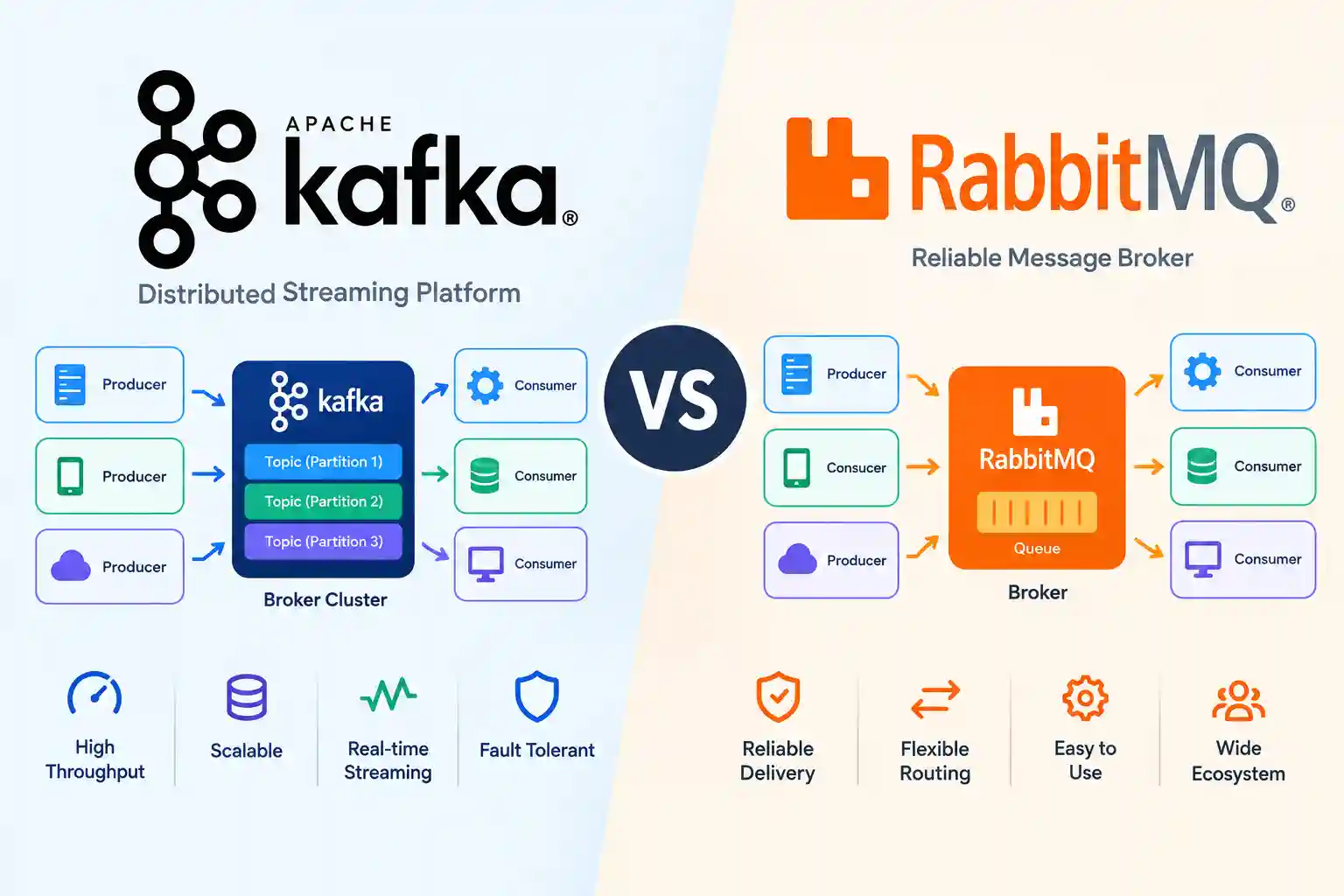

Sept. 16, 2026 - Kafka and RabbitMQ are often placed in the same category because both move data between applications.
That comparison is useful only up to a point.
Apache Kafka is fundamentally a distributed event log. RabbitMQ is fundamentally a message broker built around routing, queues and acknowledgements. Both have expanded well beyond those original boundaries, and by 2026 the overlap is larger than it used to be.
Kafka now has production-ready Share Groups, which add queue-like work distribution to its traditional event-streaming model.
RabbitMQ has Streams and Super Streams, which add persistent append-only logs, replay and partitioned high-throughput consumption to a broker historically associated with queues.
So the old rule that “Kafka is for streams and RabbitMQ is for queues” is no longer technically complete.
The better question is this:
What behavior does the application need from its messaging layer?
If the system needs a durable history of events that many independent consumers can replay at different speeds, Kafka remains a natural fit.
If the system needs flexible routing, per-message acknowledgement, work distribution, request-response patterns or message-level delivery controls, RabbitMQ remains extremely strong.
The architectural difference still matters more than the brand name.
The core Kafka model
Kafka stores records in topics.
Each topic is divided into partitions.
A partition is an ordered append-only log. Every record receives an offset, which represents its position inside that partition.
Consumers do not normally remove records when they read them.
Instead, they track their progress through offsets.
That one decision shapes most of Kafka’s behavior.
A record can be read by one consumer group today and by another group later.
A consumer can move its offset backward and replay older data if the records are still inside the configured retention window.
A new application can begin consuming an existing topic without changing the producers.
The broker is therefore storing a history of events, not merely holding work until one consumer finishes it.
This makes Kafka especially useful when the same stream of business events has several independent downstream uses.
An order event might feed billing, analytics, fraud detection, fulfillment and data warehousing without the producer needing to know how each system works.
Kafka scales through partitions
Partitions are Kafka’s primary unit of parallelism and replication.
Within the traditional consumer-group model, a partition is assigned to one consumer in the group at a time.
That preserves order inside the partition and gives applications a straightforward way to scale processing horizontally.
Adding consumers can increase parallelism until the group has enough consumers to cover the available partitions.
This also means partition design is an architectural decision.
A system that creates too few partitions can limit parallel consumption later.
A system that creates very large numbers of partitions introduces metadata, file and operational overhead.
Message keys matter because they determine which records need to stay in the same ordered partition.
For example, an application may use customer ID as the key so that events for one customer remain ordered, while events for different customers are processed in parallel.
Kafka guarantees ordering within a partition, not global ordering across an entire multi-partition topic.
Kafka no longer requires ZooKeeper
Kafka 4.0, released in March 2025, was the first major version to operate entirely without ZooKeeper.
Current Kafka releases use KRaft, Kafka’s Raft-based metadata system.
This removed the need to operate a separate ZooKeeper ensemble alongside the brokers.
That change is operationally important.
Cluster metadata, controller leadership and related coordination now live inside Kafka’s own architecture.
As of September 2026, Apache Kafka 4.3.1 is the latest official 4.3 patch release published by the project.
The change to KRaft does not make Kafka operationally trivial.
Operators still have to plan brokers, controllers, partitions, replication, disk capacity, networking, retention, upgrades and failure recovery.
But one major external dependency has disappeared.
RabbitMQ starts with routing
RabbitMQ’s traditional messaging path is different.
A publisher sends a message to an exchange.
The exchange applies routing rules and sends that message to one or more queues or streams through bindings.
Consumers then receive messages from those destinations.
That exchange layer is one of RabbitMQ’s strongest architectural features.
Routing logic can be expressed without putting all of that knowledge inside the producer.
An application can route by exact routing key, pattern, fanout or headers depending on the topology.
This makes RabbitMQ particularly useful when message delivery depends on business routing rules.
The producer can publish one event while the broker determines which queues should receive it.
Queues are about work ownership
A conventional RabbitMQ queue is much closer to a work queue than a Kafka log.
Messages wait for consumers.
A consumer receives a delivery.
The application acknowledges successful processing.
Once processing is acknowledged, the message can be removed from the queue.
If a consumer fails before acknowledgement, the broker can redeliver the message.
That model fits work that should normally be completed by one worker rather than replayed indefinitely by many independent applications.
Examples include sending an email, resizing an image, generating a report, charging an order after validation or dispatching a background job.
The important concept is not simply storage.
It is work ownership and acknowledgement.
Quorum queues are the durable RabbitMQ default
Modern RabbitMQ deployments that need replicated durable queues should generally use quorum queues.
Quorum queues use the Raft consensus algorithm and replicate queue state across multiple RabbitMQ nodes.
RabbitMQ describes them as the default choice when a replicated, highly available queue is required.
Publisher confirms are especially important with quorum queues.
A confirmation is issued only after the message has been replicated to a quorum and is considered safe by the queue.
Consumers should use manual acknowledgements when processing correctness matters.
That produces an explicit chain of responsibility:
the publisher confirms the broker accepted the message safely, and the consumer confirms that application processing completed.
RabbitMQ also documents the trade-off.
Quorum queues prioritize consistency and data safety, which adds replication and disk work.
They are not the ideal choice for every temporary queue or for workloads where the absolute lowest possible latency matters more than durability.
RabbitMQ Streams changed the comparison
RabbitMQ Streams make the Kafka-versus-RabbitMQ discussion much more interesting.
A RabbitMQ stream is an immutable append-only log.
Messages are retained rather than destructively removed after one consumer reads them.
Consumers can read the same messages repeatedly by offset.
Streams are persistent and replicated.
Super Streams partition that model so throughput and consumption can scale across several stream partitions.
That architecture overlaps directly with use cases historically associated with Kafka.
RabbitMQ’s own documentation recommends its dedicated Streams protocol when applications want the best stream throughput and access to stream-specific capabilities.
So RabbitMQ can now support both classic queue semantics and log-style replay inside the same broader platform.
This does not make its architecture identical to Kafka.
Kafka’s entire data model, ecosystem and operational design were built around partitioned logs from the beginning.
RabbitMQ Streams are one data structure inside a messaging platform that also supports exchanges, queues and several messaging protocols.
Kafka has moved toward queue semantics too
The convergence works in the other direction.
Kafka 4.2 made Share Groups production-ready.
Traditional Kafka consumer groups assign partitions among consumers.
Share Groups can distribute individual records from a topic among multiple consumers using acquisition locks and explicit acknowledgements.
A consumer can accept a record after successful processing, release it for another delivery attempt, reject it as unprocessable or renew the lock when processing takes longer.
That gives Kafka a more direct work-queue model without replacing the underlying topic log.
Kafka 4.3 added additional Share Group controls and monitoring.
This is significant because applications no longer have to assume that Kafka can only scale work by assigning whole partitions to individual consumers.
But Share Groups remain part of Kafka’s event-log architecture.
They do not recreate RabbitMQ’s exchange topology or protocol model.
Retention is one of the biggest practical differences
Kafka topics normally retain data according to configured time or size policies.
Consumption does not automatically delete the record.
That is ideal when event history has continuing value.
A company might keep customer activity for seven days, thirty days or longer, allowing new consumers, debugging systems or data pipelines to replay it.
Traditional RabbitMQ queues behave differently.
Their purpose is usually to hold messages until they are handled.
Once an acknowledged message is no longer needed, keeping it indefinitely provides little value and only consumes storage.
RabbitMQ Streams are the exception because they intentionally use retention and replay semantics.
This leads to an important design question:
Is the message mainly a temporary job, or is it a durable business event?
If it is a durable event that may have several future readers, Kafka’s default model is naturally aligned with the problem.
If it is a job whose lifecycle should end after successful processing, RabbitMQ queue semantics are naturally aligned with that problem.
Delivery semantics are not a one-word feature
Both platforms provide strong delivery controls, but engineers should avoid reducing reliability to labels such as “exactly once.”
Kafka supports idempotent producers and transactions.
Transactions can atomically write records to multiple topic partitions and commit consumed offsets as part of the same processing flow.
Kafka Streams can use these capabilities to provide exactly-once processing semantics within the Kafka processing model.
That does not mean a Kafka transaction magically makes an external database update exactly once.
Once a workflow crosses system boundaries, application-level coordination is still required.
RabbitMQ emphasizes publisher confirms and consumer acknowledgements.
A publisher can know when the broker has taken responsibility for a message.
A consumer can explicitly acknowledge successful processing.
Failed consumers can cause messages to be redelivered.
That generally produces at-least-once processing unless the application makes its handler idempotent or adds another deduplication strategy.
The correct architecture assumes failures will happen.
It then defines what a duplicate, retry or partial failure means for the business operation.
Routing is where RabbitMQ is usually more expressive
RabbitMQ exchanges make sophisticated routing a first-class broker concept.
One published message can be routed into different queues based on bindings.
A direct exchange can route by exact key.
A topic exchange can match patterns.
A fanout exchange can broadcast.
A headers exchange can use message attributes.
This is useful when producers and consumers need flexible delivery relationships.
Kafka routing is usually simpler.
A producer chooses a topic and, directly or through a partitioner, a partition.
Independent consumer groups decide which topics they subscribe to.
Fanout is achieved by creating separate consumer groups that each read the same topic.
That model is powerful, but the routing logic is less like a broker-side message switch and more like independent subscriptions to durable logs.
Kafka is strongest when replay is a feature
Consider a transaction-event stream.
A fraud system reads it in real time.
A finance pipeline reads the same events.
A data platform stores derived analytics.
Three months later, a new risk model needs historical events.
If those events are still retained, Kafka makes replay a normal operation.
The new consumer establishes its position and reads the existing log.
That is one of Kafka’s greatest architectural strengths.
The original producer does not have to resend the data.
The original consumers do not have to coordinate with the new one.
The log becomes a reusable record of what happened.
RabbitMQ is strongest when delivery behavior is the feature
Now consider a document-processing service.
A request arrives.
One worker should process it.
If that worker crashes, another should try.
The application may need a retry delay.
Some jobs may have higher priority.
Failed messages may need dead-letter handling.
The producer may need confirmation that the broker safely accepted the job.
This is where RabbitMQ’s queue model is very natural.
RabbitMQ 4.3 expanded quorum queues with 32 strict message-priority levels, delayed retries and consumer-timeout capabilities.
Those are broker behaviors designed around individual units of work.
Trying to reproduce every one of those semantics by treating a durable event log as a task queue can add unnecessary application complexity.
Protocol support is another major difference
Kafka has its own binary protocol and a broad client ecosystem built around it.
RabbitMQ supports multiple messaging protocols.
RabbitMQ 4.3 natively supports both AMQP 0-9-1 and AMQP 1.0.
It can also support MQTT, STOMP and WebSocket-based messaging through its protocol support and plugins.
That can matter in heterogeneous systems.
An IoT device may want MQTT.
A business application may use AMQP.
A browser may need WebSockets.
Protocol flexibility can make RabbitMQ a useful integration layer when clients are not all built around the same messaging stack.
Kafka’s strength is different.
Its ecosystem is standardized around the Kafka protocol and Kafka’s log semantics.
That consistency can simplify large data platforms built around one event backbone.
Performance cannot be reduced to “Kafka is faster”
There is no responsible universal benchmark that proves one platform is always faster.
Performance depends on message size, batching, persistence settings, acknowledgements, replication factor, partition count, queue type, disk speed, network, producer behavior and consumer behavior.
Kafka’s design is extremely effective for high-throughput sequential log workloads.
Producers can batch records.
Partitions allow parallelism across brokers.
Consumers can fetch records in batches.
Sequential disk access and the log architecture can produce high aggregate throughput.
RabbitMQ can also process very large messaging workloads, but different queue types make different trade-offs.
Quorum queues write durable data to disk and replicate through consensus.
Streams are designed for high-throughput persistent replay.
Classic queues have different characteristics again.
The useful question is not which product wins a generic benchmark.
It is which configuration matches the application’s durability, latency and replay requirements.
Latency also depends on durability choices
Low latency is often discussed without specifying what “delivered” means.
A publisher can consider a message delivered when it enters a local socket buffer.
Or it can wait until a leader receives it.
Or it can wait until replicated storage confirms it.
Those are very different guarantees.
Kafka producers expose acknowledgement and durability settings.
RabbitMQ exposes publisher confirms and different queue types.
Stronger guarantees generally require more coordination, network communication or disk work.
Comparing latency without holding durability settings constant produces misleading conclusions.
Operational complexity is different, not absent
Kafka’s operational challenge is often capacity architecture.
Teams need to think about partition counts, broker distribution, retention, disk growth, replication, consumer lag and rebalancing.
KRaft simplified the architecture by removing ZooKeeper, but cluster design still matters.
RabbitMQ’s operational complexity is often topology and queue behavior.
Teams need to understand exchanges, bindings, virtual hosts, queue types, acknowledgements, prefetch, dead-letter behavior, policies and cluster placement.
Quorum queues add consensus replication.
Streams add another storage and consumption model.
Neither platform is a “set it and forget it” system at serious scale.
Managed services can reduce operational work, but they do not remove architectural decisions.
Security is mature on both
Kafka supports TLS for encryption and authentication, SASL mechanisms including Kerberos, PLAIN, SCRAM and OAuth bearer tokens, plus authorization through ACLs and pluggable authorization.
RabbitMQ supports TLS, mutual TLS, users, resource permissions, authentication backends and virtual hosts for logical separation.
RabbitMQ permissions are scoped through virtual hosts and resources.
Kafka security is commonly organized around principals, listeners and ACL-protected resources such as topics and consumer groups.
Neither platform is secure merely because the software supports these controls.
Production security still depends on configuration, certificate management, credential rotation, network segmentation and least-privilege access.
Failure handling should influence the choice
RabbitMQ makes failed work explicit through acknowledgements, redelivery, dead-lettering and retry-oriented features.
That is extremely useful for business workflows where one message corresponds to one action.
Kafka tends to make failure handling part of stream processing.
A consumer can retry, pause, redirect failed records to another topic or use framework-level error handling.
Kafka 4.2 added dead-letter-queue support to Kafka Streams exception handlers, and Share Groups add acknowledgement concepts closer to queue processing.
The gap is narrowing.
But the mental models remain different.
RabbitMQ asks, “Has this work item been handled?”
Kafka traditionally asks, “How far has this consumer progressed through the log?”
When Kafka is the stronger architectural fit
Kafka is especially compelling when the system needs several of these properties together:
A durable history of events.
Independent consumer groups.
Replay and reprocessing.
High-volume event ingestion.
Stream processing.
Long-lived event pipelines.
Change-data-capture feeds.
Analytics and operational systems reading the same source events.
Ordering within keyed partitions.
A company may use Kafka as a central event backbone because the data remains useful after the first consumer has processed it.
The log itself becomes part of the data architecture.
When RabbitMQ is the stronger architectural fit
RabbitMQ is especially compelling when the system needs:
Work queues.
Complex routing.
Per-message acknowledgements.
Priority.
Delayed retries.
Request-response communication.
Short-lived task delivery.
Dead-letter workflows.
Several messaging protocols.
Broker-managed routing between many producers and consumers.
In these systems, the value lies less in preserving a long event history and more in controlling how a unit of work reaches the right consumer and what happens if processing fails.
When either platform can work
There is a large middle ground.
Application events can be published through RabbitMQ Streams.
Background jobs can now be distributed with Kafka Share Groups.
Both systems can replicate data.
Both can support durable messaging.
Both can process large workloads.
Both can secure network connections and authenticate clients.
This is why architecture diagrams should start with requirements rather than a technology logo.
A team should define:
How long messages need to exist.
Whether they must be replayed.
How many independent consumers need the same event.
Whether routing depends on message attributes.
Whether consumers own partitions or individual work items.
What happens after processing failure.
What ordering guarantee matters.
How much operational complexity the team can support.
Only then does the technology choice become clear.
A practical decision table
| Requirement | Kafka | RabbitMQ |
|---|---|---|
| Durable event history | Native core model | Use Streams |
| Event replay | Native through offsets | Native with Streams |
| Traditional work queues | Share Groups now support this pattern | Core strength |
| Flexible broker routing | Basic topic and partition model | Strong exchange and binding model |
| Per-message acknowledgement | Share Groups support acknowledgement states | Core queue behavior |
| Consumer fanout | Separate consumer groups | Bind queues or use streams |
| Strict message priority | Not a core log concept | Quorum queues support 32 strict levels in 4.3 |
| Multiple messaging protocols | Kafka protocol | AMQP 0-9-1, AMQP 1.0 and additional protocols |
| Stream processing | Kafka Streams integrated with ecosystem | Usually application or external processing over streams |
| Request-response workflows | Possible but not the natural model | Natural messaging pattern |
| Large replayable data pipelines | Strong fit | Streams can support this |
| Complex task retry flows | Application-oriented | Strong broker-oriented controls |
The table is not a benchmark.
It describes architectural fit.
The 2026 comparison is closer than the historical one
The most important development is convergence.
Kafka 4.2 made Share Groups production-ready.
RabbitMQ 4.3 continues to strengthen Streams and quorum queues.
Kafka has moved toward queue-style consumption.
RabbitMQ has moved toward log-style consumption.
Yet the systems have not become interchangeable.
Kafka still organizes the world around durable partitioned event logs.
RabbitMQ still organizes the world around routing messages into messaging data structures and controlling their delivery.
Those foundations influence tooling, operations and how developers reason about failures.
The strict conclusion
Kafka versus RabbitMQ is not a contest with one universal winner.
Kafka is usually the more natural foundation when events need to become durable, replayable data that several systems may consume independently over time.
RabbitMQ is usually the more natural foundation when messages represent work that needs routing, acknowledgement, retries, priorities or protocol flexibility.
In 2026, the boundary is no longer absolute.
Kafka Share Groups can behave much more like a work queue.
RabbitMQ Streams can behave much more like a persistent event log.
That makes simplistic comparisons less useful, not more.
The best choice comes from identifying the application’s dominant semantic requirement.
If the system asks, “What happened, and who may need to read it later?”, think in logs and event streams.
If the system asks, “Who should do this work, and what happens if they fail?”, think in queues and delivery semantics.
That distinction is more durable than any benchmark chart.
Reader questions
Frequently asked questions
What is the main difference between Kafka and RabbitMQ?
Kafka is fundamentally a distributed append-only event log built around topics, partitions, offsets and replay. RabbitMQ is fundamentally a messaging broker built around exchanges, queues, routing and acknowledgements.
Is Kafka better than RabbitMQ for event replay?
Kafka’s core model is designed for retained event history and replay through offsets. RabbitMQ can also provide replay through RabbitMQ Streams, which use persistent append-only storage.
Is RabbitMQ better for background jobs?
RabbitMQ queues are naturally suited to background work that should be delivered to one worker, acknowledged after processing and retried or dead-lettered after failures. Kafka Share Groups now support a more queue-like work distribution model as well.
Does Kafka still require ZooKeeper?
No. Kafka 4.0 and later operate without ZooKeeper and use KRaft for metadata management and controller coordination.
What are RabbitMQ quorum queues?
Quorum queues are durable replicated RabbitMQ queues based on the Raft consensus algorithm. RabbitMQ recommends them when applications require replicated, highly available queues with strong data-safety properties.
Can RabbitMQ work like Kafka?
RabbitMQ Streams provide append-only persistent storage, replay by offset and partitioning through Super Streams, so they overlap with several Kafka-style streaming use cases. The surrounding architecture and ecosystem remain different.
Can Kafka work like a traditional queue?
Yes, increasingly. Kafka Share Groups became production-ready in Kafka 4.2 and allow records to be acquired by individual consumers with acknowledgement, release, reject and lock-renewal behavior.
Which is faster, Kafka or RabbitMQ?
There is no universal answer. Performance depends on message size, batching, persistence, replication, acknowledgements, partitions, queue type, disk performance, network and application design. Benchmarks are meaningful only when durability and workload assumptions are comparable.
When should an application choose Kafka?
Kafka is usually a strong fit when events must be retained, replayed, consumed by several independent systems or processed as long-lived high-volume event streams.
When should an application choose RabbitMQ?
RabbitMQ is usually a strong fit when applications need flexible routing, work queues, message acknowledgements, retries, priorities, request-response patterns or support for multiple messaging protocols.
Nexuswild welcomes factual corrections. Email [email protected] with evidence and the article URL.