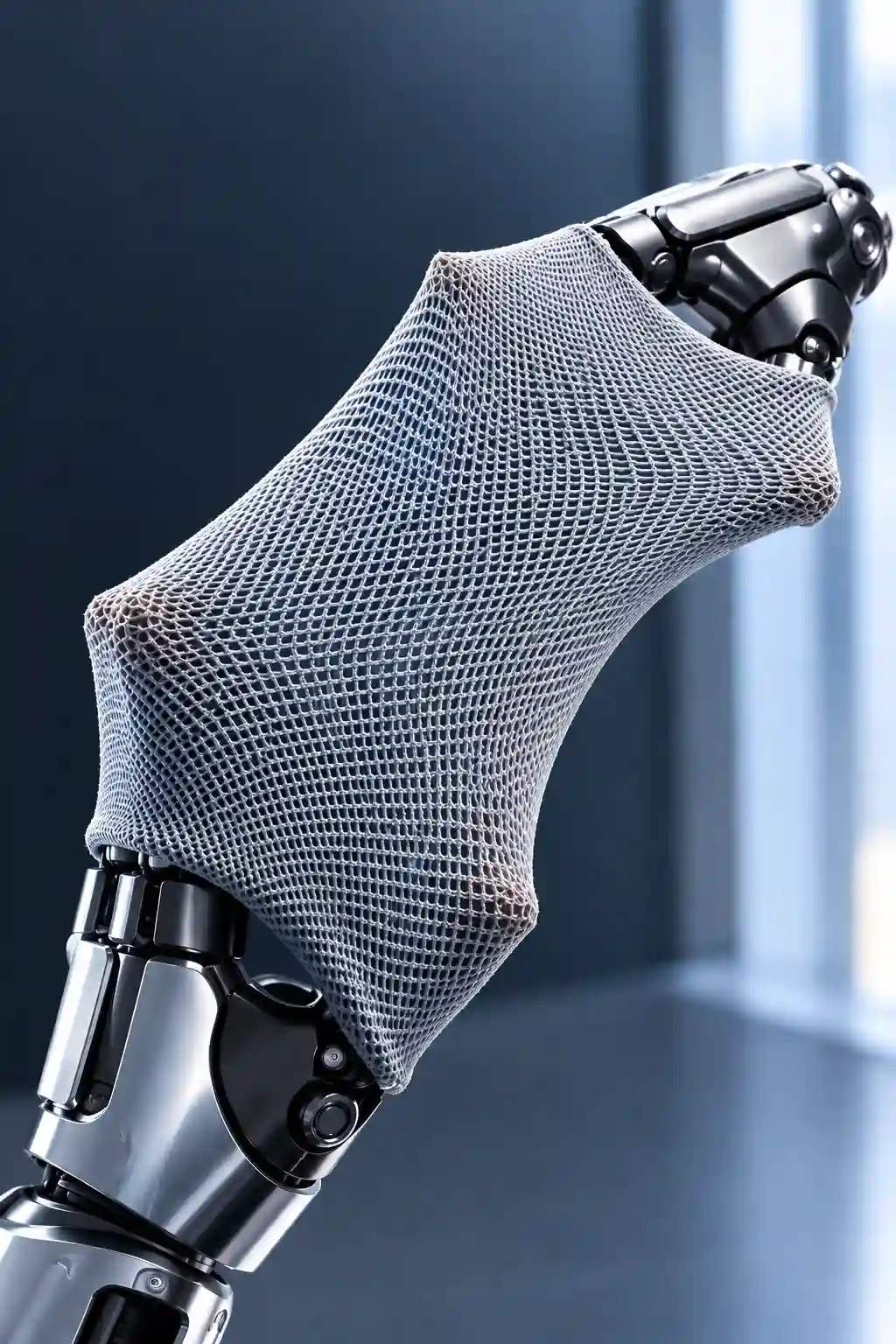

A Chinese company called KnitReal has introduced RoboSkin, a seamlessly knitted fabric covering designed to fit over the joints and body surfaces of humanoid robots. The product has circulated primarily through short video demonstrations and social media posts rather than a formal press campaign, making it a notable but still sparsely documented entrant in a wider trend of companies building clothing and soft coverings specifically for humanoid robots.
It's important to state upfront how limited the independently verifiable information about RoboSkin currently is. Unlike many robotics announcements covered by trade publications or backed by a company press release, RoboSkin's public visibility so far rests mainly on short-form video content shared by technology commentators on social platforms, describing the same core claims in similar language. No company website, technical white paper, peer-reviewed research or dedicated press release from KnitReal was identified in the course of researching this article. Readers should treat the details below accordingly, as descriptions of what has been shown and claimed publicly, not as independently verified specifications.
What RoboSkin Is Said to Be
According to social media posts describing the product, including one from a technology commentator whose post was widely reshared, RoboSkin uses seamless knitting, multi-directional stretch, and a soft matte finish designed to conform to moving robot joints and complex body surfaces. A short video posted to YouTube describes RoboSkin as "a seamless fabric made for humanoid robots" that "bends with robot joints and reduces friction from repetitive movement," though the video itself functions as a brief demonstration clip rather than a detailed technical explainer.
Seamless knitting, as a manufacturing technique, refers to producing a garment or covering as a single continuous piece of fabric using computerized knitting machines, rather than cutting and sewing separate fabric panels together. This approach is already used in activewear and performance clothing to reduce chafing points and allow fabric to stretch smoothly across a body's contours. Applied to a robot, the same principle would in theory allow a covering to follow the shape of a joint through its full range of motion without a seam catching, bunching or tearing at a stress point, though this publication did not find independent testing data confirming how RoboSkin performs in practice.
The Problem This Type of Covering Is Intended to Address
Humanoid robots with exposed mechanical joints, actuators and wiring face several practical issues that a fabric covering could plausibly help address: protecting internal components from dust and minor impacts, reducing visible wear from repeated joint movement, and giving the robot a more finished, approachable appearance for settings where it interacts with people. Rigid plastic or metal shells, by contrast, are harder to fit precisely around a joint's full range of motion and can create pinch points or gaps as a limb bends.
This general rationale is consistent with a broader pattern of companies building soft, fabric-based coverings and clothing specifically for humanoid robots, a trend that has been reported more substantively elsewhere. Paris-based Maison Roboto, described in a company statement as a "robot couture atelier" established in 2024, has said it develops garments tailored to the dimensions and movement characteristics of different humanoid robot platforms, and announced in 2026 that it was field-testing robot clothing during mobility trials in China. Separately, Xinhua reported in July 2026 that humanoid robots developed by Aitu, a Zhejiang-based sewing technology company, were being tested for handling and separating fabric pieces inside Chinese garment factories, illustrating a related but distinct application of robots and textiles working together in manufacturing rather than as a robot's own outer covering.
KnitReal: What Is and Isn't Known
Based on the sources reviewed for this article, KnitReal (also rendered as KNITREAL in some social media posts) appears to be a company operating within China's rapidly expanding humanoid robotics supply chain, which has drawn substantial investment and seen a growing number of specialized component and accessory makers emerge alongside major robot manufacturers. Beyond this general context, this article did not find verified information about KnitReal's founding date, headquarters location, funding, leadership or company size.
No confirmed customer names, commercial partnerships with specific humanoid robot manufacturers, or independent demonstrations at a named industry event were identified in the sources available. Given the absence of a company statement, technical documentation or third-party robotics trade coverage, RoboSkin's current development stage should be considered unconfirmed rather than assumed to be either an early prototype or a production-ready product. It should not be described as commercially available unless a verifiable source, such as a company announcement, product listing or independent report, confirms that status.
Distinguishing This RoboSkin From Similarly Named Products
Readers researching this topic should be aware that the name "RoboSkin" has been used previously by unrelated organizations for different technologies. US-based BeBop Sensors has marketed its own product line under the name RoboSkin since at least 2022, consisting of fabric-based tactile pressure sensors, including a "Robo-Finger" sensing system, designed to give robots a sense of touch rather than simply covering their surfaces. Separately, an EU-funded academic research initiative from the early 2010s also used the name ROBOSKIN to describe a capacitive tactile sensing system tested on robots including iCub, KASPAR and NAO. Neither of these earlier or unrelated products is affiliated with KnitReal, and this article's use of "RoboSkin" refers specifically to the knitted fabric covering attributed to KnitReal in the sources described above.
Possible Applications, With Appropriate Caveats
If a product along the lines described for RoboSkin performs as claimed, plausible applications could include protective, close-fitting coverings for humanoid robots used in settings where appearance and durability both matter, such as service, hospitality or research demonstration environments, as well as manufacturing settings where dust and debris protection for exposed joints could reduce maintenance needs. These are reasonable, general possibilities consistent with how seamless knitted fabric functions in other applications, not confirmed use cases that KnitReal itself has publicly documented in the sources reviewed for this article.
Why It Matters
Seamless textile coverings represent one of several approaches companies are exploring to solve a genuine, practical problem in humanoid robotics: how to protect and finish a robot's moving joints without restricting their range of motion or adding rigid components that could crack or pinch during use. Knitted fabric's inherent stretch and lack of seams make it a logically appealing material for this purpose, and the broader activity around robot-specific garments, from Maison Roboto's tailored clothing to specialized textile handling robots documented by Xinhua, suggests the idea of dressing and covering humanoid robots is gaining wider interest across China's robotics supply chain specifically.
Whether RoboSkin itself becomes a meaningful part of that trend is not something that can be confirmed based on currently available information. Its visibility to date has been driven largely by short social media clips rather than substantiated technical claims, named partnerships, or independent testing, and any assessment of its real-world durability, protective performance or manufacturing scale would require verification that has not yet surfaced in credible reporting.
Further reading and useful links
Reader questions
Frequently asked questions
What is KnitReal's RoboSkin?
RoboSkin is described in social media posts and short videos as a seamlessly knitted fabric covering designed to fit over humanoid robot joints and body surfaces, offering multi-directional stretch and a matte finish. No official company statement or technical documentation from KnitReal was found to independently confirm these claims in detail.
Is RoboSkin commercially available?
This is not confirmed. No verified information on pricing, launch dates or commercial availability was found in the sources reviewed for this article, and its development stage should be treated as unconfirmed rather than assumed.
Is KnitReal's RoboSkin the same product as BeBop Sensors' RoboSkin?
No. BeBop Sensors, a US company, has separately marketed a fabric-based tactile sensor product line under the name RoboSkin since 2022, which is unrelated to KnitReal's knitted covering. An older, unrelated EU academic project also used the same name for a tactile sensing system.
Nexuswild welcomes factual corrections. Email [email protected] with evidence and the article URL.