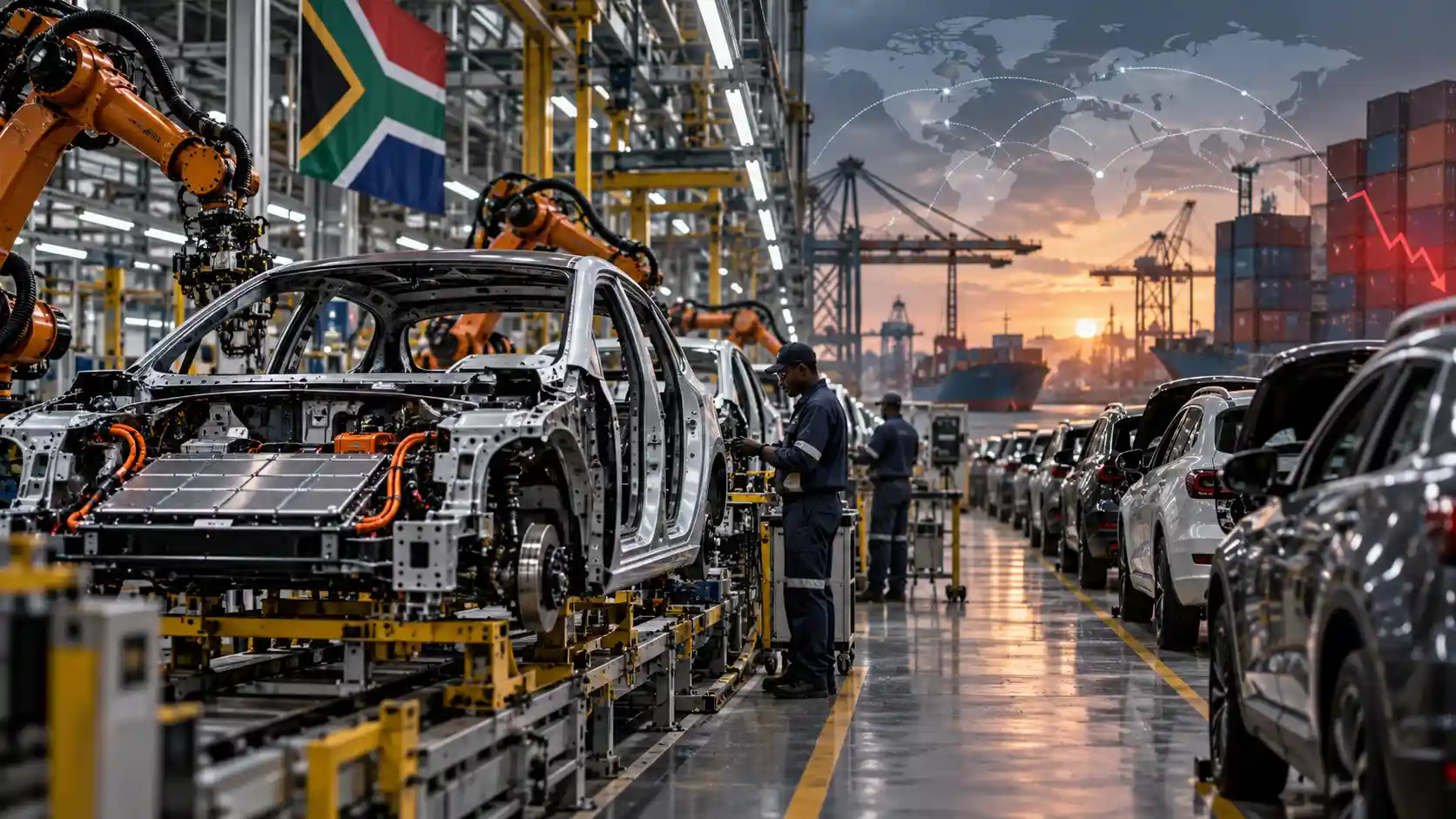

JOHANNESBURG, Sept. 24, 2026 - South Africa has built one of the most developed automotive manufacturing systems in Africa, but the global shift to electric vehicles is changing what a competitive car-producing country needs to offer.
In 2025, South Africa produced 618,077 vehicles and exported 414,271. Automotive exports reached a record R291 billion and represented 15.6% of the country’s total exports. Vehicle and component manufacturing generated 23.8% of value added inside South Africa’s manufacturing sector.
Those numbers show an industry with real industrial depth.
They also explain why the EV transition matters so much.
The immediate risk is not that South Africans suddenly stop buying combustion-engine vehicles. It is that South Africa’s biggest export markets electrify faster than its factories and suppliers.
About 70.5% of South Africa’s light-vehicle production was exported in 2025. Roughly 80.3% of exported light vehicles went to the European Union and United Kingdom region.
That means future investment decisions made by global automakers can matter as much as current sales.
If new EV platforms, battery systems, power electronics and software-heavy vehicle programs are assigned elsewhere, South Africa could continue producing profitable combustion vehicles for years while losing the next generation of industrial investment.
South Africa is a serious automotive producer
South Africa remained Africa’s largest vehicle producer in 2025, accounting for 50.3% of the continent’s vehicle output.
Its global production share was 0.64%, ranking the country 21st worldwide.
Government investment material estimates that the automotive value chain supports around 115,000 direct manufacturing jobs across vehicle assemblers and component suppliers.
The main production clusters are in Gauteng, the Eastern Cape and KwaZulu-Natal.
The sector includes vehicle assembly as well as engines, tyres, catalytic converters, transmission components and other parts.
Its strength has been built over decades.
But its success is heavily export dependent.
Export dependence is becoming the central strategic risk
In 2025, the EU and UK accounted for R182.8 billion, or 62.8%, of total South African automotive export value.
Germany was the top vehicle export destination, followed by the UK, France, Belgium and Italy.
That geographic concentration worked well when European demand was dominated by combustion vehicles.
The market is changing.
Europe’s post-2035 policy framework has been made more flexible, but the direction remains toward sharply lower tailpipe emissions and much greater electrification.
The UK is also continuing its zero-emission-vehicle transition.
The industrial question is therefore straightforward.
Can South African plants manufacture the next vehicles those markets will demand?
The domestic EV market remains small
South Africa’s local new-energy-vehicle market is still at an early stage.
NEV sales reached 16,716 units in 2025, up 7.1% from 2024.
But NEVs represented only 2.8% of total new-vehicle sales because the overall market expanded more quickly.
This creates a difficult asymmetry.
Domestic demand is not yet large enough to force rapid factory conversion.
Export markets are electrifying faster.
A global automaker deciding where to place its next EV program therefore compares South Africa with countries that may already have larger EV demand, stronger battery ecosystems, deeper electronics supply chains or more aggressive industrial support.
That is why South Africa’s transition cannot be measured only by EV sales inside the country.
The more important metric is future manufacturing allocation.
South Africa has started the transition
The country is not starting from zero.
BMW began producing the X3 plug-in hybrid at Rosslyn.
Ford invested R5.2 billion to prepare Silverton for the Ranger plug-in hybrid.
Toyota has hybrid production experience and has committed further investment connected to new-energy vehicles.
South Africa therefore has factories and engineering teams capable of adapting.
Government policy has also moved.
From March 1, 2026, qualifying investments in battery-electric and hydrogen-powered vehicle production can claim a 150% first-year tax deduction.
The incentive applies to qualifying assets brought into use through February 2036.
The Automotive Investment Scheme also provides cash grants for qualifying automotive investment.
These incentives improve the economics of conversion.
They do not guarantee that automakers allocate future global models to South African plants.
Model allocation is the real battle
A car factory survives because it keeps receiving products.
A plant may build one vehicle platform for years.
When that platform approaches the end of its life, the parent company decides where the replacement will be produced.
That decision can determine the future of the plant and its supplier network.
In the combustion era, South Africa competed with labour skills, industrial incentives, trade access and established supplier clusters.
The EV era adds more criteria.
Battery proximity matters.
Power-electronics capability matters.
Software talent matters.
Low-carbon electricity can matter.
Domestic EV demand matters.
Charging infrastructure matters.
And production scale matters because EV and battery investments require enormous upfront capital.
South Africa has to win on this wider scorecard.
Catalytic converters show how the value chain can shrink
South Africa has long been a major exporter of catalytic converters.
They remained the country’s largest automotive component export in 2025, accounting for 26% of component export value.
But battery-electric vehicles do not need exhaust-treatment systems.
Total automotive component exports fell 3.5% to R61.2 billion in 2025, with declining catalytic-converter exports identified as a major reason.
This illustrates the transition risk clearly.
An EV does not simply replace an engine with a battery.
It changes the entire bill of materials.
Exhaust systems disappear.
Fuel systems shrink.
Some engine and transmission components lose value.
Batteries, motors, inverters, thermal-management systems, high-voltage electronics and software become more important.
A country can preserve final assembly while still lose industrial value if the new components are imported.
Local content becomes harder, not easier
South Africa imported R151 billion of original-equipment components in 2025.
The long-term industrial strategy aims to increase local content substantially.
Electrification raises the difficulty.
If a South African EV plant imports battery cells, battery packs, motors, inverters, power electronics and software systems, the country may preserve assembly without capturing much of the new value chain.
The real industrial objective therefore has to extend beyond assembling electric cars.
South Africa needs capability in battery systems, e-axles, thermal management, power electronics, charging hardware, software and higher-value mineral processing.
The country has mineral resources relevant to batteries and fuel cells.
But mineral resources alone do not create an automotive technology industry.
The higher-value gains come from processing, manufacturing, engineering and intellectual property.
Electricity is part of automotive competitiveness now
For years, South African manufacturing has had to manage electricity reliability problems.
That hurts capital-intensive production.
The rapid expansion of private renewable generation and storage can become an advantage if industrial facilities gain reliable access to lower-carbon electricity.
Vehicle makers increasingly measure emissions across their supply chains.
The carbon intensity of manufacturing can affect the lifecycle footprint of an exported vehicle.
This means energy policy and automotive policy are converging.
A future vehicle plant will be judged not only on wages and tax incentives, but also on the reliability and carbon intensity of the electricity behind it.
Logistics remain critical
South Africa is far from its largest export markets.
That creates a freight disadvantage.
Trade agreements, industrial incentives and specialized export systems have helped offset it.
But port and rail reliability remain essential.
Automakers compare the entire delivered cost of a plant, not only labour costs.
Port delays increase inventory.
Rail failures increase trucking dependence.
Unpredictable logistics increase working capital.
In a tightly synchronized industry, reliability is often as important as nominal cost.
Improving freight systems is therefore part of EV competitiveness.
Other traditional manufacturing countries face the same transition
The EV shift is changing the factory map globally.
South Africa is exposed, but it is not alone.
Germany: EV production can grow while jobs fall
Germany produced 1.67 million electric passenger cars in 2025.
EVs represented 40% of domestic passenger-car production, making Germany one of the world’s largest electric-vehicle production locations.
Yet overall production remains below pre-crisis levels.
After the first seven months of 2026, German passenger-car production was 15% below 2019.
The German auto industry also estimates that another 125,000 jobs could be lost by 2035 under the current trajectory, after around 100,000 jobs had already disappeared since 2019.
Germany shows why the transition is not simply about building EVs.
Electric drivetrains generally need fewer mechanical components.
A country can successfully electrify final assembly while still lose jobs among legacy suppliers.
Thailand: converting a legacy hub into an EV hub
Thailand spent decades building a major combustion-engine manufacturing base.
It has responded aggressively to the EV transition.
By May 2026, Thailand’s investment authority had approved 198 EV-chain projects worth more than 137 billion baht, approximately $4.1 billion.
The projects cover battery-electric vehicles, hybrids, plug-in hybrids, batteries, motors, battery-management systems, power controls and charging infrastructure.
The Thai government says companies supported by these investments employ more than 16,000 local workers.
The lesson for South Africa is not that Thailand has already won.
It is that legacy manufacturing expertise can be deliberately redirected into a new value chain before the old one disappears.
Japan: software has become an industrial issue
Japan remains one of the world’s largest automotive manufacturing countries.
Its government is now treating software-defined vehicles as a strategic industrial challenge.
Japan has set a goal for Japanese companies to capture 30% of global software-defined vehicle sales in both 2030 and 2035.
That target reflects a deeper shift.
Future automotive value is not concentrated only in engines, gearboxes and factories.
Software architecture, AI, automated driving, over-the-air updates, data systems and digital services are increasingly central to the vehicle.
A country focused only on physical assembly can retain factories while lose the highest-value technology work.
Mexico: scale buys time, but not immunity
Mexico produced about 3.95 million light vehicles in 2025.
In August 2026 alone, production reached 344,940 vehicles and exports reached 300,475.
Its North American integration, scale and proximity to the United States provide major advantages.
But even Mexico has to keep winning future electrified platforms.
Plants allocated new EV and hybrid products can remain strategic.
Plants tied only to older combustion programs can become vulnerable when model cycles end.
Scale provides a buffer.
It does not remove the transition.
Which countries are most exposed?
The most vulnerable traditional auto-manufacturing locations tend to share four characteristics.
They depend heavily on exports to markets electrifying faster than their own domestic market.
A large part of their supplier base is tied to combustion-specific systems.
They lack deep battery, motor and power-electronics ecosystems.
And their total production is small enough that a global automaker can shift future programs elsewhere without destabilizing its worldwide output.
South Africa meets several of those conditions.
That does not make decline inevitable.
It means delay is expensive.
The 2035 target is ambitious
South Africa’s Automotive Master Plan targets roughly 1.39 million vehicles of annual production by 2035.
It also seeks local content of up to 60% and around 224,000 automotive value-chain jobs.
Compare that with 618,077 vehicles produced in 2025.
The gap is enormous.
Reaching the target would require South Africa to win a much larger share of global production while the industry is simultaneously changing technology.
That makes electrification central to the master plan.
A strategy based mainly on combustion-engine export growth would be increasingly disconnected from the direction of the markets buying most South African vehicles.
Africa is an opportunity, but not an escape from electrification
Africa was South Africa’s second-largest automotive export region in 2025, accounting for R49.5 billion of automotive exports.
The African Continental Free Trade Area can improve regional market access.
That creates an opportunity for South Africa to deepen its position as the continent’s main vehicle-production hub.
But Africa should not become an excuse to avoid the EV transition.
African vehicle markets will also electrify over time.
Other countries can also attract vehicle assembly and battery investment.
The stronger strategy is dual.
Keep access to mature export markets by producing EVs and hybrids.
At the same time, expand South Africa’s role as the production and distribution hub for the African market.
The next factory decisions matter more than today’s registrations
The most important signals over the next several years will be investment decisions.
Which plants receive new EV platforms?
Where are battery packs assembled?
Where are electric motors and inverters sourced?
Which countries receive software engineering teams?
Which suppliers win long-term contracts?
Which factories are retooled rather than allowed to finish an old model and wait?
Those decisions determine the industrial map years before factory closures appear in employment statistics.
What South Africa has working in its favour
South Africa has real advantages.
It has a century of automotive manufacturing experience.
It has a substantial supplier ecosystem.
It has preferential access to major export markets.
It has established industrial clusters.
It has a skilled workforce and an existing incentive framework.
It also has a dominant position within African automotive manufacturing.
The weaknesses are equally clear.
The domestic EV market is small.
Imported components remain important.
The battery and electric-drive supply chain is still developing.
Logistics reliability needs improvement.
Electricity remains an industrial competitiveness issue.
And South Africa’s production scale is modest relative to many countries competing for global model allocations.
This is why EV policy has to be understood as industrial policy.
The strict conclusion
South Africa is not about to stop producing vehicles.
It entered 2026 after a record export year.
That is precisely why the risk can be underestimated.
Strong current exports can coexist with weak positioning for the next product cycle.
The country’s factories are deeply tied to Europe and the United Kingdom, where the market is steadily moving toward lower-emission vehicles.
Its domestic NEV market remains small.
Its largest traditional component export is directly linked to combustion engines.
And the future of its plants depends on global manufacturers choosing South Africa for the next generation of vehicles.
Germany shows that even successful EV production can reduce legacy employment.
Thailand shows that a traditional hub can aggressively attract the new battery and EV supply chain.
Japan shows that software is becoming as important as mechanical engineering.
Mexico shows how scale and regional integration can protect a manufacturing base while the transition unfolds.
South Africa has fewer buffers.
Its strongest defence is not slowing electrification.
It is capturing more of the value created by it.
The industrial winners of the next decade will not necessarily be the countries that built the most combustion vehicles in the last one.
They will be the countries that win the next battery plants, electric platforms, software teams and supplier investments.
For South Africa, that competition is already under way.
Reader questions
Frequently asked questions
Is South Africa actually at risk of losing automotive manufacturing?
There is no evidence of an immediate collapse. The longer-term risk is that future EV, battery and software-intensive vehicle programs could be allocated to other countries as current combustion-era models reach the end of their product cycles.
How many vehicles did South Africa produce in 2025?
South Africa produced 618,077 vehicles in 2025, according to naamsa.
How dependent is South Africa on vehicle exports?
About 70.5% of South Africa’s light-vehicle production was exported in 2025, and 80.3% of exported light vehicles went to the EU and UK region.
How large is South Africa’s EV market?
New-energy-vehicle sales reached 16,716 units in 2025 and represented 2.8% of total new-vehicle sales.
What EV manufacturing incentives does South Africa offer?
From March 1, 2026, qualifying electric and hydrogen vehicle production investments can receive a 150% first-year tax deduction, alongside existing automotive investment grants.
Why are catalytic converters important to this transition?
Catalytic converters were South Africa’s largest automotive component export in 2025, but battery-electric vehicles do not use them, making them a clear example of combustion-specific industrial exposure.
Which other auto-producing countries face EV transition pressure?
Germany faces supplier and employment pressure despite high EV output, Thailand is rapidly attracting EV-chain investment, Japan is focusing on software-defined vehicles, and Mexico must continue winning new electrified platforms despite its larger production scale.
Nexuswild welcomes factual corrections. Email [email protected] with evidence and the article URL.