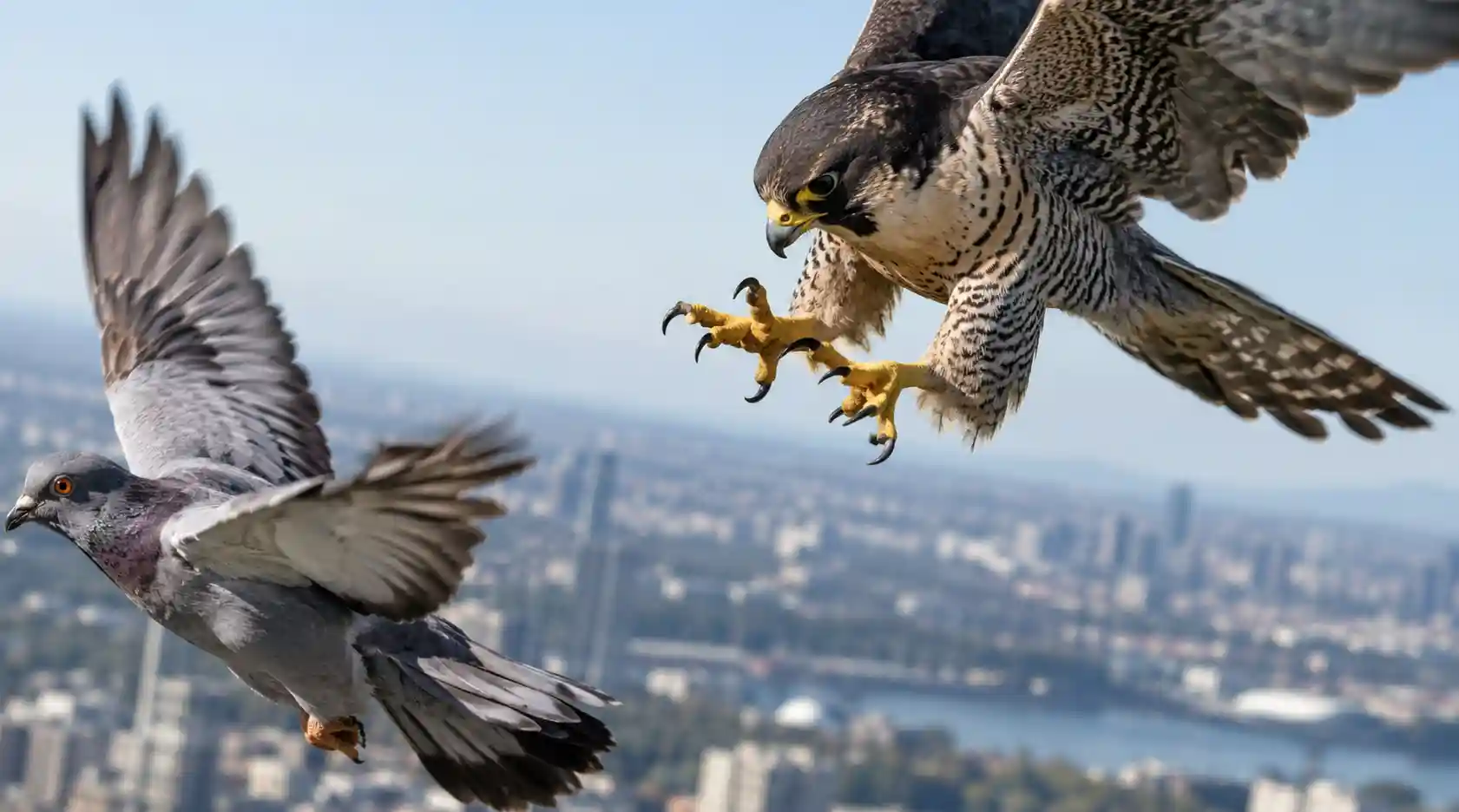

Picture a bird half the weight of a bag of sugar, folding itself into a teardrop a kilometre above the ground, and dropping toward a pigeon at a speed that would get it a ticket on the German autobahn. That bird is the peregrine falcon, and the number attached to its hunting dive - the stoop - is one of the most repeated statistics in wildlife media: 380, sometimes 389, kilometres per hour. It's a genuinely extraordinary figure. It's also one that deserves a closer look before repeating it as fact.
The Stoop, Not the Wingbeat
Peregrines aren't fast in the way most people imagine. In level, flapping flight, a peregrine cruises at a fairly ordinary 65–90 km/h - slower than a car on a motorway, and nothing close to a bird speed record. Its reputation rests entirely on one specific manoeuvre: the stoop, a near-vertical hunting dive from altitude.
A hunting peregrine climbs to a vantage point, often several hundred metres up, scanning open sky or ground for a pigeon, duck or shorebird. Once it spots a target, it doesn't flap harder - it folds. The wings sweep back and tuck against the body, the tail narrows, and the bird collapses into what researchers studying its aerodynamics call a "wrap" position: a dense, compact teardrop with almost none of the drag-producing surface area a bird normally needs to stay aloft. Then it drops, often flapping forcefully at the start of the dive to add thrust before gravity takes over.
Is 380 km/h Real?
Here the record needs sorting into three different kinds of claims, because they don't carry equal weight.
The widely cited figure - around 320 km/h (200 mph) - comes from Guinness World Records, which describes it as an estimated terminal velocity "in ideal conditions" during a hunting stoop. A peer-reviewed aerodynamics study has separately noted that stoops exceeding 320 km/h are plausible based on wing geometry and drag modelling, though tellingly, the actual dives the researchers filmed - falcons diving past a 60-metre dam - were far slower, because the birds simply didn't have enough distance to reach top speed before the study ended.
The higher number, 389 km/h (242 mph), traces back to a single, much-repeated case: in 1999, a falconer named Ken Franklin released his falcon, "Frightful," from a Cessna at roughly 5,180 metres and recorded that speed with an onboard tracking device during her dive. It's a real, documented event - but it's a one-off measurement from a falconry stunt, not a peer-reviewed field study, and it has never been independently replicated under controlled conditions. Meanwhile, on the more conservative end, some radar-tracking datasets have only confirmed speeds up to around 184 km/h (114 mph) for wild peregrines under observation - a reminder that measurement method changes the answer enormously.
So: 380 km/h isn't fabricated, but it isn't an established, repeatable scientific record either. It sits at the extreme edge of a range that most rigorous sources place closer to 320 km/h as a realistic ceiling, with faster figures representing rare, favourable-condition outliers.
The Moment of Impact
Here's the detail that most retellings skip: the falcon almost certainly isn't moving at its peak dive speed when it actually makes contact.
Falconry and raptor researchers describe the final seconds of a stoop as a controlled deceleration, not a continuation of the fall. The bird unfurls its wings and tail to increase drag, bleeds off speed, and extends its feet just before striking - the opposite of a bullet that hits at full velocity. This matches a 2018 simulation by biologists Robin Mills and colleagues at the universities of Groningen and Oxford, who modelled falcon attacks and found peregrines appear to steer using something resembling proportional navigation - the same guidance principle used in missile targeting systems - constantly adjusting their approach angle to intercept a moving, evading target. That kind of fine control is far easier at reduced speed than at 320 km/h in a straight line.
There's a related quirk in how peregrines approach prey from a distance: research by biologist Vance Tucker found wild birds fly along a curved path resembling a logarithmic spiral rather than a straight line to the target. The reason is anatomical - a peregrine's sharpest vision sits about 40 degrees off-centre in each eye, so turning its head to look straight ahead would add drag and slow it down. Flying a curved path lets it keep its head streamlined while still watching the prey with its most acute vision.
When contact happens, it's rarely a grip. High-speed film analysis cited by Stanford ornithologists shows peregrines strike with all four toes extended, not clenched into the "fist" often described in popular accounts - a percussive blow rather than a grab. Peregrines and their relatives also carry a small notch on the upper beak, sometimes called a tomial tooth, thought to help finish off prey by severing the spinal column after the strike has already done the damage.
Built to Survive Its Own Speed
Surviving repeated impacts and G-forces at these speeds requires some specific engineering. Falcon nostrils contain a small bony cone, or tubercle, that breaks up incoming airflow - plausibly preventing the ram-air pressure at high speed from damaging the lungs, though the exact mechanism is debated among researchers. A translucent nictitating membrane sweeps sideways across each eye to protect it from dust and windblast while still allowing vision, and a dark patch of feathering beneath the eye is thought to cut glare, much like the black grease football players wear.
Bird skeletons in general rely on hollow, internally braced bones to keep weight low without sacrificing strength, and raptors are no exception - a structural trade-off that matters enormously when a bird is pulling out of a dive under estimated G-forces in the range of 25–27 G, according to falcon researchers who study stoop behaviour. For comparison, human fighter pilots without G-suits typically lose consciousness around 9 G. A peregrine's oversized heart and lungs, with a resting-to-active heart rate that can climb into the hundreds of beats per minute, help keep blood and oxygen moving to the brain through that kind of deceleration.
The Physics, Stripped Down
The core physics is simple, even if the biology is elaborate. As the falcon falls, it trades height (potential energy) for speed (kinetic energy) - and because kinetic energy scales with the square of velocity, small speed increases represent large energy increases. A falcon moving at 320 km/h carries roughly four times the kinetic energy of one moving at 160 km/h, not twice.
<GenerateWidget title="Falcon Dive Aerodynamics Simulator" height="700px">
{
  "widgetSpec": {
    "id": "falcon-dive-physics",
    "height": "700px",
    "prompt": "Objective: Simulate the physics of a peregrine falcon's dive, showing how drag and gravity affect terminal velocity. Data State: initialValues: { speed: 320 }. Strategy: Standard Layout. Libraries: Matter.js or Canvas API. Inputs: Bird Posture (Toggle: Flapping / Teardrop Wrap / Braking), Starting Altitude (Slider). Behavior: Animate a falling object representing the falcon. Calculate and display real-time velocity and kinetic energy. When posture changes, alter the drag coefficient to show how the teardrop shape accelerates the bird, while braking sheds speed before impact."
  }
}
</GenerateWidget>
That squared relationship is also why the falcon's pre-impact braking matters so much. Shedding even a third of its speed before contact cuts the energy delivered at the strike by more than half - reducing the shock to the falcon's own body while still leaving plenty of force to stun or kill prey. Drag reduction - via the folded "wrap" posture - is what allows the falcon to reach a higher top speed in the first place, since a smaller, smoother profile lets it keep accelerating through air that would otherwise slow a normal, spread-winged bird well before 320 km/h.
How It Stacks Up
Among birds, the peregrine's closest rival is the golden eagle, which has been measured diving at speeds in a comparable 240–320 km/h range using similar stoop techniques. Claims that the white-throated needletail swift reaches 170 km/h in level, flapping flight are widely repeated but rest on older, less rigorous measurements; modern GPS-tracked data on the common swift puts confirmed level-flight speeds closer to 110 km/h - still impressive, but a reminder that not every "fastest bird" claim has aged equally well.
Outside birds, comparisons get murkier because the measurement methods differ. The cheetah, the fastest land animal, tops out around 104–120 km/h but only for 20–30 seconds before overheating - genuine powered sprinting, unlike a gravity-assisted dive. Sailfish and marlin are often credited with speeds near 110 km/h, but those figures largely originate from mid-20th-century experiments measuring fishing line stripped off a reel, which is a proxy for the fish's speed rather than a direct measurement. Ranking a falcon's dive against a cheetah's sprint against a fish's estimated burst produces a tidy list, but it's comparing three different kinds of physics.
What If It Hit a Person?
There's no documented case of a peregrine falcon killing or seriously injuring a human, and for good reason: humans aren't prey, so no one has ever been on the receiving end of an actual hunting stoop. The genuine, if rare, human encounters involve nesting adults dive-bombing people who wander too close to a nest site - a defensive display delivered at a fraction of hunting speed, meant to intimidate rather than strike with full force.
Purely as a physics exercise, though, it's worth asking what a full-speed impact would deliver. A bird weighing around a kilogram moving at 320 km/h carries several thousand joules of kinetic energy - concentrated into an area smaller than a fist and a collision lasting a fraction of a second. That's a serious blunt-force blow, roughly comparable to being struck by a solid object thrown with real force. It would not be trivial. But it's also a scenario that essentially never occurs in nature, since the speed, the targeting, and the intent all belong to a hunting behaviour aimed exclusively at other birds.
The peregrine's stoop remains one of the more genuinely startling numbers in biology - not because 380 km/h is a settled fact, but because even the more conservative, better-supported figure of 320 km/h represents an animal weighing about as much as a can of soup, deliberately falling faster than most highway traffic, and doing it with enough control to hit a moving target and walk away - or rather, fly away - afterward.
Further reading and useful links
Reader questions
Frequently asked questions
How fast can a peregrine falcon actually dive?
While 380 km/h is often cited from a 1999 stunt, peer-reviewed studies and rigorous tracking place the realistic ceiling for a peregrine falcon's dive (stoop) closer to 320 km/h under ideal conditions.
Does a peregrine falcon hit its prey at top speed?
No. The falcon actually decelerates just before impact, unfurling its wings and extending its toes to deliver a percussive blow, shedding speed so it can survive the strike and steer with precision.
How does a falcon survive the G-forces of a 320 km/h dive?
Peregrine falcons have specially adapted hollow, internally braced bones, oversized hearts, and unique nostril cones to break up high-speed airflow, allowing them to handle G-forces estimated between 25 and 27 Gs.
Nexuswild welcomes factual corrections. Email [email protected] with evidence and the article URL.