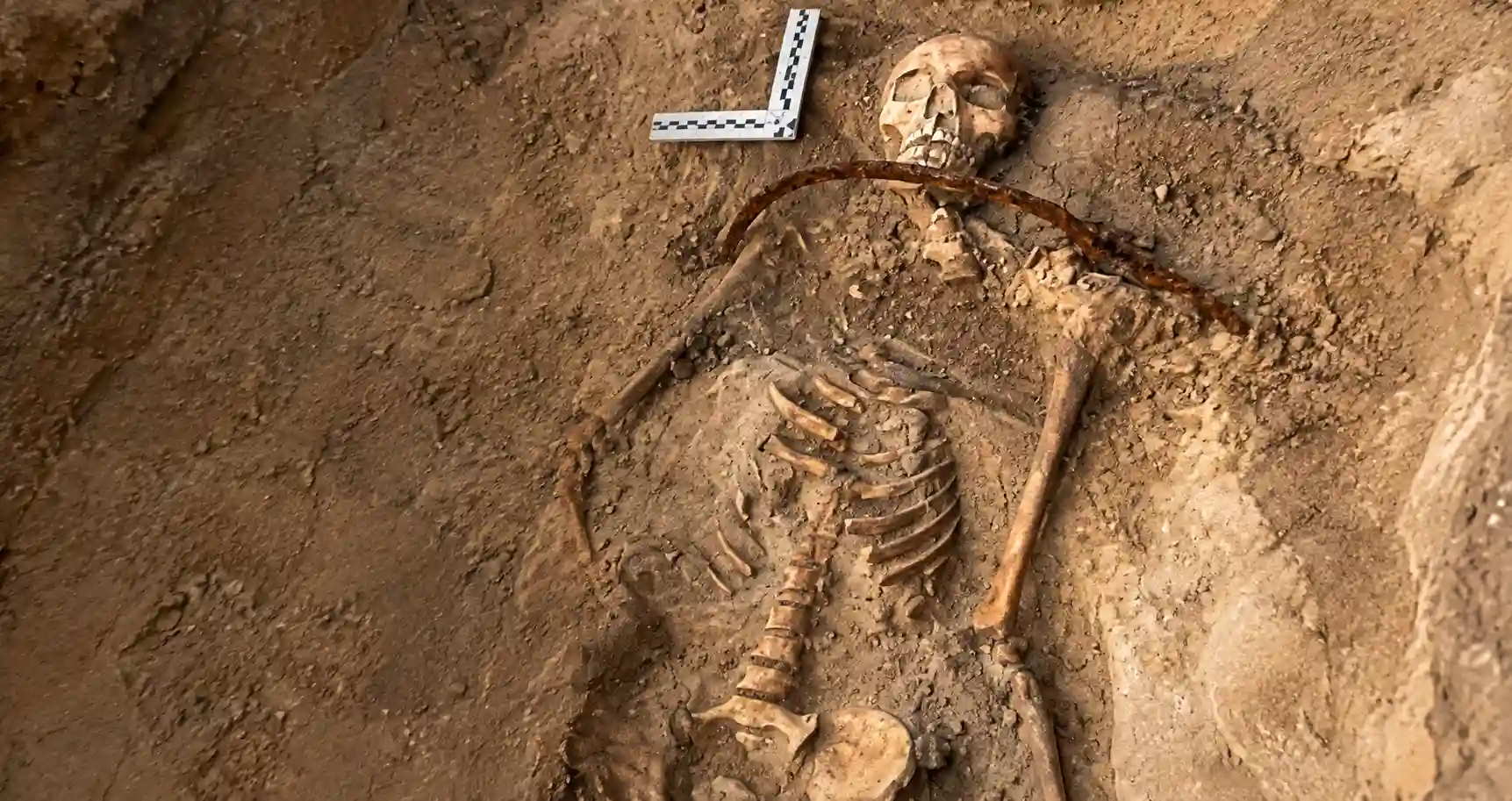

In a field near the village of Pień in northern Poland, archaeologists opened a grave that did not match anything else in the surrounding cemetery. Beneath a thin layer of soil lay the skeleton of a young woman. Across her throat rested a curved iron sickle, its blade turned toward her neck. A triangular iron padlock was fastened to the big toe of her left foot.
There were no headstones marking this cemetery, no mention of it on historical maps, and no written record explaining who was buried there or why. Researchers from the Institute of Archaeology at Nicolaus Copernicus University (NCU) in Toruń, led by Dr hab. Dariusz Poliński, have spent years trying to understand what this particular grave, catalogued as Grave 75, was meant to accomplish.
Their conclusion, published following multidisciplinary analysis, is that the burial reflects a documented category of early modern funerary practice intended to prevent a feared deceased person from returning. What follows is what the physical evidence shows, what remains uncertain, and how that evidence differs from the popular shorthand of a "vampire burial."
A Grave Unlike Any Other in Pień
Excavations at Pień, located in Poland's Kuyavian-Pomeranian Voivodeship near Dąbrowa Chełmińska, began in 2005. Over subsequent seasons, archaeologists identified 101 graves dating to the 17th century, when the site appears to have served as a burial ground for roughly four generations.
The cemetery has no known documentary history. It sits apart from the village, and it contains no crosses, medals, or other devotional objects typical of Catholic burial in the region at the time. Researchers have suggested this absence points to a Protestant or otherwise unconsecrated burial ground, plausible given that Lutheran and Mennonite communities from Germany and the Netherlands lived alongside the predominantly Catholic Polish population in this part of the Polish-Lithuanian Commonwealth.
Within the 101 graves, at least a dozen have been described by the excavation team as atypical. These include a child buried face down, skeletons weighed down with stones, and another child buried with a padlock placed beneath the foot. Grave 75, however, stood out even among these unusual burials, because it combined two distinct protective measures rather than one.
Inside Grave 75: The Sickle, the Padlock, and the Evidence
The skeleton in Grave 75 belonged to a young woman. Estimates of her age at death have been refined as analysis progressed, with the most recent multidisciplinary study placing her in her late teens, and radiocarbon evidence pointing to a burial date around the middle of the 17th century.
Near her skull, excavators recovered fine metallic threads, identified as silver and gold-gilded wire from what had been a silk cap. Textiles of this quality were expensive in 17th-century rural Poland, and their presence suggests the woman came from a household of some material means, though her precise identity, occupation, and social standing have not been established and remain unknown.
The padlock, triangular in shape and made of iron, was attached to her left big toe. It was found unlocked at the time of excavation. Analysis of the soil and the position of the skeletal remains indicates that the grave had been reopened after burial, while the body had not yet fully decomposed. It was during this second intervention, researchers concluded, that the iron sickle was placed across her neck, with its curved blade oriented toward her throat. The sickle's handle had decayed but was identified as wood, most likely birch.
A further detail has emerged from continuing research: a greenish discoloration on the roof of the woman's mouth, consistent with contact with a copper-alloy object that may have been placed there. This finding has not been fully confirmed through follow-up chemical testing, and researchers have treated it as a preliminary observation requiring further verification rather than an established fact.
Skeletal analysis also identified evidence consistent with a benign chest tumor, which may have caused a visible lump and some pain during her life, though researchers have stated this condition was not the cause of her death. No trauma, illness, or other clear indicator of how she died has been identified on her remains, and her cause of death is not established.
Beliefs About the Restless Dead in Early Modern Poland
To understand why a community would reopen a grave to add an iron sickle, it helps to look at the broader folk beliefs documented across Central and Southeastern Europe from the late medieval period into the early modern era. In many of these traditions, certain deaths, whether sudden, unexplained, or associated with someone already viewed with suspicion in life, raised fears that the deceased might not stay in their grave.
This is a matter of documented folk belief, not verified supernatural occurrence. Historical and ethnographic sources describe communities taking physical precautions against a corpse they believed could return and cause harm, whether through illness, misfortune, or unexplained deaths among the living. Archaeologists studying these graves generally frame them using terms such as "anti-vampiric," "anti-demonic," or "apotropaic" burial, borrowing vocabulary from later folklore to describe practices that predate, and are broader than, the modern literary vampire.
It is important to distinguish this folk context from any claim that the woman herself was believed, during her lifetime, to be a supernatural creature in the specific sense later popularized in fiction. The archaeological evidence documents what was done to her body after death. It does not, by itself, tell us the exact words or beliefs her community used to justify it.
Why Sickles and Iron Appear in Protective Burials
Sickles and other iron implements recur across this category of burial elsewhere in Poland. A 17th- to 18th-century cemetery excavated at Drawsko, for example, produced several burials containing sickles, along with graves where a large stone had been placed beneath the deceased's chin, apparently intended to keep the mouth or throat obstructed.
Several practical and symbolic explanations have been proposed by researchers for this pattern, drawn from the broader archaeological and historical record of such burials. A blade positioned across the neck could have been intended to injure or decapitate a corpse that tried to rise. Iron itself carried protective associations in folk belief across much of early modern Europe, often connected to ideas about warding off malevolent forces. Birch wood, identified as the likely material of the sickle's handle at Pień, has also been associated in regional folklore with protective qualities, though its specific significance in this burial cannot be confirmed beyond its identification as the material used.
What distinguishes the Pień burial from many comparable finds is the apparent sequence of events. The padlock appears to have been part of the original burial, while the sickle was added later, after the grave had already been closed once. Researchers interpret this two-stage intervention as evidence that concern about the woman returning did not end with her burial, but intensified afterward, prompting the community to reopen the grave and add a second, more severe precaution.
What Researchers Believe the Burial Reveals
Poliński and his colleagues, who have conducted radiocarbon dating, ancient DNA analysis, isotope testing, and microscopic and X-ray imaging on the remains, have proposed that the woman was likely blamed by her community for misfortune that occurred after her death, potentially including disease or agricultural hardship. Seventeenth-century Poland experienced recurring warfare, disease outbreaks, and difficult climatic and agricultural conditions, circumstances in which unexplained calamity could plausibly be attributed to a specific, already-distrusted individual.
The research team has also drawn a distinction between this kind of burial and the treatment typically given to people formally accused of witchcraft in the period, who were generally handled differently, including improvised or hastily arranged graves rather than a return visit to an existing burial plot. This suggests the woman was not, as far as the evidence indicates, the subject of a witchcraft prosecution, but rather someone regarded with suspicion or fear within her own community for reasons that are not archaeologically recoverable.
Researchers have also cautioned that such treatment historically could stem from a wide range of circumstances, including visible illness, physical difference, unusual behavior, or simply being an outsider, rather than any wrongdoing. None of these specific circumstances has been confirmed for the Pień woman herself, and her precise history remains, and may permanently remain, unknown.
Why It Matters
The Grave 75 burial offers a rare, physically documented example of how a 17th-century Polish community responded to fear of the dead, providing evidence that goes beyond later folklore collections or literary accounts. Because the grave preserves a sequence, an initial burial followed by a deliberate reopening, it allows researchers to reconstruct not just a single ritual act but a process, suggesting that communal anxiety could build over time rather than being resolved entirely at the moment of burial.
More broadly, the Pień cemetery, with its unmarked location, absence of Catholic devotional items, and cluster of atypical burials, offers a window into how marginalized, feared, or excluded individuals were treated in death in this period and region. Studying these graves helps historians and archaeologists move beyond generalized folklore to examine, case by case, the specific physical evidence of how fear, religion, and social exclusion intersected in early modern burial practice.
Fact Check
* Status: True. Confirmed by the excavating institution (Institute of Archaeology, Nicolaus Copernicus University) and corroborated across multiple independent reports of the find.
* Status: True. Confirmed as a peer-reviewed research finding in the Journal of Archaeological Science: Reports by Poliński and collaborating researchers based on stratigraphic and taphonomic analysis.
* Status: Unverified. This is preliminary and described by researchers as requiring further chemical confirmation rather than established fact.
* Status: False. Not supported by any archaeological or documentary evidence reviewed; researchers have explicitly distinguished this burial from typical witch-trial burial treatment.
* Status: False. The term "vampire burial" is a modern popular label applied to a documented folk-belief practice, not evidence of supernatural events.
- Claim: A 17th-century grave containing a young woman's skeleton, with an iron sickle placed across her neck and a triangular iron padlock attached to her toe, was excavated at Pień, Poland.
- Claim: Soil and skeletal evidence indicate the grave was reopened after initial burial, before full decomposition, and that the sickle was added during this second intervention.
- Claim: A greenish stain on the woman's palate suggests a copper-alloy object may have been placed in her mouth or nose.
- Claim: The woman was a confirmed victim of a witchcraft trial or was ritually murdered.
- Claim: The burial proves the existence of vampires or that the woman was a vampire.
Further reading and useful links
Reader questions
Frequently asked questions
Was the woman buried at Pień actually believed to be a vampire?
Researchers describe the burial as an example of a documented folk practice aimed at preventing a feared deceased person from "returning," a belief that predates and differs from the modern literary vampire. No source confirms the specific word "vampire" was used by the 17th-century community itself.
Why was an iron sickle placed across her neck?
Archaeologists interpret the sickle's position and blade orientation as a probable protective measure meant to injure or immobilize the corpse if it were believed capable of rising, a pattern also documented at other Polish burial sites of the period.
How old was the woman, and how did she die?
The most recent peer-reviewed analysis places her in her late teens at death, around the mid-17th century. Her cause of death has not been determined, and no injuries or disease markers explaining it have been found on her remains.
Was she convicted of witchcraft?
No. Researchers have specifically noted that individuals formally tried for witchcraft in this period were typically buried differently, suggesting this woman was feared or distrusted for reasons that were not part of a formal legal or religious prosecution.
Is this the only burial of its kind found in Poland?
No. Similar protective burials, including graves containing sickles, have been documented at other Polish sites such as Drawsko. Pień itself contains Poland's largest known cluster of such burials within a single cemetery.
Nexuswild welcomes factual corrections. Email [email protected] with evidence and the article URL.