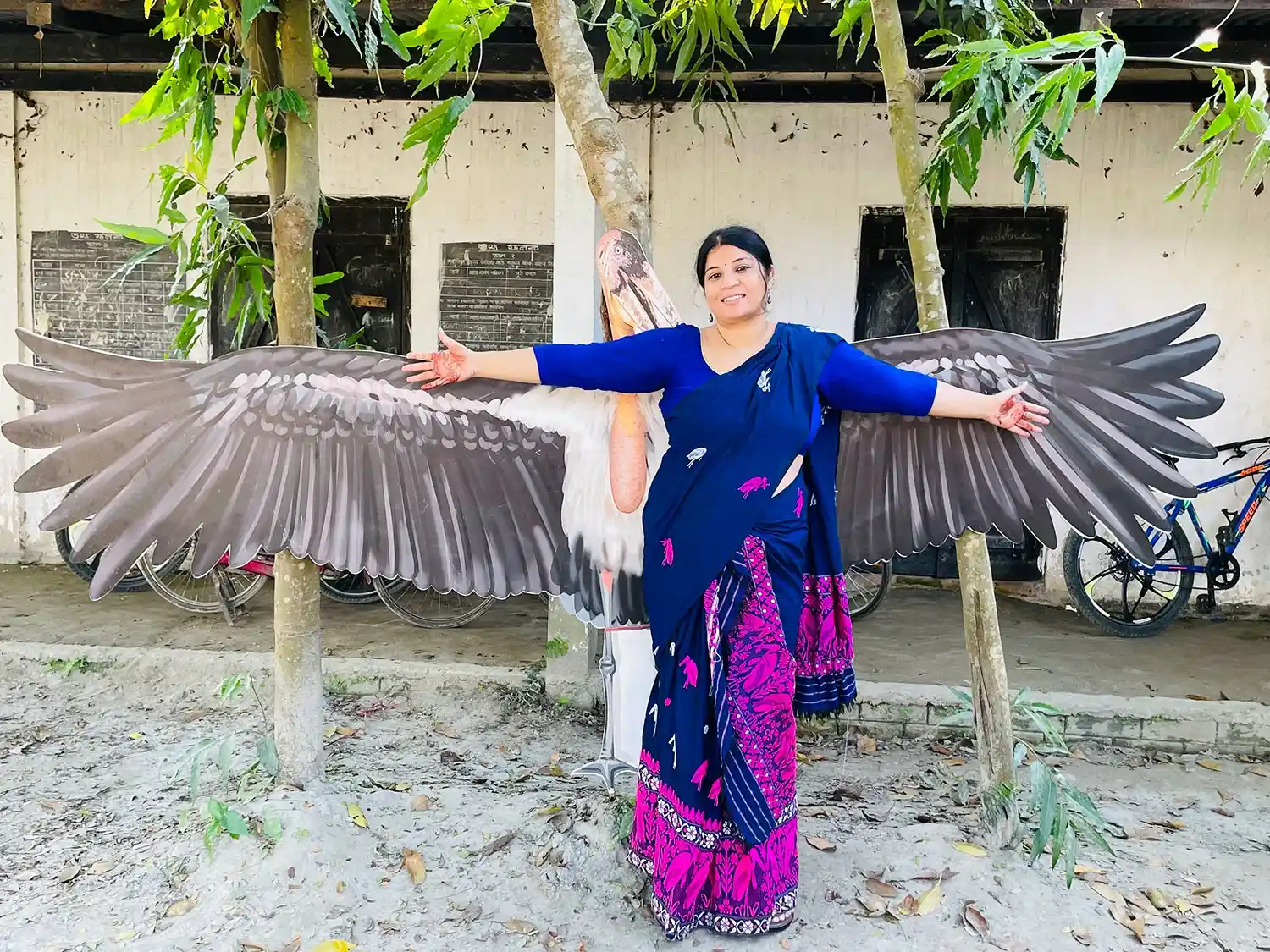

KAMRUP — Purnima Devi Barman was born in 1980 in Pub Majir Gaon, a village on the banks of the Brahmaputra River in Assam's Kamrup district. As a child, she was sent to live with her grandmother, a farmer who took her to nearby wetlands and taught her the songs of local birds. "I fell in love with the birds," Barman has said. That early bond grew into a career: she earned a master's degree and a PhD in zoology from Gauhati University and became a wildlife biologist, later working with the conservation organization Aaranyak.
The Hargila: A Misunderstood Giant
The greater adjutant stork, *Leptoptilos dubius*, is known locally in Assamese as "hargila," meaning bone swallower. It is one of the rarest storks in the world; the IUCN estimates the global population at roughly 1,360 to 1,510 mature individuals, with around 80% concentrated in Assam. Nearly five feet tall, with a bald head and a large, wedge-shaped bill, the bird scavenges at garbage dumps and wetlands. For years it was seen in many Assamese villages as a bad omen, a dirty, foul-smelling nuisance associated with disease. Villagers who owned the tall trees where the storks nested often cut them down to stop droppings and rotting food from falling into their yards, destroying nesting colonies and killing chicks.
The Moment That Changed Everything
Barman was working on her PhD research on the greater adjutant when she witnessed a nesting tree being felled in a village, killing chicks and wiping out an entire breeding colony. "It disturbed me so much that I put my PhD on hold," she has said. That loss became the turning point that redirected her career from academic research toward hands-on conservation.
From Studying Birds to Organizing Communities
Barman soon realized that data and fieldwork alone would not save the hargila. Changing how people felt about the bird mattered more than counting them. Since most nesting trees stood on private land, often owned or managed by women in rural households, she began reaching out directly to local women as partners rather than an audience to be lectured.
Birth of the Hargila Army
In 2007, Barman founded what became known as the Hargila Army, a grassroots, women-led conservation group based in Assam's Kamrup district. What started with a small circle of village women has grown into a network described in recent years as more than 20,000 members. The women monitor and protect nesting trees, rescue chicks that fall from nests, rehabilitate injured birds, and spread awareness in schools and communities.
Making Hargila a Source of Pride
Barman and the Hargila Army wove the stork into local culture rather than treating conservation as an outside imposition. Communities began holding "baby showers," using the Panchamrit ceremony traditionally performed for expecting Assamese women, to celebrate hatching stork chicks. The bird began appearing in folk songs, poems and plays. Barman helped provide women with looms and yarn to weave textiles featuring hargila motifs, which they sell, turning conservation into a source of income as well as identity. "There's a lot that the hargila has taught me," Barman has said.
A Population on the Rebound
The results have been significant, though the species remains far from secure. Assam's local greater adjutant population has grown from an estimated 450 birds around the time Barman began her work to more than 1,800 today, with a corresponding rise in protected nesting sites. In 2023, the IUCN reclassified the greater adjutant from "endangered" to "near threatened," citing conservation efforts including the Hargila Army's work, though it also notes the species remains conservation dependent and could decline again without continued protection. Barman has set a goal of helping the global population reach 5,000 birds by 2030, expanding efforts into Bihar and Cambodia.
Recognition on the World Stage
Barman's work has earned international recognition, including the Whitley Award in 2017, the Nari Shakti Puraskar in 2018 (presented in 2017/2018), the UN Environment Programme's Champions of the Earth award in 2022, the Whitley Gold Award in 2024, and a place on TIME's Women of the Year list in 2025.
A Model for Community-Led Conservation
The hargila's recovery was not the work of one person. It came from thousands of women who chose to protect nesting trees on their own land, pass on new attitudes to their children, and turn a once-feared bird into a shared source of pride. Barman's role was to spark and sustain that shift, working alongside Aaranyak, government agencies and international conservation groups. The Hargila Army remains a rare example of a species saved largely because a community decided the bird belonged to them.
Further reading and useful links
Reader questions
Frequently asked questions
Who is Purnima Devi Barman?
Dr. Purnima Devi Barman is a wildlife biologist and conservationist who founded the Hargila Army, a grassroots, women-led movement dedicated to saving the greater adjutant stork.
What is the Hargila Army?
The Hargila Army is an organization of over 20,000 women in Assam who protect the nesting trees of the greater adjutant stork, rescue chicks, and integrate conservation with local culture and livelihoods.
Why was the greater adjutant stork endangered?
Known locally as the hargila, the bird was considered a bad omen and a dirty scavenger. Villagers often cut down the tall trees where the storks nested to avoid the mess, destroying breeding colonies and pushing the species toward extinction.
Nexuswild welcomes factual corrections. Email contact@nexuswild.com with evidence and the article URL.