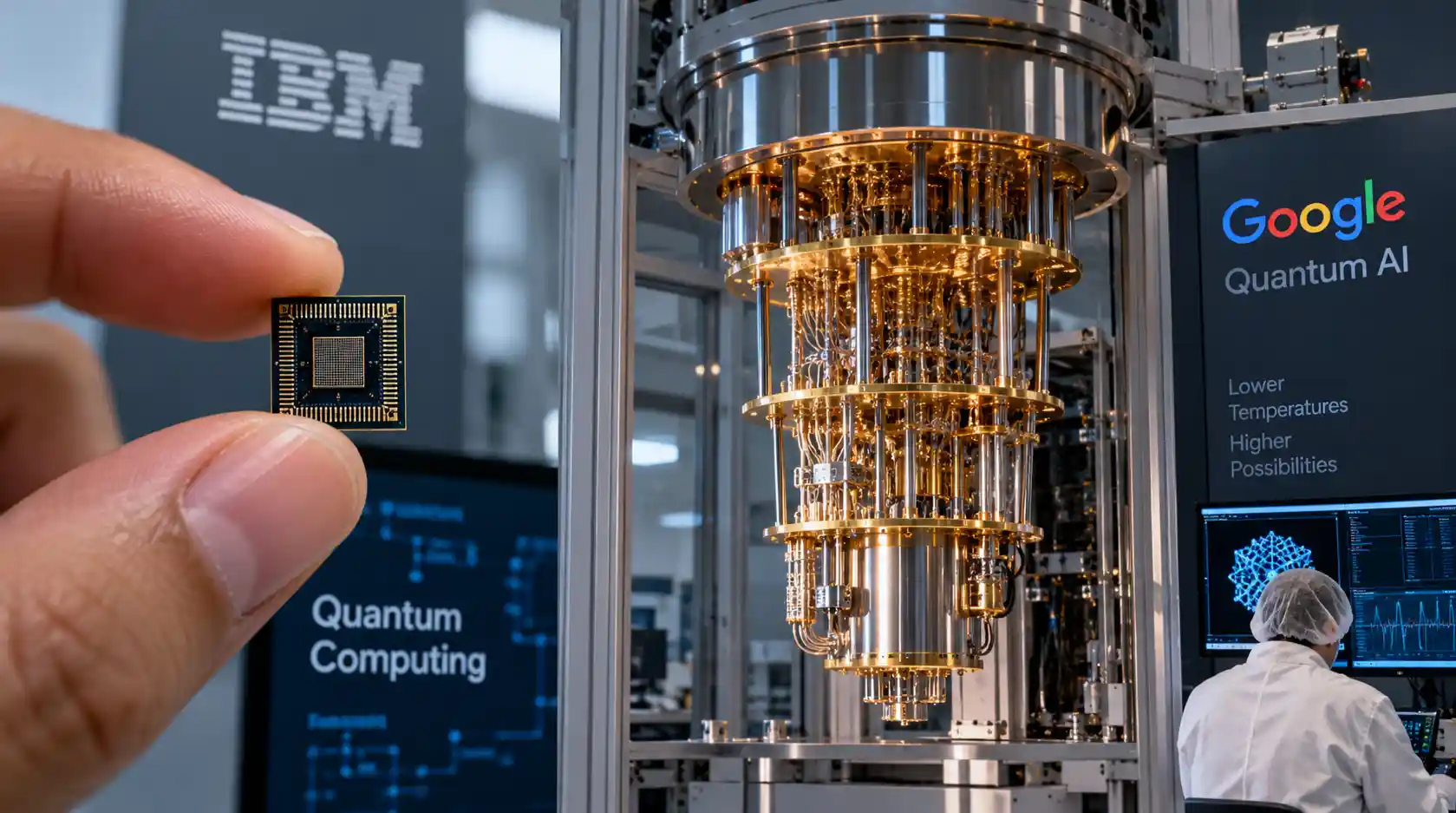

For most of quantum computing's short commercial life, the machines that generate headlines look roughly the same: a chandelier of gold-plated tubing hanging inside a refrigerator the size of a closet, chilling a chip to a fraction of a degree above absolute zero. It's an expensive, fragile way to compute, and it has shaped who gets to own a quantum computer - mostly national labs, universities and a handful of tech giants with the budget and floor space for cryogenic plumbing. A Leipzig-based startup called SaxonQ is testing a different premise: that the qubit doesn't need a deep freeze at all, because it can live inside a tiny, natural flaw in a diamond.
Spinout to Commercial Launch
SaxonQ was spun out of the University of Leipzig in 2021 by two physics professors, Marius Grundmann and Jan Meijer, along with executive Frank Schlichting. Grundmann, who has decades of experience in semiconductor physics, and Meijer, one of the more established names in ion-beam implantation, built the company around a technology known as the nitrogen-vacancy, or NV, center - a defect in diamond that has been studied in physics labs for close to two decades. On July 21, 2026, the company opened commercial orders for two systems, the SXQ128 and SXQ512, which it describes as the first diamond-based NV-center quantum computers to scale meaningfully past the single-digit qubit counts that had defined the field until now. Both are built to slot into a standard server rack, run off ordinary electrical power, and skip the cryogenic hardware and vacuum chambers that superconducting and trapped-ion machines typically require.
It's worth being precise about what already exists versus what's still on a roadmap. SaxonQ's earlier, smaller machine - a four-qubit mobile unit - has been running at Fraunhofer IWU in Dresden since June 2025 for industrial optimization work in material processing and robotics, and Germany's DLR has reportedly accepted similar four-qubit demonstrators. At Hannover Messe 2025, the company also showed the system computing the energy of a hydrogen molecule and performing basic image recognition. That's real, deployed hardware, not a lab curiosity behind glass. The newly announced SXQ128 and SXQ512 are a different matter: the smaller model is available to order with delivery promised within three months, while the larger one isn't scheduled to ship until the second quarter of 2027. So this is a commercial launch and an engineering roadmap, not yet an independently benchmarked product.
Bypassing the Cryostat
To understand why a wall-outlet quantum computer is notable at all, it helps to know what the alternatives fight against. Superconducting qubits, the approach used by IBM and Google, only behave like quantum objects when cooled to around 15 millikelvin inside a dilution refrigerator - colder than deep space - because any stray heat instantly scrambles the delicate superconducting currents that encode information. Trapped-ion and neutral-atom systems avoid millikelvin temperatures but still need ultra-high vacuum chambers and networks of lasers to isolate and cool individual atoms so they don't lose their quantum state to collisions or vibration. Across nearly every mainstream architecture, the underlying problem is the same: quantum states are exquisitely sensitive to heat, electrical noise and mechanical disturbance, so engineers isolate the qubits from the world as completely as they can.
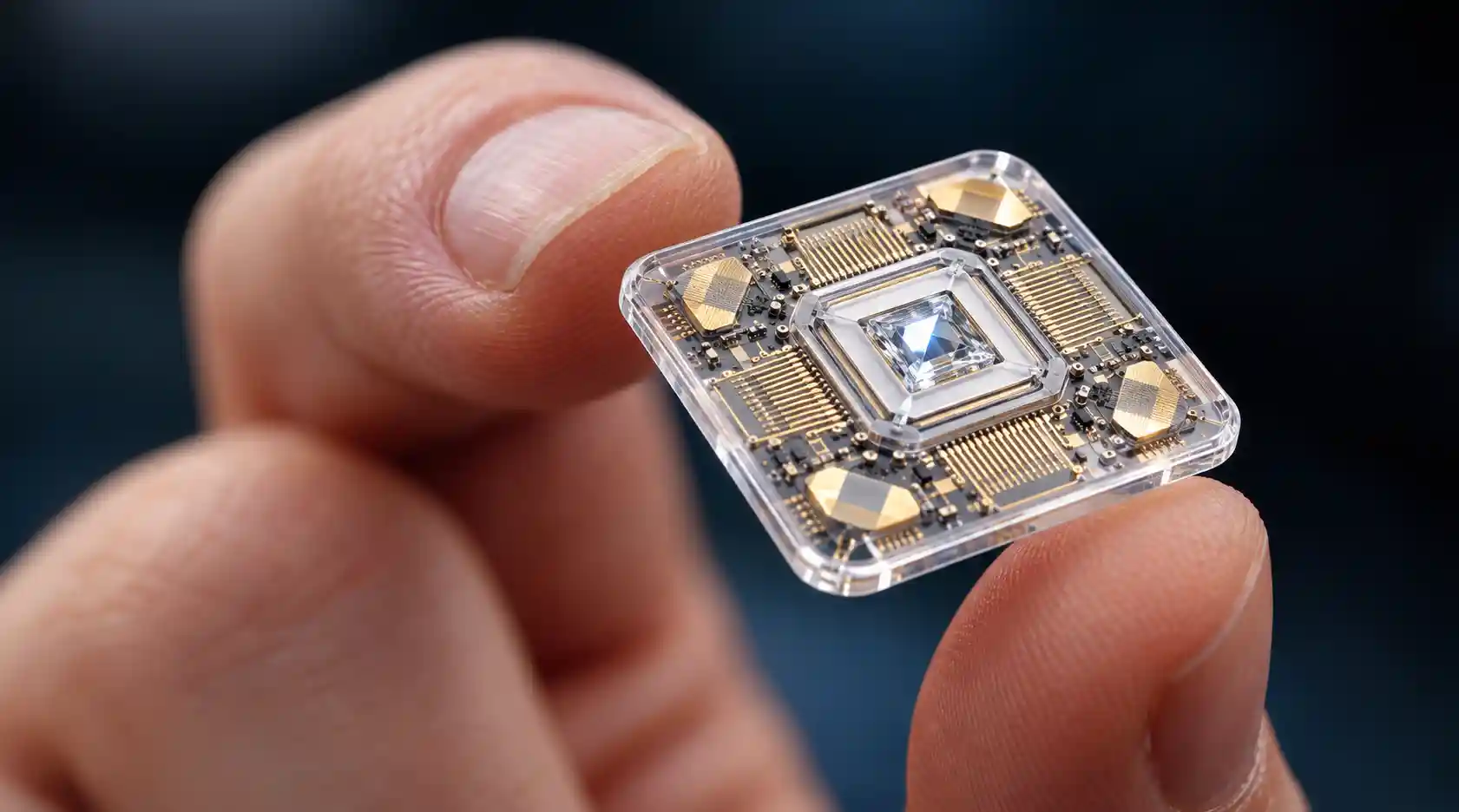
Diamond NV centers sidestep part of that problem because of where the qubit physically sits. An NV center forms when a nitrogen atom takes the place of a carbon atom in the diamond lattice, sitting next to an empty spot where another carbon atom should be. That paired defect behaves like an artificial atom, and the spin of its trapped electron can be used to store a quantum bit of information. A laser pulse initializes and reads that spin state, and microwave pulses flip and rotate it to run quantum operations - no superconducting circuitry, no dilution refrigerator. Diamond's rigid carbon lattice also shields the defect from its surroundings well enough that the spin state can survive at room temperature, a property researchers demonstrated in diamond more than a decade ago in academic settings.
SaxonQ's contribution is largely about manufacturing: turning that known physics into diamond chips with enough usable, well-placed NV centers to be worth building a computer around. The company says a patented process that co-implants sulfur alongside nitrogen - sulfur donates electrons that help keep the vacancy in the right charge state - pushed its qubit creation yield above 85%, up from roughly 10% previously. Independent, peer-reviewed work has demonstrated similar charge-assisted approaches reaching yields around 75%, and more recent academic research confirms sulfur can help NV formation while also cautioning that competing defects can limit efficiency and that the underlying mechanism isn't fully understood. SaxonQ's specific yield figure, in other words, is a company claim that sits near, but ahead of, what's been shown in published research.
Multi-Core Scaling and the Supercomputer Label
The architecture also differs from competitors in how it scales. Rather than one large, monolithic array of identical qubits, SaxonQ's machines are built from multiple smaller processing cores. According to the company's own technical specifications, the SXQ128 groups its qubits into cores of eight fully entangled qubits each, and the SXQ512 into cores of sixteen; the headline number describes the total across all cores running in parallel, not a single register in which every qubit is entangled with every other. That's an important distinction, because entanglement across an entire chip - not just qubit count - is what determines how large and complex a quantum algorithm a machine can actually run. Splitting a problem across many small cores, a technique known as circuit cutting, works for some workloads but adds classical computation to stitch results back together, and by the company's own account doesn't scale well for problems that need extensive entanglement.
On the performance side, SaxonQ reports single-qubit gate fidelities up to 99.92–99.98%, but two-qubit gate fidelity - a better proxy for how well a chip can run real algorithms - is reported around 97%, with anything above 99% for multi-qubit operations described by the company as simulated rather than measured. None of these figures have yet been through independent, third-party benchmarking.
Given all that, calling either machine a "quantum supercomputer," as some coverage has, overstates where the technology sits. Eight or sixteen genuinely entangled qubits per core, without fault-tolerant error correction, is a meaningful engineering step for a room-temperature architecture, but it's well short of what "supercomputer" implies in either the classical or quantum sense. SaxonQ itself frames error correction and true logical qubits as future roadmap items, targeting systems in the thousands or tens of thousands of qubits sometime after 2030.
Practical Deployability
What the approach does plausibly offer, even at this early stage, is deployability. A rack-mounted system that plugs into normal power and tolerates an ordinary office or factory floor opens quantum experimentation to organizations that could never justify a cryostat and a dedicated physics team - something reflected in Fraunhofer IWU's use of the smaller machine for manufacturing optimization, and in the company's pitch around low-latency, on-site use cases like robotics. NV centers are also, separately from computing, an established sensing technology, capable of extremely sensitive magnetic field detection, which points toward a natural overlap between SaxonQ's hardware and quantum sensing applications. Chemistry and materials-science simulations of small molecules, and pattern-recognition tasks pitched as quantum convolutional neural networks, are the application areas the company has actually demonstrated or discussed, rather than more ambitious claims about breaking encryption or outperforming classical supercomputers broadly.
The Engineering Hurdles Ahead
The engineering hurdles ahead are the ones that have defined NV-center research for years: growing the number of qubits that can be fully entangled within a single core, linking cores together without crippling overhead, lifting two-qubit fidelities well above 97%, and eventually adding real error correction - all while manufacturing diamond chips at the placement precision and yield needed to do it consistently.
Whether SaxonQ can clear those hurdles faster than superconducting and trapped-ion systems can shrink their own infrastructure is still an open question. What's verified today is narrower but real: a room-temperature quantum device has moved out of the physics lab and into a factory in Dresden, and a German startup is now betting that a flaw in a diamond can do, without a refrigerator, what has so far demanded one of engineering's coldest environments.
Further reading and useful links
Reader questions
Frequently asked questions
How does a diamond-powered quantum computer work?
It uses a defect in a diamond's crystal lattice - called a nitrogen-vacancy (NV) center - as a qubit. The spin of an electron trapped in this defect stores quantum information, which can be manipulated using lasers and microwaves at room temperature.
Why is room-temperature quantum computing significant?
Traditional quantum computers require massive, expensive dilution refrigerators to cool qubits to near absolute zero. A room-temperature system can fit in standard server racks and run on regular power, making it deployable in ordinary industrial and office environments.
Is SaxonQ's quantum computer a 'supercomputer'?
No. While the SXQ128 and SXQ512 are significant engineering achievements, their qubits are divided into smaller, 8-qubit or 16-qubit fully entangled cores running in parallel. They lack the full-chip entanglement and error correction necessary to rival the classical or quantum definition of a supercomputer.
Nexuswild welcomes factual corrections. Email [email protected] with evidence and the article URL.