
SK hynix Revenue Tops 100 Trillion Won as AI Memory Demand Drives Record Q3
SK hynix reported record third-quarter 2026 financial results on Wednesday, October 28, as demand for artificial intelligence memory and high-value server products drove revenue above 100 trillion South Korean won for the first time.
The South Korean semiconductor company posted revenue of 104.62 trillion won ($approximately 73 billion) for the July–September quarter, up 327.9% from a year earlier and 31.9% from the previous quarter. Operating profit reached 83.33 trillion won, an increase of 632.1% year over year and 37.6% quarter over quarter, according to its earnings release.
The company’s operating margin reached 79.7%, rounded to 80% in its release. SK hynix attributed the results to rising prices for key memory products and stronger demand for high-value-added chips used in AI infrastructure.
AI memory and server products drive earnings
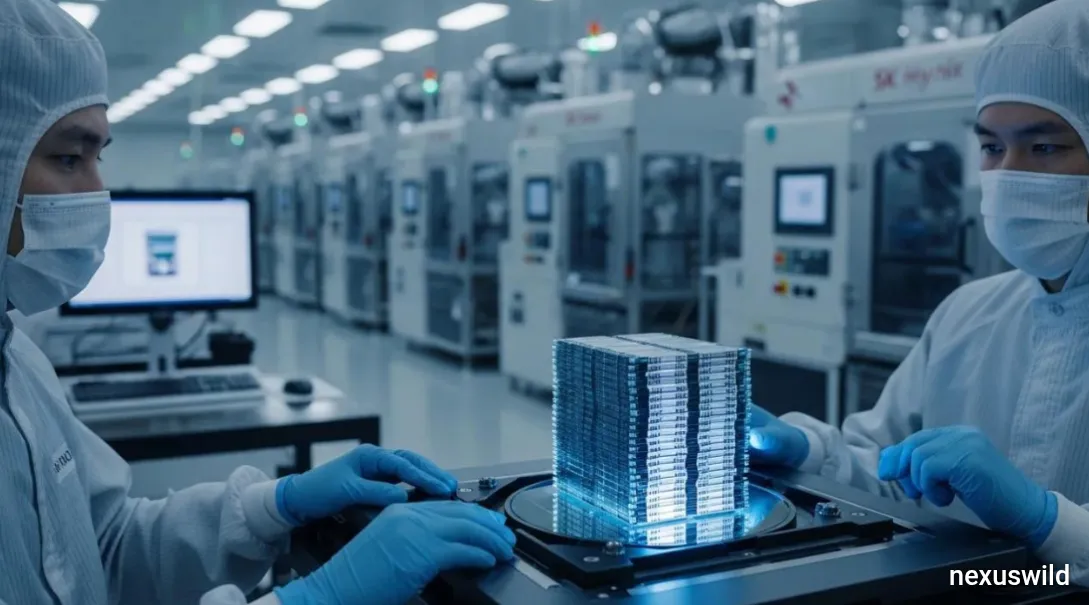
The results reflect the expanding role of memory in AI computing systems. High-bandwidth memory, or HBM, is used alongside advanced processors to help move data efficiently through AI workloads. Server-grade DRAM and solid-state storage are also important components in data centres.
SK hynix said its DRAM business benefited from higher sales of server DDR5 memory, while HBM4 shipments began increasing. In NAND flash, the company reported stronger sales of 321-layer TLC enterprise solid-state drives, which are used in data-centre storage.
The company’s earnings announcement said prices of key products had risen amid growing AI memory demand. That pricing environment, alongside product mix and sales growth, contributed to its unusually high operating margin.
However, the results should not be read as proof that all parts of the semiconductor market are experiencing the same conditions. SK hynix is heavily exposed to advanced memory products, and its performance reflects its own product portfolio, customer relationships and market position.
HBM4 expected to become a mainstream product
SK hynix said it expects HBM4 to become its mainstream HBM product beginning in the fourth quarter of 2026. The company plans to ramp up production at its M15X facility to support increased HBM4 output.
HBM4 is the next generation of high-bandwidth memory designed for demanding AI and high-performance computing applications. Its wider adoption is relevant to the AI hardware supply chain because memory availability and performance can affect how quickly computing systems are deployed.
The company’s roadmap signals that it expects demand for advanced memory to remain strong. It is also expanding its use of newer DRAM manufacturing processes and plans to increase production of server-oriented products, including DDR5 and LPDDR5-based solutions.
These are company plans and expectations, not a guarantee that every product transition or capacity expansion will proceed on schedule.
Long-term agreements provide demand visibility
SK hynix said it has signed long-term agreements with 14 major customers, including leading global cloud-service providers. The agreements cover more than 50% of its planned production capacity for 2027 and 2028.
The company said the agreements typically involve terms of around five years, with pricing structures designed to reflect market conditions within agreed ranges. It said the approach is intended to improve demand visibility while maintaining flexibility in response to market changes.
The agreements are important because semiconductor manufacturing requires substantial capital investment and careful capacity planning. Having a significant portion of future output covered by customer commitments can help a manufacturer plan production and investment.
Still, the agreements do not remove all risk. Actual demand, customer requirements, pricing and the timing of future AI infrastructure spending may change.
Shareholder-return plan worth about 100 trillion won
Alongside its earnings, SK hynix announced a shareholder-return plan totaling approximately 100 trillion won for 2026.
The company said the plan includes cash dividends of at least 30 trillion won and share repurchases and cancellations totaling at least 60 trillion won. It said the program includes returning most of the gains from its investment in Japanese chipmaker Kioxia to shareholders.
The board also approved a third-quarter cash dividend of 20,000 won per share and a share repurchase of 20 trillion won. According to the company, 10 trillion won of the repurchased shares earmarked for shareholder returns will be cancelled, while the remaining portion is intended for employee compensation and is not included in the shareholder-return total.
The plan represents a major capital-allocation decision. It also comes as the company considers increasing investment to expand production capacity and support demand for advanced memory.
Net profit declined from the previous quarter
Despite the record revenue and operating profit, SK hynix’s net profit fell 57.7% quarter over quarter to 39.78 trillion won. It was still up 215.7% from the same quarter a year earlier.
The sequential decline is an important distinction when interpreting the results. The previous quarter included unusually large investment-related gains, making the comparison more complex than the operating performance alone suggests.
Investors and analysts will therefore be watching both the company’s core memory business and the effect of non-operating items on future earnings.
What the results mean for the AI hardware market
SK hynix’s performance highlights the importance of memory in the current AI infrastructure buildout. Advanced processors attract much of the attention, but AI systems also depend on high-bandwidth memory, server DRAM and data-centre storage.
The company’s results provide evidence that demand and pricing for its high-value memory products remain strong. Its long-term customer agreements also indicate that major buyers are securing supply ahead of future capacity needs.
The wider outlook remains subject to uncertainty. Semiconductor demand can change with technology cycles, customer investment plans, competition and broader economic conditions. Capacity expansion also requires large investments and can create risks if supply eventually grows faster than demand.
For now, SK hynix’s third-quarter results show how strongly advanced memory products are contributing to its earnings. The next indicators to watch are HBM4 production and revenue, the company’s investment plans for 2027, and whether the current pricing environment can be sustained.
Nexuswild welcomes factual corrections. Email contact@nexuswild.com with evidence and the article URL.