
Picture the app pinging that your ride has arrived, and you walk out to a car with an empty driver's seat. That scene is now real in parts of Austin, Texas - but which car shows up, and how empty that seat really is, depends heavily on exactly what "Tesla Robotaxi" you've ordered.
Tesla is currently running two distinct things under one brand: a ride-hailing service built on modified Model Y SUVs that mostly still have a steering wheel, whether or not anyone is using it, and a much newer, much smaller rollout of the purpose-built Cybercab, which genuinely has no wheel or pedals at all. Conflating the two is the most common mistake in coverage of Tesla's robotaxi push, and it's worth untangling before asking how close the company actually is to a driverless future.
The Model Y Fleet vs. The Cybercab
Tesla launched its Robotaxi service in Austin in June 2025 using Model Y vehicles, initially with a human safety monitor seated up front who could intervene but wasn't driving. Over the following year the service expanded to Dallas and Houston in Texas, and Miami, Orlando and Tampa in Florida, with rides booked through Tesla's own app in a manner similar to Uber or Lyft.
Tesla began removing the in-cabin safety monitor from a portion of Austin's fleet on a limited basis starting in January 2026, mixing monitor-free cars into the broader supervised fleet and gradually increasing that ratio, according to Tesla AI lead Ashok Elluswamy. By Tesla's own account on its Q2 2026 earnings call in late July, the company had logged more than 380,000 unsupervised miles across six cities in two states; by early September that figure had grown to roughly one million miles, following a decision to remove monitors from most operations outside the San Francisco Bay Area. The Bay Area remains the clear exception: California's permitting rules require a human safety driver behind the wheel there, and that requirement hasn't changed.
So do the cars carrying passengers today actually lack a steering wheel? For the overwhelming majority of rides, no. The Model Y robotaxis retain a conventional steering wheel and pedals regardless of whether a monitor is sitting in the vehicle - the "driverless" element refers to nobody actively controlling those pedals and wheel, not to their absence.
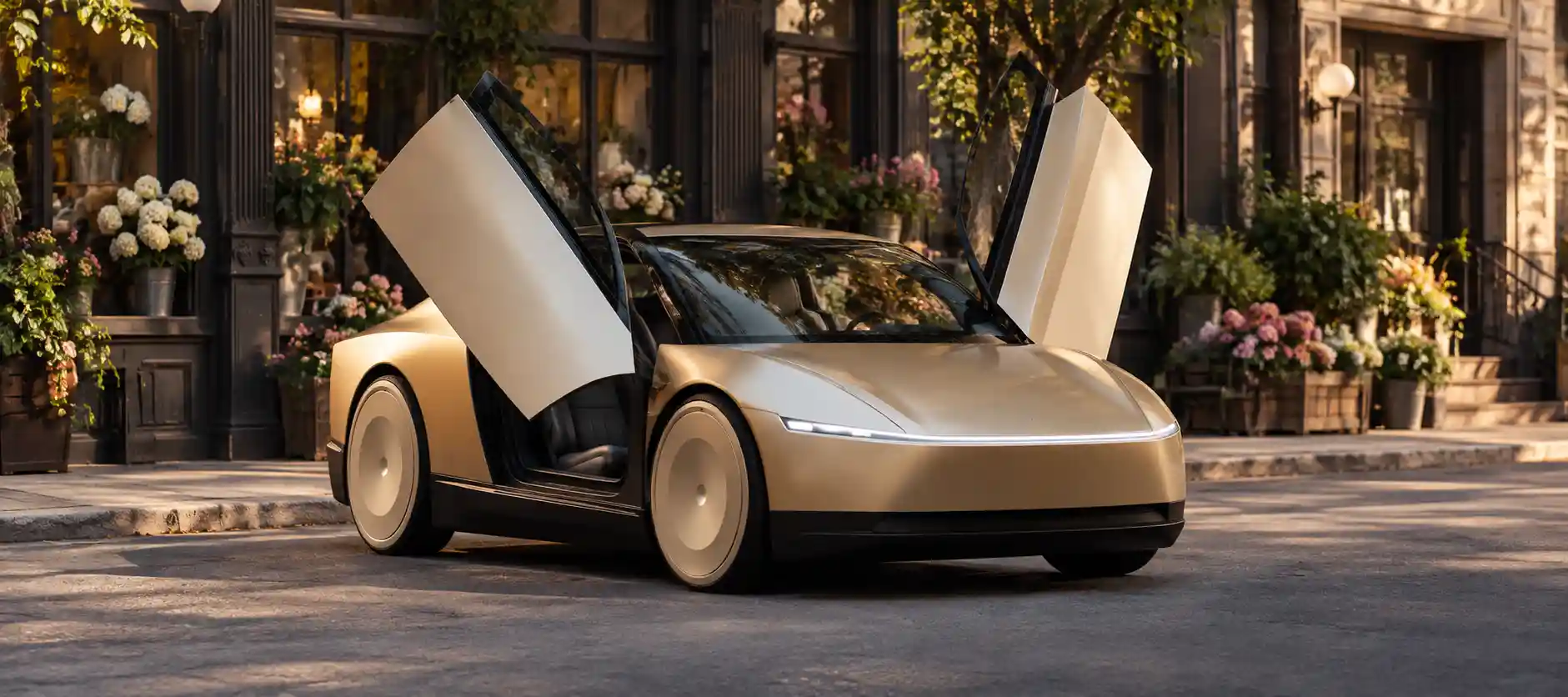
The genuinely wheel-free, pedal-free vehicle is the Cybercab, a two-seat, purpose-built robotaxi Tesla unveiled as a concept in October 2024. Tesla began road-testing production versions of the Cybercab in Austin in mid-2026, initially with a safety monitor still riding in the passenger seat, and held an invite-only public launch event in Austin on September 3, 2026, after which the company began offering Cybercab rides to passengers in limited parts of the city. That rollout remains geographically narrow and separate from the far larger Model Y fleet; there is no confirmed evidence the Cybercab has expanded to other cities or replaced the Model Y as the primary vehicle serving the network.
Manufacturing and the $30,000 Promise
Manufacturing has followed a similarly staged path. The first production Cybercab rolled off the line at Gigafactory Texas in February 2026, with Musk describing that early phase as pilot validation. Volume production began in April 2026 using Tesla's newer "unboxed" modular assembly process, though Musk cautioned the ramp would be "agonizingly slow" given the novel manufacturing methods involved.
By July 2026, more than 100 production units had reportedly been spotted at Giga Texas and testing sites in dozens of cities, though most of that fleet has been used for testing and internal operations rather than public rides. Every Cybercab built so far has gone into Tesla's own fleet; the company has said it intends to sell the vehicle to individual consumers for under $30,000 sometime in 2027, but as of this writing there is no configurator, order page or confirmed delivery date.
The Technology and the Teleoperators
Technically, Tesla's approach - for both the Model Y fleet and the Cybercab - relies on cameras and neural networks rather than the lidar-and-radar sensor stacks used by competitors like Waymo and Zoox. Tesla calls the underlying software Full Self-Driving (Unsupervised) when operating without a monitor.
The system isn't purely autonomous end to end: NHTSA-reported incident data covering July 2025 through March 2026 shows at least two low-speed incidents in which a remote teleoperator, rather than the onboard software, was in control when the vehicle made contact with an object - confirming that human remote assistance is part of how Tesla's system handles at least some situations it can't resolve on its own.
Unresolved Regulatory Questions
Regulatory questions remain genuinely open rather than settled. Beyond California's safety-driver mandate, the National Highway Traffic Safety Administration opened an audit on September 3, 2026 - the same day as the Cybercab's public launch - into how Tesla self-certified the vehicle as compliant with federal safety standards despite lacking a steering wheel and pedals; Tesla's position is that rules written around human drivers don't apply to a vehicle with no human controls at all. That audit is unresolved.
Separately, federal regulators have proposed rules that would drop the brake-pedal requirement specifically for vehicles designed to be driven exclusively by automated systems, a change in Tesla's favor that was still in public comment as of mid-2026. NHTSA also maintains a broader, separate Engineering Analysis investigation into Tesla's FSD software across roughly 3.2 million consumer vehicles, unrelated to the robotaxi fleet specifically but relevant to how regulators view the underlying technology.
On safety, the same NHTSA dataset recorded 17 total incidents involving the Austin robotaxi fleet between July 2025 and March 2026, six of them minor contact events attributed at least partially to Tesla's system, with no major crashes reported in that window. Tesla executives described the unsupervised program's record as "impeccable" on the Q2 2026 earnings call, though the company hasn't published a detailed, independently verifiable incident methodology alongside that characterization, and outside analysts reviewing the same NHTSA data have reached less favorable per-mile comparisons against average human driving records.
The Economics of a Driverless Future
The economic pitch is where the gap between today and Tesla's stated ambition is widest. Musk has repeatedly cited a long-term operating cost target of around $0.20 per mile once the fleet scales, which would undercut human-driven ride-hailing by a wide margin.
<GenerateWidget title="Ride-Hailing Economics: Human vs Driverless" height="600px">
{
  "widgetSpec": {
     "id": "ride-hailing-economics-calculator",
     "height": "600px",
     "prompt": "Objective: Create a calculator that lets users compare per-mile operating costs between human-driven ride-hailing and driverless robotaxis.\nData State: initialValues: { driverCost: 0.80, vehicleCost: 0.30, chargingCost: 0.15, insuranceCost: 0.18, maintenanceCost: 0.05 }.\nStrategy: Form Layout.\nLibraries: Math.js.\nInputs:\n- Human Driver Cost per Mile (Slider)\n- Vehicle Depreciation (Slider)\n- Energy/Fuel Cost (Slider)\n- Insurance (Slider)\n- Maintenance (Slider)\n- Driverless Mode (Toggle: On removes driver cost)\nBehavior: Display a bar chart comparing total cost per mile with and without the driver. Show the breakdown of costs using distinct visual segments. Update the totals in real-time as users adjust sliders. When Driverless Mode is toggled on, instantly drop the driver cost segment to zero and recalculate the net total per mile."
  }
}
</GenerateWidget>
Current Austin fares, however, run on a per-mile structure - roughly a few dollars base plus per-mile charges - that lands in a range broadly comparable to existing Uber and Lyft pricing, not dramatically below it. One independent estimate from Morgan Stanley put Tesla's actual current operating cost closer to $0.81 per mile, against roughly $1.43 for Waymo and $1.71 for traditional rideshare - a real gap, but nowhere near the eventual 20-cent target, and contingent on scale Tesla hasn't yet reached.
If Tesla or its rivals do eventually close that cost gap at scale, the implications for Uber, Lyft, traditional taxis and even personal car ownership are significant in theory: removing a driver's wage from the cost structure of a ride is the single biggest lever available in ride-hailing economics, and Tesla has floated letting individual Cybercab owners list their car on the network when not in personal use, echoing a short-term rental model.
None of that has been tested at meaningful scale yet, and both the regulatory questions around wheel-free vehicles and the unresolved gap between projected and actual operating costs mean the disruption remains a projection rather than a demonstrated outcome. For now, the more accurate summary of where things stand is narrower than the headlines suggest: a modest, expanding fleet of monitored and lightly-supervised Model Ys doing most of the actual driving, and a real but still small population of truly driverless Cybercabs just beginning to prove themselves on Austin's streets.
Further reading and useful links
Reader questions
Frequently asked questions
Does the Tesla Robotaxi have a steering wheel?
Currently, the vast majority of the vehicles operating in Tesla's Robotaxi network are modified Model Y SUVs, which still have conventional steering wheels and pedals. However, Tesla recently launched a very limited number of its purpose-built Cybercabs in Austin, which have no steering wheel or pedals.
Where is Tesla's Robotaxi service available?
As of September 2026, the service is operational in six cities: Austin, Dallas, and Houston in Texas; and Miami, Orlando, and Tampa in Florida. A supervised version (requiring a human driver) operates in the San Francisco Bay Area due to California regulations.
How much does a ride in a Tesla Robotaxi cost?
While Elon Musk targets a long-term cost of $0.20 per mile, current pricing in Austin is structured similarly to Uber and Lyft, with a base fare plus per-mile charges.
Nexuswild welcomes factual corrections. Email [email protected] with evidence and the article URL.