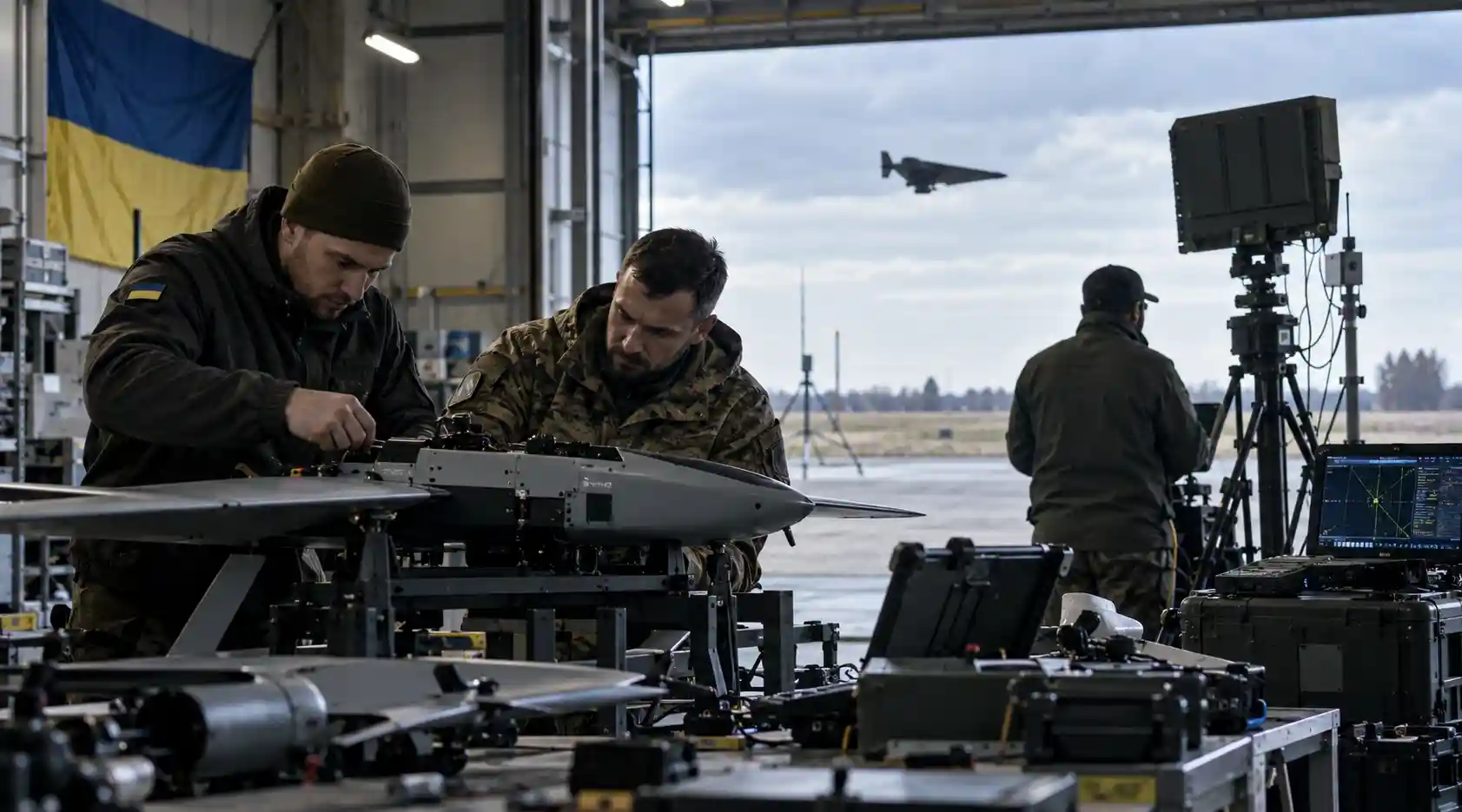

KYIV - Russia's long-range drone campaign against Ukraine has quietly crossed a threshold this year. On the night of September 2-3, 2026, roughly half of the 163 aerial targets Ukraine's air force tracked were jet-powered variants of the Shahed-type strike drone Russia calls Geran, flying at 400 to 650 km/h - speeds that route around the layered, low-cost air defence Ukraine spent the past two years building.
Ukraine still downed or suppressed 135 of those targets, an 83% rate that night, but the following night, against another majority-jet salvo, the figure fell to 65%. That gap is the clearest evidence yet that Ukraine's defence industry is now racing against a genuinely different threat, not a faster version of the old one.
The Jet-Powered Shift
For most of the war, Russia's workhorse strike drone was the Geran-2, a licence-built copy of Iran's Shahed-136: a piston-engined, propeller-driven airframe cruising around 180-185 km/h, nicknamed "the moped" for its distinctive engine drone. It was cheap, produced at scale from Russia's Alabuga plant in Tatarstan, and individually easy to hit - Ukrainian officials and independent trackers have described intercept rates against it reaching into the low-to-mid 90s percent, achieved through a layered mix of mobile machine-gun and MANPADS teams, radar-guided anti-aircraft guns such as the German Gepard, electronic-warfare jamming of its satellite-navigation link, and, increasingly, cheap FPV interceptor drones.
The jet-powered variants change that equation by design. Ukraine's military intelligence directorate (HUR) first detailed a turbojet-powered Geran-3 in September 2025, built around a Chinese Telefly engine and reported at the time to reach somewhere between roughly 300 and 370 km/h. Russia has since introduced the Geran-4, a more thoroughly redesigned airframe - reinforced to survive the structural loads of higher-speed flight - that Ukrainian Air Force spokesman Yuriy Ignat has said cruises around 320 km/h at altitudes up to 4 km, and the Geran-5, a larger, conventionally-shaped airframe with a claimed range approaching 1,000 km and speeds reported by Ukrainian officials at 450-600 km/h, operating as high as 6 km.
Ukrainian intelligence assessed in August 2026 that monthly production of the jet-powered Geran-4 and Geran-5 combined, at roughly 3,000 airframes, had overtaken output of the piston Geran-2. One defence-focused outlet tracking the shift put total jet-powered launches at around 1,400 between January and mid-June 2026, against roughly 180 for the whole of 2025 - a rough order-of-magnitude increase, even allowing for uncertainty in any single count.
The Economics and Limits of Electronic Warfare
Speed and altitude are what make these drones difficult, not any single technological leap. A propeller-driven interceptor or a fixed machine-gun position built around a roughly 180 km/h target has very little margin against something moving two to three times faster, and Ukrainian officials have said plainly that mobile fire teams and older interceptor types often simply cannot catch up. Flying higher also pushes the threat out of the engagement envelope of small arms and shoulder-fired missiles and into the zone where far more expensive systems - fighter jets, medium-range surface-to-air missiles - are the more reliable answer, which is precisely the cost trade Russia wants to force.
Ukrainian Defence Intelligence's teardown of recovered Geran-4 wreckage, published in May 2026, also pointed to a second complication: a redesigned nose housing an electro-optical seeker, suggesting some jet variants may rely less on the continuous radio and satellite links that electronic warfare is built to jam, and more on inertial navigation with optical terminal guidance in the final dive.
That last point matters because it sets a real limit on Ukraine's most cost-effective countermeasure. Jamming still works well against radio-and-satellite-dependent drones - an electronic-warfare expert quoted by Ukrainian outlet Army Inform noted that radio waves travel at the speed of light, so a target's velocity doesn't blunt a jammer's effect the way it blunts a gun or an interceptor's chase. But a drone that has already switched to inertial and optical guidance by the time it enters its terminal dive has nothing left to jam.
Ukraine's Fast-Tracked Interceptors
Ukraine's response has moved on two fronts: faster kinetic interceptors, and continued layering of the defences that already worked. On the interceptor side, several companies have shown prototypes explicitly built around jet or near-jet speeds, though none appear to be fully proven, mass-fielded systems yet.
- SkyFall: Introduced the P1-SUN JetKiller, which the company says is undergoing combat trials and has already downed Iranian-designed Shahed drones; it reportedly reaches up to 370 km/h, operates out to 30 km and 9,000 metres, and carries a 500-gram warhead with AI-assisted terminal guidance.
- F-Drones: Fielded an upgraded LITAVR+, which CEO Stanislav Khutor says exceeds 400 km/h and is built to reach jet-speed Shaheds as high as 9,000 metres, using GPS-free inertial navigation and optical "last-mile" targeting.
- State Initiatives: Ukraine's Ministry of Defence unveiled a turbojet-powered interceptor called Alexa Spatium, launched from a mobile catapult (performance figures withheld). In August, former Digital Transformation Minister Mykhailo Fedorov said an unnamed Ukrainian-built jet interceptor capable of exceeding 600 km/h had entered combat testing.
- TAF Industries: The Ministry of Defence formally approved the Kolibri-i10 interceptor for service, though its stated top speed (above 200 km/h) suggests it is built more for the slower Geran-2/3 threat.
President Volodymyr Zelensky said in late August that four Ukrainian companies had developed relevant interceptor technology and ordered the most promising design fast-tracked toward production in the thousands, while Defence Minister Yevhen Khmara confirmed four candidate interceptor models had already undergone field testing.
A Live Test in Counter-Drone Warfare
The economics behind this push are stark and well documented. Independent estimates put a single Patriot PAC-3 interceptor at roughly $3.5-4 million; a Geran, by contrast, is generally estimated to cost Russia somewhere between $20,000 and $50,000 to build. Ukraine's answer to that imbalance has been the FPV interceptor drone, built for as little as $2,500-5,000 and credited by Ukraine's air force with destroying roughly one in three Russian aerial targets nationally.
The open question is whether that favourable exchange rate survives the shift to jet power. A turbojet engine and more sophisticated guidance almost certainly cost more to build than a basic propeller FPV frame, even if the new interceptors remain far cheaper than a missile.
What is clear is that battlefield feedback, not laboratory research cycles, is driving the pace here. HUR's detailed public teardowns of recovered Geran-3 and Geran-4 airframes have functioned almost as open engineering briefs, and Ukrainian firms have iterated existing, already-fielded platforms within months rather than years. Brave1, the state platform coordinating Ukraine's defence-tech sector, has said countering jet-powered drones is now a stated priority.
Real limitations remain. Most of the jet interceptors named publicly are still in trials, with performance claims resting on company statements rather than independently confirmed kill data. Scaling any of them from prototype to the thousands-per-month volume needed to match Russia's own jet-Geran output is unproven. And as the interception-rate dip on consecutive nights in September suggests, the newest Russian variants are, for now, outrunning Ukraine's fielded defences in measurable ways even as new interceptors reach the battlefield.
Further reading and useful links
Reader questions
Frequently asked questions
What is the new threat to Ukraine's air defense?
Russia has introduced and scaled up production of jet-powered variants of the Shahed/Geran strike drone, which fly at 400 to 650 km/h - more than twice as fast as earlier propeller-driven models, allowing them to evade many of Ukraine's cheaper interceptors.
What are the new jet-powered Russian drones called?
The newer jet-powered models are primarily designated as the Geran-3, Geran-4, and Geran-5, featuring turbojet engines and, in some cases, redesigned airframes capable of higher altitudes and speeds.
How is Ukraine responding to these faster drones?
Ukrainian defense companies, such as SkyFall, F-Drones, and TAF Industries, are developing and testing their own high-speed, jet-powered interceptor drones designed to catch up with and destroy the incoming Russian UAVs before they reach their targets.
Nexuswild welcomes factual corrections. Email [email protected] with evidence and the article URL.