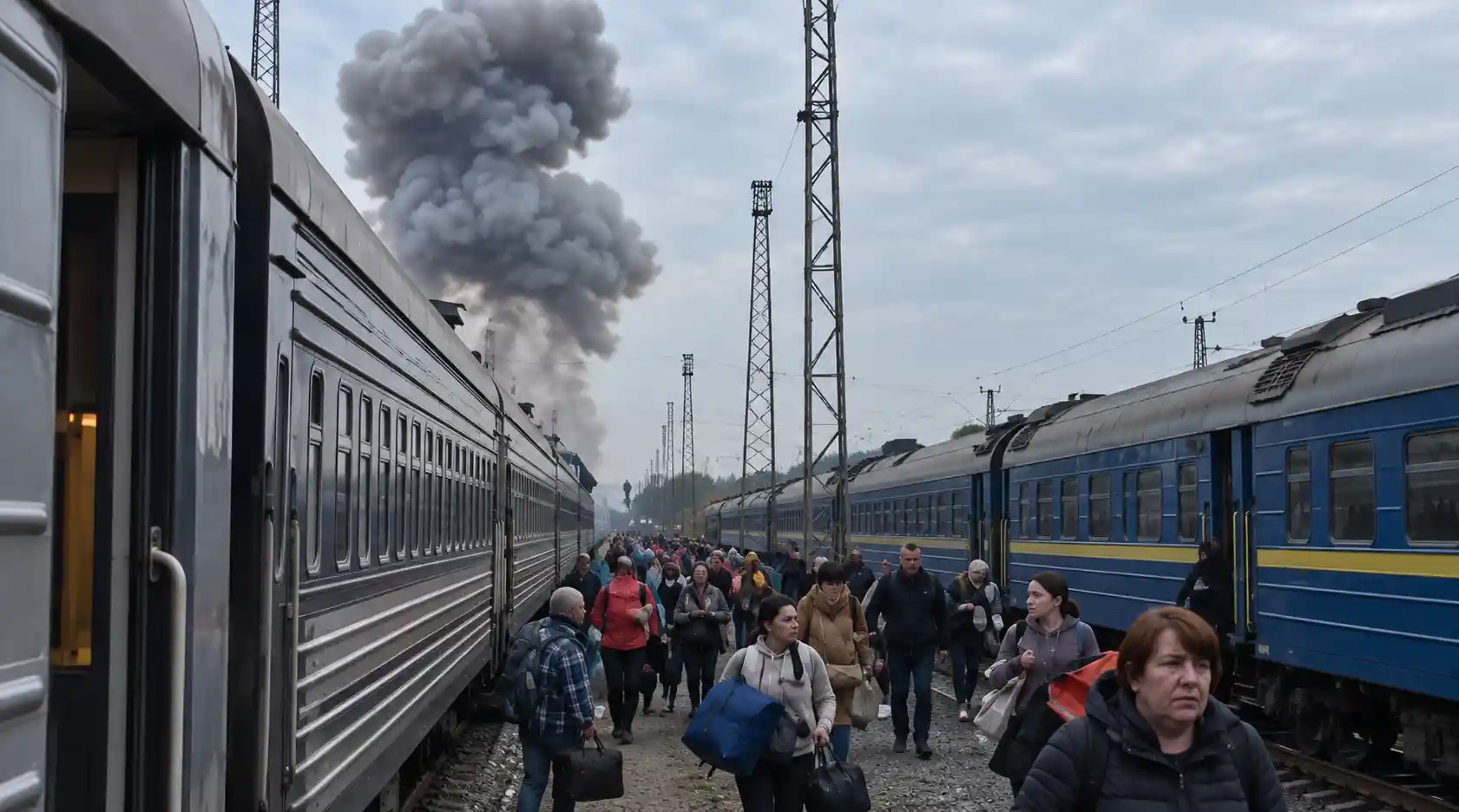

A Russian drone struck the locomotive of a Kyiv-to-Warsaw passenger train at Yahodyn station in western Ukraine on Sunday, September 13, 2026, minutes after a diplomatic train carrying former UK Prime Minister Boris Johnson, former Swedish Prime Minister Carl Bildt and security advisers from several European Union states had pulled out of the same station. A separate train carrying former CIA Director David Petraeus was still standing at the platform at the moment of the strike. Ukraine's state railway operator, Ukrzaliznytsia, said no one was hurt, but raised the possibility that the diplomatic train had been the drone's intended target.
Yahodyn sits roughly two kilometres from the Ukraine-Poland border, near the Yahodyn-Dorohusk crossing, on the rail line that connects Kyiv to Warsaw. Photographs distributed by Ukrzaliznytsia's press office show a locomotive damaged by the strike; the company reported no casualties on any of the trains at the station and no immediate reports of wider infrastructure damage beyond the locomotive itself. Some reporting has described the weapon involved as a jet-powered drone, a category Russia has increasingly deployed against Ukrainian targets in 2026, though the specific model used in this strike has not been independently confirmed.
A Close Call for Diplomats
According to Ukrzaliznytsia, the diplomatic train's departure had been moved up as part of what the company described as real-time adjustments to train timetables, made in response to the ongoing threat of Russian strikes along that route. A dispatcher with the railway's Central Monitoring Group detected the incoming drone and issued an evacuation alert approximately 15 minutes before impact.
Bildt, who shared video of the strike on social media, said the train he had been travelling on was not hit but "just had an evacuation warning," adding that the train that was struck went "minutes after us" and was itself evacuated as the drone approached, with no one hurt. His account is consistent with Ukrzaliznytsia's version of the timeline, though the precise gap between the diplomatic train's departure and the strike has been reported by different outlets simply as "minutes," without a more exact figure independently verified.
Johnson, Bildt, Günter Sautter - a foreign and security policy adviser to German Chancellor Friedrich Merz - and the accompanying EU security advisers had been in Kyiv for the Yalta European Strategy conference, an annual gathering of political, business, security and media figures held in the Ukrainian capital. They were travelling back toward Poland when the incident occurred. Petraeus, on the separate train still at the station when the drone hit, was not reported to have any connection to the same delegation or conference in the available reporting.
Assessing the Target
Ukrzaliznytsia's public statement went further than simply describing the sequence of events. The company said it was "highly probable" - in some translations, "quite possible" - that the drone's actual target had been the diplomatic train, precisely because it had left the station earlier than scheduled. It said it could not rule out the possibility of deliberate targeting.
That assessment, however, comes from Ukraine's own state railway operator, a party directly affected by the war, rather than from an independent investigation or a Western government intelligence assessment; no such independent confirmation of intent has been publicly reported. The Russian Defence Ministry, for its part, said its long-range drone operations in western Ukraine were aimed at infrastructure supporting the movement and delivery of military cargo from Europe - a general justification about rail infrastructure that made no reference to any individuals aboard the trains.
The two accounts are not straightforwardly reconcilable: Ukrzaliznytsia's suspicion centers on the diplomatic train specifically, while Moscow's stated rationale centers on the rail corridor's role in supply logistics. It is also worth noting that the train carrying Petraeus, which was present at the station at the exact moment of the strike, was not the one hit - a detail that complicates any straightforward reading of the incident as a targeted attempt on the visiting dignitaries. On the available evidence, it is not possible to confirm whether the Western officials were deliberately targeted, incidentally endangered, or unconnected to the drone's intended objective.
Johnson addressed the strike publicly on social media, writing that he did not know "what warped logic drove Putin to blow up a stationary Ukrainian locomotive on the Polish border this morning," and calling it representative of "the kind of random and senseless attack Ukrainians are enduring every day." He also praised Ukrzaliznytsia staff and passengers as "absolutely heroic" and called for continued Western support for Ukraine. In a separate interview with Forbes Ukraine published the same day, Johnson said Putin "must understand that this war is stupid" and argued Ukraine should maintain pressure on Russia, including strikes on Russian infrastructure. Neither the Russian government nor Russian state media has commented specifically on the presence of the Western officials at the station at the time of the strike.
The Strategic Role of Ukraine's Railways
The incident is the latest in a long pattern of Russian strikes on Ukraine's rail network since the full-scale invasion began in 2022, a network that has taken on outsized strategic and symbolic importance during the war. With Ukrainian civilian airspace closed, Ukrzaliznytsia's trains are the primary means by which foreign leaders, officials and journalists travel into and out of Kyiv, in addition to their role moving troops, military cargo, and civilians fleeing front-line areas.
Rail stations and lines have been struck repeatedly over the course of the war, including a 2022 missile strike on a crowded evacuation platform at Kramatorsk that killed dozens of civilians, and attacks on rail infrastructure have periodically coincided with visits by Western officials to Kyiv, drawing recurring accusations from Ukrainian officials that Russia times or directs such strikes with those visits in mind - accusations Moscow has consistently denied or not directly addressed.
Sunday's strike also came amid a broader flare-up of activity along the border that day: Ukrainian border guards reported that a separate Russian drone had struck a truck less than a mile from Polish territory earlier that morning, prompting a temporary closure of the Yahodyn-Dorohusk crossing. Together, the incidents underscore how the war's front line - in the form of long-range drone strikes - continues to reach areas immediately adjacent to NATO territory, even as the practical evidence for who or what specifically was being targeted at Yahodyn on Sunday remains, for now, unresolved.
Further reading and useful links
Reader questions
Frequently asked questions
Was Boris Johnson injured in the train strike in Ukraine?
No. Boris Johnson and other Western officials had departed Yahodyn station minutes before the drone struck a different locomotive on the tracks.
Where did the Russian drone strike the train?
The drone struck a locomotive at Yahodyn station in western Ukraine, which sits roughly two kilometers from the Polish border on the Kyiv-Warsaw rail line.
Were the Western officials the specific target of the drone attack?
Ukraine's state railway operator, Ukrzaliznytsia, suggested it is "highly probable" the diplomatic train was the target, but this has not been independently verified. The Russian Defence Ministry claimed its operations were aimed at military logistics infrastructure.
Nexuswild welcomes factual corrections. Email [email protected] with evidence and the article URL.