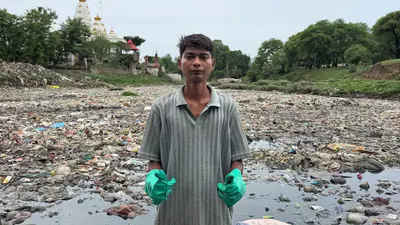

The water is the colour of weak tea, thick with algae in patches, and studded with the debris of everyday life: torn plastic bags, empty snack wrappers, broken flip-flops, plastic bottles bleached pale by the sun. Along the banks of the Ajnar River, where it curls through the middle of Biaora town in Madhya Pradesh's Rajgarh district, a young man wades in, often alone, sometimes with a friend or two, and begins pulling waste out by hand.
There is no excavator, no municipal crew, no fluorescent safety vest. Just a pair of hands, a few basic tools, some dustbins bought with his own money, and hours of unglamorous, repetitive labour: reaching into muck, lifting out sodden plastic, sorting it onto the bank, carrying it away.
The young man is Surendra Singh Choudhary, known online as Bittu Tabahi. Over the past several months, videos of him standing knee-deep in the Ajnar, clearing sections of it choked with garbage and algae, have circulated widely on social media, turning a local, largely unnoticed problem into a subject of national conversation.
Who Is Bittu Tabahi, and Why Did He Start
Choudhary is 20 years old and a science undergraduate from Biaora, a commercial town in Rajgarh district connected by rail and by National Highway 3 to cities including Indore and Bhopal. The Ajnar is the river that runs through the centre of Biaora, and it is one that Choudhary passed regularly, including on visits to a nearby temple.
According to reporting on his work, he began cleaning the river on January 26, 2026, Republic Day, after growing repeatedly disturbed by how polluted the water and its surroundings had become. There was no organisation behind him and no official campaign. It started as one person deciding to do something about a problem he walked past often.
He and his friends spent roughly Rs 30,000, according to reports citing people who have documented his work, on basic equipment and dustbins, some of which he placed around the riverbank himself in an attempt to reduce future littering.
By his own account and that of local reporting, the response from many residents was not immediate encouragement. He has said people initially mocked him, called him misguided, and in some cases suggested, half-mockingly, that he clean their household drains instead.
That changed as before-and-after videos of stretches of the Ajnar, filthy in one frame and visibly cleaner in the next, began to spread.
In March, industrialist Anand Mahindra referenced criticism that Choudhary had faced online, over accusations that he was cleaning the river mainly to gain social media attention, and wrote that if "a desire for likes can become a force for good," he had no objection, calling him his "Monday Motivation."
More recently, his videos drew a response from Boyan Slat, the Dutch founder and chief executive of The Ocean Cleanup. Slat replied to a post about Choudhary's work with a brief message: "Come work for us."
It is worth being precise about what this is and is not. It was a public social-media reply, not a confirmed employment contract, and at the time of writing there is no independent confirmation of a formal offer, its terms, or whether Choudhary has responded to it.
A Small River, and a Very Large Problem
The Ajnar is not one of India's famous rivers. It does not carry the religious weight of the Ganga or the Narmada, nor does it appear in national water-quality headlines.
That, in a sense, is the point.
According to Rajgarh district's own administrative profile, the Ajnar is simply "the main river of Biaora city," running through its centre, alongside other local waterways in the region such as the Parvati, Newaj and Dudhi rivers, some of which feed larger systems including the Kali Sindh and Chambal further downstream.
Rivers like this exist by the thousands across India: small, locally important, unmonitored by national data systems, and often used simultaneously as a water source, a bathing spot, a place of worship and a dumping ground.
What has happened to the Ajnar has happened, in some form, to countless similar rivers.
The Central Pollution Control Board's most recent nationwide assessment, Polluted River Stretches for Restoration of Water Quality, based on monitoring carried out in 2022 and 2023, identified 296 polluted stretches across 271 rivers in 32 states and Union territories, down from 351 stretches in an earlier 2018 baseline.
Madhya Pradesh, according to analysis of that report, accounted for 18 of these identified stretches. Thirty-seven stretches nationally fell into the CPCB's most severe category, Priority I, where the organic pollution load is high enough to seriously deplete oxygen in the water.
That measurement, Biochemical Oxygen Demand or BOD, is central to how scientists judge river health. It measures how much oxygen microorganisms consume while breaking down organic waste, such as sewage, in the water.
The more untreated organic matter a river carries, the more oxygen gets used up decomposing it, and the less is left over for fish, insects and other aquatic life.
Water that is safe for bathing, by CPCB's own standard, should have a BOD level under 3 milligrams per litre; stretches exceeding 30 mg/L are considered critically polluted.
In the most extreme cases, dissolved oxygen falls close to zero, a condition sometimes described as a river being biologically dead in a given stretch, unable to support most complex aquatic organisms.
What Ends Up in India's Rivers, and Why
Indian rivers absorb pollution from several directions at once, and the Ajnar's condition reflects a pattern familiar across the country.
Untreated domestic sewage is the largest single contributor nationally. Government assessments over recent years have consistently found that a large share, by some estimates well under half, of the sewage generated in Indian towns and cities is treated before it reaches a water body.
Plastic waste, from packaging, carry bags and single-use items, does not biodegrade in any meaningful timeframe. It breaks down instead into smaller and smaller fragments known as microplastics, which are now found not only in river sediment but inside fish tissue, and increasingly in treated drinking water supplies.
Religious offerings and ritual waste, flowers, cloth, idols, ash and the general practice of immersion, add another layer, particularly around festivals, when even a well-meaning tradition can temporarily overwhelm a small river's capacity to absorb organic material.
Household garbage dumped directly onto banks, agricultural runoff carrying fertiliser and pesticide residue, and, in some regions, industrial effluent complete the picture.
Each source is individually modest in a place like Biaora; together, over years, they are enough to turn a working local river into what many residents no longer think of as usable water.
Why It Matters Beyond the Riverbank
The consequences of this kind of pollution extend well past the smell and the visible mess.
Rivers like the Ajnar often feed into groundwater that nearby communities draw from for drinking and household use; contamination at the surface does not stay confined to the surface.
Farmers downstream who use river water for irrigation risk drawing on water carrying pathogens or chemical residue. Fish populations, already stressed by low oxygen levels, decline, affecting both local biodiversity and the livelihoods of anyone who depends on fishing.
Public health researchers have long linked contaminated surface water to the transmission of waterborne diseases such as diarrhoeal illness, typhoid and cholera, conditions that remain a significant burden in parts of rural and small-town India.
Some public-health estimates suggest that a meaningful share of India's overall communicable disease burden is connected to water quality, underlining that river pollution is not merely an aesthetic or environmental issue but a public-health one, particularly for children.
How Bittu Tabahi Works, and What He Doesn't Have
Based on available reporting, Choudhary's method is essentially manual and low-tech: entering the water, physically removing plastic, algae mats and debris, sorting it, and disposing of it, while placing dustbins nearby to try to intercept future litter before it reaches the water.
This is documented largely through his own social-media videos rather than through any formal monitoring body, which means there is no independently verified figure for the total volume or weight of waste he has removed. Claims of specific tonnage should be treated cautiously until an official measurement exists.
It is also important to be accurate about the scale and structure of his effort.
Reports describe him as working largely on his own, occasionally alongside friends who helped fund equipment. There is no confirmed involvement of an environmental NGO, a corporate sponsor or a local government body in his day-to-day cleaning work.
This distinguishes his effort from larger, organised river-cleaning drives elsewhere in India, which have sometimes mobilised hundreds of volunteers, temple and civic bodies, or state-run agencies such as WAPCOS on rivers like the Yamuna.
Choudhary's work is smaller in scale, but arguably more personally sustained: a routine returned to repeatedly over months, rather than a single mobilised event.
What Ordinary Citizens Can Learn From This
Choudhary's story is easy to turn into simple inspiration, and harder to turn into a usable lesson.
The more useful reading is not "one person can clean a river," which is only partly true and not scalable to India's 296 identified polluted stretches, but a set of more specific, transferable observations.
The first is about proximity. He did not set out to clean a famous river or launch a national campaign; he responded to the one he passed on his own daily route. Environmental action that starts with a place a person actually knows and uses tends to be more durable than action aimed at an abstract, distant cause.
The second is about time. A single cleanup day, however well attended, removes visible waste temporarily; rivers that stay clean require repeated, unglamorous return visits, which is closer to what Choudhary has done over months than what a one-off drive achieves.
The third is about documentation. His before-and-after videos are what moved this from a private, locally mocked activity into something that reached an international plastic-pollution organisation and a prominent industrialist.
Recording environmental work honestly, without exaggeration, can widen its impact well beyond what the physical labour alone would achieve.
Why Prevention Beats Repeated Cleanup
Perhaps the most important lesson embedded in this story is one that environmental engineers and river-restoration experts have made for years: removing waste from a river after it has entered is far less efficient than stopping it from entering in the first place.
A plastic bag pulled out by hand today does not undo the plastic bag, sewage discharge or immersion waste that will enter the same stretch tomorrow unless something changes upstream of the river itself.
This is why Choudhary's dustbin placements, however modest, point toward the more structurally important half of the solution: waste segregation at the household level, so recyclable material does not end up mixed with organic waste headed for open dumping; consistent municipal garbage collection so residents are not left to dispose of waste themselves; public awareness so fewer people see a riverbank as an acceptable place to leave trash in the first place; and functioning recycling and treatment infrastructure so that waste, once collected, actually goes somewhere other than back into a water body eventually.
The Limits of Volunteer Effort
None of this is a substitute for public infrastructure, and it would be a disservice to Choudhary's own work to pretend otherwise.
Individual and volunteer river cleanups cannot process the volume of untreated sewage that CPCB data shows continues to enter Indian rivers daily, nor can they substitute for functioning sewage treatment plants, industrial effluent monitoring or legal enforcement against dumping.
The CPCB's own 2025 assessment, while showing measurable improvement, a fall from 351 to 296 polluted stretches since 2018, explicitly frames continued progress as dependent on expanding sewage treatment capacity, strengthening pollution-control board enforcement and sustained government investment through programmes such as Namami Gange, not on volunteer labour.
Madhya Pradesh's own experience illustrates this. The state government has previously run large public campaigns focused on its principal river, the Narmada, including a multi-month Narmada Seva Yatra aimed at reducing pollution and encroachment along its banks.
Such state-led efforts, alongside stricter rules on liquor shops and mining near riverbanks, reflect the scale of intervention that river restoration ultimately requires, well beyond what any individual, however dedicated, can deliver alone.
What Bittu Tabahi Can Teach Us
- Start with the environmental problem closest to you. A river you pass every day is more actionable than one you have only read about.
- Consistency can matter more than one-day campaigns. Returning to the same stretch repeatedly, over months, achieves more than a single large but isolated cleanup event.
- Community behaviour must change alongside cleanup work. Removing waste without addressing why it was dumped there in the first place only delays the next accumulation.
- Documenting environmental work can inspire wider participation. Honest, unembellished before-and-after evidence can move public attention and resources in ways quiet labour alone cannot.
- Preventing pollution is better than removing pollution later. Dustbins, segregation and awareness upstream reduce the need for repeated downstream cleanup.
- Citizens, businesses and governments all share responsibility for healthy rivers. Individual effort can start a conversation; sustained restoration needs sewage treatment, enforcement and public investment behind it.
A River, and a Larger Question
Whatever comes of the attention Choudhary has received, including whatever, if anything, materialises from Boyan Slat's public message, the more durable value of his story may lie in what it exposes rather than what it resolves.
The Ajnar is one small river among the hundreds identified as polluted across India, kept relatively clean today in patches because one young man decided, repeatedly, to get into the water.
That is a genuine and, by most accounts, personally costly commitment.
It is not, on its own, a river restoration programme, and treating it as one risks letting the larger, harder work of sewage treatment, waste segregation, municipal enforcement and sustained public investment off the hook.
The most useful way to read Bittu Tabahi's work is as a demonstration of what individual persistence can start, and a reminder of how much more is needed from communities and public institutions alike to make sure a river, once cleaned, has a reason to stay that way.
Reader questions
Frequently asked questions
Who is Bittu Tabahi?
Bittu Tabahi is the online name of Surendra Singh Choudhary, a 20-year-old science undergraduate from Biaora in Madhya Pradesh who has drawn attention for repeatedly cleaning sections of the Ajnar River.
When did Bittu Tabahi start cleaning the Ajnar River?
According to reports, Choudhary began cleaning the river on January 26, 2026, after becoming concerned about the amount of garbage and pollution in the water.
Is Bittu Tabahi cleaning the river alone?
Reports describe him as working largely on his own, with occasional help from friends. There is no confirmed environmental NGO, corporate sponsor or government body running his day-to-day cleanup work.
Did The Ocean Cleanup offer Bittu Tabahi a job?
The Ocean Cleanup founder Boyan Slat publicly replied to a social-media post about Choudhary with the message 'Come work for us.' At the time covered by the article, there was no independent confirmation of a formal employment contract or its terms.
How polluted are India's rivers?
The Central Pollution Control Board's latest nationwide assessment cited in the article identified 296 polluted stretches across 271 rivers in 32 states and Union territories.
Can volunteer cleanups solve river pollution?
Volunteer cleanups can remove visible waste and raise public awareness, but they cannot replace sewage treatment, waste-management systems, industrial pollution controls, enforcement and long-term public investment.
Nexuswild welcomes factual corrections. Email contact@nexuswild.com with evidence and the article URL.