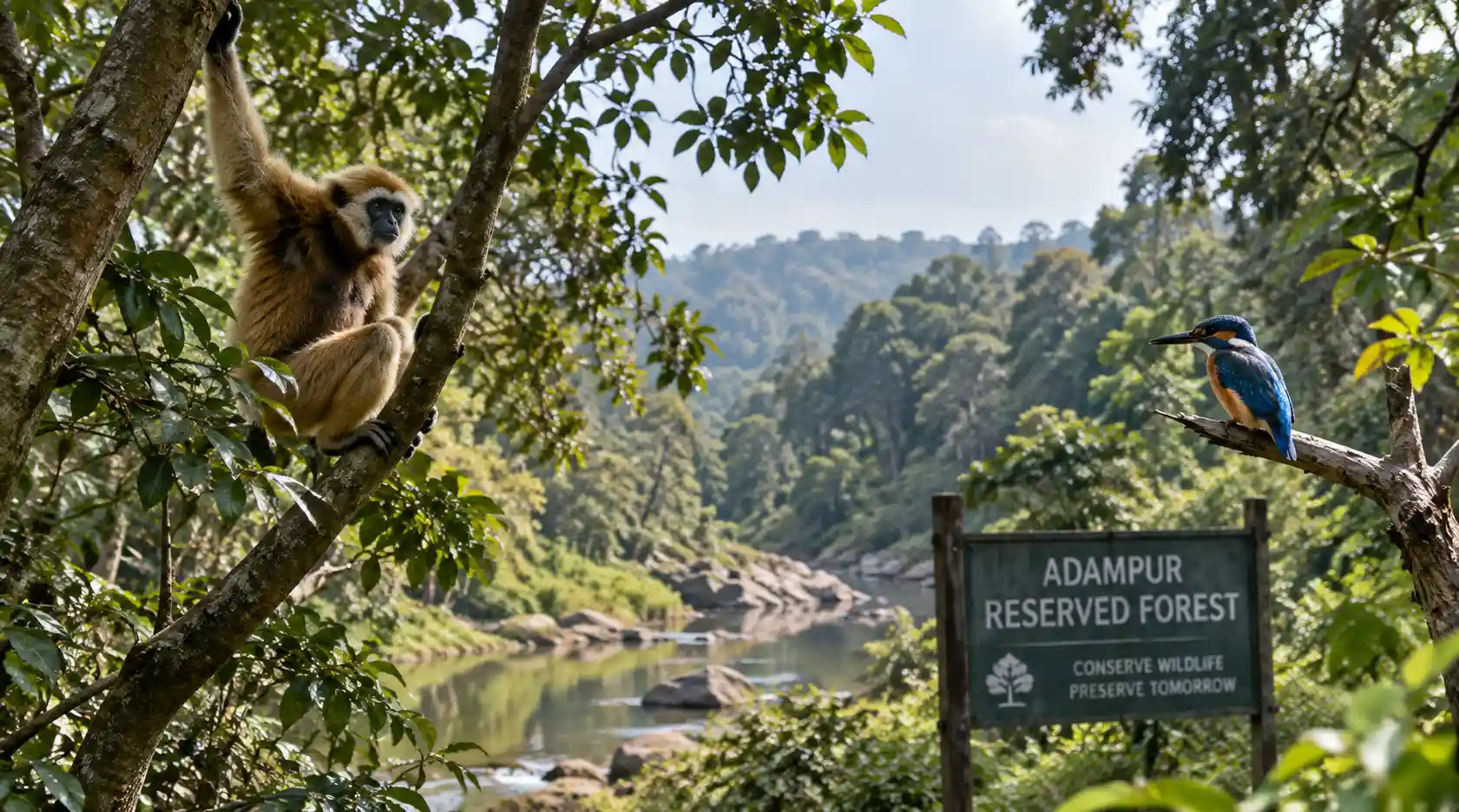

The trail into Adampur Reserved Forest does not stay a trail for long. Within the first stretch, it dissolves into a chhara, one of the hill streams that cut repeatedly through this patch of forest in Bangladesh's Moulvibazar district, and walking becomes wading - knee-deep water, loose stones, slick mud banks. It was along one of these streams, on a survey day in August 2026, that a team of researchers heard what they had come partly hoping to hear: the loud, rising duet of a pair of hoolock gibbons, somewhere up in the canopy, moving away from them through the trees. They followed as far as the terrain allowed. They never saw the animals. They only heard them, which, as the wildlife biologist leading the trip later wrote, is often exactly how a forest chooses to reveal itself.
That trip was a return. The same researcher, Dr Reza Khan, had first walked Adampur thirteen years earlier, in 2012, guided by local naturalists familiar with the forests of greater Sylhet. He came back in August 2026 as part of a 14-member team working under the Bangladesh Forest Department and IUCN Bangladesh's project to update the country's Faunal Red List. The gap between those two visits - thirteen years, almost to the season - turned an ordinary survey into something closer to a before-and-after study of a single forest, conducted not with instruments but with memory.
Where Adampur Sits, and What Surrounds It
Adampur is not, technically, a stand-alone reserve. It is a forest beat within the Rajkandi Reserved Forest, itself administered under the Moulvibazar Forest Division of the Bangladesh Forest Department, in Kamalganj Upazila, Moulvibazar District, Sylhet Division - close enough to the international border that the Indian state of Tripura lies just beyond it. Public records give somewhat different figures for its size: Wikipedia lists the Adampur forest beat at roughly 5,290 hectares (13,080 acres), while separate reporting on the wider Rajkandi Forest Range - which groups the Adampur, Kurma and Kamarchhara beats together - puts that combined range at 20,270 acres. The discrepancy likely reflects different administrative boundaries or survey dates rather than an error in either source, but it is worth stating plainly rather than picking one number and presenting it as settled.
What is clearer is the terrain and habitat type: mixed-evergreen hill forest, threaded by chharas that carry monsoon runoff down between low hillocks, with dense bamboo groves (locally known varieties include Muli, Mitenga, Dolu and Rupai bamboo) and a forest inspection bungalow near the entrance. A Khasi settlement, or punjee, sits close to the forest boundary - part of a wider pattern across Sylhet's hill forests, where Khasi communities maintain betel-leaf agroforestry gardens woven into the edges of surviving forest patches, according to recent reporting on Indigenous livelihoods in the region. Inside Adampur, a trail known as Jhiripath is also one of the routes used to reach the Hum Hum waterfall, a well-known local landmark.
Rajkandi, and by extension Adampur, sits within the Indo-Burma biodiversity hotspot, one of the world's recognised concentrations of species richness and extinction risk. A 2018 study published in the Bangladesh Journal of Plant Taxonomy recorded 549 species of flowering plants from 123 families across the Rajkandi Forest Range. The same forest has been documented to hold rare mammals including golden cats, Asiatic black bears, serows, pangolins and small-clawed otters, alongside close to 300 recorded bird species, a number of them listed under CITES.
The Gibbons: Heard More Often Than Seen
The western hoolock gibbon (*Hoolock hoolock*) is the only ape species found in Bangladesh, and one of only two ape species native to the Indian subcontinent. Globally, the IUCN lists it as Endangered. Within Bangladesh specifically, national assessments - including the 2015 IUCN Bangladesh Red List - classify it as Critically Endangered, reflecting how much more precarious its position is at the western edge of its range than across the species as a whole.
The numbers behind that classification have shifted over time, partly because survey effort has improved. An assessment in 2006 estimated Bangladesh's entire gibbon population at around 250 to 280 individuals. A far more comprehensive nationwide survey, carried out between January 2019 and March 2024 and published in 2025, confirmed gibbon occurrence at 46 locations across 42 forest fragments in the country's southeast and northeast, and revised the national population estimate upward to at least 816 individuals in at least 254 groups. That is more than double the earlier figure - but the researchers themselves attribute this primarily to far more thorough survey coverage, not to an actual doubling of the gibbon population in fewer than twenty years. No population count specific to Adampur itself was located in the course of researching this piece; what is documented is simply that gibbon calls were recorded there both in 2012 and again in 2026, which confirms continued presence without establishing numbers, trend, or group size at this particular site.
Nationally, the pressures on hoolock gibbons are well documented in the conservation literature: habitat fragmentation, loss of continuous canopy (which gibbons depend on for their exclusively arboreal method of travel), illegal harvesting of forest resources, and encroaching agriculture. Bangladesh's remaining gibbon populations are largely confined to small, disconnected forest blocks in the Chittagong Hill Tracts and the Sylhet hill forests - a category that includes Rajkandi and Adampur.
Kingfishers, and a Genuine Scientific First
Among Adampur's birds, one species carries a documented distinction rarely attached to a Bangladeshi forest site: the Oriental dwarf kingfisher (*Ceyx erithaca*), also called the black-backed or three-toed kingfisher, one of the smallest kingfisher species in South and Southeast Asia. A study recording the first confirmed breeding of this species in Bangladesh was based on observations made at Adampur in 2012 - a nesting tunnel discovered on 17 April that year, excavation and feeding activity tracked through the following weeks, and fledging recorded on 30 May, with a clutch size of three to seven eggs and a nest tunnel roughly 54 centimetres deep, sited about a metre above the stream bed. It remains one of the more concrete pieces of published science tied specifically to this forest, rather than to the wider region.
During the 2026 survey, a pair of dwarf kingfishers was again seen near one of the chharas, appearing briefly before vanishing back into the vegetation - consistent with the species' famously elusive behaviour, and welcomed by the team simply as a sighting, without an attempt to photograph or pursue it. Elsewhere along the survey route, the team recorded a silver-breasted broadbill, bronze drongo, drongo cuckoo, green-billed malkoha, pin-striped tit-babbler and black-headed yellow bulbul, and watched a pair of white-browed bulbuls tending a cup-shaped nest built about three metres above a chhara, containing three eggs. Near the end of the day's walk, the team encountered a mixed-species foraging flock - a loose, temporary association of birds as different as a tailorbird, a shikra and a whistling thrush, moving together through the forest simply because following the same insect activity made foraging more efficient for all of them. Regionally, close to 300 bird species have been documented across the wider Rajkandi range, though that figure describes the forest range as a whole rather than Adampur alone.
What Else Moves Through Adampur
The 2026 survey also turned up a tropical swallowtail moth (*Lyssa zampa*), a large nocturnal species with a wingspan of about 16 centimetres, found unusually exposed in daylight on a leaf; more than a dozen butterfly species were collected by a dedicated team member for scientific specimen records and DNA barcoding. Macaques were recorded moving through the canopy, as they had been in 2012, though the source material does not specify which macaque species. After dark, a separate team documented a green pit viper and Bhamo frogs - species that, as the survey team noted, are essentially invisible during the day and only become apparent once the sun goes down, underscoring how a single forest effectively behaves as several different habitats depending on the hour.
Among plants, two species drew particular attention during the 2026 visit: *Dasymaschalon longiflorum*, with unusual red, chilli-like floral structures, and *Oreocnide integrifolia*, known locally as Bormala, whose pale fruit closely resembles mulberries and is eaten by both birds and people.
The Change That Mattered Most
For all of that recorded diversity, the single most striking observation from the 2026 return was an absence rather than a presence. In 2012, tree ferns had grown in visible abundance along the chhara banks - tall, umbrella-crowned plants with a distinctly ancient appearance, evoking a much older geological era. By 2026, they were difficult to find. The forest itself still looked green and intact; wildlife was still present in diversity. But this one plant group, once a defining visual feature of parts of Adampur, had thinned out sharply.
Crucially, no single confirmed cause has been established for that decline. Possible explanations raised by the survey team included changes in soil or air moisture, alterations to canopy cover, physical disturbance, shifts in stream flow or course, competition from other vegetation, or broader climatic change - quite possibly some combination of several of these factors rather than one clear driver. The point made explicitly by the researchers was not that they had solved the mystery, but that a change this visible, occurring over thirteen years without anyone tracking it in the interim, illustrates how biodiversity loss can begin quietly, well before it reaches a species dramatic or charismatic enough to trigger public concern.
Pressure From Beyond the Tree Line
Some of the pressure on this landscape is more directly documented. Reporting published by The Daily Star in December 2025 examined construction activity inside the wider Rajkandi Forest Range, which includes the Adampur beat. For decades, only mud housing had been permitted for residents of Kalenji village, a community of forest-department-appointed caretakers living inside the reserved forest boundary. That same reporting found that roughly 100 families were now living in the area, with several brick-built structures having gone up along the roadside - construction that residents said would not have been possible without at least the tacit awareness of forest officials. The Bangladesh Environmental Journalists' Association's Moulvibazar chapter called for stronger surveillance and removal of unauthorised structures, while the Rajkandi Forest Range officer acknowledged that permanent brick construction is not permitted inside reserved forest and said the matter would be examined.
This kind of gradual, small-scale encroachment - a house here, a cleared roadside plot there - tends to attract far less attention than large-scale deforestation, but it accumulates in the same direction: shrinking the effective footprint of continuous forest available to species like the hoolock gibbon, which cannot easily cross open, treeless ground. It sits alongside the broader, nationally documented pressures on Bangladesh's gibbon habitat - fragmentation, resource extraction and agricultural conversion - that conservation researchers have flagged as the primary drivers behind the species' precarious status across the country.
Who Is Watching, and What Happens Next
The August 2026 survey itself is one visible thread of conservation infrastructure: a Bangladesh Forest Department and IUCN Bangladesh partnership specifically intended to update the country's Faunal Red List, drawing on field teams that include both professional biologists and dedicated citizen naturalists. Nationally, hoolock gibbon research and conservation work in Bangladesh - including the comprehensive 2019–2024 population survey - has drawn support from organisations such as the IUCN Section on Small Apes, the Gibbon Conservation Alliance, the Wildlife Conservation Network, Primate Conservation Inc. and the Rufford Foundation, alongside the Forest Department's own SUFAL Innovation Grant programme, though this support operates at a national and regional level rather than as an Adampur-specific project. Locally, the forest-caretaker arrangement in Kalenji village represents a long-standing, if currently strained, model of community stewardship tied directly to the reserve's boundaries.
Why a forest of this size, in this particular corner of Bangladesh, matters beyond its own boundary comes down largely to scarcity. Mixed-evergreen hill forest of the kind found at Adampur survives in only a few pockets of the country - chiefly here in Sylhet and in the Chittagong Hill Tracts - and it is precisely this habitat type that hoolock gibbons, capped langurs and forest-interior birds require. Positioned against the Tripura border, Adampur forms part of a broader, if increasingly fragmented, belt of sub-Himalayan foothill forest that once ran more continuously across what is now an international boundary. Its network of chharas does more than complicate hiking routes: by opening gaps in the canopy, these streams create sunlit edge habitat that concentrates insect life, and with it, the small birds - warblers, babblers, sunbirds, flowerpeckers - that depend on that food source.
What the future holds for Adampur's gibbons, kingfishers and other wildlife is genuinely uncertain, and the honest answer is that thirteen years apart is too sparse a dataset to establish firm trends for most of what lives there. The continued presence of calling gibbons and breeding kingfishers in 2026 is a real, documented, and encouraging sign. The disappearance of the tree ferns, and the creeping arrival of brick houses inside forest boundaries meant to hold only mud ones, are equally real and considerably less encouraging. Both observations point toward the same underlying need identified by the researchers themselves: not a single dramatic intervention, but sustained, repeated monitoring - so that the next time someone walks this forest looking for what has changed, they are working from data collected across the intervening years, rather than from memory alone.
Further reading and useful links
Reader questions
Frequently asked questions
Where is Adampur Reserved Forest located?
Adampur is a forest beat within the Rajkandi Reserved Forest in the Moulvibazar district of Bangladesh's Sylhet Division, positioned near the international border with the Indian state of Tripura.
Why is Adampur Reserved Forest important for wildlife?
The forest is part of the Indo-Burma biodiversity hotspot and provides critical habitat for endangered species, including the western hoolock gibbon and the Oriental dwarf kingfisher.
What major ecological change was observed in Adampur between 2012 and 2026?
A 2026 survey found that tree ferns, which were abundantly growing along the forest's stream banks in 2012, had largely disappeared, pointing to subtle but significant ecological shifts.
Nexuswild welcomes factual corrections. Email [email protected] with evidence and the article URL.