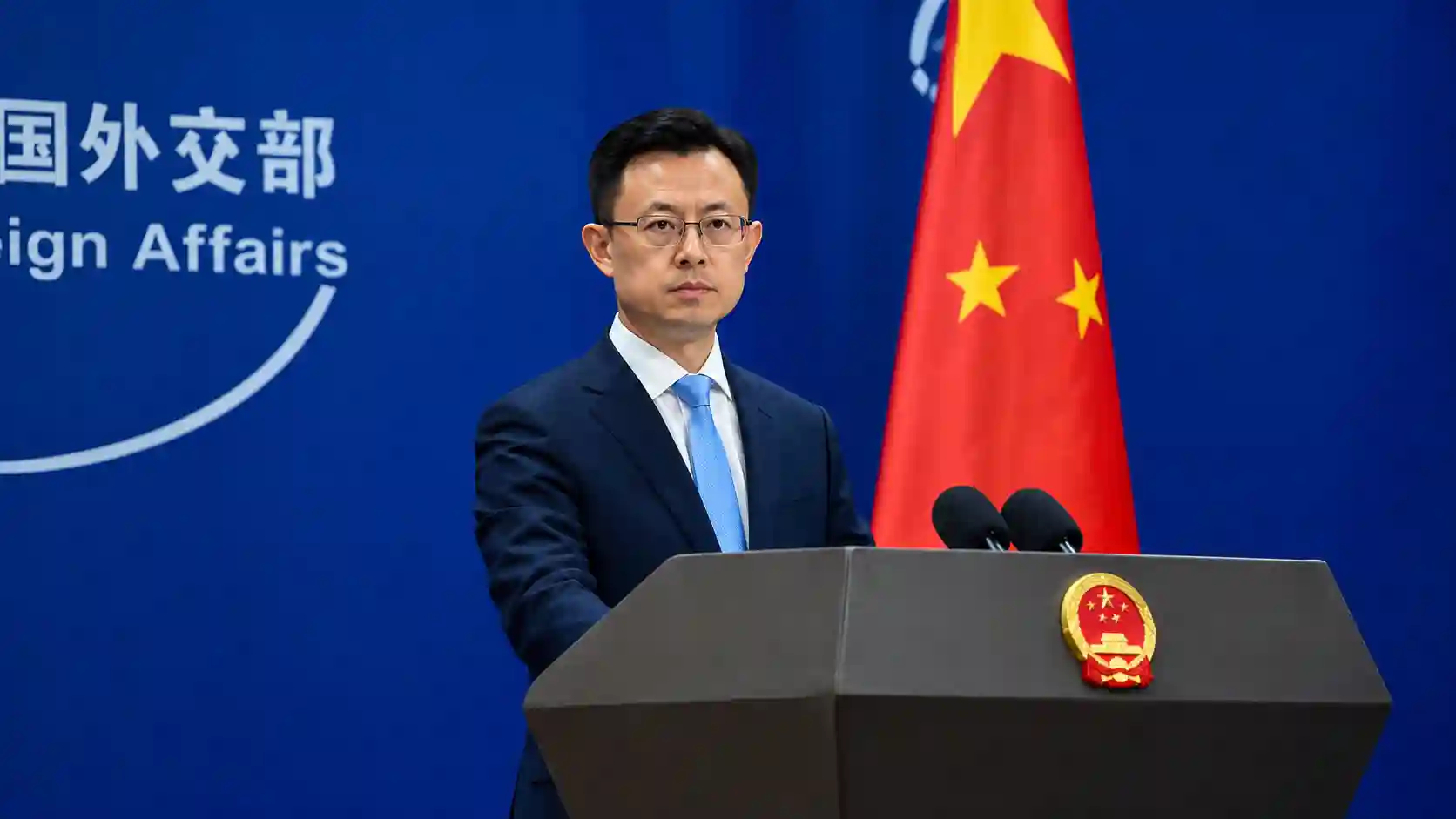

China's Ministry of Foreign Affairs pushed back on Monday, September 14, against remarks by Anthropic CEO Dario Amodei calling for continued U.S. restrictions on China's access to advanced AI technology, setting up a fresh exchange in the broader dispute between Washington and Beijing over who controls the frontier of artificial intelligence.
The dispute traces back to a lengthy essay Amodei published on Saturday, September 12, in which he warned that "a Chinese lead in AI would pose grave danger for the United States and the world." In the essay, Amodei argued for continuing restrictions on the sale of cutting-edge AI chips and chipmaking equipment to China as a way to preserve what he described as the United States' current advantage in frontier AI development. He also wrote that global efforts to slow the pace of AI development would eventually require cooperation with China, calling it "the autocratic country with by far the most advanced AI capabilities" outside the U.S. itself, and separately predicted that swarms of autonomous AI "agents" could be capable of effectively taking over parts of the internet within six to twelve months unless AI researchers agreed to a coordinated slowdown.
It's important to be precise about what Amodei was and wasn't calling for. His remarks amount to policy advocacy from the head of a private AI company, not an announcement of U.S. government action, and he does not hold authority to set or change American export-control rules - that power rests with the Commerce Department and other federal agencies. Amodei's essay argued in favor of maintaining and extending existing chip-related restrictions rather than laying out a specific new mechanism, and he combined that position with a broader appeal for international cooperation on AI safety that included, rather than excluded, China as a necessary partner in any eventual slowdown.
How Beijing Responded
According to reporting from NPR and the Associated Press, China's Ministry of Foreign Affairs was asked about Amodei's essay at a Monday briefing and responded by saying that all parties should work together on AI, a comparatively measured official line. A sharper rebuttal came from China's state-run Global Times newspaper, which in a Sunday editorial dismissed Amodei's essay as a veiled call to "contain" China. The editorial argued that while the essay presents itself as focused on global AI security, it is, in the paper's words, "packed with containment provisions targeting China" and amounts in substance to a "Cold War playbook" for the AI sector. The Global Times is a Communist Party-affiliated outlet known for nationalist commentary, and its editorial should be read as reflecting an official-adjacent but distinct voice from the Foreign Ministry's own, more restrained statement.
The exchange also touched on cybersecurity. Amodei's essay came several days after the FBI, the National Security Agency and the Cybersecurity and Infrastructure Security Agency issued a joint advisory alleging that Chinese AI developers had engaged in "aggressive, malicious" efforts to extract, or "distill," capabilities from advanced U.S. models, including Anthropic's Claude and OpenAI's GPT systems. China's Commerce Ministry dismissed those claims as groundless, arguing that model distillation is a technique commonly used by AI companies generally, and countered that the U.S. was itself pursuing a "monopoly" over the global AI industry.
The Wider Argument
Beijing's position, as reflected in these statements, rests on two main threads: that techniques like distillation are standard industry practice rather than evidence of wrongdoing, and that U.S. restrictions on chips and advanced models function to entrench American dominance rather than to address genuine safety concerns. Lizzi C. Lee, a fellow at the Asia Society Policy Institute's Center for China Analysis, framed the underlying tension this way: both Washington and Beijing want to ensure the other side cannot establish a decisive technological chokepoint over it. Lee also raised what she described as an evident contradiction from Beijing's vantage point - if the U.S. wants China's cooperation on frontier AI safety while simultaneously restricting its access to frontier computing power, it isn't clear what that cooperation would practically consist of. That observation is an independent analyst's framing of the dispute's logic, not a claim attributed to either government.
Chinese officials have also been positioning the country's own AI diplomacy separately from this specific exchange. President Xi Jinping has called for establishing a global AI governance framework involving Global South countries, casting China as a leading proponent of open-source AI development. China's Ministry of State Security has separately published commentary calling for accelerating the creation of a system to prevent and manage AI security risks. Notably, the exchange over Amodei's essay comes shortly before a planned meeting between President Trump and Xi later in September, at which AI governance is expected to be among the topics discussed, according to reporting reviewed for this article.
Chips, Models and the Broader Competition
Amodei's advocacy for chip restrictions is not a new position for him. He has previously criticized decisions by the U.S. administration to permit limited sales of advanced Nvidia and AMD processors to approved Chinese customers, arguing publicly at the World Economic Forum in Davos earlier this year that doing so risked eroding an American advantage in chip manufacturing that he believes remains substantial. He has also engaged directly with U.S. lawmakers on the issue, meeting with senators from both parties to advocate for export restrictions, AI transparency legislation and other policy measures - activity that reflects a company executive lobbying for his preferred policy outcomes, distinct from the export-control decisions that remain the province of the U.S. government itself.
The competitive landscape Amodei's essay addresses involves more than any single company. U.S. developers including OpenAI and Google have likewise built frontier-scale models, and Chinese developers - including firms that produce widely used open-source models - have narrowed the performance gap with U.S. systems even as questions persist over exactly how close that gap is. Independent commentary on Amodei's prior essays, including critiques from AI researchers, has noted that estimates of China's lag behind U.S. frontier capabilities have varied, with some assessments cited elsewhere putting Chinese open-source models roughly six to twelve months behind top U.S. systems as of mid-2026 - a gap that is itself part of why the debate over restricting compute and model access carries such weight for both governments.
Why This Matters for the Supply Chain
The underlying policy debate - how tightly the U.S. should restrict advanced chip and chipmaking-equipment exports to China - carries direct consequences for semiconductor companies such as Nvidia and AMD, whose China sales have already been shaped by shifting federal rules this year, as well as for cloud infrastructure providers and any company reliant on globally distributed AI supply chains. Tighter restrictions could constrain revenue for chipmakers selling into the Chinese market while reinforcing the compute advantage American AI labs currently hold; looser rules could ease near-term commercial pressure on chipmakers while, in the view of restriction advocates like Amodei, narrowing the gap Chinese developers face in accessing frontier-level computing power.
What Comes Next
The dispute is likely to remain a live undercurrent as the Trump-Xi meeting approaches later this month, with AI governance expected to feature in those discussions alongside other bilateral issues. Policymakers and technology companies are likely to be watching for any shift in the administration's stance on chip export licensing, further findings or rebuttals related to the distillation allegations raised in last week's joint security advisory, and whether Beijing's public statements on AI cooperation translate into any concrete diplomatic proposal ahead of, or during, the leaders' meeting.
Further reading and useful links
Reader questions
Frequently asked questions
Why did Beijing push back against Anthropic CEO Dario Amodei?
China's Foreign Ministry and state media were responding to an essay by Amodei advocating for continued U.S. restrictions on advanced AI chips and chipmaking equipment to China, which state media criticized as a 'containment' strategy.
What did Dario Amodei argue in his essay?
Amodei argued that a Chinese lead in AI poses significant global risks and urged the U.S. to maintain export controls to preserve its AI advantage, while simultaneously advocating for eventual international cooperation on AI safety.
How do U.S.-China AI restrictions affect the tech industry?
U.S. export restrictions directly impact the revenue of semiconductor companies like Nvidia and AMD by limiting sales to the Chinese market, while attempting to maintain the technological edge of American AI developers.
Nexuswild welcomes factual corrections. Email [email protected] with evidence and the article URL.