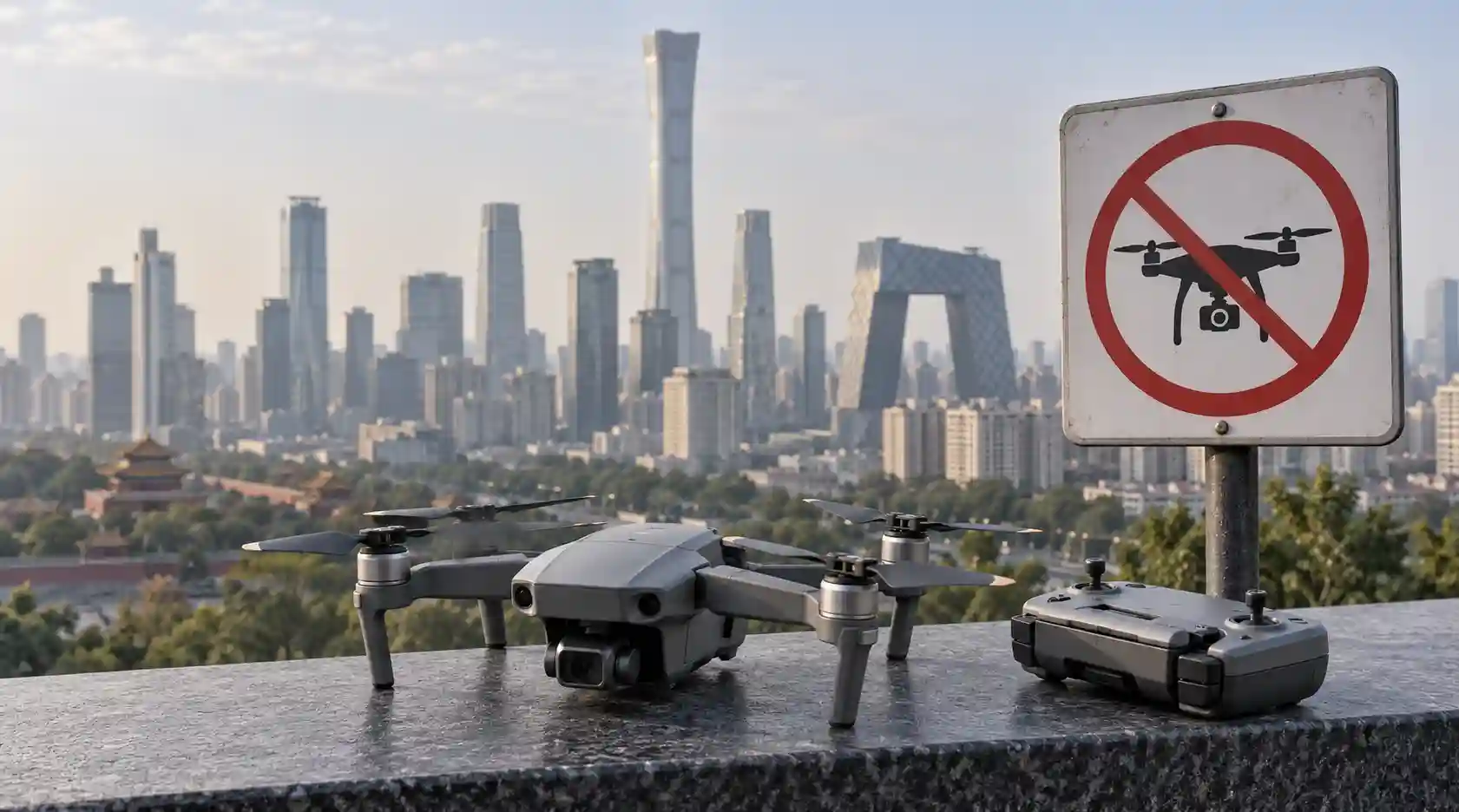

Beijing will ban the possession and storage of drones anywhere within city limits starting November 15, 2026, under revised regulations announced Sunday, September 13 - a significant escalation from rules introduced earlier this year that had still allowed registered drone owners to keep their devices. The move closes what officials describe as a remaining gap in the capital's drone controls, following a fatal light-aircraft crash in June that struck Beijing's tallest skyscraper.
What Exactly Is Being Banned
The scope of the new rules is specific and worth stating precisely, since it is broader than the earlier regulations but not unlimited. According to reporting from the Associated Press, Bloomberg, AFP and the South China Morning Post, the revised rules - approved this month and set to take effect November 15 - prohibit possessing or storing drones or their key components anywhere within Beijing's administrative boundaries, alongside an existing ban on unauthorized flights. Bringing drones or drone components into the city, including by tourists, is also prohibited, extending a restriction that was already in place. The measure applies across the whole of Beijing's city limits, not merely a temporary event zone or a single district, and - unlike the earlier rules - no longer includes a pathway for residents to keep a small number of registered devices at home.
That earlier framework, which took effect May 1, 2026, had banned new drone sales, rentals and imports into Beijing without prior approval from public security authorities, while letting existing owners register their devices with police by April 30 and keep them, subject to storage limits of no more than three drones or ten designated "core components" per address within the city's Sixth Ring Road. The new November rules eliminate that possession allowance entirely: from mid-November, no unregistered or newly-restricted drone can legally be kept in Beijing at all, regardless of prior registration.
Why Beijing Says It's Doing This
Beijing's municipal government has framed the tightening rules around airspace security in the capital specifically, rather than drones as a general technology. The regulations, in the government's own wording reported by the South China Morning Post, state that the revisions aim to "adapt to the new situations, tasks and requirements" of drone management and "to effectively fortify the capital's security defences". City authorities have separately said they intend to "further tighten control measures and comprehensively investigate hidden safety hazards" to strengthen airspace security. Xiong Jinghua, a senior official with the Beijing Municipal People's Congress, said earlier this year that the city's goal was to "strike the best balance" between safety and continued technological and economic development - language officials have used to explain why Beijing, as the seat of China's central government and military institutions, applies stricter drone controls than other Chinese cities.
The immediate trigger for this latest escalation was a fatal accident in late June 2026, when a small aircraft crashed into the CITIC Tower - also known as China Zun, Beijing's tallest skyscraper - killing the pilot and injuring 13 people. While that crash involved a light aircraft rather than a drone, Bloomberg and other outlets reported it as the specific catalyst that prompted authorities to close remaining loopholes in drone possession rules, on top of general concerns about unauthorized drone incursions near sensitive sites such as government compounds and military installations.
Enforcement, Penalties and What Owners Must Do
The rules are enforced by Beijing's public security authorities. Under the May 2026 framework, unauthorized drone flights could draw fines of up to 10,000 yuan (about $1,463) and confiscation of the device; organizations or individuals selling drones or the 17 categories of designated core components without approval faced separate fines. Multiple outlets reported that under the new November rules, authorities can confiscate non-compliant drones and impose fines on both individuals and companies, though a specific fine schedule for the possession ban itself was not detailed in the reporting reviewed.
For existing owners, the government has outlined disposal and relocation options rather than requiring residents to simply discard their equipment. According to the South China Morning Post and Bloomberg, citing the state-owned Beijing Daily, residents will have until November 14 to move their drones outside city limits or dispose of them, with the government offering a buyback program - reportedly capping payouts at 3,000 yuan (about $447) per unit - as well as free shipping options to mail devices out of the city.
Exemptions
The regulations are not an absolute, unconditional ban on every drone in every context. Reporting on the May rules described specific carve-outs for approved uses including counter-terrorism operations, emergency and disaster rescue, agriculture, education and research, each requiring case-by-case approval from relevant authorities. Whether those same category exemptions carry forward unchanged under the stricter November possession ban was not fully detailed in the sources reviewed for this report, and should not be assumed without further official clarification; some reporting on the earlier framework noted that flying schools and sports facilities were hopeful, but not certain, that they would eventually receive exemptions of their own.
A Wider Pattern of Tightening Control
The November rules extend a run of measures Beijing has introduced over roughly the past year. The city's entire airspace was designated a no-fly zone requiring pre-approval for any flight, a restriction predating this year's changes. That was followed by the May 2026 sales, storage and import restrictions, and now the near-total possession ban. Beijing's approach also fits a longer-running precedent: municipal authorities imposed a similar, though explicitly temporary, drone and low-altitude aircraft ban ahead of the Chinese Communist Party's 20th National Congress in 2022. The current measures differ in that they are framed as a lasting regulatory shift rather than an event-specific restriction tied to a fixed end date.
Effects on the Market and Commercial Drone Uses
China is home to more than three million registered drones, according to government data cited in multiple reports, and the sector forms part of what Chinese planners call the "low-altitude economy" - covering uses such as food delivery, agriculture, infrastructure inspection and building maintenance - which official projections put at generating more than 2 trillion yuan (roughly $290 billion) by 2035. Beijing's restrictions sit awkwardly alongside that national ambition, and CNN reported that the city's drone retail sector has already been affected: DJI, the Shenzhen-based company that is the world's largest drone maker, has removed products from its flagship Beijing store shelves, and dealers across the city reported sharp sales declines even before the May rules took full effect, with used-drone listings rising on resale platforms as owners looked to offload devices ahead of registration deadlines. DJI did not respond to CNN's questions on the impact of the ban. E-commerce platforms including Taobao and JD.com reportedly halted drone shipments to Beijing addresses when the May rules took effect.
Public Reaction
Reaction from drone owners captured in AFP and other reporting has been largely critical. One user on the Chinese social media platform WeChat described the May rules as "a crazy one-size-fits-all system," and dealers and drone-flying school staff told AFP they were concerned about how they would maintain or replace equipment once stricter storage and import limits took hold. Some owners said they intended to sell their drones rather than navigate the new restrictions. This report did not find published reaction specifically addressing the November possession ban from industry groups, though the pattern of concern voiced around the earlier rules suggests similar pushback is likely as the November 15 deadline approaches.
For now, the practical effect is this: drone flights in Beijing already required prior approval, and from November 15, so will simply keeping one in the city at all - a rule that, notably, does not apply to the rest of China, where drone ownership remains legal subject to real-name registration requirements.
Further reading and useful links
Reader questions
Frequently asked questions
What is the new drone regulation in Beijing?
Starting November 15, 2026, possessing, storing, or bringing a drone and its core components into Beijing's city limits is strictly banned, closing a previous loophole that allowed registered ownership.
Why did Beijing ban drones completely?
The city cited the need to 'safeguard the security of the capital.' The immediate catalyst was a fatal incident in June 2026 when a small aircraft crashed into the CITIC Tower (China Zun), heightening fears over unauthorized airspace incursions.
What can current drone owners in Beijing do?
Owners must dispose of their drones or move them outside the city limits by November 14, 2026. The government has offered a buyback program with subsidies up to 3,000 yuan per device, as well as waived shipping fees to send them elsewhere in China.
Nexuswild welcomes factual corrections. Email [email protected] with evidence and the article URL.