
Every few years, a new candidate is anointed as the place that will absorb the manufacturing capacity companies no longer want concentrated in China. Vietnam has had its turn. So has Mexico. Increasingly, the candidate is not a country but a single Indian state: Gujarat. The label "the next China" gets attached loosely and often - but the underlying question is worth asking seriously. Gujarat has genuine manufacturing scale by Indian standards, real semiconductor and EV investment now on the ground, and infrastructure that outpaces most of the country. Whether that adds up to a credible alternative to China, or simply the best version of what India currently offers, depends on the numbers.
The scale of Gujarat's industrial base
Gujarat is India's most industrialised state by almost any measure. The secondary sector - industry and manufacturing - accounted for close to 43% of the state's gross state domestic product (GSDP) in 2025-26, roughly double the industry share of India's GDP as a whole, which sits closer to 17%. That gap is the clearest evidence that Gujarat is structurally different from the rest of the country: it has built its economy around factories and processing, not services or agriculture.
The export numbers reinforce this. Gujarat accounted for around 30% of India's total merchandise exports in FY25, and in FY26 it retained its position as India's top exporting state, contributing roughly $110 billion to India's record $863 billion in combined goods-and-services exports. Petroleum products alone made up close to 38% of the state's exports, a reminder that refining and petrochemicals, not electronics, still form the backbone of Gujarat's trade.
Foreign investment has followed a similar trajectory. According to the Department for Promotion of Industry and Internal Trade (DPIIT), Gujarat drew about $46 billion in FDI between October 2019 and June 2025 - a large number, though it needs context. A meaningful share of that flow is concentrated in a handful of very large single projects (oil refining, petrochemicals, and more recently semiconductors), rather than spread across a broad base of mid-sized manufacturers, which is closer to how FDI typically distributes across Chinese provinces.
Sector by sector: where the substance is
Semiconductors. This is the sector generating the most attention, and it is also where the gap between announcement and operation is starkest - and narrowing fastest. Micron's $2.75 billion assembly, test and packaging (ATMP) facility in Sanand became India's first commercial semiconductor production site when it was inaugurated in February 2026. It has already shipped memory modules to Dell and expects to assemble tens of millions of chips in 2026, scaling toward hundreds of millions in 2027. This is real, operating capacity, not a plan.
Tata Electronics' much larger project - a ₹91,000 crore (roughly $11 billion) chip fabrication plant in Dholera, built with Taiwan's Powerchip Semiconductor Manufacturing Corporation and using ASML lithography tools - is a different story. As of mid-2026, construction had crossed the halfway mark, with trial production targeted for December 2026 and commercial output expected to ramp through 2027-28. It is a serious, financed, under-construction project - but it is not yet producing a single commercial chip, and fabs anywhere in the world routinely slip their timelines during the equipment-calibration phase Tata is now entering.
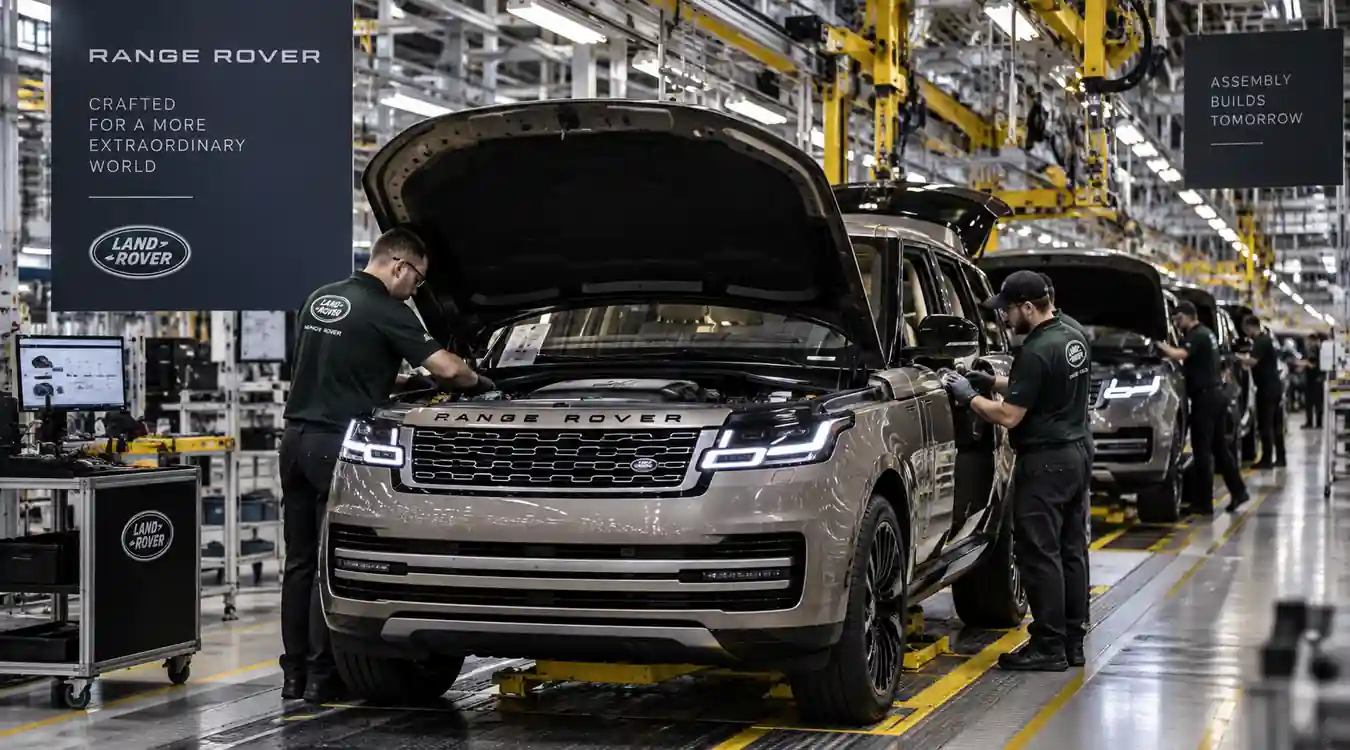
Automobiles. This is Gujarat's most mature diversification success. Tata Motors' Sanand plant (built on the site Ford abandoned when it exited India) is now a hub for the Nexon EV, Punch EV and Curvv EV. Maruti Suzuki's Hansalpur facility, with cumulative investment of over ₹25,000 crore, crossed one million vehicles produced and now builds the company's first battery-EV, the e-Vitara, largely for export to Europe. Maruti's board has separately approved close to ₹5,000 crore for land and preparatory work on a second Gujarat plant, planned for up to a million units of annual capacity - an announced project, not yet under full construction. Tata's battery arm, Agratas, has committed over $1.3 billion to cell manufacturing in the state. Taken together, Sanand has become India's most concentrated EV manufacturing cluster.
Chemicals and petrochemicals. This is Gujarat's oldest and deepest industrial strength, anchored by Reliance's Jamnagar refinery - the largest single-site refinery in the world - and the Dahej Petroleum, Chemicals and Petrochemicals Investment Region (PCPIR), which has drawn more than ₹1 lakh crore in investment since 2009 across roughly 180 operating units, with several hundred more under construction. ONGC Petro Additions (OPaL), a $4 billion complex producing over a million tonnes of ethylene a year, anchors the cluster; Reliance, BASF, Aditya Birla, SRF, Torrent and Adani all operate there. This is the one sector where Gujarat's scale genuinely approaches an integrated industrial-complex model similar to what exists on the Chinese coast, though India still imports much of its base petrochemical feedstock (methanol, ethylene, propylene) from the Gulf, which China's fully integrated crackers do not need to do.
Pharmaceuticals. Gujarat has more than 3,300 licensed pharmaceutical manufacturing units and accounts for roughly 30-35% of India's pharma sector turnover and close to 28% of the country's pharma exports - a real, longstanding export strength, built over three decades rather than a recent pivot.
Textiles. Surat alone produces around 40% of India's man-made fabric and close to 18% of the country's textile exports. It is a labour-intensive cluster competing directly with Chinese and Southeast Asian mills on cost, and recent GST rate cuts on inputs like zari and handloom components are aimed at sharpening that competitiveness further.
Renewable energy. Adani Green's Khavda project in the Rann of Kutch is, on current plans, the largest renewable energy park in the world - a 30 GW solar-wind-storage complex spread over 538 square kilometres. By mid-2026 roughly 9-10 GW had been commissioned at the site out of the eventual 30 GW target for 2029, with Adani Green's national operating portfolio reaching 19.3 GW after adding over 5 GW in FY26 alone. This is squarely an "operational and scaling" story rather than a paper promise - though the 2029 full-buildout date is itself a projection, not a fact.
Engineering and general manufacturing rounds out the base, spread across castings, machine tools and auto ancillaries clustered mainly around Rajkot and the Ahmedabad-Vadodara belt.
The clusters: Sanand, Dholera, Mundra, Dahej, Surat
Sanand has evolved from a single Tata Motors plant in 2008 into Gujarat's densest manufacturing zone - automobiles, EVs, and now semiconductor assembly sitting within a few kilometres of each other, with Ford, Honda, Hero MotoCorp and MG Motor also present. Dholera, by contrast, is a 920-square-kilometre greenfield "Special Investment Region" still being built largely from scratch; its flagship anchor is the Tata-PSMC fab, and supporting infrastructure - an expressway to Ahmedabad reported around 90% complete, and an international airport whose completion date has already slipped past several earlier targets - is being built in parallel with, not ahead of, the industrial tenants. This is a meaningful distinction from Sanand or Dahej, where infrastructure largely preceded the investment. Mundra, run by Adani Ports, became the first Indian port to cross 200 million tonnes of cargo in a single year (FY25) and now handles close to a third of India's container traffic; an approved ₹45,000 crore expansion aims to more than double its capacity. Dahej and Surat, described above, remain Gujarat's most mature and least speculative clusters.
Infrastructure and logistics
Gujarat's roughly 1,600-kilometre coastline and network of ports (Mundra chief among them) give it a genuine logistics advantage within India - older estimates put the state's share of India's total port cargo handling at around 40%. Installed power generation capacity stood at close to 73,000 MW as of April 2026, split across private, state and central utilities, with renewable capacity growing fastest. This combination - deep-water ports, surplus power, and dedicated freight corridor connectivity - is a genuine structural edge over most other Indian states, and the reason multinational manufacturers keep returning to Gujarat over Karnataka, Tamil Nadu or Uttar Pradesh when siting export-oriented plants.
Why companies consider Gujarat under China+1
The commercial logic for diversification is fairly clear-cut. India's manufacturing wage cost, at roughly $0.8 an hour, is meaningfully below Vietnam, Thailand and Indonesia, let alone coastal China. Section 301 tariffs on Chinese goods entering the US range from roughly 7.5% to 145% depending on the product category, while India faces standard low tariff rates - a real cost delta for tariff-exposed categories. India's working-age population is also projected to grow by close to 100 million by 2031, a demographic tailwind China no longer has. Government policy has reinforced this with the Production Linked Incentive scheme (roughly ₹2 lakh crore across sectors) and the India Semiconductor Mission, under which ten projects worth about ₹1.6 lakh crore had been approved across six states as of December 2025. None of this is unique to Gujarat - it applies to India broadly - but Gujarat's port and power infrastructure make it the state best positioned to capture the resulting investment.
Gujarat versus China: a sober comparison
This is where the "next China" framing needs testing rather than repeating. On the numbers that actually define manufacturing power - global value-added share - the gap is not close. China's share of global manufacturing value-added stood at roughly 28-32% as of 2023; India's, nationally, was about 3.2%, up only marginally from 1.5% in 1995. Gujarat, as India's leading industrial state, might account for somewhere around a sixth to a fifth of India's manufacturing output - meaning its share of global manufacturing value-added is a fraction of a single percentage point. China also retains structural advantages Gujarat has not replicated: fully integrated supplier ecosystems where a factory can source hundreds of components within a single industrial park, decades of tooling and automation expertise, and feedstock self-sufficiency in petrochemicals that Gujarat's Dahej cluster still lacks. What Gujarat offers instead is a lower cost base, a large English-speaking managerial class, political stability, and - increasingly - a credible position in specific niches: memory-chip assembly and testing, EV manufacturing for export, generic pharmaceuticals, and mid-market textiles.
Advantages, weaknesses, and open questions
Gujarat's advantages are real: consistent state government policy continuity since the early 2000s, a coastline with deep-water ports, comparatively reliable power, and a state administration experienced at fast-tracking industrial land and clearances. Its weaknesses are equally real and less discussed in promotional coverage. Water stress is serious and structural - the state has already drawn down roughly two-thirds of its groundwater reserves, and Kutch, the district hosting both Khavda's renewable park and heavy industry, has a documented history of drought and competition between farmers and factories for scarce water. Industrial pollution has degraded river water and fisheries near clusters like Dahej, prompting Supreme Court intervention in the past over effluent treatment. Skilled-labour shortages are a national problem Gujarat has not solved any better than other states - semiconductor and precision-engineering roles require training pipelines that are only now being built alongside the factories themselves. And a meaningful share of the investment figures cited in state summits are MoUs, not committed capital: Gujarat's own Vibrant Gujarat summit series has historically converted roughly 70% of signed MoUs into actual investment, with the state targeting a 90% conversion rate for the most recent editions - a target, not yet a demonstrated result.
What it would take
For Gujarat to move from "India's best industrial state" to a genuinely globally significant manufacturing hub, several things would need to happen simultaneously rather than sequentially. The Dholera fab needs to hit commercial production on something close to its stated 2027 timeline, since a slip would undercut confidence in every other announced semiconductor project. The state needs to build a domestic component-supplier base deep enough that assembly plants are not simply importing finished sub-systems and doing final assembly - the gap China has spent thirty years closing. Water infrastructure investment needs to keep pace with industrial water demand rather than trailing it, given how central Kutch has become to both renewables and heavy industry. And skilling programs need to produce technicians for semiconductor and EV-battery roles at a volume that matches the capacity being installed, not the capacity currently announced.
The verdict, for now
Gujarat is not "the next China," and treating it as an inevitability rather than a possibility overstates both the current evidence and the scale of the gap. What Gujarat has built is something more specific and, in its own way, more useful to evaluate: India's most complete manufacturing ecosystem, with real operating capacity in automobiles, chemicals, pharmaceuticals, textiles and - as of 2026 - a first foothold in semiconductor assembly, alongside a genuinely enormous but partially unbuilt bet on chip fabrication and renewable energy at Dholera and Khavda. Some of that is running today. Some of it is under construction with credible timelines. And some of it is still an MoU on a stage in Gandhinagar. The distinction matters, and it is the one that gets lost most often in coverage of Gujarat's manufacturing ambitions.
Reader questions
Frequently asked questions
Is Gujarat really the next China for manufacturing?
Not yet. Gujarat has India’s strongest industrial ecosystem and credible advantages in ports, power, autos, chemicals, pharmaceuticals and new semiconductor investment, but China remains far larger and deeper in global manufacturing, supplier networks and industrial integration.
Why is Gujarat important to the China Plus One strategy?
Gujarat combines deep-water ports, industrial power capacity, export-oriented manufacturing clusters, relatively low labor costs and large projects in semiconductors, EVs, chemicals and renewable energy.
What semiconductor projects are operating in Gujarat?
The supplied analysis identifies Micron’s Sanand assembly, test and packaging facility as operational in 2026. Tata Electronics’ Dholera fabrication plant is a much larger project but is still under construction.
What are Gujarat’s biggest manufacturing strengths?
The state has mature strengths in petrochemicals, automobiles, pharmaceuticals, textiles, engineering and ports, with semiconductors, EVs and renewable energy emerging as newer growth areas.
What could limit Gujarat’s manufacturing growth?
The supplied analysis highlights water stress, pollution, skilled-labor shortages, supplier depth, infrastructure execution and the gap between announced investment and actually commissioned capacity.
Nexuswild welcomes factual corrections. Email [email protected] with evidence and the article URL.