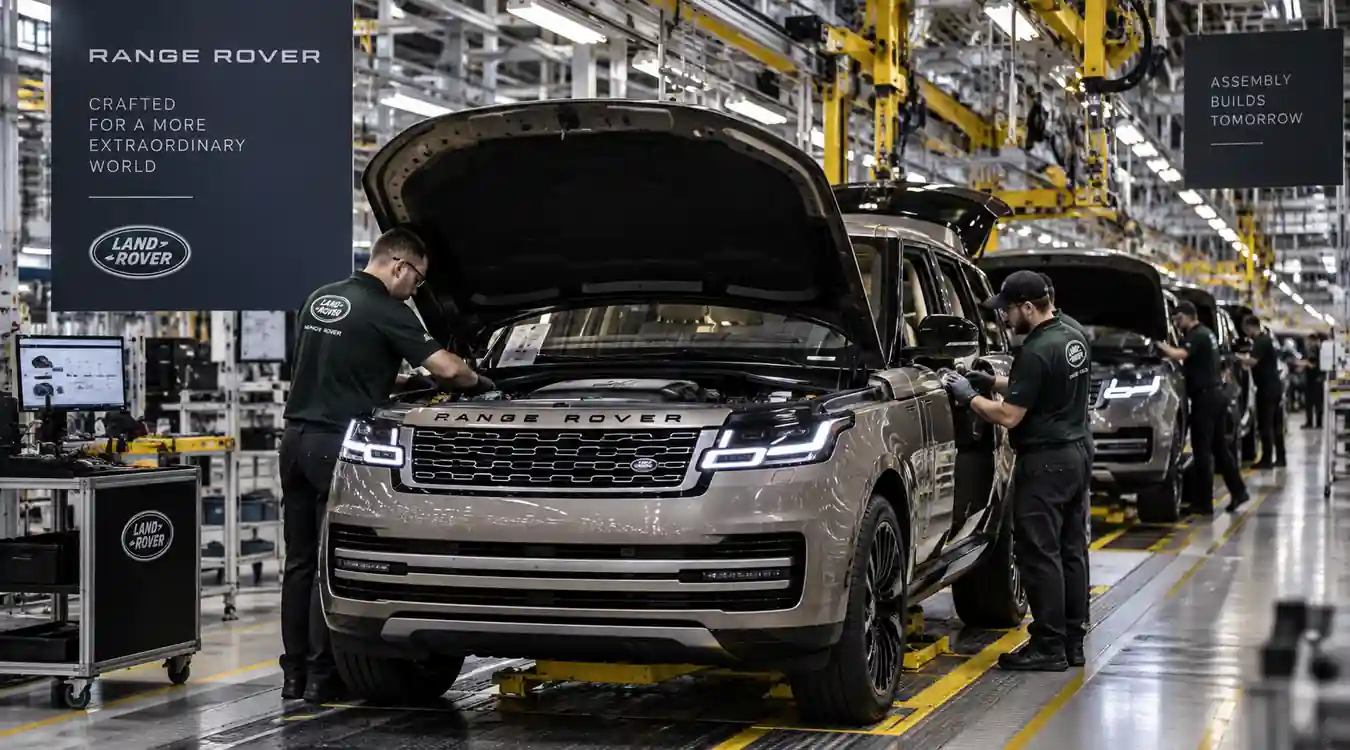

Jaguar Land Rover’s plan to cut around 4,000 roles over the next two years is not just a corporate restructuring story.
It is a test of how much pressure Britain’s automotive manufacturing system can absorb before cost-cutting at one large company begins to weaken the industrial network around it.
JLR is targeting about £1.7 billion of savings as it tries to lower the annual vehicle volume required to break even toward 300,000 units. The company has said the reductions are expected to focus mainly on salaried and management roles and be achieved through voluntary means wherever possible, while direct manufacturing jobs are not expected to be the main target.
The logic is financial.
JLR’s full-year FY26 revenue fell to £22.9 billion, down 20.9% from the previous year. Profit before tax and exceptional items fell to just £14 million from £2.5 billion a year earlier. Adjusted EBIT margin dropped to 0.7% from 8.5%.
The company ended the year with £2.6 billion of net debt and generated negative £2.2 billion of free cash flow.
Those numbers explain why management is trying to reduce structural costs.
But they also explain why suppliers across the West Midlands are nervous.
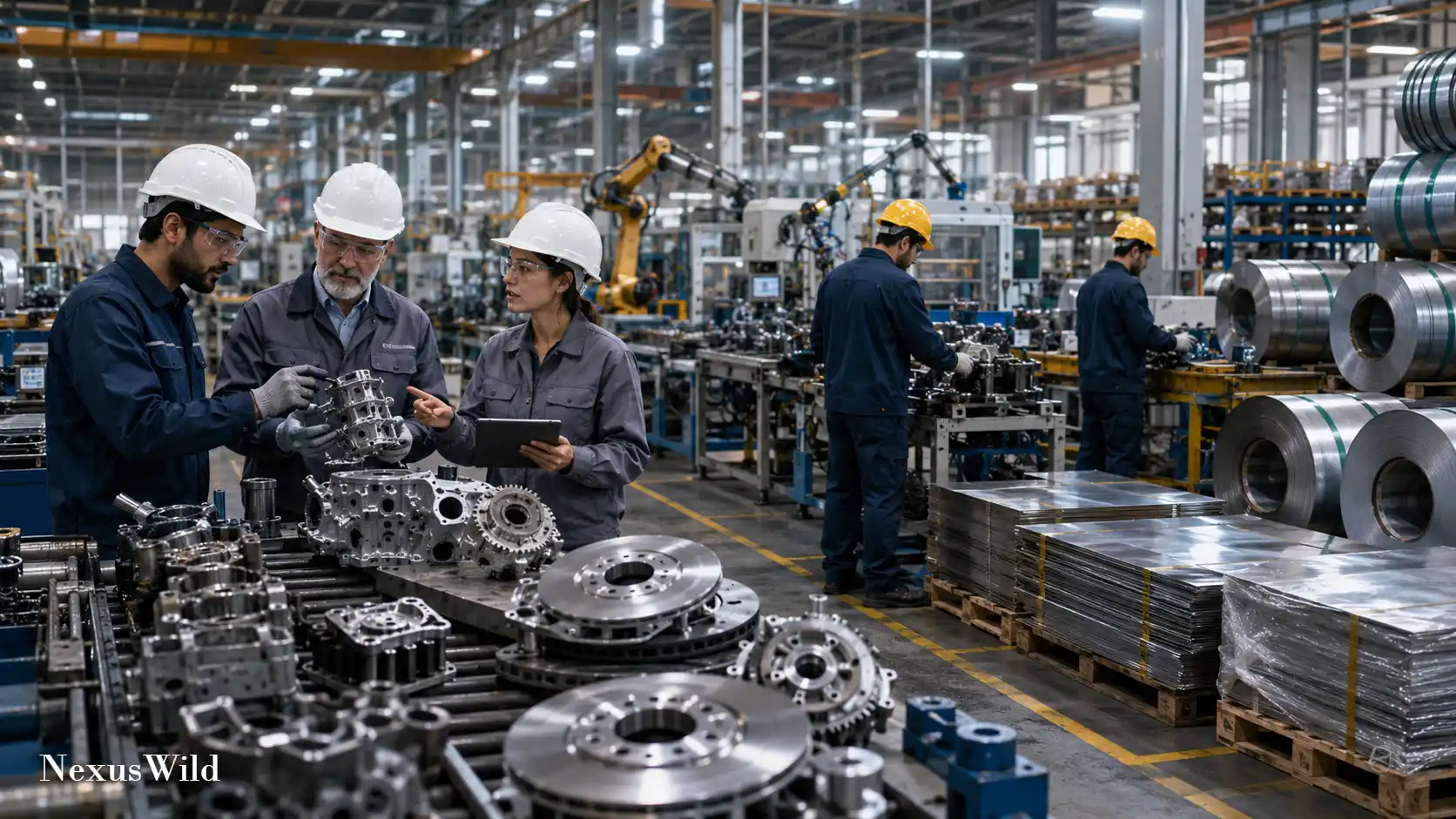
JLR sits at the centre of a dense industrial network of foundries, plastics companies, tooling specialists, electronics suppliers, engineering consultancies, logistics providers and service businesses. When the carmaker cuts spending, changes production schedules or delays programmes, the effects can move quickly through that network.
JLR’s problem is not one bad quarter
The scale of the restructuring becomes clearer when the latest financial numbers are placed in context.
For FY26, JLR reported revenue of £22.9 billion, down 20.9% year over year.
Profit before tax and exceptional items fell from £2.5 billion to £14 million.
Adjusted EBIT margin fell from 8.5% to 0.7%.
Loss after tax was £244 million, compared with a £1.8 billion profit a year earlier.
Free cash flow for the full year was negative £2.2 billion.
JLR said the year was hit by multiple headwinds, including U.S. tariffs, pressure in China, the planned wind-down of outgoing Jaguar models and production disruption following a cyber incident.
That combination is important.
A company can usually absorb one temporary shock if the underlying business remains strong.
JLR has been dealing with several at the same time.
Tariffs raise the cost of selling vehicles into important export markets.
Weakness in China affects one of the most important regions for global luxury cars.
A model transition can reduce volume before replacement products reach scale.
And a production shutdown creates immediate cash-flow pressure because fixed costs continue even when cars are not moving through factories.
The cyberattack exposed the cost of industrial downtime
The cyberattack that disrupted JLR in 2025 demonstrated how financially sensitive a modern automotive production system can be.
Production was paused for roughly four weeks.
The company later put the direct financial impact at around £200 million.
The problem spread beyond JLR’s own factories.
Suppliers built around predictable production schedules suddenly faced reduced orders, delayed cash flow and underused labour and equipment.
That is the structural risk now returning in a different form.
A cyberattack stops production suddenly.
A cost-reduction programme changes demand more gradually.
But both can leave suppliers carrying fixed costs against lower revenue.
The £1.7 billion savings target is about lowering the break-even point
JLR’s restructuring target is more meaningful than the headline number of job cuts.
Management wants to reduce the volume required for the company to break even toward 300,000 vehicles annually.
That is a classic industrial resilience strategy.
A manufacturer with a lower fixed-cost base can remain profitable at lower production volumes.
That matters when demand is volatile.
If fixed costs are too high, a modest decline in sales can produce a disproportionate decline in earnings.
JLR is therefore trying to make the business less sensitive to volume.
The £1.7 billion savings programme is intended to simplify the organisation, reduce overhead and improve the economics of the business before the next generation of products reaches scale.
The job cuts are one part of that effort.
Cost reduction does not mean JLR is stopping investment
The restructuring is taking place alongside one of the largest investment programmes in the company’s history.
JLR has said investment spending will remain around £18 billion over five years from FY24.
That money is being directed toward electrification, digital systems, advanced manufacturing and new products.
This creates a difficult financial balance.
The company needs to reduce operating costs while continuing to spend heavily on the technologies required to remain competitive.
That is not unusual in the automotive industry.
The transition to electric and software-defined vehicles requires enormous upfront investment before the financial return is clear.
Manufacturers therefore face two opposing pressures at once: cut the cost of the existing organisation while funding a more expensive future architecture.
Suppliers are exposed because automotive economics are interconnected
The most important risk sits outside JLR’s own payroll.
Modern car manufacturing is built around supplier specialization.
A single vehicle can require tens of thousands of individual parts.
JLR’s supply chain includes more than 700 companies involved in producing components and services for its vehicles.
Many suppliers have built factories, tooling and workforces around expected JLR volumes.
That creates concentration risk.
If a supplier receives a large percentage of revenue from one automaker, even a small production reduction at the customer can have an outsized impact on the supplier’s cash flow.
Unlike a large multinational manufacturer, smaller suppliers may not have enough liquidity to absorb months of weak demand.
The West Midlands is especially exposed
JLR is economically important far beyond its own employment numbers.
Oxford Economics estimated that the company supported £17.9 billion of UK economic activity in 2024 and around 199,000 jobs across the wider economy.
The West Midlands accounted for an estimated £8.7 billion of that contribution, equivalent to about 4.7% of the regional economy.
A further £1.1 billion of economic contribution was associated with the North West, where JLR operates its Halewood plant.
Those figures show why the restructuring matters regionally.
A large automotive company supports far more activity than appears on its own payroll.
Its spending supports component suppliers.
Supplier employees spend income locally.
Engineering firms win contracts.
Transport companies move parts.
Professional services companies support legal, financial, technology and compliance work.
When the anchor manufacturer weakens, the multiplier can work in reverse.
Some suppliers are already operating with thin buffers
The industrial base around JLR includes companies in metalforming, die casting, plastics, tooling and engineering.
These businesses often depend on expensive machinery that must keep running at high utilization rates.
A die-casting machine or injection-moulding line does not become cheap simply because demand falls.
The capital is already installed.
Energy still costs money.
Skilled workers must be retained if the business expects demand to recover.
That means suppliers can move from profit to loss quickly when order volumes fall.
One group of around 15 businesses supplying JLR represents roughly £2 billion of revenue and around 12,000 to 14,000 employees.
Their concern is not only the current restructuring.
It is whether UK vehicle production volumes remain high enough to justify future investment.
Investment confidence may matter more than the immediate job cuts
This is the deeper industrial problem.
A supplier deciding whether to spend £20 million on a new production line needs visibility.
It needs confidence that the customer will still require those parts five or ten years from now.
If production plans keep changing, model launches are delayed or plant utilization falls, the supplier may choose not to invest.
That creates a second-order effect.
Lower supplier investment means older machinery.
Older machinery can mean lower productivity.
Lower productivity raises unit costs.
Higher unit costs make UK manufacturing less competitive.
That can encourage more sourcing from overseas.
The result can become self-reinforcing.
The risk is therefore not simply that 4,000 JLR employees leave.
It is that uncertainty changes capital-allocation decisions across the supply chain.
China is changing the benchmark
Chinese automakers have become a major competitive pressure because they are forcing the global industry to compete on a different cost curve.
Many Chinese groups combine battery manufacturing, software, electronics, vehicle production and supply-chain control more tightly than traditional Western manufacturers.
That can reduce costs and shorten product-development cycles.
For a luxury producer such as JLR, the answer is not necessarily to become the cheapest manufacturer.
Its brands compete on design, performance, heritage and premium pricing.
But even luxury manufacturers need cost discipline.
If rivals can develop vehicles faster, source batteries more cheaply or integrate software more efficiently, the difference eventually appears in margins.
That is why JLR’s restructuring is as much about engineering economics as headcount.
U.S. tariffs complicate the recovery
The United States is one of the most important markets for high-value British vehicles.
Tariffs therefore matter more to JLR than they would to a manufacturer whose sales are concentrated domestically.
Higher import costs can be absorbed by the manufacturer, passed to consumers through higher prices or shared with dealers.
None of those options is painless.
Absorbing tariffs reduces margin.
Passing them through can weaken demand.
Sharing them reduces economics elsewhere in the distribution chain.
For a company already trying to restore profitability, trade friction raises the value of every pound saved elsewhere.
The first quarter showed improvement, but cash pressure remained
JLR’s first quarter of FY27 showed that the company was still profitable despite difficult conditions.
Profit after tax was £66 million.
But free cash flow was negative £998 million during the quarter.
Closing cash stood at £1.7 billion, while total liquidity was £5.9 billion, including undrawn credit and loan facilities.
The liquidity position means JLR is not operating without financial resources.
But the free-cash-flow number shows why management is focused on cost and capital efficiency.
A business can report accounting profit while still consuming cash.
For an automaker funding new platforms and electrification, sustained negative free cash flow would eventually become a constraint.
The supplier question is whether JLR can cut without hollowing out capability
The most difficult part of restructuring an industrial company is deciding what can be removed safely.
Corporate overhead can be simplified.
Management layers can be reduced.
Duplicate functions can be merged.
Processes can be automated.
But engineering knowledge and supplier capability can be harder to rebuild once lost.
A specialist toolmaker that closes does not reappear instantly when demand returns.
A veteran engineer who leaves the industry takes tacit knowledge with them.
A supplier that shifts production overseas may not bring it back.
That means the quality of cost reduction matters as much as the quantity.
JLR remains a strategically important UK manufacturer
JLR says it employs almost 40,000 people globally and describes itself as the UK’s largest automotive employer and largest investor in automotive research, development and engineering.
That position gives the company significance beyond its own financial statements.
It is part of Britain’s remaining high-value manufacturing infrastructure.
The company supports design, powertrain engineering, materials science, software, testing, manufacturing and advanced production skills.
The UK automotive question is therefore not simply whether JLR can survive a difficult cycle.
It is whether Britain can preserve enough scale across the entire ecosystem to keep advanced vehicle manufacturing economically viable.
The next two years will show whether the restructuring works
JLR’s plan is financially understandable.
A company that saw profit before tax fall from £2.5 billion to £14 million cannot ignore its cost base.
A company that generated negative £2.2 billion of free cash flow cannot treat efficiency as optional.
A company facing tariffs, Chinese competition, software investment and electrification cannot carry unnecessary structural cost indefinitely.
But restructuring can create its own risks.
If JLR succeeds, it will emerge with a lower break-even point, stronger cash generation and enough investment capacity to fund its new electric and digital product cycle.
If the process weakens suppliers, reduces engineering capability or damages confidence in future UK production, the savings could come with a larger industrial cost.
That is why the 4,000 job cuts matter beyond JLR.
The real story is about whether one of Britain’s most important manufacturers can become financially leaner without making the ecosystem around it structurally weaker.
Reader questions
Frequently asked questions
How many jobs is Jaguar Land Rover cutting?
JLR plans to reduce its global workforce by around 4,000 roles over the next two years.
Why is JLR cutting jobs?
The company is trying to lower structural costs, improve competitiveness and reduce the number of vehicles it needs to sell to break even amid weaker profits, tariffs, Chinese competition and major technology investment.
How much money does JLR want to save?
JLR is targeting around £1.7 billion of savings as part of its cost-reduction programme.
How profitable was JLR in FY26?
JLR reported £22.9 billion of FY26 revenue and £14 million of profit before tax and exceptional items, down sharply from £2.5 billion a year earlier.
What was JLR’s free cash flow in FY26?
Full-year free cash flow was negative £2.2 billion.
How important is JLR to the West Midlands?
Oxford Economics estimated JLR supported £8.7 billion of economic activity in the West Midlands in 2024, equivalent to about 4.7% of the regional economy.
Is JLR stopping investment because of the job cuts?
No. JLR has maintained plans for around £18 billion of investment over five years from FY24, including electrification, digital technologies and new products.
Nexuswild welcomes factual corrections. Email [email protected] with evidence and the article URL.