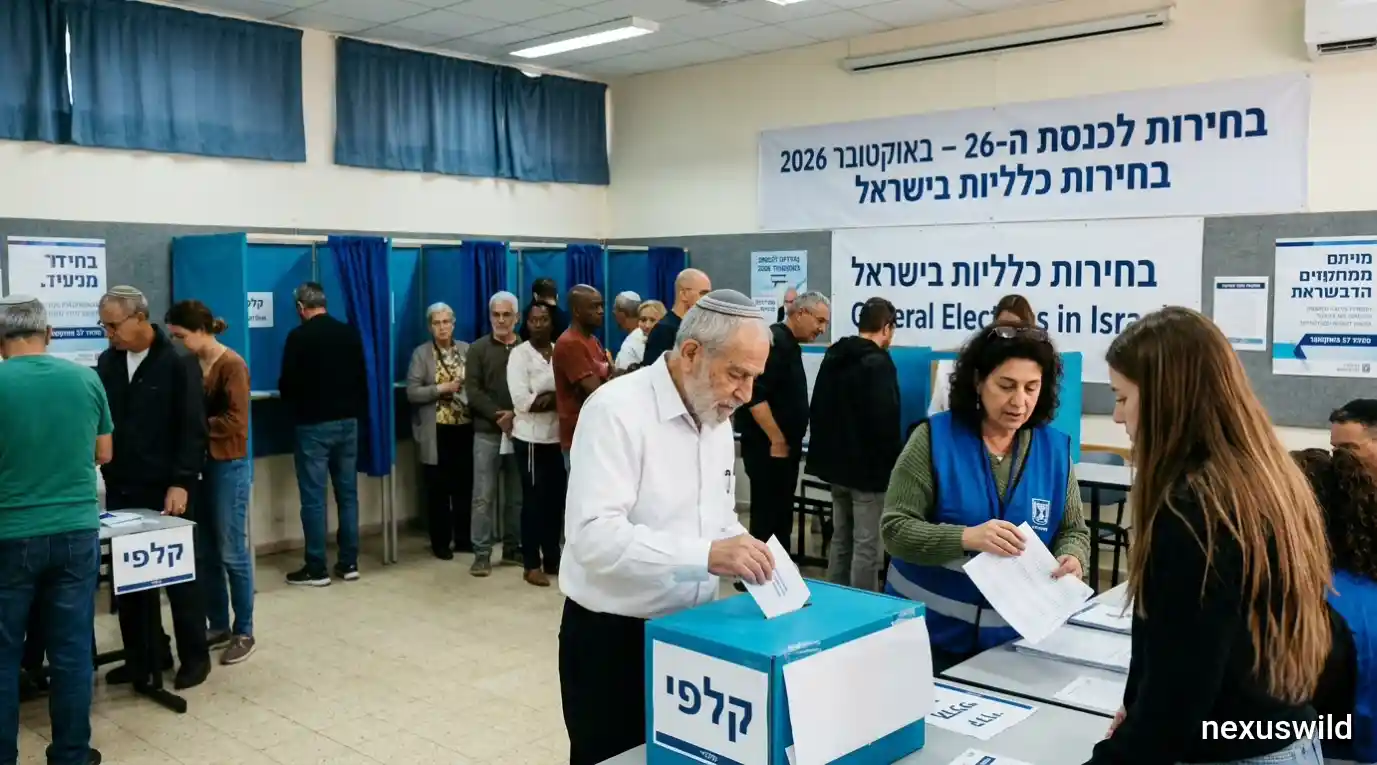

Israelis went to the polls on October 27 in a closely contested general election that could determine whether Prime Minister Benjamin Netanyahu remains in office or a rival bloc can assemble a governing majority. The vote is the country’s first national election since the Hamas-led attacks of October 7, 2023, and the subsequent wars and security crises that have reshaped Israeli politics.
Early participation was unusually strong. Israel’s Central Elections Committee reported that turnout had reached 44.9% by 2 p.m. local time, the highest rate recorded by that point in an election. The figure compared with 38.9% at the same time during the 2022 election, according to reporting by The Times of Israel.
The election pits Netanyahu’s Likud party and its right-wing and religious allies against opposition forces led by former military chief Gadi Eisenkot, who heads the centrist Yashar party. Pre-election polling suggested a tight contest, with neither side assured of the 61 seats required to command a majority in the 120-member Knesset.
The final result will depend not only on which parties receive the most votes, but also on how the seats are distributed and whether competing political groups can negotiate a workable coalition.
Early turnout reaches a record level
The high participation rate became one of the defining developments of election day. By 2 p.m., 44.9% of eligible voters had cast ballots, according to the Central Elections Committee. The committee said at least three million people had voted by that point.
Turnout was also elevated in some Arab-majority communities and among military personnel, although participation varied substantially by locality. The Times of Israel reported that Rahat recorded 39.9% turnout by noon, while turnout among Israeli soldiers stood at 48% by 1 p.m., according to the military.
These figures provide a snapshot rather than a final national turnout rate. Participation can change considerably during the evening, and local figures should not be treated as representative of the entire electorate.
High turnout also does not automatically indicate which side is benefiting. The political effect depends on the preferences of people who vote, where turnout increases, and how votes are distributed among parties that must clear Israel’s electoral threshold.
The Central Elections Committee remains responsible for overseeing the process and publishing official figures. Until polling concludes and the count progresses, claims about the final turnout or the election’s winner remain premature.
Netanyahu faces a serious political challenge
Netanyahu, Israel’s longest-serving prime minister, entered the election seeking another term after a period marked by the October 7 security failures, prolonged conflict and growing domestic disagreement over the government’s policies.
The campaign has been shaped by arguments over national security, accountability for the 2023 attacks, military service exemptions for ultra-Orthodox men, the handling of the wars and Israel’s international standing. Netanyahu has defended his record on security and emphasized his relationship with US President Donald Trump.
The prime minister’s political position remains complicated. His Likud party and its allies have a committed base, but pre-election polls suggested that the governing bloc could struggle to retain a parliamentary majority. The campaign also took place against the backdrop of Netanyahu’s ongoing corruption trial and criticism of the government’s handling of national security.
A loss of seats would not necessarily remove Netanyahu immediately. Israel’s parliamentary system requires a government to be formed through coalition negotiations, and the largest party does not automatically secure the right to govern if another combination can command a majority.
Gadi Eisenkot leads a centrist challenge
Eisenkot, a former chief of staff of the Israel Defense Forces, has emerged as Netanyahu’s principal rival in the contest. His Yashar party is part of a wider opposition landscape that includes other parties with different political priorities.
Eisenkot has presented himself as a security-focused alternative, arguing that Israel needs a change in leadership and a different approach to governance following the October 7 attacks and subsequent conflicts. His military background is central to his political identity, although his positions on security and the Palestinians do not represent a complete break from the existing political consensus.
The opposition is not a single unified party. Its potential governing strength depends on the number of seats won by Yashar and other parties, including groups led by Naftali Bennett, Yair Lapid, Avigdor Lieberman and Yair Golan.
These parties share an interest in replacing Netanyahu but differ on policy and the terms of a future coalition. Those differences could complicate efforts to turn an electoral challenge into a stable government.
Why 61 seats matter
Israel elects its 120-member Knesset through proportional representation. Parties receive seats according to their share of the vote, provided they pass the national electoral threshold of 3.25%.
A coalition needs the support of at least 61 lawmakers to command a majority in the Knesset. Because votes are divided among multiple parties, the election does not simply determine a single winner in the way a presidential election might.
Smaller parties can therefore have an outsized influence on government formation. A party with only a limited number of seats may become essential if larger blocs fall short of a majority.
Arab-led parties, including Ra’am and the Joint List, could affect the arithmetic if the major blocs are unable to secure sufficient support elsewhere. However, the potential for cooperation is politically constrained. Eisenkot has said that Ra’am would not be part of a government he leads, while mainstream Zionist opposition parties have generally resisted formal coalition partnerships with Arab factions.
The final seat distribution will determine whether these parties can influence a government from within a coalition, provide external support or remain outside the governing arrangement.
What a parliamentary deadlock could mean
If neither bloc can assemble 61 seats, Israel could face prolonged negotiations over the composition and priorities of a new government. Political leaders would need to reconcile differences over security policy, military service, budgets, judicial and governance issues, and relations with regional and international partners.
A prolonged period without a stable coalition could complicate the passage of the 2027 national budget and delay some policy decisions. It could also create uncertainty for businesses and investors who depend on predictable fiscal and regulatory policies.
Financial-market effects are possible, but they should not be assumed in advance. Israeli bond yields, the shekel and local equities respond to several factors, including interest-rate expectations, security developments, global financial conditions and fiscal policy. The election alone cannot explain every market movement.
The result could also influence Israel’s approach to regional security, relations with the United States and other partners, and policy toward Gaza and the occupied West Bank. However, the precise consequences would depend on the parties that ultimately form the government and the agreements they reach.
What happens after polling closes
Polling stations are scheduled to close at 10 p.m. local time, although voting can continue for people still waiting in line. Exit polls are expected after closing, while official results will be published as the count progresses.
Israel’s Central Elections Committee has indicated that final results are expected to be published in the official record by November 4, 2026. Preliminary figures may change as additional ballots are counted and verified.
If no bloc has a clear majority, President Isaac Herzog will consult party leaders and assign the task of forming a government to the candidate considered most likely to succeed. The candidate can have up to six weeks to form a coalition, with a possible extension under the applicable process. If efforts fail, another candidate may be asked to try; a continuing deadlock could eventually lead to another election.
For now, the high early turnout and tight pre-election contest point to a consequential vote, but they do not establish who will govern. The decisive questions are the final seat distribution, the willingness of parties to cooperate and whether a coalition can command a stable majority in the Knesset.
Nexuswild welcomes factual corrections. Email contact@nexuswild.com with evidence and the article URL.