
MUNNAR, Sept. 11, 2026 - Neelakurinji looks like a miracle because humans experience it as a sudden event.
For most of its life, however, nothing dramatic is visible.
A Neelakurinji plant can spend years as a modest green shrub in the high-elevation grasslands of the Western Ghats. It grows, stores energy, survives seasonal change and remains almost anonymous among grasses and shola vegetation.
Then, in the final phase of its life, the strategy changes completely.
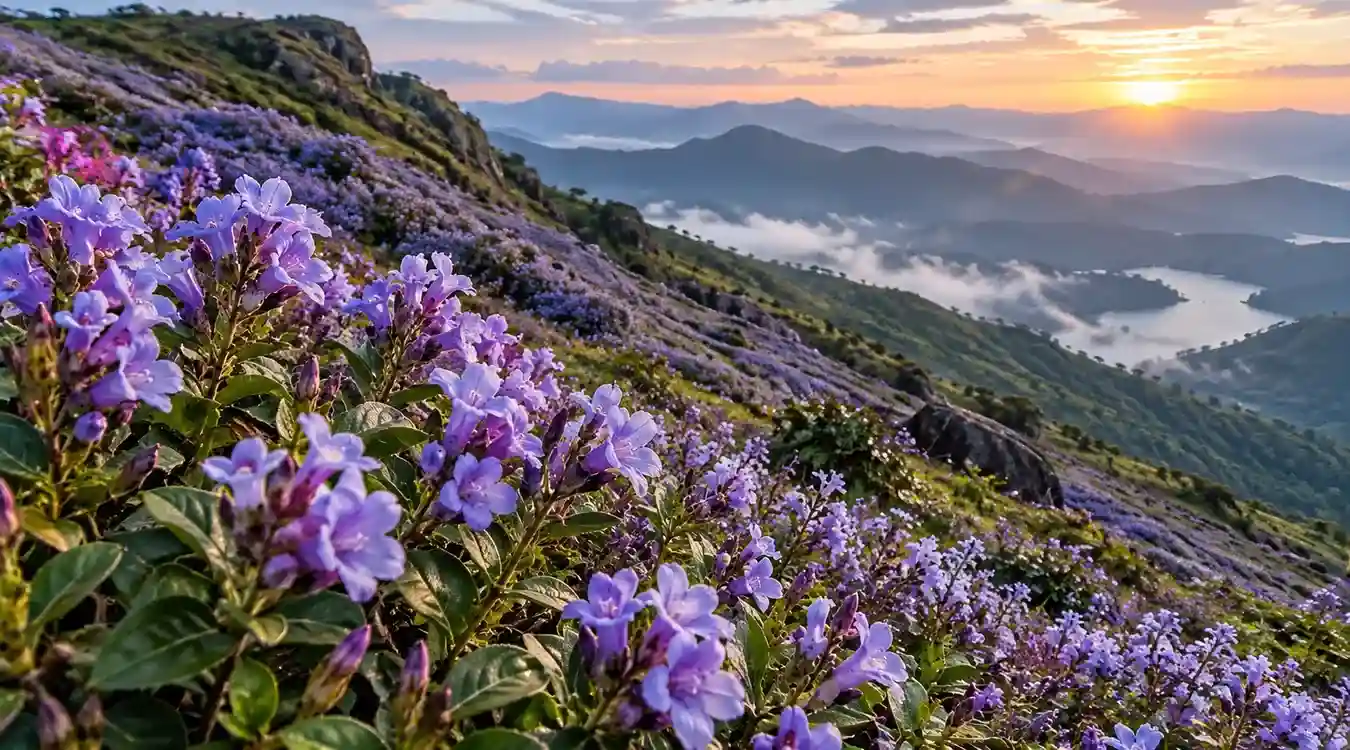
Thousands or millions of plants in the same population can flower within the same season. Hillsides that were green become blue-violet. Bees and other flower visitors arrive in large numbers. Pollination is followed by fruit and seed production. Then the parent plants die.
The next generation begins from seed.
That sequence is the key to understanding Neelakurinji.
Its scientific name is Strobilanthes kunthiana. It belongs to the Acanthaceae family and is best known for populations that follow a roughly 12-year synchronized flowering cycle.
The familiar statement that Neelakurinji “blooms once every 12 years” is broadly correct, but incomplete.
It does not mean every Neelakurinji plant across the Western Ghats flowers in the same calendar year.
Different populations can be synchronized to different 12-year schedules.
That explains why parts of the Munnar region are flowering in 2026 even though another famous Munnar population flowered in 2018 and is associated with a 2030 cycle.
Why the 2026 bloom matters
Kerala Tourism has documented a distinct population around the Mattupetty-Kannimala region that flowered in 1990, 2002 and 2014.
Twelve years after 2014 comes 2026.
This population follows a different calendar from the widely remembered 2018 mass flowering in other parts of the Munnar landscape.
In September 2026, flowering has been reported around Chokramudi and the Mattupetty-Korandakkad hills.
The important biological idea is population synchronization.
A local population can keep its own multi-year rhythm even while another population of the same species nearby is several years ahead or behind.
So the correct question is not simply, “When does Neelakurinji bloom?”
It is, “Which population, in which place, on which cycle?”
What exactly is Neelakurinji?
Neelakurinji is a perennial shrub of montane habitats in southern India.
Kew Science records Strobilanthes kunthiana from Kerala and Tamil Nadu and notes its occurrence on high slopes and ravines, especially above about 1,800 metres.
Botanical literature associates it strongly with the high-altitude grassland and shola systems of the Western Ghats.
A typical plant is relatively small, often around 30 to 60 centimetres tall, although individuals can become much larger under favourable conditions.
The flowers are usually described as pale blue, lilac, mauve or blue-violet.
One individual flower is attractive.
The global fame of Neelakurinji comes from scale.
When a synchronized population flowers together, the colour of an entire hillside can change.
The life cycle in one sentence
Neelakurinji spends many years growing vegetatively, flowers and reproduces once in a synchronized event, produces seeds, and then the parent plant dies.
Botanists describe this strategy with terms such as monocarpic or semelparous.
Monocarpic means a plant flowers and fruits once before dying.
Semelparous is the broader biological term for an organism that makes one major reproductive investment in its lifetime.
For plants that spend multiple years growing before synchronized mass flowering, the term plietesial is also used.
Neelakurinji is one of the best-known examples.
Stage 1: Seeds begin the next generation
The cycle starts after the previous generation has finished flowering.
Pollinated flowers develop into dry capsules.
Scientific reviews report that the capsules mature and open roughly one or two months after flowering.
Seeds are then released into the grassland environment.
This stage is less visually impressive than the bloom, but it is biologically more important.
A plant trampled, uprooted or cut before seed production may lose its only opportunity to reproduce.
That is why protecting flowering patches matters for the next generation, not just for tourism.
Stage 2: Germination
After seeds reach the soil, regeneration depends on the environment.
Moisture, soil condition, temperature, competition, grazing, insects and disturbance all affect survival.
Research reviews describe large numbers of seedlings emerging under suitable conditions after rain, followed by natural losses as young plants face predators, competition and weather.
Producing many seeds does not mean every seed becomes an adult shrub.
Mass reproduction creates opportunity.
Habitat conditions decide how many survive.
Stage 3: Years of vegetative growth
For most of its life, Neelakurinji does not flower.
It invests in roots, stems, leaves and stored energy.
This is the vegetative phase.
In a 12-year population, this quiet stage occupies most of the plant’s life.
From a human perspective the plant appears to be waiting.
Biologically, it is growing and preparing for a single reproductive event.
The spectacular flowering season may last only weeks.
The biological preparation takes years.
Stage 4: Reproductive maturity arrives together
The next remarkable step is synchronization.
Plants across the same population enter the flowering phase within the same season.
This is called gregarious or synchronized flowering.
Why would a plant evolve this strategy?
Several explanations are biologically plausible.
Mass flowering attracts large numbers of pollinators.
It increases the chance of pollen transfer between plants.
Mass seed production can overwhelm seed predators, allowing some seeds to escape consumption.
Long vegetative growth also allows the plant to accumulate resources for a very large reproductive effort.
But scientists still do not have a complete molecular explanation for how Neelakurinji measures such a long interval and coordinates flowering so precisely.
The 12-year pattern is well documented.
The exact internal timing mechanism remains partly unresolved.
Stage 5: Flowers open during a concentrated season
Research on Neelakurinji floral biology shows that flowers open in the morning and can remain functional into a second day before senescing.
The flowers are hermaphroditic, meaning each flower contains male and female reproductive structures.
The flower arrangement supports insect pollination, especially by bees.
Studies have found that viable pollen remains available into the second day, giving the flower another opportunity to be pollinated if the first day is unsuccessful.
At landscape scale, this creates an ecological pulse.
A hillside filled with thousands of flowering shrubs becomes a temporary concentration of nectar and pollen.
Why bees matter
Bees are important visitors to Neelakurinji flowers.
They move pollen between flowers and help successful fertilization.
The bloom therefore supports more than tourism.
It briefly reorganizes local food availability for pollinating insects.
The flowering season is also associated with rare seasonal honey sometimes called Kurinji honey.
Claims about extraordinary medicinal benefits should be treated cautiously unless supported by strong clinical evidence.
The ecological relationship between bees and flowering Neelakurinji is important without exaggerated health claims.
Stage 6: Flowers become fruit
After successful fertilization, the plant redirects resources into fruit and seed development.
For a semelparous species, this is the final reproductive investment.
The plant has spent years building the biological capacity to reproduce.
Now it spends that stored capital.
That is why Neelakurinji does not behave like an annual garden flower that blooms repeatedly.
Its strategy is concentrated reproduction.
Stage 7: Seed capsules mature
After flowering, the fruits mature into capsules.
These capsules eventually open and release seeds into the surrounding habitat.
The famous blue-violet landscape begins to fade.
Visitors may see the hills turn dry or brown as flowering ends.
That does not mean the life cycle has failed.
The parent generation is ending.
The next generation is entering the soil.
Stage 8: The parent plant dies
After seed production, the individual plant dies.
This mass senescence is a normal part of Neelakurinji biology.
It is not usually a sign of disease.
The species is monocarpic.
One generation invests heavily in one reproductive episode and then disappears.
Seedlings and surrounding grassland vegetation gradually occupy the space.
The next cycle starts.
A simplified 12-year model
The life cycle can be visualized like this:
Year 0: Seeds are released after the previous flowering generation reproduces.
Year 1: Seeds germinate when conditions are suitable. Many seedlings do not survive.
Years 2 to 10: Surviving plants remain in vegetative growth, building roots, stems, leaves and stored resources.
Year 11: Plants approach reproductive maturity.
Year 12: A synchronized population enters mass flowering.
Weeks later: Pollination occurs and fruits begin to form.
One to two months later: Seed capsules mature and release seeds.
After reproduction: The parent plants senesce and die.
This is a simplified model.
Real populations show local variation, and some plants can flower before or after the main synchronized year.
Why wait 12 years?
The honest scientific answer is that no single mechanism has been proven to explain every part of the timing system.
Several factors may contribute.
Long growth allows energy accumulation.
Synchronous flowering can increase pollinator attraction.
Mass seed production can reduce the proportion of seed lost to predators.
Seasonal signals such as day length, temperature and rainfall may interact with developmental mechanisms inside the plant.
But the full biological clock remains an open research question.
That is one reason the species is so fascinating.
Scientists know the pattern far better than they understand the complete mechanism.
Does every plant flower exactly on schedule?
No.
Nature is not a mechanical stopwatch.
Botanical records show some flowering in years before and after a major event.
Small patches can also flower outside the most famous bloom year.
There is another complication.
The genus Strobilanthes contains many species, and different species can have different flowering intervals.
So a report of “Kurinji” flowers outside a major Neelakurinji year may involve a different population, a different species or scattered individuals.
Correct identification matters.
Why 2026 and 2030 can both be correct
This is one of the most important facts about Neelakurinji.
Kerala Tourism records the Mattupetty-Kannimala population blooming in 1990, 2002 and 2014.
That sequence points to 2026.
A separate widely known sequence includes large flowering events in 1982, 1994, 2006 and 2018.
That sequence points toward 2030.
Both can be correct because local populations can be internally synchronized without being synchronized with every other population.
A headline saying “the next Neelakurinji bloom is 2030” can be correct for one major population and misleading if applied to all of Munnar or the Western Ghats.
Where does Neelakurinji live?
Neelakurinji is associated with high-elevation landscapes of the southern Western Ghats.
Its habitat includes montane grasslands, slopes, ravines and the margins of shola forests.
These ecosystems are biologically rich and hydrologically important.
They support many specialized plants and animals adapted to cool, wet mountain conditions.
Protecting Neelakurinji therefore means protecting an ecosystem, not simply a photogenic flower.
Why habitat disturbance is dangerous
A species that reproduces only once has a special vulnerability.
If habitat is destroyed years before flowering, the population cannot simply reproduce the following season.
If flowering plants are trampled during the reproductive year, the damage occurs at their only major chance to produce seed.
If the new seedlings are lost after germination, another long cycle may be needed before the population recovers.
Plantations, construction, roads, invasive species, uncontrolled tourism, fire, grazing and trampling can all affect regeneration.
The long cycle magnifies the cost of disturbance.
Kurinjimala and conservation
Kerala created Kurinjimala Sanctuary to protect important Neelakurinji habitat around Kottakamboor and Vattavada in Idukki district.
The logic of conservation extends beyond flowering years.
A green, non-flowering Neelakurinji shrub is the same biological individual that may create the famous blue landscape years later.
If the quiet phase is destroyed, the future bloom is also destroyed.
Tourism can help and harm
Mass flowering brings visitors, guides, transport activity and tourism income.
It can also place pressure on fragile mountain habitats.
Visitors walking into flower patches can damage shrubs.
Plucking flowers removes reproductive tissue.
Litter and off-trail movement can disturb the habitat.
The responsible approach is simple.
Stay on designated routes.
Do not pluck flowers.
Do not stand inside flowering patches.
Follow forest access rules.
Avoid litter.
Treat the bloom as a living reproductive event, not as a decorative background.
Why the colour looks blue, purple or violet
Neelakurinji is associated with the colour blue, but different photographs can look violet, lilac or purple.
Flower age, light, weather, camera processing and flower density all affect appearance.
The surrounding green vegetation, mist and brown stems also influence the landscape colour.
So descriptions of blue, violet and purple hills are not necessarily contradictory.
They are different views of the same mass-flowering phenomenon.
A plant that changes how we think about time
Humans tend to understand nature through annual seasons.
Neelakurinji works on another scale.
One generation can spend roughly a decade preparing for a few weeks of reproductive intensity.
The flowering is not the beginning of the story.
It is the climax.
The real story began when the previous generation released seeds years earlier.
Seeing a Neelakurinji bloom therefore means witnessing the final reproductive stage of a generation.
The scientific takeaway
Neelakurinji does not simply sleep for 12 years and suddenly wake up.
It remains alive and grows through the interval.
The unusual feature is the timing of reproduction.
A synchronized population spends years in vegetative growth, reaches reproductive maturity, flowers massively, is pollinated, produces seeds and then dies.
The next generation restarts the cycle.
Different populations can follow different 12-year calendars, which is why flowering in 2026 and another major cycle associated with 2030 are not contradictory.
The exact biological mechanism behind the long synchronization is still not fully solved.
That uncertainty makes Neelakurinji even more extraordinary.
For a few weeks, the Western Ghats display the answer in colour.
For the remaining years, the science continues quietly in green.
Reader questions
Frequently asked questions
Why does Neelakurinji bloom once in 12 years?
Populations spend most of their life in vegetative growth before entering a synchronized reproductive phase. The 12-year pattern is well documented, but the complete molecular mechanism controlling the long-term synchronization is still not fully understood.
Does Neelakurinji die after flowering?
Yes. It is monocarpic or semelparous. After flowering, pollination, fruiting and seed production, the parent plant senesces and dies.
What happens after the flowers fade?
Successful flowers form seed capsules. The capsules mature and release seeds that can germinate under suitable conditions and establish the next generation.
Why can Neelakurinji flower in 2026 if another bloom is expected in 2030?
Different populations can follow separate synchronized 12-year calendars. Kerala Tourism records a Mattupetty-Kannimala cycle for 1990, 2002, 2014 and 2026, while another major Munnar population flowered in 2018 and is associated with 2030.
Where does Neelakurinji grow?
It is associated mainly with high-elevation grasslands, slopes, ravines and shola landscapes of the southern Western Ghats.
Nexuswild welcomes factual corrections. Email [email protected] with evidence and the article URL.