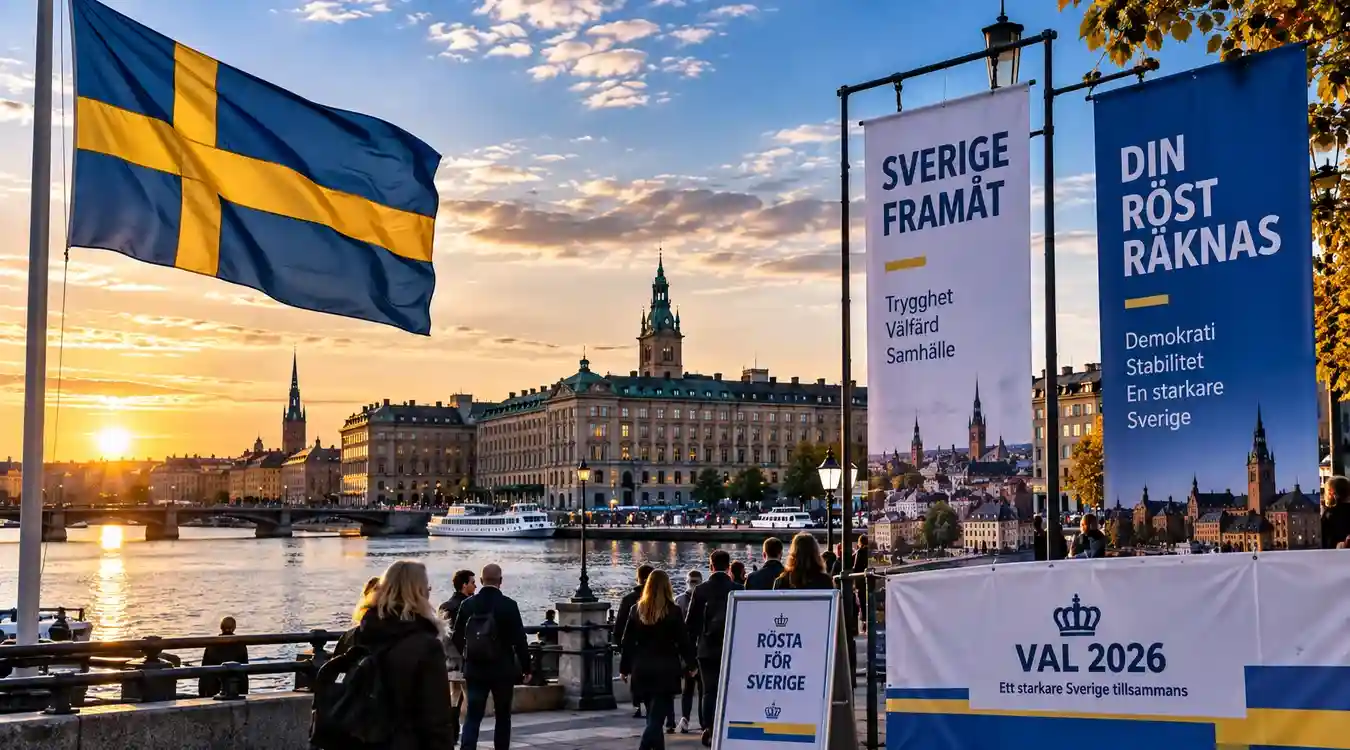

STOCKHOLM - Sweden heads to the polls on Sunday, September 13, 2026, in a general election that will decide not only who governs the country but how far the Sweden Democrats, the nationalist party that has shaped policy from outside government since 2022, can push their way into it.
Voters will elect all 349 members of the Riksdag, along with 21 regional councils and 290 municipal councils, in elections held simultaneously on a fixed date set by law. A party or bloc needs 175 seats for a majority. The contest pits Prime Minister Ulf Kristersson's governing coalition of Moderates, Christian Democrats and Liberals - backed in parliament by the Sweden Democrats - against a Social Democrat-led opposition under former Prime Minister Magdalena Andersson.
Where the Parties Stand
Polling in the final weeks has shown the four-party, red-green opposition bloc with a narrow but fairly consistent lead over Kristersson's governing "Tidö parties," so named after the manor house where they struck their 2022 cooperation deal. Late-campaign surveys from pollsters such as Verian, Demoskop, Infostat and Novus showed the opposition ahead by roughly three to eight points, though a mid-August Demoskop poll indicated the gap had narrowed compared with June.
Within those totals, the Social Democrats have polled consistently as Sweden's largest single party, generally in the high-20s to low-30s percentage range. The Sweden Democrats have polled in the high teens, at times running close behind or ahead of Kristersson's Moderates, who have struggled to regain the ground they lost when the Sweden Democrats overtook them as the largest party on the right in 2022. The Left Party, Centre Party, Christian Democrats and Greens have each polled in the mid-single digits to around 7%, while the junior coalition Liberals have repeatedly polled near or below the 4% threshold required to win Riksdag seats, raising the prospect that Kristersson's coalition could lose a member party outright.
The Sweden Democrats' Push for Power
The starkest change from 2022 is the openness with which the Sweden Democrats, led by Jimmie Åkesson, are campaigning for formal ministerial posts rather than the outside "confidence and supply" role they have played since the Tidö Agreement. In a Sveriges Radio interview, Åkesson said that if the governing bloc wins, ministerial posts should be distributed roughly in proportion to each party's vote share - which, based on current polling, could give the Sweden Democrats somewhere in the range of 12 to 14 of the government's 24 ministerial posts. He named finance, foreign affairs, justice, defence and, above all, migration as portfolios of particular interest, though he said he is not seeking the premiership itself.
Kristersson has publicly rejected that scale of demand. Responding to a question from Swedish broadcaster SVT about whether a future government could include 12 Sweden Democrat ministers, he said it could not, adding that ministerial and policy negotiations happen after an election is won, not before it. He has said the cabinet would remain at 24 ministers. Andersson, for her part, has repeatedly invoked the prospect of "12 Sweden Democrat ministers" on the campaign trail as a warning to voters about what a Kristersson win could bring.
Two Blocs, Two Candidates for Prime Minister
Andersson, who briefly served as prime minister in 2021–22 before losing power in 2022, is seeking to return to the post at the head of a Social Democrat-led government, though she has also signaled a wish to cooperate across bloc lines on some issues regardless of the outcome. Kristersson is seeking a second term after leading Sweden's first coalition dependent on Sweden Democrat support in the Riksdag. Neither the Left Party nor the Centre Party has committed to entering government with the other side, and coalition-building on the left has been complicated at times by public friction between Andersson and her smaller potential partners over strategy.
What Voters Are Weighing
Healthcare has emerged as the single dominant concern this cycle, cited by a majority of respondents in a recent SVT/Verian survey, alongside ongoing anxiety over gang-related crime, schools, and eldercare. Analysts note a shift from 2022, when law-and-order and energy prices topped the agenda almost unchallenged: with fuel prices and reported crime rates both down from their 2022 peaks, those issues have receded somewhat, while strains on healthcare, welfare services and living costs have moved to the fore.
Energy policy - including the government's pivot from renewables toward nuclear power - and Sweden's post-2024 status as a full NATO member also feature, alongside continuing debate over the citizenship, asylum and deportation rules tightened under the Tidö Agreement, some of which took effect as recently as June 2026.
The Sweden Democrats have campaigned on reducing asylum migration to what they describe as the lowest level in Europe, expanding deportation powers, and keeping fuel and energy costs down. The Moderates are running on tax cuts, continued anti-crime measures and shorter healthcare waiting times. The Social Democrats are proposing expanded welfare spending, including universal dental care, while broadly retaining the stricter migration posture adopted since 2015. The Left Party has proposed a windfall tax on high earners to fund public services.
How the Landscape Has Shifted Since 2022
The most consequential change since the last election is institutional rather than electoral: the Tidö Agreement gave the Sweden Democrats an office inside the Government Offices allowing the party to influence legislation and budgets and access briefings normally reserved for ministers, despite sitting outside the cabinet. That arrangement is what Åkesson is now seeking to convert into formal government positions. Sweden also joined NATO in 2024, ending a long tradition of military non-alignment, a shift that has removed alliance membership itself as a point of major contention between the main blocs.
What Different Outcomes Could Mean
A Social Democrat-led win would likely see a Andersson government revisit some of the more contested Tidö-era proposals, such as plans to curtail permanent residency permits, while leaving Sweden's post-2015 restrictive migration framework, NATO membership and defence spending commitments largely intact. A continuation of Kristersson's government would turn on how much ground he cedes to Åkesson in post-election coalition talks. On EU matters, Sweden has positioned itself among the bloc's "frugal" net-contributor states resisting a larger long-term EU budget, a stance that analysts expect to persist regardless of which bloc wins.
Official results are expected to be finalized in the days following the vote, with final counts, including postal and overseas ballots, typically confirmed about a week after polling day under Swedish election procedure.
Further reading and useful links
Reader questions
Frequently asked questions
When is the 2026 Swedish general election?
The Swedish general election will be held on Sunday, September 13, 2026.
Who are the main candidates for Prime Minister of Sweden?
The two primary candidates are incumbent Prime Minister Ulf Kristersson, leader of the Moderate Party, and former Prime Minister Magdalena Andersson, leader of the Social Democrats.
What is the role of the Sweden Democrats in this election?
The far-right Sweden Democrats currently support the center-right government from the outside. For the 2026 election, their leader, Jimmie Åkesson, is demanding formal cabinet positions (ministerial roles) if the right-wing bloc wins a majority.
Nexuswild welcomes factual corrections. Email [email protected] with evidence and the article URL.