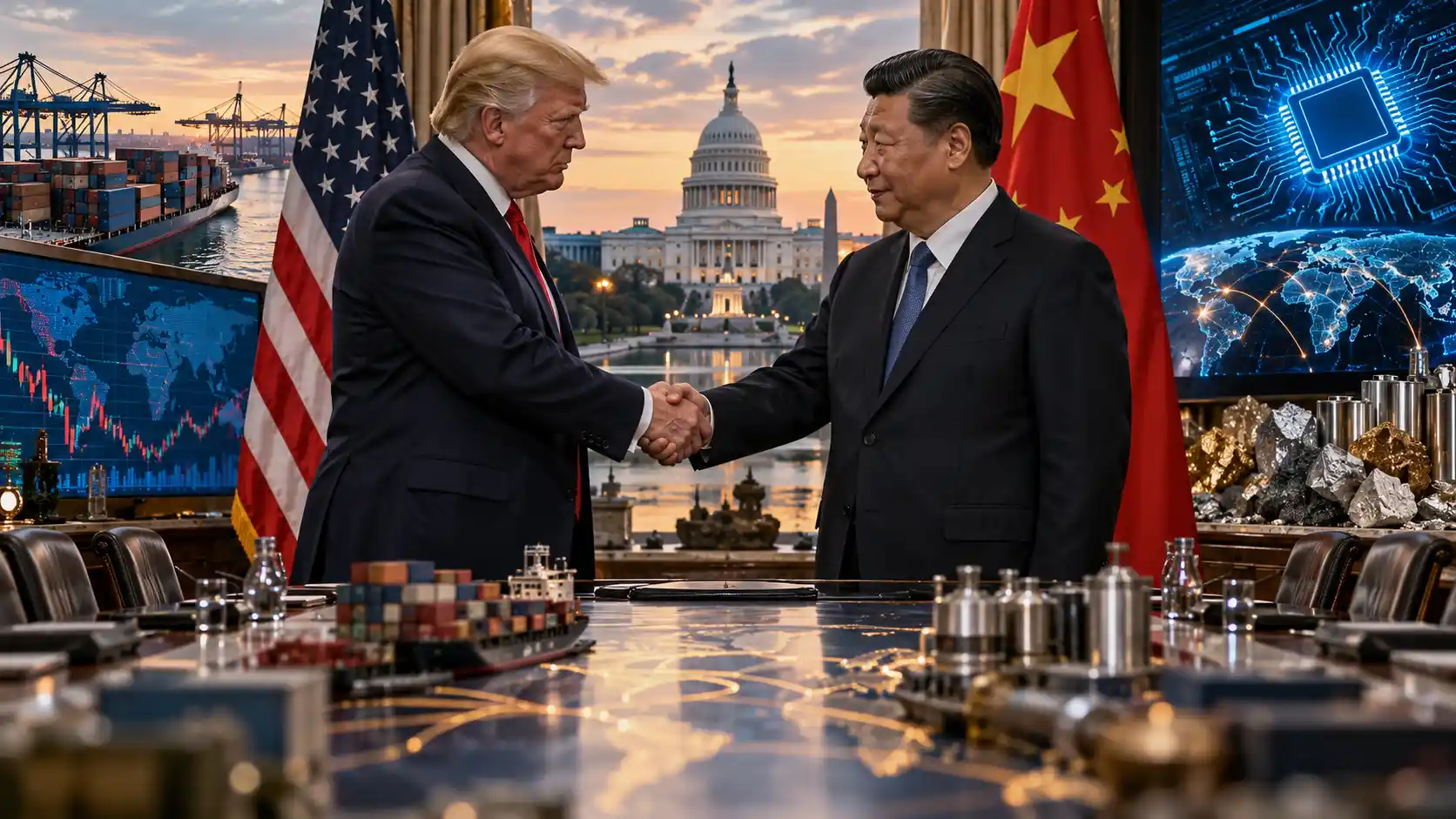

WASHINGTON, Sept. 24, 2026 - President Donald Trump is hosting Chinese President Xi Jinping in Washington for a state visit that places the world’s two largest economies back at the same negotiating table while trade, artificial intelligence, critical minerals, agriculture and industrial policy are increasingly linked.
Xi arrived at Joint Base Andrews on September 23 for a September 23-25 visit. The White House scheduled the formal state program for September 24. As of publication, no final joint economic readout or new summit agreement had been released.
That distinction is essential.
The immediate question is not what the two governments have agreed today, because that remains unresolved publicly. It is what is economically at stake if Washington and Beijing change policy in sectors already under negotiation.
U.S.-China decisions can affect semiconductor supply, electric vehicles, aircraft manufacturing, farm exports, AI infrastructure, rare-earth processing, battery materials and the cost of capital for companies exposed to either market.
The starting point is the May 2026 framework
The September visit builds on understandings reached during Trump’s trip to China in May 2026.
The White House said the two governments created a U.S.-China Board of Trade and a U.S.-China Board of Investment to manage commercial and investment issues.
China also agreed to address U.S. concerns over rare-earth and critical-mineral supply shortages, including issues involving yttrium, scandium, neodymium and indium.
The White House also announced that China had approved an initial purchase of 200 U.S.-made commercial aircraft for Chinese airlines and committed to buy at least $17 billion per year of U.S. agricultural products in 2026, 2027 and 2028, in addition to earlier soybean commitments.
Those measures did not remove the broader structure of strategic competition.
Existing U.S. Section 301 tariffs on Chinese products still range from 7.5% to 100%, depending on product category, and strategic sectors remain subject to particularly restrictive treatment.
Trade is now about industrial systems, not only goods flows
The current U.S.-China economic dispute reaches far beyond the bilateral trade balance.
Governments increasingly treat technology, manufacturing capacity, supply-chain resilience and national security as connected questions.
A tariff on an electric vehicle can influence battery investment, component sourcing and factory location.
An export restriction on advanced computing hardware can affect AI development, data-centre design and cloud infrastructure.
A restriction involving rare-earth processing can affect electric motors, aerospace systems, defence manufacturing and renewable-energy equipment.
That is why a leader-level meeting can matter across industries even when only a few formal policy changes are announced.
Semiconductors remain the hardest technology issue
The semiconductor relationship remains structurally constrained.
The United States maintains a 50% Section 301 tariff on specified semiconductor imports from China, while advanced-computing and semiconductor-manufacturing technologies remain subject to export-control rules.
China has simultaneously made semiconductor self-sufficiency a major industrial priority.
This creates a distinction that matters for businesses.
The two countries can expand trade in non-sensitive goods without automatically resolving the advanced-chip dispute.
A broader commercial agreement would therefore not necessarily mean restrictions on frontier computing or semiconductor-manufacturing technology had been relaxed.
No such September 24 relaxation had been officially announced at publication.
AI has become a direct diplomatic issue
Artificial intelligence is no longer discussed only through chips.
Chinese government reporting on U.S.-China economic consultations held in New York on September 20 said the two sides held dialogues on AI-related issues.
That gives AI its own place in bilateral economic diplomacy.
Possible areas of discussion can include safety, incidents, standards, market access and the relationship between frontier AI systems and national security, although no final September 24 framework had been released at publication.
The economic consequences are wide.
AI infrastructure depends on accelerators, memory, networking, electricity, data centres, cloud platforms and software.
Any policy change affecting computing access can alter capital spending across that chain.
Rare earths may be the most consequential supply-chain issue
Critical minerals expose one of the clearest forms of U.S.-China interdependence.
U.S. Geological Survey analysis shows China remains a major source of materials used by U.S. industry.
Imports from China represented about 67% of U.S. apparent consumption of rare-earth compounds and metals in the referenced data. China also accounted for 63% for bismuth metal, alloys and scrap, 53% for antimony metal and oxide, and 43% for graphite.
Dependence is even higher for some heavy rare-earth materials.
USGS 2026 data show that U.S. imports of terbium compounds and metals were sourced 100% from China during 2021-24. Lutetium compounds and metals were also sourced 100% from China, while China supplied 86% of ytterbium compounds and metals.
These are strategically important materials.
Rare earths are used in high-performance magnets. Graphite matters for batteries. Antimony has industrial and defence applications.
That is why the May agreement specifically addressed critical-mineral supply and processing technology.
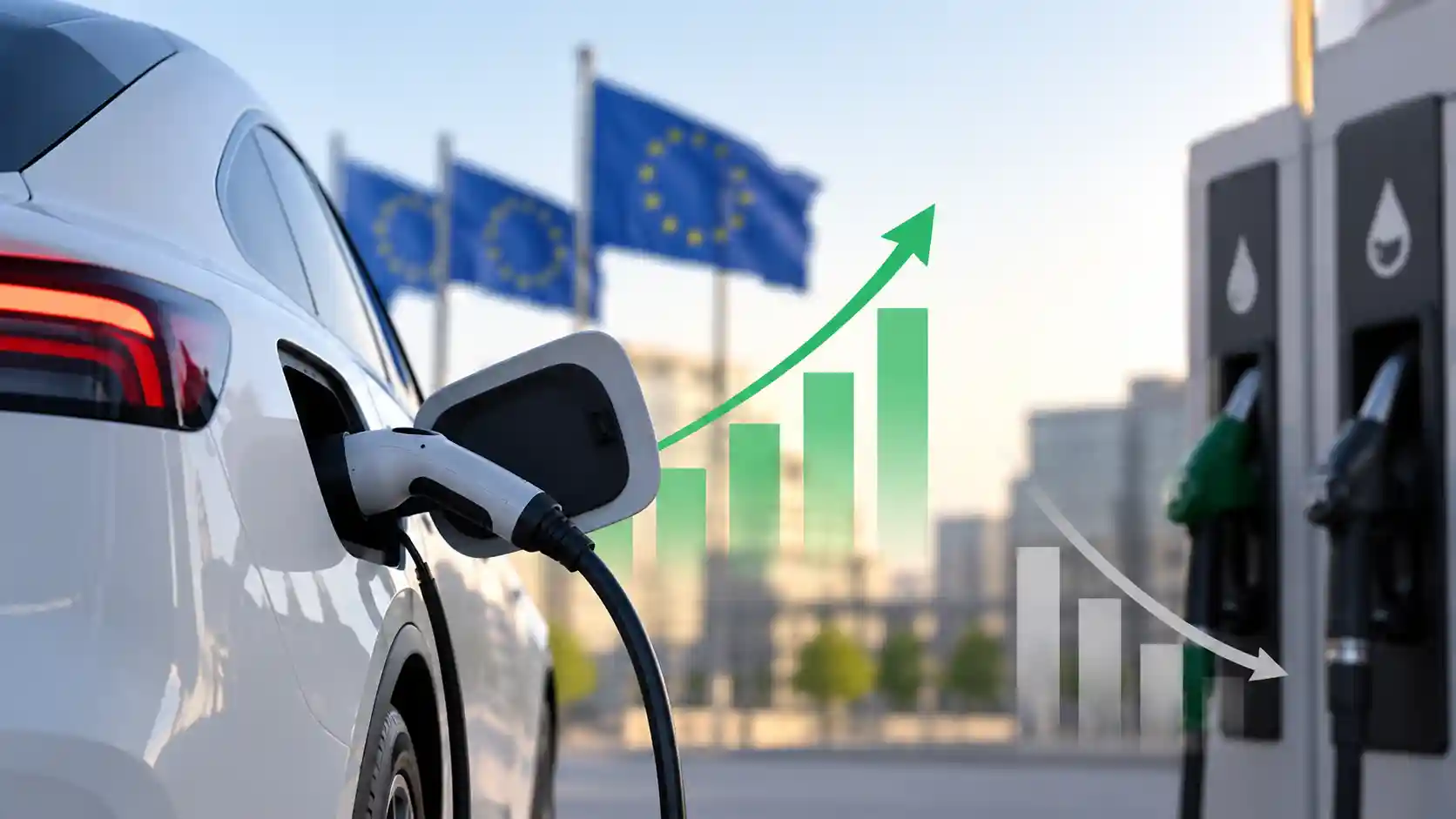
Electric vehicles remain heavily insulated by tariffs
Chinese electric vehicles continue to face a 100% U.S. Section 301 tariff.
That effectively separates the U.S. passenger-EV market from normal direct Chinese vehicle competition.
The issue is broader than finished cars.
China has large production capacity across batteries, battery materials, power electronics and other parts of the EV supply chain.
That means policy discussions can affect where battery plants are built, how supply chains are structured and how Chinese capital participates in overseas industrial projects.
As of publication, there had been no official September 24 announcement changing the 100% EV tariff.
Agriculture is easier to measure than diplomatic language
Agriculture gives both sides a more concrete negotiating channel because purchases can eventually be verified.
The May framework included a Chinese commitment to purchase at least $17 billion per year of U.S. agricultural products in 2026, 2027 and 2028, in addition to earlier soybean commitments.
Recent USDA sales announcements show continued soybean purchases.
Private exporters reported 192,000 metric tons of soybeans for delivery to China on September 3, 272,000 metric tons on September 10 and another 111,000 metric tons on September 18 for the 2026/27 marketing year.
These transactions matter because China is a major global soybean buyer and changes in Chinese demand can affect U.S. farm income, commodity prices and export logistics.
Agricultural agreements are also easier to verify than broad political declarations because actual purchases appear in official sales and shipment data.
Aerospace links diplomacy directly to manufacturing
The White House said in May that China approved an initial purchase of 200 U.S.-made commercial aircraft for Chinese airlines.
Large aircraft orders affect a much wider industrial system than the final assembly line.
They support engines, avionics, metals, electronics, maintenance, logistics and high-skilled manufacturing.
China is also one of the world’s largest aviation markets.
That makes aircraft purchases an important commercial indicator of whether the economic relationship is stabilizing or becoming more restrictive.
No additional aircraft commitment had been officially announced on September 24 at publication.
Strategic resources connect civilian and military supply chains
Critical minerals are politically difficult because many support both civilian and national-security applications.
Permanent magnets can be used in electric motors, wind turbines and defence systems.
Graphite can be used in battery supply chains.
Specialty metals appear in aerospace and electronics.
USGS said in February 2026 that the United States remained reliant on China as a major source for 14 of the 33 critical minerals for which the country was most dependent on imports.
Mineral-reliant U.S. industries represented about $4.09 trillion in value in 2025.
That means mineral policy is not a narrow mining issue. It reaches deeply into industrial production.
Iran is part of the geopolitical background
The meetings also take place while the Middle East remains unstable.
During Trump’s May visit to China, the White House said Trump and Xi agreed that Iran could not have a nuclear weapon and called for the Strait of Hormuz to remain open.
On September 24, China’s foreign ministry said prolonged U.S.-Iran conflict did not serve the common interests of the parties involved or the international community and called for disputes to be resolved through dialogue.
Iran matters economically because instability in the Gulf can affect oil prices, shipping costs, insurance and inflation.
That gives Middle East security an indirect connection to the trade and industrial outlook surrounding the summit.
The visit follows fresh economic consultations
The state visit did not begin from a blank page.
Chinese Vice Premier He Lifeng met U.S. Treasury Secretary Scott Bessent and U.S. Trade Representative Jamieson Greer in New York on September 20.
Chinese government reporting said the teams discussed economic and trade issues, implementation of earlier understandings and AI-related matters.
That means the leader-level meetings come after technical and ministerial preparation.
It does not guarantee agreement.
It does mean many of the detailed questions have already been discussed below presidential level.
What companies are watching
For semiconductor companies, the key variables are export controls and tariff treatment.
For automakers and battery producers, they are tariffs, investment rules and supply-chain restrictions.
For farmers, actual purchase volumes matter.
For aerospace manufacturers, aircraft orders and delivery conditions matter.
For industrial companies, critical-mineral availability and processing restrictions may be the most immediate concern.
For AI companies, any formal government-to-government mechanism could affect safety coordination, technology access or operating rules.
Different sectors face different risks, but they share one feature: policy can materially change commercial economics.
Why implementation matters more than ceremony
State visits produce photographs, formal arrivals and dinners.
Businesses eventually care about implementation.
A purchase commitment matters when orders are booked and delivered.
A mineral agreement matters when materials actually move through supply chains.
An AI dialogue matters when it produces operating rules.
A tariff decision matters when customs treatment changes.
That creates three different levels of summit outcome:
political statements, formal policy commitments, and measurable commercial execution.
The first can occur immediately.
The second requires legal and administrative detail.
The third may take months or years.
What is confirmed as of September 24
Xi is in Washington for a September 23-25 state visit.
Trump and Xi reached a package of economic understandings in May.
The two governments held economic and trade consultations in New York on September 20.
Those consultations included AI-related dialogue.
China has agricultural purchase commitments already in place.
China previously approved an initial purchase of 200 U.S.-made aircraft.
Critical minerals remain a major point of U.S. supply dependence.
High U.S. tariffs remain in place on Chinese electric vehicles and specified semiconductors.
As of publication, the White House and Chinese government had not released a final September 24 joint economic readout announcing changes to those major policies.
What remains open
It remains unclear whether the state visit will produce additional tariff relief.
No verified announcement had changed the U.S. 100% tariff treatment of Chinese electric vehicles.
No verified announcement had removed major advanced-semiconductor export restrictions.
No final public agreement had established new quantitative rare-earth supply commitments beyond the existing framework.
No final summit document had defined the scope of a new AI mechanism.
Those questions should remain open until official language is published.
The larger economic meaning
The Washington meetings matter because the United States and China are trying to manage competition without eliminating economic interdependence.
The United States still depends on China for significant parts of several mineral supply chains.
China still buys large quantities of U.S. agricultural products.
Commercial aviation connects the two economies.
Global semiconductor production depends on equipment, materials and customers spread across multiple countries.
AI increases the strategic value of compute and electricity.
EVs increase the strategic value of batteries and minerals.
The relationship is therefore neither ordinary free trade nor complete economic separation.
It is managed interdependence under tighter national-security constraints.
The strict conclusion
The economic significance of the Trump-Xi Washington meetings will be measured by whether the two governments change rules that affect real industries.
Semiconductors sit at the center of the technology-security dispute.
Electric vehicles remain protected by extremely high U.S. tariffs.
Agriculture provides a measurable channel for Chinese purchasing commitments.
Aerospace has a major existing order framework.
Rare earths expose the cost of supply-chain dependence.
AI is becoming a direct diplomatic subject rather than merely an extension of the chip dispute.
As of September 24, those issues remain active rather than resolved.
That makes the state visit economically important even before a final communiqué appears.
The world economy is waiting not for one ceremonial headline, but for evidence of how the United States and China intend to manage the industries that increasingly define growth, security and technological power.
Reader questions
Frequently asked questions
Is Xi Jinping in Washington for talks with Donald Trump?
Yes. Xi arrived in Washington on September 23, 2026 for a state visit running through September 25, with the formal White House program on September 24.
Has a new U.S.-China trade deal been announced on September 24?
As of publication, no final September 24 joint economic readout had been released. Existing commitments from earlier 2026 remain the clearest verified framework.
Which industries are most exposed to the talks?
Semiconductors, AI infrastructure, electric vehicles and batteries, agriculture, aerospace and critical minerals are among the most directly exposed sectors.
What is the current U.S. tariff on Chinese electric vehicles?
The United States maintains a 100% Section 301 tariff on Chinese electric vehicles under the strategic-sector tariff framework.
Why are rare earths important?
China remains a major supplier of materials used in electric motors, electronics, batteries, aerospace and defence manufacturing, creating supply-chain dependence that both governments treat as strategically important.
What agricultural commitments has China made?
The May 2026 framework announced by the White House said China would purchase at least $17 billion per year of U.S. agricultural products in 2026, 2027 and 2028, in addition to earlier soybean commitments.
Is AI part of the U.S.-China talks?
Yes. Chinese government reporting on September 20 economic consultations said the two sides held dialogues on AI-related issues. No final September 24 AI agreement had been publicly released at publication.
Did China agree to buy U.S. aircraft?
The White House said in May 2026 that China approved an initial purchase of 200 U.S.-made commercial aircraft for Chinese airlines.
Nexuswild welcomes factual corrections. Email [email protected] with evidence and the article URL.