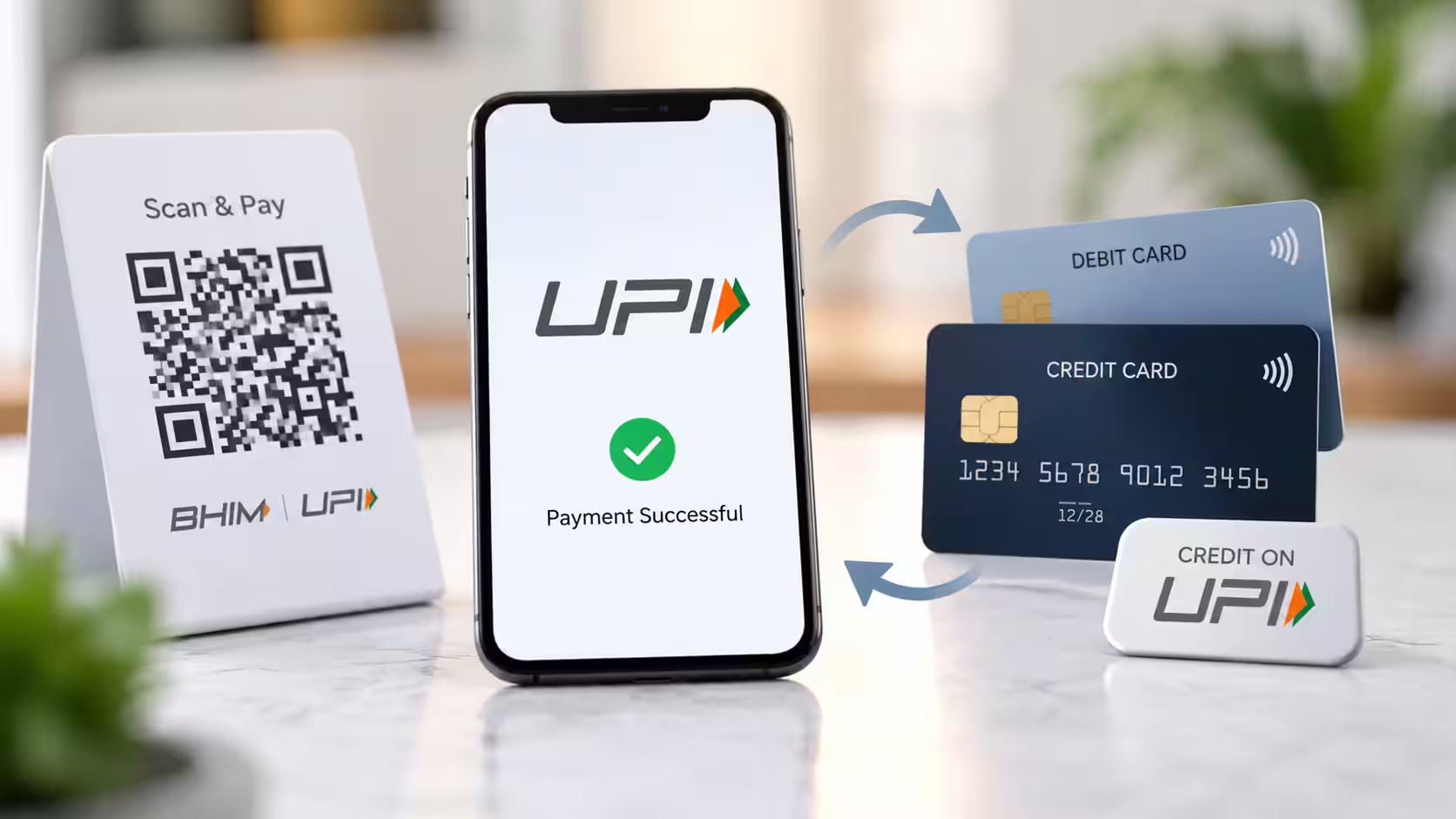

For years, the Unified Payments Interface (UPI) has operated on a zero-fee model, driving an unprecedented digital payments revolution across India. However, the ecosystem is undergoing a major structural shift. Following a recent notification from the Government of India and the National Payments Corporation of India (NPCI), a targeted Merchant Discount Rate (MDR) framework will be introduced for high-value commercial transactions.
Taking effect on October 15, 2026, the new policy mandates a 0.4% MDR on specified Person-to-Merchant (P2M) UPI transactions that exceed ₹2,000. While this marks the end of the universally free merchant processing era, the regulatory framework has been carefully calibrated to protect ordinary consumers and small vendors. Person-to-Person (P2P) transfers remain entirely free, and commercial payments up to ₹2,000 will continue to attract zero charges.
As businesses prepare for this transition, understanding the mechanics of the new 0.4% charge is crucial. Furthermore, contextualising this fee against the traditional costs associated with accepting debit and credit cards reveals that UPI, even with an MDR, remains one of the most cost-effective digital payment channels in the global financial system.
What is UPI MDR?
To understand the implications of the new rules, it is essential to first define what a Merchant Discount Rate actually is. MDR is not a government tax. Instead, it is a processing fee that a merchant pays to their acquiring bank (the bank that provides their payment QR code or point-of-sale terminal) for the service of securely facilitating a digital transaction.
Whenever a customer makes a digital payment, multiple entities work in the background within milliseconds to ensure the money moves securely from the buyer's bank to the seller's bank. These entities include the customer's bank (the issuer), the merchant's bank (the acquirer), the technology platform facilitating the transfer (the third-party app provider), and the central network operator (the NPCI).
The MDR serves as the financial fuel for this entire ecosystem. When a merchant is charged the 0.4% fee, that amount is distributed among these participating entities. This revenue allows the banks and technology providers to maintain secure servers, prevent cyber fraud, manage customer service operations, and upgrade the broader payment infrastructure. Crucially, the MDR is deducted automatically by the acquiring bank before the final settlement amount is credited to the merchant's account. Therefore, it is a backend business expense incurred by the seller, not an upfront surcharge levied on the buyer.
How Much Will Merchants Pay?
The new UPI MDR framework is structured around specific monetary thresholds and caps to ensure fairness. The baseline rate is 0.4%, but it only activates when a customer pays a merchant an amount exceeding ₹2,000 in a single transaction. To protect businesses handling exceptionally large ticket sizes, the absolute maximum fee a merchant can pay on a single transaction is capped at ₹300, which triggers at the ₹75,000 mark.
Here is how the calculation works in practical terms:
- Example 1: A ₹3,000 UPI merchant payment. Because the transaction exceeds the ₹2,000 threshold, the 0.4% MDR applies. The calculation is 0.4% of ₹3,000. The merchant will pay an MDR of ₹12, receiving ₹2,988 in their bank account.
- Example 2: A ₹10,000 UPI merchant payment. The 0.4% rate is applied to the full amount. The merchant will pay an MDR of ₹40, receiving a final settlement of ₹9,960.
- Example 3: A ₹50,000 UPI merchant payment. Applying the 0.4% rate, the merchant will incur an MDR of ₹200. They will receive ₹49,800.
- Example 4: A ₹75,000 UPI merchant payment. At this specific amount, 0.4% equals exactly ₹300. This is the maximum fee allowed under the new framework. The merchant pays ₹300 and receives ₹74,700.
- Example 5: A ₹1,00,000 UPI merchant payment. A strict mathematical calculation of 0.4% on one lakh rupees would equal ₹400. However, because the government has instituted a maximum cap of ₹300 for transactions of ₹75,000 and above, the merchant's fee remains frozen at ₹300. They will receive ₹99,700.
It is vital to reiterate that these examples represent the merchant-side processing costs. A customer buying a ₹10,000 television via UPI will only see ₹10,000 debited from their bank account. The ₹40 fee is absorbed entirely by the electronics retailer.
Additionally, the government has established specific flat-rate exceptions for essential sectors. Payments for railways, telecommunications, insurance, utility bills, and agricultural inputs will not attract the percentage-based fee. Instead, transactions above ₹2,000 in these categories will incur a flat MDR of just ₹5. Furthermore, capital market transactions (such as mutual fund investments and stockbroking) will attract a much lower nominal rate of 0.02%, also capped at ₹300.
UPI vs Debit Cards
For years, merchants have accepted debit cards, and those transactions have always carried processing fees. Comparing the new UPI structure with existing debit card rules highlights the continued economic advantage of the UPI ecosystem.
When a customer swipes a debit card, the funds are drawn directly from their bank account, much like a standard UPI transfer. However, the legacy infrastructure supporting card networks is different. In India, standard debit card MDRs typically range up to 0.90% for transactions above ₹2,000. It is important to note that debit card pricing is not a single universal number. The exact rate can vary significantly based on the specific card network (such as Visa or Mastercard), the merchant's business category code, the total annual turnover of the enterprise, and whether the card is inserted physically into a terminal or used for an online e-commerce transaction. Additionally, the government has previously mandated different treatments for domestic RuPay debit cards to encourage digital adoption.
Despite these variables, the baseline comparison remains clear. A merchant processing a ₹10,000 transaction on a standard non-RuPay debit card could pay up to ₹90 in fees. Processing that exact same ₹10,000 transaction through the new UPI framework will cost the merchant exactly ₹40. Therefore, even with the introduction of the 0.4% fee, UPI remains substantially cheaper for businesses than traditional debit card acceptance.
UPI vs Credit Cards
The cost difference becomes even more pronounced when comparing UPI against credit cards. Credit cards are fundamentally different financial instruments. When a customer uses a credit card, the money is not coming from their bank account; the issuing bank is essentially granting the customer an unsecured micro-loan for up to 45 days.
Because credit cards involve significant financial risks, complex underwriting, rewards programs, cash-back incentives, and interest-free grace periods, the underlying processing fees must be high enough to fund all these features. Consequently, typical credit card MDRs range between 1.5% and 2.5% of the total transaction value. Premium corporate cards, international cards, or high-tier rewards cards can sometimes push that fee closer to 3%.
The majority of this fee is made up of the "interchange rate," which is the portion paid back to the bank that issued the credit card. Because direct account-to-account UPI transactions do not involve granting credit, funding airport lounge access, or managing default risk, the ecosystem does not require such high fees.
For a merchant selling a ₹50,000 laptop, a customer paying with a premium credit card (assuming a 2% MDR) would cost the business ₹1,000 in processing fees. If the customer pays via a direct bank-account UPI transfer, the 0.4% MDR means the merchant pays only ₹200. This massive disparity explains why merchants strongly prefer UPI for high-ticket items and why the 0.4% rate is considered highly competitive within the broader financial services market.
Payment Method Comparison
| Payment Method | Merchant Charge/MDR | Who Bears the Merchant-Side Cost | Key Condition |
|---|---|---|---|
| UPI (Standard) | 0.4% (capped at ₹300) | Distributed among acquiring bank, issuer, app provider, and NPCI | Applies only to P2M transactions above ₹2,000 |
| UPI (Essential Sectors) | Flat ₹5 | Distributed among ecosystem partners | Applies to rail, telecom, insurance, fuel, utilities above ₹2,000 |
| Debit Card | Typically up to 0.90% | Distributed among acquiring bank, card network, and issuing bank | Varies based on card type, network, and merchant turnover |
| Credit Card | Typically 1.5% to 2.5% | Distributed among acquirer, card network, and issuer (interchange) | Rates vary significantly based on card tier and rewards structure |
Note: Card MDRs are variable and depend on the specific commercial agreement between the merchant and their acquiring bank.
Who is Most Affected?
The introduction of the 0.4% MDR is highly targeted, meaning the vast majority of daily retail interactions will remain completely unaffected. The entities most impacted by the new framework are larger merchants, established e-commerce platforms, and organised retail chains that routinely process individual transactions exceeding ₹2,000.
A consumer buying a ₹25,000 smartphone, a ₹5,000 grocery haul at a supermarket, or booking a ₹12,000 airline ticket via UPI will trigger the MDR for those respective businesses.
However, small neighbourhood merchants, local grocers, and street vendors will largely escape the new fee structure. Firstly, according to official government FAQs, more than 95% of all P2M UPI transactions by volume fall below the ₹2,000 threshold. Since payments under ₹2,000 remain completely free, the overwhelming majority of retail payments will incur zero cost.
Secondly, the framework includes specific exemptions for small enterprises classified under the Person-to-Person-Merchant (P2PM) category. Small vendors who receive up to ₹1 lakh per month through their UPI QR codes directly into their bank accounts will continue to enjoy mandatory zero MDR. For these micro-merchants, accepting digital payments will remain entirely free, preserving the grassroots digitization movement that UPI initiated.
Will Customers Pay More?
The most common concern regarding any new financial fee is whether it will eventually trickle down to the consumer. Officially and legally, customers will not pay the 0.4% UPI MDR.
The notification explicitly states that consumers will continue to transact free of cost. Banks and payment aggregators have been strictly advised to ensure that merchants do not pass MDR charges directly to customers as a surcharge at the checkout counter. If a customer is buying a shirt listed at ₹2,500, they will scan the QR code and pay exactly ₹2,500.
Furthermore, the new rules do not impact Person-to-Person (P2P) transfers in any way. P2P transfers currently constitute roughly 70% of total UPI transactions by value. Whether a user is sending ₹5,000 to a family member for an emergency, splitting a ₹3,000 dinner bill with a friend, or transferring ₹50,000 between their own linked bank accounts, those transactions remain fundamentally free without any volume limits or tiered caps.
Consumers must, however, distinguish between MDR and platform convenience fees. While merchants cannot charge a UPI surcharge, a third-party ticketing website may still charge its own separate "booking fee" or "platform fee" for using their software, regardless of which payment method the buyer selects.
Why Has UPI MDR Been Introduced?
The primary rationale behind introducing the 0.4% MDR is the long-term commercial sustainability of the digital payments ecosystem. UPI has grown at a staggering pace. According to official documents, the network processed 2,451 crore transactions worth ₹29.9 lakh crore in August 2026 alone.
Managing this immense volume requires massive physical and digital infrastructure. Banks, the NPCI, and technology providers spend an estimated ₹20,000 crore annually to maintain server bandwidth, provide bank-end technical support, deploy advanced cybersecurity measures, and run complex fraud-prevention algorithms. For years, the government heavily subsidised these costs to promote digital adoption. However, as UPI has achieved dominant scale, relying purely on government subsidies is no longer considered a viable long-term strategy.
The revenue generated from the new MDR will be injected directly back into the ecosystem. This capital is necessary to ensure that banking servers do not crash during peak festival shopping seasons and that the network remains resilient against increasingly sophisticated cyber threats. Additionally, the government has proposed creating a dedicated fund from these revenues to incentivize payment aggregators to expand UPI acceptance infrastructure in rural areas and Tier 3 to Tier 6 cities.
What This Means for Merchants
For the merchant community, the shift from a free model to a 0.4% fee requires a recalibration of payment processing economics.
Consider a mid-sized electronics retailer. Previously, if they sold ₹10,00,000 worth of appliances via UPI in a month, they kept the entire sum. Under the new rules, if all those sales were individual transactions above ₹2,000, they would pay roughly ₹4,000 in MDR, taking home ₹9,96,000.
While no business welcomes a new expense, industry experts argue that the economic impact is highly manageable because the alternative is much worse. If that same retailer were forced to accept those payments via credit cards due to a lack of UPI options, their processing costs could easily skyrocket to ₹20,000 (at a 2% rate). Because the 0.4% fee is mathematically minimal compared to traditional card infrastructure, merchants have very little economic incentive to inflate retail shelf prices. They are still saving a substantial amount of money every time a customer chooses to scan a UPI code instead of inserting a credit card.
The introduction of the 0.4% UPI MDR represents a maturation of India's digital public infrastructure. By keeping small transactions free, completely exempting peer-to-peer transfers, and maintaining a low percentage rate capped at ₹300 for high-value sales, policymakers have attempted to balance the need for commercial sustainability with the goal of financial inclusion. For merchants, while the days of entirely free high-value digital processing are ending, the new targeted framework ensures that UPI remains the most affordable, efficient, and broadly accepted payment instrument in the country, vastly outperforming legacy debit and credit card networks in cost efficiency.
Further reading and useful links
Reader questions
Frequently asked questions
What is the new UPI MDR?
The new UPI MDR is a 0.4% fee levied on merchants for receiving payments above ₹2,000 through the Unified Payments Interface. It is a cost borne by the business, not the consumer.
When will the 0.4% UPI MDR take effect?
The new framework, introduced by the Government of India and the National Payments Corporation of India (NPCI), will officially take effect on October 15, 2026.
Will customers have to pay the 0.4% UPI fee?
No. Consumers will continue to use UPI completely free of charge. The MDR is strictly a merchant-side processing fee, and merchants are not permitted to pass it directly to customers.
How does UPI MDR compare with debit-card charges?
UPI remains significantly cheaper. While the new UPI MDR is 0.4%, standard debit card MDRs typically range up to 0.90% for transactions above ₹2,000, depending on the card network and merchant category.
How does UPI MDR compare with credit-card charges?
Credit cards are generally the most expensive payment method for merchants to accept, with typical MDRs ranging between 1.5% and 2.5%. The 0.4% UPI rate offers businesses a much more affordable digital payment alternative.
Nexuswild welcomes factual corrections. Email [email protected] with evidence and the article URL.